



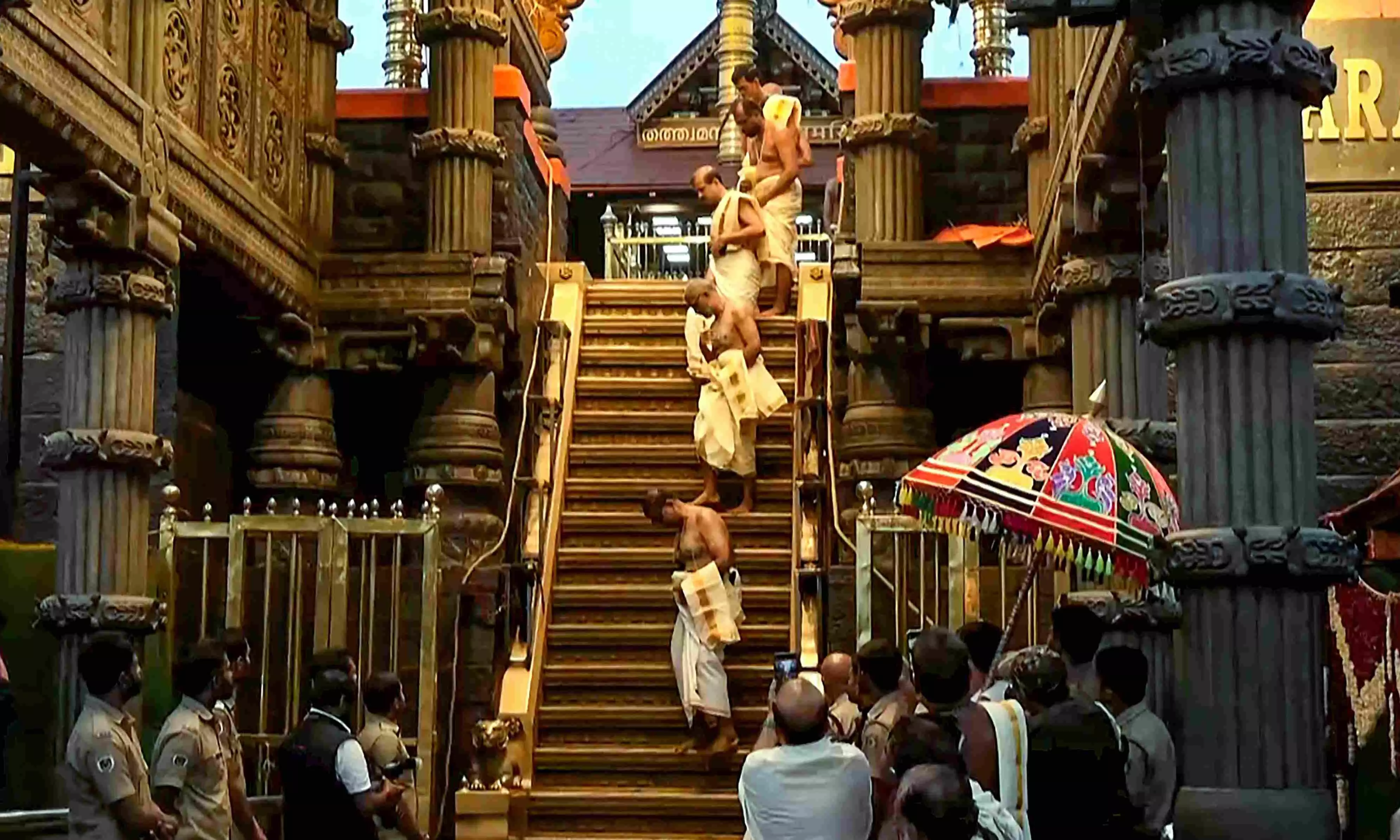
Supreme Court questions non-believer's right to enter Sabarimala
A nine-judge bench asked whether it is a devotee or non-devotee seeking temple entry, as hearings on religious discrimination against women at Sabarimala continued

New Delhi: Can a non-believer from North India claim the right to enter the Sabarimala temple in Kerala? The Supreme Court raised this pointed question on April 29 as a nine-judge Constitution bench began hearing petitions on religious discrimination against women at temples and other places of worship. The bench said that before ruling on the right of entry, it must first determine whether the claim is being made by a devotee or a non-devotee.
The bench, headed by Chief Justice of India (CJI) Surya Kant, is examining the scope of religious freedom practised by multiple faiths across India. The Sabarimala temple, where women between the ages of 10 and 50 were historically barred from entering, is at the centre of the broader question of whether religious custom can override constitutional rights.
2018 verdict revisited
Senior advocate Indira Jaising, appearing for petitioners Bindu Ammini and Kanakadurga, the two women who entered the temple after the 2018 Supreme Court verdict, argued that restricting a Scheduled Caste woman from entering the temple would violate Article 17 of the Constitution, which abolishes untouchability.
Also Read: Sabarimala case: Why every faith has a stake in the nine-judge SC Bench?
A five-judge Constitution bench, by a 4:1 majority verdict in September 2018, had lifted the ban that prevented women between the ages of 10 and 50 from entering the Sabarimala Ayyappa temple, holding that the centuries-old practice was illegal and unconstitutional.
Caste vs age
"Today we are told that non-caste Hindus can enter Sabarimala, but not women," Jaising said, adding that Article 17 ensures all men can enter without any caste restriction. The bench, however, clarified that the petitioner was not stopped because she belongs to a scheduled caste, but because she fell within the 10-to-50 age group that the temple restricts.
Jaising argued that the exclusion of women operates during the most productive period of their lives. "You cannot tell me to live half a life. Avoid living between 10 and 50, and then live before 10 and after 50. That will lead to substantial deprivation," she said. She also submitted that the right to enter a temple and worship is a fundamental right guaranteed under Article 25(1) of the Constitution.
State refused to give protection
Jaising recalled that after the 2018 judgment, Ammini and Kanakadurga were the only two women who successfully climbed up and performed darshan. After they came out, certain Sangh leaders spoke of "shuddhi karan." She filed a petition in the Supreme Court, noting that no other woman had succeeded since, because the state had refused to provide protection for the climb.
Also Read: SC flags limits on religious autonomy during Sabarimala hearing
Justice Nagarathna observed that Article 26(b) protects diversity within denominations and that diversity is India's strength. "By giving that protection, there is unity in the country. That is how one should look at it. Therefore, respect diversity," she said.
The court had earlier observed that it was very difficult, if not impossible, for a judicial forum to define parameters to declare a particular practice of a religious denomination as essential or non-essential. The hearing was still underway.