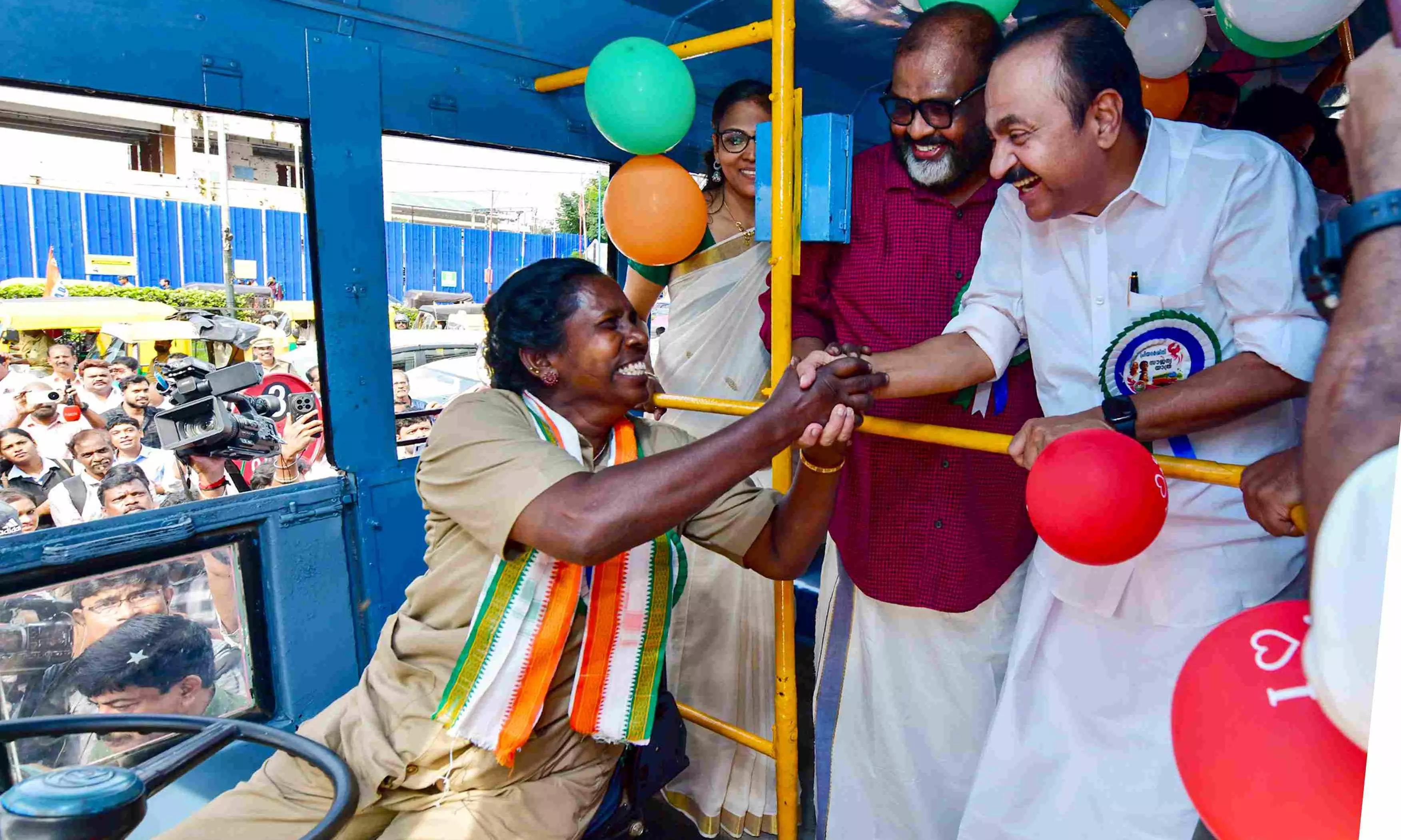
Kerala Chief Minister VD Satheesan, along with State Transport Minister CP John, interacts with KSRTC's first PSC-recruited woman driver during the launch of 'Priyadarshini', the free KSRTC bus travel scheme for women, in Thiruvananthapuram on June 15, 2026. Photo: PTI
Half Pinarayi, half Satheesan: 100 days of balancing act
Welfare schemes and Mission Samudra have given the CM his talking points, but Vande Mataram, PM SHRI and a string of course corrections have kept the Opposition on the offensive

Keralam Chief Minister V D Satheesan said at a media event last week, marking his government’s first 100 days, that he would not mind being called “half Pinarayi Vijayan” for his performance.
He said there was nothing wrong in adopting the positives of a political opponent. “Pinarayi has his good sides and bad sides. I have my good sides and bad sides too. I am trying to change my bad sides. And I will take Pinarayi's good sides from the other side. So, you can call me ‘half Pinarayi’.”
It was an unusual acknowledgement from a politician who spent years as Leader of the Opposition taking on Vijayan’s government, often accusing it of centralisation, opacity and an unwillingness to listen.
Satheesan’s benchmark
Now, as Chief Minister, Satheesan says there are things worth learning from his predecessor. But he adds that the government needs to be tough to negotiate the state's needs.
Also read: Why and how VD Satheesan became the inevitable choice as Kerala CM
Keralam’s finances are in difficult shape and the government is quietly working on projects that will take time to show results, he said. He insisted that the UDF government is working on an action plan and the results will be visible within 6 months.
That six-month promise is now becoming the benchmark Satheesan has set for his government. The first 100 days, meanwhile, have been far less quiet.
Welfare announcements
The government has announced an ambitious development agenda, including Mission Samudra, its plan to build a stronger maritime economy around Keralam’s coastline, ports and inland waterways. The revised Budget also included welfare measures such as a hike, though nominal, in the honorarium of ASHA workers who had been striking against the Pinarayi government.
Priyadarshini, the free travel scheme for women in state-owned transport buses, is another visible welfare initiative.
Operation Toofan, the anti-drug trafficking drive, has allowed the government an opportunity to present itself as a system willing to take on a problem that cuts across politics and society. The campaign has brought multiple departments together in a state-wide drive against drugs, combining enforcement with awareness and rehabilitation.
Also read: News reporting in Kerala becoming 'unethical to the core': CM Satheesan
These are the government's strongest answers to the criticism that its first 100 days have been dominated by controversies. But there have been plenty of those.
Vande Mataram row
The Vande Mataram episode was perhaps the earliest indication. The full version of the national song was played at the government’s swearing-in ceremony, which had already drawn attention after the CM chose to use his expanded name - Vadassery Damodara Menon Satheesan, also seen by some as a marker of his upper-caste identity.
Following the backlash over using 'Menon' during his oath-taking ceremony in May 2026, Satheesan defended the decision, saying, “Why is it wrong if I mention my father’s name? Shouldn’t I remember him?” Notably, in 2021, he had taken oath using the shorter version of his name, identifying himself simply as “V D Satheesan.”
A subsequent government circular recommending the full six-stanza rendition for Independence Day programmes drew objections from allies and criticism from the Left. The government then clarified that only the traditional first two stanzas would be used at government functions. On Independence Day, the state-level function did not have Vande Mataram at all. The episode left the government explaining a decision it had itself initiated.
Soft approach towards Centre
The PM SHRI, a Union government-sponsored scheme to upgrade selected government schools as model institutions in line with the National Education Policy 2020, produced an even more politically awkward moment. The UDF had opposed the scheme while in Opposition. The new government eventually decided to sign the agreement, arguing that Keralam could not afford to turn down the Centre’s assistance.
The decision was not without dissent inside the government. Minister M Liju had opposed signing PM SHRI in the cabinet sub-committee. The government's critics saw the final decision as another indication of its softer approach towards the Modi government.
Also read: Satheesan’s first phase marred by govt-party discord
That criticism has become a recurring theme. Unlike the LDF government, which frequently used the Governor's address and Budget speech to take on the Centre over financial restrictions, federalism and the state's rights, the Satheesan government has largely avoided that confrontational language.
Satheesan's defence is that confrontation cannot be the only way a state government deals with Delhi. The Opposition sees this as softness towards the BJP regime.
Governor’s interventions
The Governor's interventions have added another dimension to the argument. Rajendra Arlekar has been summoning state officials to Lok Bhavan, sometimes on issues involving the functioning of the elected government. The Opposition argues that the Governor is effectively creating an alternative centre of administration.
The opposition has strongly objected to these interventions. “The Governor sees the government’s silence as submission. In effect, the Governor is challenging the government’s constitutional and federal powers. During the previous LDF government, when Raj Bhavan made similar interventions, the government mounted a strong constitutional defence. The UDF government’s surrender, at the cost of the elected government’s authority and rights, is also an insult to the voters,” said Pinarayi Vijayan.
Also read: Can VD Satheesan's 'governance with empathy' survive Kerala’s fiscal reality?
The participation of some state university Vice-Chancellors, appointed directly by the Governor as Chancellor, in RSS events and their open expression of right-wing views has further fed into the same political argument.
Accountability promise test
The Waqf issue offered another example of the government having to explain its position. Its affidavit in the High Court was criticised for appearing to depart from the earlier government's stand. The Satheesan government had agreed to fill two vacancies for non-Muslim and Shia members of the Waqf Board, something the previous government had challenged in the Supreme Court.
After the Opposition raised the issue, the government submitted a fresh affidavit saying the two seats would remain vacant until the Supreme Court decides the matter. Another course correction, perhaps.
The Thiruvananthapuram BJP councillor’s oath-taking episode was even more embarrassing for the government. A bureaucratic intervention allowed BJP councillor R Sugathan, who was in jail under the Anti-Social Activities (Prevention) Act, to avail leave from council meetings after he sought escorted parole. Sanctioning his parole effectively helped the BJP-led Corporation council avert a possible no-confidence motion.
Even though the official involved was later suspended, the episode raised a more uncomfortable question for the government. Local Self Government (LSG) Minister said he had been bypassed by officials in a matter with clear political consequences. For a government that has promised administrative accountability, this was difficult to explain.
Transparency debate
The vehicle modification promise has also run into trouble. The UDF had promised greater freedom for vehicle modifications, a politically popular commitment in a state with a large community of automobile enthusiasts. But the Union government's position on the statutory standards has limited what the state can do.
Also read: From 'Pookie' to policy: Can Satheesan's optics survive governance?
The controversy over the Chief Minister’s helicopter journey followed, with allegations that it was for a personal purpose. Satheesan defended the use of the state-rented helicopter, saying he was travelling to meet an investor whom he could not name. The explanation did little to end the debate over transparency and the use of public resources.
Balancing act
These controversies have allowed the Opposition to construct a broader narrative. Leader of the Opposition has already attacked the government over rising prices and what Vijayan describes as the weakening of market intervention through Supplyco and Horticorp. He has also dismissed the government's claims over Vizhinjam connectivity as an attempt to take political credit for the previous government's work.
The political contest, therefore, is no longer simply about whether Satheesan is different from Pinarayi. It is increasingly about what he chooses to retain from the Pinarayi model and what he deliberately leaves behind.
“Satheesan wants the efficiency and decisiveness without the confrontation. He wants investment without prolonged political battles. He wants to negotiate with Delhi rather than fight every issue with the Centre. And he wants large projects such as Mission Samudra to become the visible face of his government, and we know that is a political gamble, but he will end up winning it,” said a Congress leader.
The government's first 100 days suggest the gamble has not been without costs. The government has had to explain several decisions, make a few course corrections and defend itself against the charge that its pragmatism is turning into political accommodation.