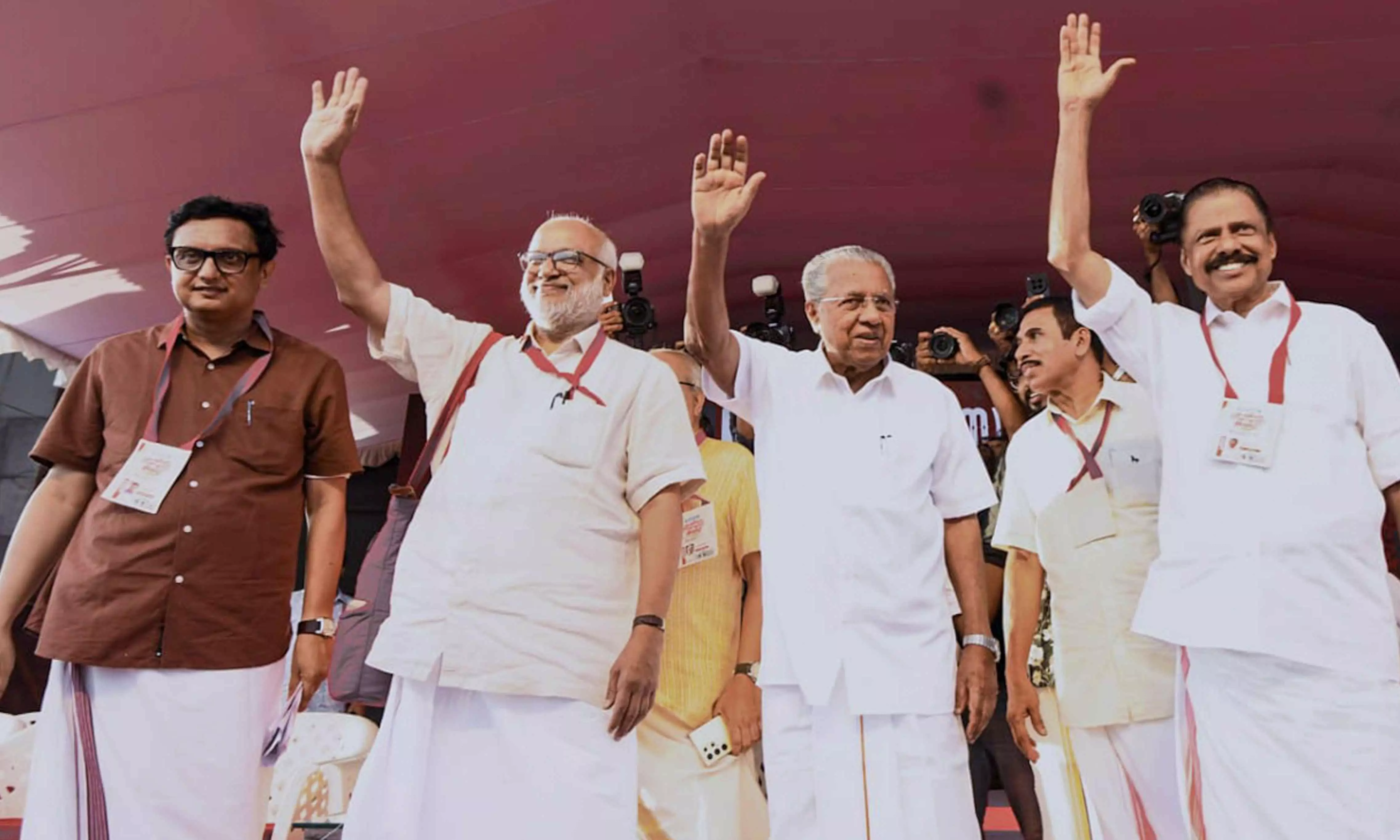
Leader of Opposition in the Keralam Legislative Assembly Pinarayi Vijayan General secretary of the Communist Party of India (Marxist) M A Baby and others during a public meeting of CPI(M) state committee meeting, at Freedom Square, in Kozhikode on Tuesday (September 15). Photo: PTI
CPI(M)’s Keralam reset: Course correction begins after poll rout; new faces inducted
The Kozhikode exercise combines leadership changes with an admission of organisational weaknesses and the need for course correction

When the CPI(M)’s extended state committee began in Kozhikode on Sunday (September 13), few expected it to end with a significant organisational overhaul. There had been speculation about a political resolution, an admission of failure by the leadership, or some structural changes involving responsibilities and directives for the road ahead.
The Enforcement Directorate (ED)’s intervention in the CMRL-Exalogic case, with fresh allegations involving former chief minister Pinarayi Vijayan and his family, had also raised questions about whether the party’s introspection would be overshadowed by the need to defend its tallest leader in Kerala.
Party restructuring
The three-day exercise, however, went beyond a review of the electoral defeat. It resulted in changes to the state secretariat and the state committee, while also bringing some of the sharpest criticism of the leadership into the open.
Also read: Kerala CPI(M) faces internal dissent over electoral defeat, leadership accountability
Three new members were inducted into the state secretariat - P Jayarajan, MB Rajesh and V Sivankutty. John Brittas was also brought in as a central committee invitee. Senior leaders TM Thomas Isaac and TP Ramakrishnan made way for the new entrants. CPI(M) general secretary MA Baby later said both leaders had volunteered to step aside and concentrate on their responsibilities as central committee members.
The party constitution allows central committee members to attend the state Secretariat when they are available in the state capital when the body meets.
Jayarajan’s elevation
Jayarajan’s entry into the state Secretariat was among the more politically significant decisions. There had been widespread criticism within the party over his exclusion from the Secretariat despite his standing among the party rank and file in Kannur. Interestingly, it was Pinarayi Vijayan himself who backed senior leader Ashok Dhawale’s formal proposal for Jayarajan's induction into the state Secretariat.
Jayarajan’s elevation is being seen within the party as part of the organisational ‘course correction’ following the electoral setback, especially in Kannur. His relationship with the state leadership had often been the subject of discussion within party circles.
Opportunities for youth, women
The restructuring also brought nine new faces into the state committee, all of them either young leaders or women. The move indicates an attempt to give greater representation to a younger generation and women at a time when the party is facing questions about its organisational structure and its connect with voters.
Also read: CPM delegates call for reclaiming festivals from right-wing appropriation in Keralam
“People have great expectations from the CPI(M)’s organisational restructuring. Central committee members have been removed from the state Secretariat, while more young people and women have been included. Even minor shortcomings within the CPI(M) will be examined and corrected. The criticism is not directed at individuals. Whether it is a senior leader or a grassroots comrade, criticism will be raised when necessary. This is a party that has even reprimanded top leaders like EMS Namboodiripad,” committee member KK Shailaja said.
The discussions inside the extended state committee were marked by strong criticism of the state leadership. Delegates from the districts raised questions about the party’s functioning and its handling of the electoral campaign, while some also defended the existing leadership and organisational structure.
State secretary MV Govindan did not conceal the intensity of the criticism when he spoke to the media during the meeting. “Criticism is part of our internal democracy. If there is no criticism, why have we been gathered here? We are introspecting in detail. I was subjected to criticism. If I am not criticised, how can we be a communist party?” Govindan said.
Corrective measures
The criticism in the meeting, however, was sharper than what was publicly acknowledged by the leadership.
According to party sources, CPI(M) general secretary MA Baby did reprimand the state secretary while responding to the discussions, though Govindan evaded the question about it. Baby pointed to shortcomings in the handling of the party’s candidate selection in Kannur and said organisational matters involved collective responsibility.
Also read: CPI(M) launches rare introspection after Kerala poll rout
At the same time, he stressed that individual responsibility also existed and criticised Govindan for failing to discharge some of those responsibilities. Govindan had been under fire over the candidature of his wife, PK Shyamala, and her eventual defeat in a party stronghold. Baby also said Pinarayi Vijayan’s style of functioning should change.
“The corrective measures had been decided earlier. The Politburo itself had assessed the shortcomings within the party. Correcting mistakes alongside political and organisational work is part of the Communist method. Such corrective measures are not something new,” Baby later told the media.
Self assessment
According to the Politburo’s assessment, two major weaknesses had emerged within the party. One was parliamentarism and the other was the absence of collective functioning. Baby said both would have to be corrected wherever they existed.
The political message from Pinarayi Vijayan at the concluding public meeting was different in emphasis. His speech focused largely on the political challenges facing the Left and the BJP’s growing influence.
“The Union government and the BJP are waging an ideological attack on the communist party. Communalism is being systematically intensified across the country and the BJP is trying to implement the RSS agenda. The VD Satheesan government in Kerala has also succumbed to the RSS agenda on the Waqf issue. Would this have happened if the LDF had returned to power in the last Assembly election? The UDF’s position is to go along with the RSS agenda,” Pinarayi said.
Resolution against ED action on Pinarayi
The BJP’s growing electoral presence in Kerala presents a difficult challenge for the CPI(M). The party will have to confront Hindutva mobilisation at a time when it is also seeking to regain the confidence of sections of the minority communities that have traditionally formed an important part of its electoral support.
Also read: Kerala CPI(M)’s moment of truth: Cadres speak, leadership under fire
The ED’s action against Pinarayi Vijayan and his family, including his daughter Veena T and son-in-law and former minister PA Mohammed Riyas, was another issue that hung over the proceedings. The agency’s fresh allegations in the CMRL-Exalogic case emerged while the party was engaged in an exercise that was expected to focus primarily on its electoral defeat.
The developments created an additional political complication for the leadership. According to party sources, the emergence of documents and allegations during the committee proceedings led some participants to moderate their criticism of Pinarayi Vijayan.
The party eventually responded politically to the ED action. A resolution opposing the agency’s move against Pinarayi Vijayan and Riyas was unanimously adopted by the state committee.
The real test
For the CPI(M), the three-day exercise has therefore produced a mix of organisational changes, internal criticism and a renewed political line.
The party has accepted that there were failures. The leadership has faced criticism and taken responsibility. It has brought new faces into the state committee and made changes to the secretariat. It has also identified parliamentarism and the weakening of collective functioning as issues that need to be addressed.
Now the introspection will move to the districts, where extended committee meetings are expected to examine the reasons for the electoral setback in greater detail. What was said in Kozhikode will have to be tested against the experience of the party’s local units and its relationship with voters.
The three days in Kozhikode have not produced an answer to all the questions. They have, however, made one thing clear. The CPI(M) knows that the electoral setback cannot be dealt with by simply waiting for another election. The changes inside the organisation are an attempt to begin that process. Whether they can bring about a change outside the party will be the real test.