


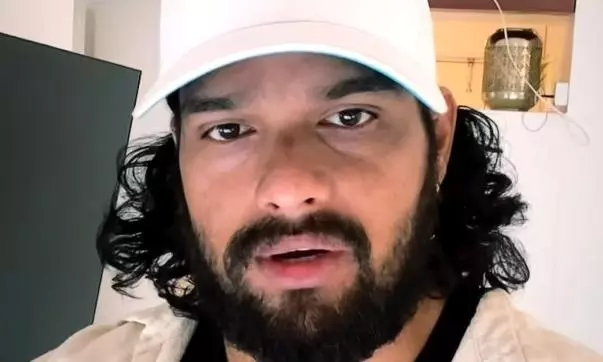
Fort Kochi police have registered a case against Amrit Singh Darren, who has the Instagram account ‘Litichokup’ (screengrab from account)
Fort Kochi hate video sparks row; influencer booked, parties condemn remarks
Police register a case against influencer Amrit Singh Darren over a video targeting Fort Kochi and Kashi Art Café, triggering political outrage

A video by right-wing influencer Amrit Singh Darren, making communal allegations about Fort Kochi, Kashi Art Café, and Keralam’s Muslim community, has triggered a political backlash. Fort Kochi police have registered a case against him, while the Muslim Youth League and DYFI have condemned the alleged hate campaign.
Circulated through the Instagram account ‘Litichokup’, the video targets Kashi Art Cafe over its display of images of Mahatma Gandhi and Muhammad Ali Jinnah and its alleged sale of beef dishes. It then makes sweeping claims about Fort Kochi’s religious composition, portraying Muslims as a source of danger and suggesting that Keralam is heading towards a crisis.
BJP leader’s daughter comments
The controversy also involves Diya Krishna, social media influencer and daughter of BJP leader and actor Krishnakumar, who commented “Sad reality” under the video. She later said she was referring only to the image of Jinnah and had commented after watching the video’s first part.
Also read: CPI(M), Congress slam Keralam Governor’s reported veg-only kitchen directive
Fort Kochi police registered a case against Darren under Sections 353(2) and 192 of the Bharatiya Nyaya Sanhita (BNS), concerning statements intended to promote enmity between groups and provocation with the potential to cause a riot. The allegations are being investigated.
Beef with Jinnah and beef
Darren questions why an establishment named after Kashi, the Hindu holy city also known as Varanasi, should display Jinnah alongside Gandhi. He also objects to the cafe serving beef and suggests that its name should be changed to reflect what he portrays as its religious character.
The video claims that 95 per cent of Fort Kochi’s business owners, taxi and autorickshaw drivers, small traders and street vendors are Muslims. Darren alleges that local residents with right-wing views are afraid to speak openly and claims that the Keralam government receives money from Arab countries to promote Islam. He makes similar allegations about a mosque in Varkala.
CM, Pinarayi condemn video
Chief Minister VD Satheesan has condemned the video, saying attempts to divide communities would not be tolerated. He said a case had been registered and that the law would take its course.
Former chief minister and Leader of the Opposition Pinarayi Vijayan has also condemned the video, accusing the Sangh Parivar of using online provocateurs to spread communal hatred.
Also read: When Keralam's warring Sunni factions find common ground in silencing women
In a post on X, Vijayan wrote: “Fort Kochi and Varkala are places where cultures meet, histories intertwine and diversity thrives. Now, a vlogger peddling hate for profit seeks to paint these vibrant destinations in communal colours. Having failed to divide Keralam, the Sangh Parivar is outsourcing its hate campaign to online provocateurs.”
Pinarayi said Keralam’s secular spirit would not yield to hatred and called on the state government to take strict legal action against those spreading communal enmity.
MYL lodges complaint
The Ernakulam district committee of the Muslim Youth League (MYL) submitted a complaint to the Kochi City Police Commissioner seeking stringent action against Darren.
The complaint argued that the video could undermine communal harmony and public peace, and stressed that freedom of expression could not justify content allegedly promoting religious hatred.
The Democratic Youth Federation of India (DYFI) has also condemned Darren’s remarks.
The controversy has also revived a broader question for Keralam’s public sphere that whether its diverse communities and cultural spaces will be discussed on their own terms or recast through narratives that treat religious identity as evidence of threat.