Deep inside the Sathyamangalam Tiger Reserve, 500 km from Chennai, live 19-year-old Ravi and 18-year-old Radha (names changed). They dropped out of school, got married, and are expecting their first baby in four months. One pair of parents was migrating to neighbouring state for livelihood, and hence the teenage couple tied the knot in a rush.
Their story reflects a systemic crisis in the region. For, despite stringent laws, the intersection of poverty, migration, and tradition continues to fuel school dropouts and early pregnancies among tribal communities.
Like Ravi and Radha, numerous tribal children in the hills drop out of school and slip into child labour or child marriage. Many face a stark choice: stay in a government residential hostel to continue studies, or migrate with parents to cities and enter the workforce as child labour.
No big plans for the future, say this young teenage couple who will turn parents in 4 months. Photo: Pramila Krishnan
There are 11 tribal villages spread across this tiger reserve region in Tamil Nadu. An eerie silence hangs over them, as houses are located far away from one another.
Thwarted ambitions
Ravi and Radha, seated outside their mud house, spoke with The Federal. “We decided to stay on in our village and tend to the farm lands. We have not planned anything major about our life," said Ravi. "We want to build a big house. Unlike many other marriages, our marriage was solemnised by our parents. There was no dowry exchange. We followed the practice of our ancestors.’’
At a later stage, the two plan to move to Tiruppur, the knitwear hub located 100 km from their village, to make a living. “We have no other plans about our future,’’ said Radha, who's readying for motherhood.
There are 11 tribal villages spread across Tamil Nadus Sathyamangalam Tiger Reserve. Photo: Murali Krishna
Radha and Ravi's wedding happened despite stringent measures taken by the state government. Erode district has recorded nearly 250 child marriages in the past three years, with 55 held in 2025 alone.
According to Tamil Nadu’s Economic Survey (2025), child marriages continue to be rampant, with the state average hovering at 12.8 per cent against the worrisome all-India average of 23.3 per cent. The statistic is defined the percentage of women aged 20-24 years married before the legal age of 18.
Tamil Nadu's child marriage rate is far lower than the national average, but that's little comfort, since the numbers are rising steadily every year. In rural areas, the proportion of child marriages is 15.2 per cent, compared to 10.4 per cent in urban areas.
Major drivers
Experts say parental migration and entrenched cultural practices are the major drivers. The 2011 Census shows Tamil Nadu's Erode district had one of the state's lowest rural literacy rates at 65.4 per cent, with even lower rates in tribal belts. Girls in these regions often drop out after Class 8, experts noted.
Erode district collector S Kandasamy told The Federal that efforts are on to address the lack of economic opportunities for the parents of the children who dropped out of school in recent years. When parents migrate and are absent from their lives, these children tend to drop out of school, he added.
Social workers and teachers are working hard to bring these children back to schools. For instance, government school teacher P Poongodi walks through forest patches to trace the children who stopped attending the Bejeletti Government Tribal Residential Middle School.
Teachers go beyond their brief
“Some parents who migrate to neighbouring states leave their children under the care of relatives or neighbours. For want of monitoring at home, some of these children stop attending school. Sometimes, we convince the children and they show up for a day or two, but again they disappear," Poongodi told The Federal. "I continue to visit their homes, scour farm fields, the forest and local temples to bring these children back to school."
There are days when Poongodi has even had to comb and plait the hair of her students, as their parents had migrated for work. “In many families, parents marry off their daughters once they complete class 10. They do not want girl children to stay in residential school complexs," she said.
"Some tribal families want to stick to their cultural practice of child marriage. Though people are aware that child marriage is illegal and they will be punished under the law, they argue that their cultural values are much more important. It’s a big struggle to call of these marriages,’’ pointed out Poongodi.
Social workers interact with the parents of the children in the tribal area. Photo: Karuppusamy
She added that many tribal children are introverts and hesitate to interact as they speak a Telugu dialect. “I tried to learn their dialect and make an effort to interact with them. Some of our efforts have paid off as four students from our school cleared the exams and got enrolled in a prestigious government model school this year. This has recently attracted attention among the students.
But a few parents told me that they would not send their children to a farway school,’’ she said. Instead, they preferred to migrate to cities.
Intervention in the form of van
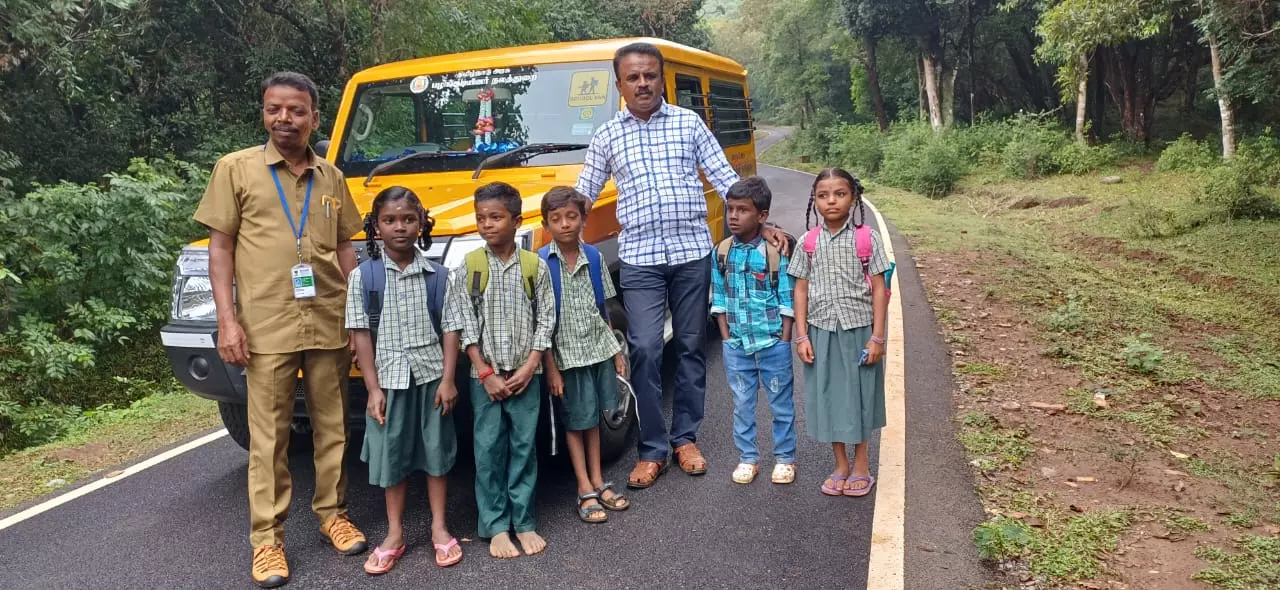
Erode-based tribal rights activists R Karuppusamy of READ NGO and SC Nataraj of Sudar NGO have stepped in with a new effort to bring the children back to school. They have introduced free van services in the hilly stretches of the Sathyamangalam reserve and Bargur hills in recent months, which they say has improved attendance in the schools.
They noted that some children who preferred returning home rather than staying in residential schools dropped out mainly due to lack of transport. Amid risks such as wild animals, rain and fog, the van service has enabled students to attend school regularly.
Parents are being honoured for sending their children back to school
S Annadurai, Director of the Tribal Welfare Department, told The Federal that steps have been taken to ensure regular transport from tribal villages to government schools. “We tied up with voluntary organisations in hill stations and engaged vans to pick up students from their doorsteps. Recently, 100 school dropouts were sent for a two-day tour-cum-counselling session with the Erode district collector. The majority of students showed up at school the same week," he recounted.
"The parents believe they should follow their cultural values. I stayed at the Sathyamangalam Tiger Reserve region for a day and interacted with the villagers. We are looking to improve the livelihood of parents and reduce emmigration so that children will be continue to be under their care," Annadurai said.
When the parents do send their children back to school, the local administration makes it a point to honour them, to set an example for the others.
SOP yet to take off
In 2021, the Tamil Nadu government formed a committee to draft a Standard Operating Procedure (SOP) to prevent child marriages, as the TN Prohibition of Child Marriage Rules lacked clarity on stakeholder roles. Sources confirmed to The Federal that although the SOP was formulated, it has not yet been released or implemented.
Until systemic changes arrive, the burden of keeping children in school falls on a handful of officials, activists, and teachers — each making their way, often on foot, through forest and field.
(To report a child marriage, dial helpline: 1098, 1091; Police helpline 100)
This report was filed under Population First’s Laadli Media Fellowship 2026.