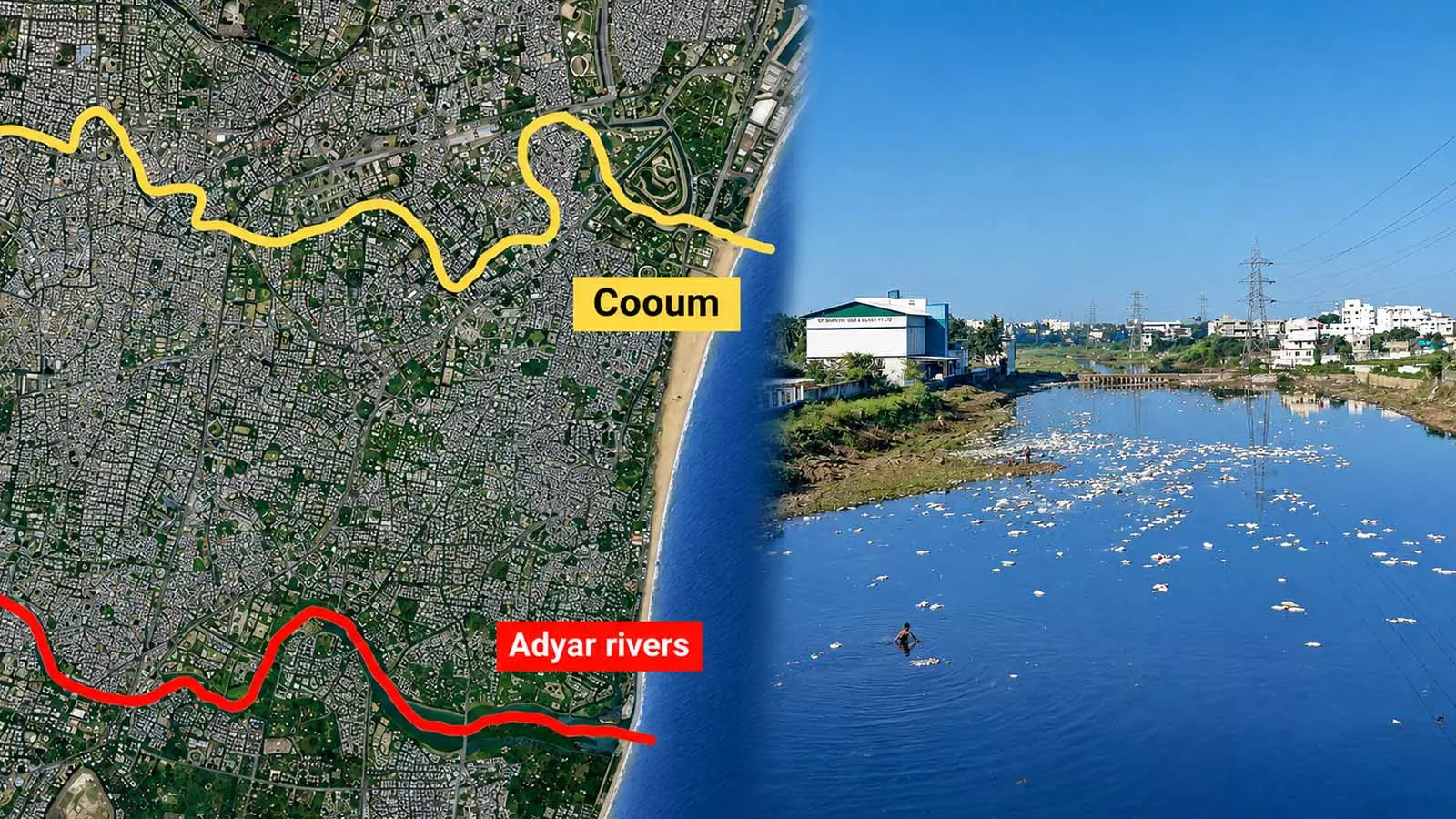
Once a clean freshwater river and a key source of drinking water for Madras, the Cooum has been severely degraded by rapid urbanisation and the discharge of untreated sewage.
From Seoul to Singapore: Can global lessons revive Chennai’s Cooum?
The TVK government has unveiled a fresh Cooum River restoration plan, but decades of failed clean-up efforts raise a familiar question: can this time be different?

Can Chennai’s Cooum river get a new lease of life by drawing lessons from Seoul and Singapore? The Tamil Nadu government, in its latest Budget, has proposed restoring the heavily polluted waterway, citing Seoul’s Cheonggyecheon stream and Singapore’s Kallang Basin as possible models.
Once a clean freshwater river and a key source of drinking water for Madras, the Cooum has been severely degraded by rapid urbanisation and the discharge of untreated sewage. Experts say cleaning up the river is a Herculean task (more of it later in the copy)
Global models
Seoul revived its buried Cheonggyecheon stream after removing an elevated highway that had covered it for decades. The restoration, completed in October 2025, brought back a 5.8-km stretch of waterway at a cost of around $281 million, creating a green corridor that now serves as a public space, wildlife habitat and flood-management system in the heart of the city.
Also read: How Bengaluru lost touch with its waters and why getting it back is urgent
Singapore, meanwhile, took a longer and broader approach to restoring the Kallang Basin and six other rivers. The decade-long clean-up, carried out between 1977 and 1987 at an estimated cost of $150-240 million, transformed a heavily polluted area burdened by industrial waste, sewage and pig farms. The basin is now part of the Marina Reservoir catchment.
Despite their different approaches and timelines, both projects demonstrate that severely degraded urban waterways can be restored through sustained planning and coordinated action. The question now is whether Chennai can replicate that success with the Cooum.
Government’s plans
The Tamilaga Vettri Kazhagam (TVK) government is promising a global-model approach to revive the Cooum and Adyar rivers. The government plans to invite global tenders to prepare feasibility studies and project reports.
Also read: Giving life to a dying river: P Selvaraj, the man behind revival of Kousika
In its maiden Budget, the government allocated nearly Rs 30,000 crore to the Municipal Administration and Water Supply Department. The restoration of the Cooum and Adyar rivers has emerged as one of its flagship priorities.
Six decades
For Chennai, however, the Cooum story is one of repeated promises and incomplete results. The first major Cooum improvement project dates back to 1967, when then Chief Minister C N Annadurai launched an initiative involving desilting and widening of the river channel.
Since then, the river has been the subject of one restoration attempt after another. Foreign consultancy studies were commissioned in the early 1990s, while central government sewage funding followed in the 2000s.
A dedicated river trust was formed in 2006, a World Bank-backed relaunch followed in 2008, and fresh funds were sanctioned as recently as 2019 to address sewage outfalls — many of the same pollution sources that continue to be flagged today.
Repeated failures
The pattern has remained familiar: projects are announced, money is allocated, and sewage outfalls are targeted, but implementation on the ground remains the biggest challenge.
Encroachments have continued to spread along sections of the river, while sewage continues to enter the waterway. A CAG audit had earlier recorded 118 sewage outfalls into the Cooum as part of the river restoration project.
Also read: Shades of Blue review: What rivers, ponds and lakes tell us about India’s water crisis
The scale of the problem remains stark. Nearly 70,000 families live along the river’s course, while the Cooum has continued to face severe pollution. A 2024 report noted that the Central Pollution Control Board described the river as India’s most polluted river in its 2022 assessment.
A fragile river
But despite six decades of efforts, why has the restoration of the Cooum River been difficult? Ecologist Jayashree Vencatesan argues that the reason is the nature of Chennai’s waterways.
“Chennai has its rivers. So-called rivers, Kosasthalaiyar, Cooum, Adyar, as it expands furthermore, they are actually very seasonal streams,” the environmentalist said. “They’re not rivers like your perennial, high-flowing, intense-flowing rivers.”
The Cooum’s flow is heavily dependent on the monsoon, making it a fragile and vulnerable water system. According to the environmentalist, that also limits how far the river can realistically be restored. “Cleaning is very difficult. You can recover it to a point, not any more. Heuristically speaking, it can be up to 45 per cent recovery. That’s all,” she added.
The environmentalist also pointed to the river’s long history of human intervention. The Cooum has been altered and manipulated repeatedly over the years, meaning that restoring it to a completely natural state may no longer be possible.
Sewage challenge
The fundamental problem, however, remains pollution. Last year, a private tanker was caught dumping sewage directly into the Cooum, highlighting how difficult it remains to prevent untreated waste from entering the river.
Also read: India’s cities are drowning in a crisis of governance, not rains
This is not a new problem. Earlier government restoration plans have repeatedly identified sewage interception as a crucial component. The CAG had also flagged delays in implementing interceptor sewer works under earlier restoration projects.
The comparison with international projects therefore raises a difficult question. Paris managed to clean up sections of the Seine ahead of the 2024 Olympics after an eight-year effort, while Chennai has spent nearly six decades attempting to revive the Cooum.
TVK's test
The TVK government insists that its approach will be different. It is promising fresh feasibility studies, global tenders and a roadmap inspired by cities that have successfully restored their waterways.
The Cooum has survived six decades of plans, consultants, committees, funds and political promises. The question now is whether the TVK government can break that cycle — or whether its Cooum restoration plan will become yet another chapter in a story that has never really ended.