








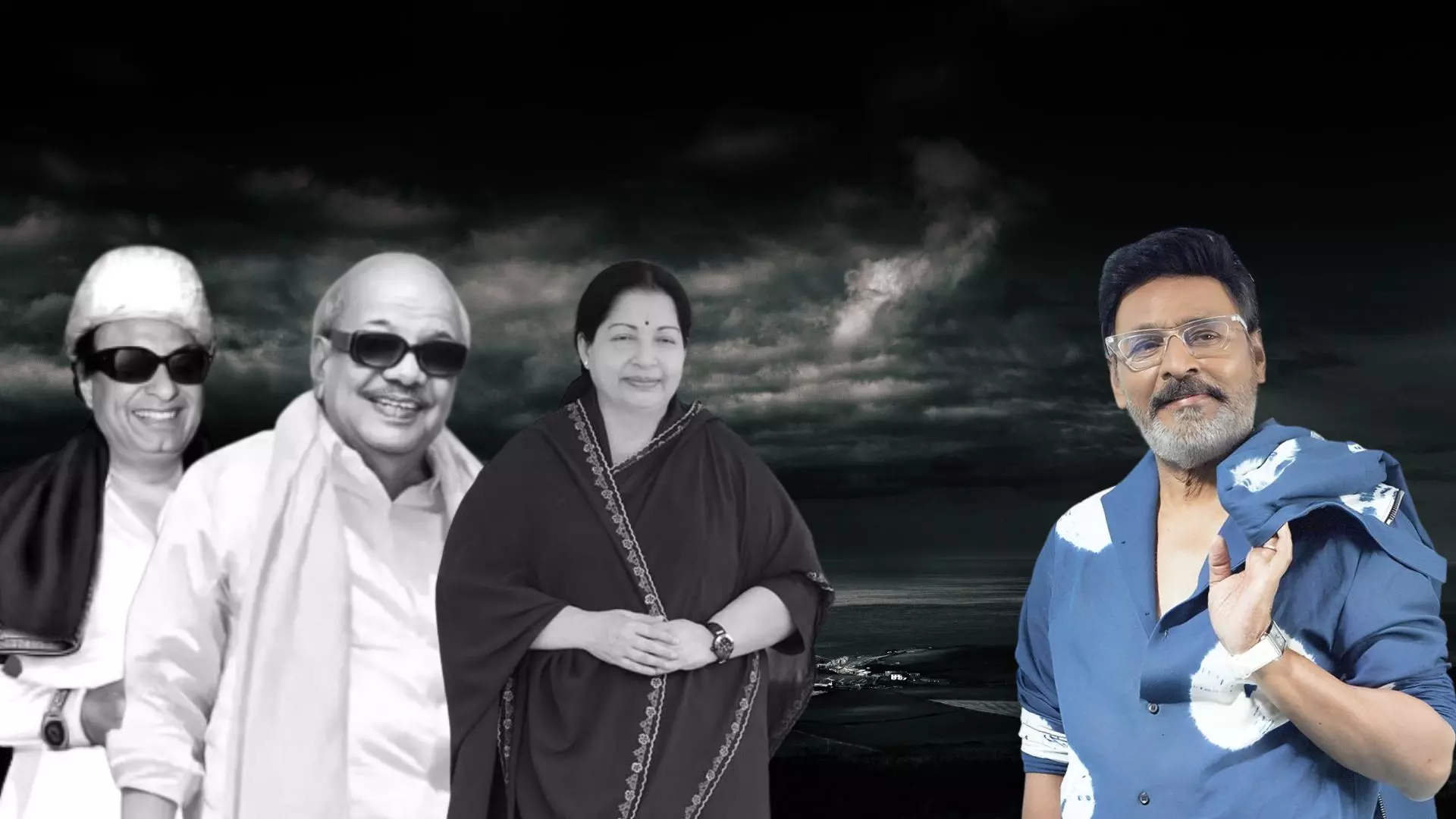
K Bhagyaraj beyond cinema: Why MGR’s ‘artistic heir’ failed in politics
K Bhagyaraj ruled Tamil cinema but never found lasting success in politics. What held back MGR’s artistic heir?

The Tamil film fraternity suffered a major blow on Saturday (June 27) as veteran actor and director K Bhagyaraj passed away in Chennai following a cardiac arrest at the age of 73.
Even as Tamil cinema mourns his death, Bhagyaraj’s political journey remains one of the most intriguing chapters of his life. Despite being hailed as MGR’s "artistic heir" in the world of cinema and enjoying enormous popularity on screen, he never managed to replicate that success in politics.
Early moves
His political career began during the split in the AIADMK in 1988, when he supported the Janaki Ramachandran faction.
After the Janaki faction suffered a crushing defeat in the 1989 Assembly elections, Bhagyaraj launched his own party, the MGR Makkal Munnetra Kazhagam. He hoped to unite MGR’s fan base and convert it into a political force.
Also read: Four films, four genres: How K Bhagyaraj created cinema history in 1981
The party later backed the DMK-led alliance in the 1989 Lok Sabha elections, but it failed to make any significant impact. Bhagyaraj eventually returned to the AIADMK.
Ahead of the 2006 Assembly elections, he switched camps again and joined the DMK after meeting M Karunanidhi. During that period, he also criticised J Jayalalithaa over remarks directed at national leaders.
Shifting alliances
Bhagyaraj later met then chief minister Karunanidhi and suggested the idea of subsidised rice distribution. However, he eventually returned to the Jayalalithaa-led AIADMK.
Even in 2022, his appearance at a BJP event highlighting Prime Minister Narendra Modi's welfare schemes triggered political debate in Tamil Nadu.
Political observers say that while Bhagyaraj possessed star appeal and enjoyed the goodwill associated with MGR, he lacked the organisational strength and consistency required to build a lasting political movement.
Why it failed
Frequent shifts between parties weakened Bhagyaraj’s political credibility. Unlike MGR and Jayalalithaa, who built powerful party structures and retained loyal cadres for decades, Bhagyaraj’s political ventures remained largely centred on his personal popularity.
Also read: Breaking the superstar mould: How Bhagyaraj redefined the Tamil film hero
His party even contested elections in Kerala in 1989, but it performed poorly. Over time, he found himself increasingly on the sidelines of active politics.
Observers believe this was the key difference between cinematic popularity and political success. While cinema gave him visibility, it did not translate into a durable grassroots network.
Contrast with Vijay
Bhagyaraj’s political journey has often been compared with that of Joseph Vijay. After launching Tamilaga Vettri Kazhagam, Vijay contested the 2026 Tamil Nadu Assembly elections and emerged as the leader of the single largest party before taking oath as the chief minister.
Political analysts argue that Vijay succeeded by transforming his fan base into a disciplined political organisation, maintaining a consistent message and building a strong grassroots network — factors that Bhagyaraj was unable to establish despite his immense popularity.
Also read: How Bhagyaraj diverted Tamil cinema’s comedy track
Bhagyaraj’s life remains a reminder that in Tamil Nadu, cinema can open the door to politics, but lasting success ultimately depends on organisation, consistency and public connect beyond the silver screen.
(The content above has been transcribed from video using a fine-tuned AI model. To ensure accuracy, quality, and editorial integrity, we employ a Human-In-The-Loop (HITL) process. While AI assists in creating the initial draft, our experienced editorial team carefully reviews, edits, and refines the content before publication. At The Federal, we combine the efficiency of AI with the expertise of human editors to deliver reliable and insightful journalism.)


