








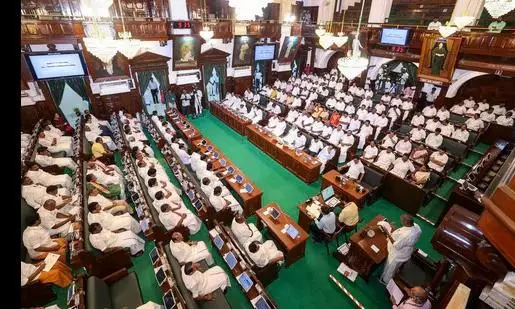
Before the 2021 elections, the DMK had promised a minimum of 100 sitting days per year. The actual average was less than one-third of that promise. File photo: PTI
Fewer sittings, faster laws: DMK cleared 194 Bills in 155 days, with minimal debate
The 16th Tamil Nadu Assembly records the lowest number for any full five-year term since the first Assembly in 1952, averaging only 32 days a year

As Tamil Nadu prepares to elect its 17th Legislative Assembly on April 23, a report by PRS Legislative Research has laid bare the functioning of the outgoing DMK-led 16th Assembly (May 2021 to March 2026).
The report says the House sat for just 155 days, the lowest number for any full five-year term since the first Assembly in 1952, averaging only 32 days a year. Yet the same period saw 201 Bills introduced and 194 passed at breakneck speed, with no pieces of legislation sent to committees for scrutiny.
The PRS report paints a picture of an institution that met less frequently than desirable, but worked speedily. Each sitting lasted roughly five hours - a figure that has remained steady for decades, resulting in more than 725 hours of proceedings.
Fewer sessions, more Bills
Since 2023, the Speaker has simply adjourned sessions without prorogation, effectively keeping a single session alive for the entire year. This procedural tweak ensured that pending business did not lapse, allowing the government to recall the House without fresh gubernatorial summons.
Before the 2021 elections, the DMK had promised a minimum of 100 sitting days per year. The actual average was less than one-third of that promise. Political analyst Kanniappan Elangovan told The Federal, “The Assembly has become a platform to praise the ruling party leader rather than a place for serious legislative debate. Most MLAs speak about undug canals, buses not running, or temple consecrations, rather than laws or rules.”
Also read: Tamil Nadu | Readoption of Bills marks fresh twist in Governor-govt row
Despite the thin calendar, the government pushed through legislation on key themes. Education, urban/municipal governance, and law and order accounted for nearly one-third of all Bills. Notable laws included converting municipalities into corporations, introducing preferential quotas for government-school students in professional courses, slum redevelopment reforms, regulating online gaming, and banning hookah bars.
Apex court intervention
On several occasions, over 10 Bills were passed in a single day. On September 13, 2021, 19 Bills were cleared; five had been introduced only the previous day. Similar bursts occurred in May 2022 (17 Bills), December 2024 (18 Bills), and April 2025 (14 Bills, 12 of which were introduced within three days). Not a single Bill was referred to a committee during the entire term, a sharp departure from earlier practice.
Also read: Here are the 10 TN Bills now deemed approved after SC’s rap for Governor Ravi
Governor’s assent became another flashpoint. Twelve university-related Bills that sought to shift the power to appoint Vice-Chancellors from the Governor to the state government languished for years. The Tamil Nadu government moved the Supreme Court. In April 2025, the apex court ruled that the 10 re-passed Bills would be “deemed to have received assent,” citing prolonged inaction as unconstitutional. Nine other Bills waited more than a year for assent; six were eventually deemed passed following the court verdict.
Debate time reduced
Budget scrutiny was also curtailed. The general discussion on the Budget lasted only four days on average, the lowest since the Third Assembly. Department-wise discussions averaged 17 days, well below the long-term norm. Since the 13th Assembly, however, no department budget has been guillotined. A separate Agriculture Budget, introduced in 2021-22, has continued.
Motion of Thanks on the Governor’s Address was allotted three days on average, down from four to six days in earlier decades. The 2023 session saw disruptions; in 2024, 2025 and 2026, the Governor walked out without delivering the full Address. Starred questions, which allow oral answers and supplementary queries, were dominated by four departments: Tourism, Culture & Religious Endowments (11 per cent), Municipal Administration (9 per cent), Water Resources (7 per cent), and Hindu Religious & Charitable Endowments. On average, MLAs asked three starred questions per sitting; there was no gender gap in participation.
Also read: TN Governor RN Ravi walks out of Assembly, yet again, amid anthem row
The Assembly passed 17 unanimous resolutions criticising Union policies - the 2020 Farm Laws, Citizenship Amendment Act, NEET/CUET, and “One Nation, One Election.” It also unanimously condemned the Governor’s delay on Bills. Calling Attention Motions (35 in total) focused on public works, water resources, and municipal issues. Ministers made 32 statements, almost all by the Chief Minister.
Call for live broadcast
While the House met rarely, a handful of MLAs shone through with near-perfect attendance and active participation. VCK MLA Aloor Shanavas topped the attendance charts. He told The Federal that the Chief Minister ensured opposition parties were given adequate speaking time, in a departure from earlier practices where the House was often disrupted or broadcast feeds cut. “We demand full, uninterrupted live telecast of Assembly proceedings,” he added.
Also read: Can states scrap governor’s address? PDT Achary explains
“The Assembly proceedings are not fully broadcast live. On a large scale, debates in the House do not take place with proper statistics and data," said Elangovan. "Opposition parties often politicise issues, boycott the Assembly, walk out, and then discuss the matter with the media. People knowledgeable about laws, rules and procedures are not even fielded as candidates in Assembly elections. It does not appear that members have any knowledge of legislative amendments. Most members only speak about things like ‘canals not being dug, buses not running, or temple consecrations not performed."
Announcements of projects under Rule 110 have increased significantly, which has turned the Assembly into a debate-less forum. In the Legislative Assembly, there is no evidence anywhere of members consulting the copy of a Bill brought in for a particular department before participating in discussions,” he added.