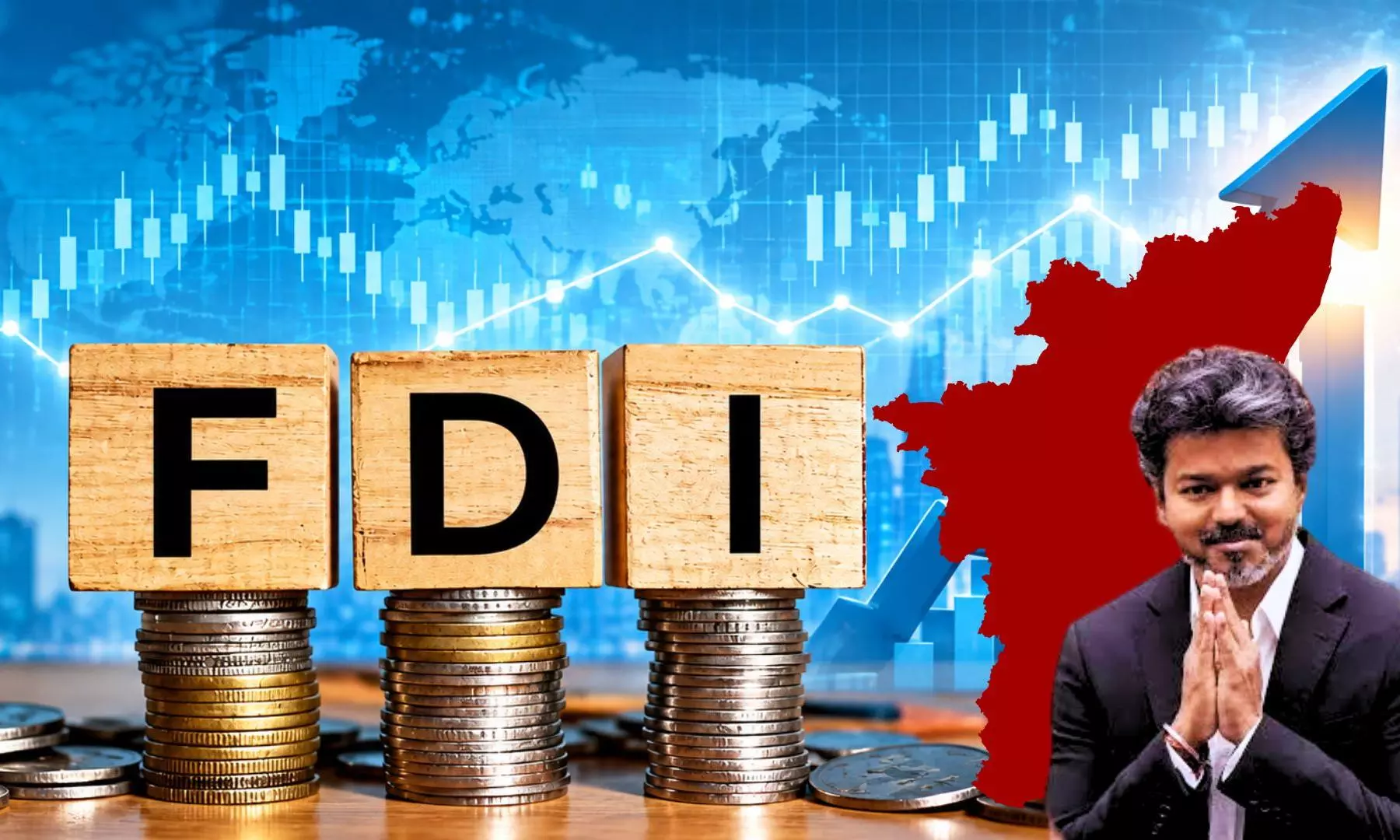
The latest FDI numbers raise a question over how much of Tamil Nadu’s surge can be attributed to the single large financial-services transaction and how much reflects broader investment momentum.
Tamil Nadu overtakes Maharashtra, Karnataka in FDI in Q2; what changed?
Tamil Nadu topped India’s FDI rankings with $5.95 billion in the latest quarter, boosted by a major financial-services deal and growing GCC investments

Tamil Nadu has overtaken Maharashtra and Karnataka to emerge as India’s top destination for foreign direct investment (FDI), attracting $5.95 billion in FDI equity during the July-September quarter, according to Department for Promotion of Industry and Internal Trade (DPIIT) data.
The inflow was more than double the state’s tally during the same period last year and accounted for around 30 per cent of India’s total FDI equity inflows. Maharashtra followed with $4.22 billion, while Delhi attracted $2.67 billion. Karnataka and Gujarat ranked fourth and fifth with $2.11 billion and $1.30 billion, respectively.
The latest numbers mark a sharp shift from the pattern seen in recent years, when Maharashtra and Karnataka routinely led India’s FDI rankings. Maharashtra recorded $19.6 billion in FY25 and $18.4 billion in FY26, while Karnataka was the runner-up in both years.
What changed?
Karnataka’s FDI inflows fell 63 per cent in the latest quarter, with its share of national inflows dropping from 31 per cent to 11 per cent. Maharashtra also recorded a 21 per cent decline, with its share falling from 29 per cent to 21 per cent.
Also read: Tamil Nadu's boom is built to last, says economist
A major factor behind Tamil Nadu’s jump was Japanese banking giant MUFG’s $4.4-billion investment for a 20 per cent stake in Chennai-based non-banking financial company Shriram Finance. Since Shriram Finance is registered in Tamil Nadu, the investment was counted in the state’s FDI tally.
“The MUFG-backed Shriram Finance deal did the heavy lifting. That's about RS 42,000-43,000 crore, which is huge. But let us not take the credit away from the fact that the other sectors have also contributed significantly,” said R Ganapathi, former president of SICCI.
He also pointed to the growth of global capability centres (GCCs), citing the presence of a large pool of trained engineering graduates as one of Tamil Nadu’s strengths.
GCC push
Tamil Nadu has also continued to attract investments in the GCC space. During the current July-September quarter, the state has attracted investments from US companies including pharma major Walgreens and coffee giant Starbucks.
The latest FDI numbers, however, raise a question over how much of Tamil Nadu’s surge can be attributed to the single large financial-services transaction and how much reflects broader investment momentum.
Also read: TN losing investments? Korean firm exit raises political heat
The political question is also relevant. In 2026, C Joseph Vijay’s party Tamilaga Vettri Kazhagam (TVK) ended nearly six decades of DMK-AIADMK dominance in Tamil Nadu. However, the Shriram Finance transaction had been locked in before the new government took office.
Long-term push
Ganapathi said Tamil Nadu’s investment performance cannot be attributed to a single deal or government, arguing that the state’s industrial and investment strengths have developed over several decades.
“I’m not going to say that one deal, one government has been the reason for all these things. I think it has been a sustained, continuous effort from almost the start of the state in 1958. We have always been ahead of the curve,” he said.
He also pointed to investment announcements made during the first 100 days of the new government and an EY memorandum of understanding on setting up GCCs, signed around the chief minister’s visit to the UK.
Sustaining momentum
The next challenge for Tamil Nadu will be sustaining the momentum. Ganapathi said sectors including automobiles, electric vehicles, electronics, aerospace and shipbuilding could play an important role, while faster clearances, land availability and stronger social infrastructure would also matter.
Also read: Is Tamil Nadu losing investments to Andhra? Here are facts behind project claims
“I think the auto sector, the EV sector, the electronics sector, the aerospace sector and the shipbuilding sector will all play an important role in sustaining this momentum,” he said.
Tamil Nadu is at the top of the FDI table for now. But with a large part of the latest inflow coming from the MUFG-Shriram Finance transaction, the next few quarters will show whether the state can maintain the momentum and broaden its investment base.