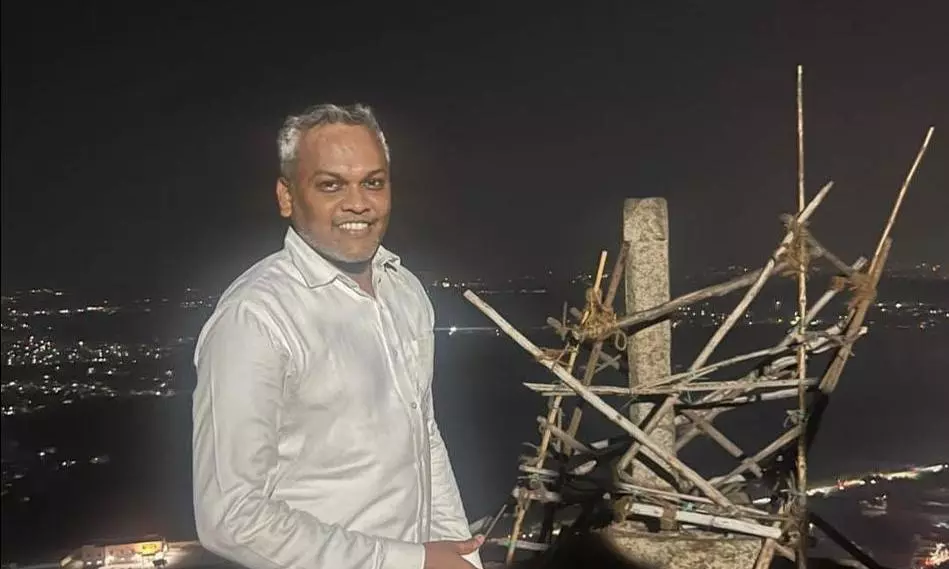
Speaking to The Federal, petitioner's counsel Arun Swaminathan says this newly surfaced village sketch could be a turning point. File photo
Thiruparankundram row: Petitioner provides village map calling pillar a ‘deepathoon’
Petitioner’s counsel Arun Swaminathan claims a 1980 govt topo sketch labels the pillar a 'light pavilion', bolstering the argument against the survey-stone theory

The dispute over lighting the Karthigai Deepam atop the Thiruparankundram hill in Madurai has gained fresh momentum after petitioner Rama Ravikumar’s counsel, Advocate Arun Swaminathan, told the Madurai Bench of the Madras High Court that he has obtained documentary evidence identifying the hilltop pillar as a “deepathoon” and not a British-era survey stone as claimed by the Tamil Nadu government and several historians.
Sharing the evidence with The Federal, Swaminathan says a government-issued village topo sketch of Thiruparankundram in early 1980 labels the structure as a light pavilion, strengthening the argument that the pillar was historically used for ceremonial lamp-lighting.
New layer added to case
The revelation has added a new layer to a case steeped in questions of ownership, religious rights, and communal sensitivity. The pillar’s classification has been at the heart of the conflict, with archaeologists insisting it is a 19th-century survey marker, while petitioners argue it is part of an older temple tradition. The dispute is further complicated by references to the 1920 civil court ruling and the Privy Council’s 1931 confirmation, both of which held that the hilltop, barring the dargah, belongs to the temple.
In an interview with The Federal, Swaminathan says this newly surfaced village sketch could be a turning point. He argues that the right to light the lamp is legally backed by historical judgments, and maintains that Hindu worshippers can be allowed to perform the ritual in a designated area beyond 15 metres from the dargah, consistent with previous court directions, while ensuring peace and order on the hill.
Why has the issue of lighting a lamp on the hilltop pillar resurfaced now, after so many decades?
It is true that for nearly 160 years, there was no consolidated effort to study why the lamp was not lit on the summit pillar. But historically, the dispute related to ownership of the land on the hill actually began in 1862. The next major record comes from the 1920 civil court judgement, which noted that in both 1862 and 1921, there were disputes over whether the summit belonged to the temple or the dargah.
Also Read: Why Justice Hari Paranthaman suggests 'immediate impeachment' of Justice Swaminathan
From the available records, we cannot conclusively say whether lighting the lamp continued uninterrupted during that period. What is clear is that the court in 1920 and later the Privy Council in 1931 held that the entire subject land, barring the area occupied by the mosque, belonged to the Thiruparankundram temple. So, the legal foundation exists.
The present urgency arises because my client seeks to revive a traditional practice that was clouded by later political disputes. The real dispute related to lighting the lamp began in 1994.
You mentioned that the real dispute began only in 1994. What happened then?
The major conflict was triggered in 1994, not before. At that time, Hindu Munnani made an assertive claim to light the lamp at the summit stone pillar. This caused a split within Hindu organisations themselves. A faction opposed to Hindu Munnani filed a writ petition against them.
In the 1994 judgment by Justice Kanagaraj, the petitioner offered what is called a negative prayer, essentially asking the court to restrain the other Hindu group. In arguing their fears, they even claimed that Hindu Munnani would “break the lamp and turn it into something like Babaji Masjid”.
Also Read: Bhagwat wades into Thiruparankundram row, says 'awakened' Hindus in TN can resolve it
Despite this negative prayer, the court interpreted the earlier 1920 civil court judgement and concluded that the temple owns the hill except for the mosque area, and therefore, lighting the lamp is permissible if done in a regulated manner. Under the HR&CE Act, an earmarked space can be allotted for Hindu worshippers, provided it is 15 metres away from the dargah. So the revival of the dispute today is really tied to the legal and political chaos triggered in 1994, and not ancient practice.
Critics argue that the pillar on the summit is just a British survey marker, not an ancient ‘deepathoon’. Does this affect your claim?
The archaeological debate about whether the pillar is a British survey stone or an ancient lamp post is a separate question. Our argument does not depend on proving the antiquity of the pillar.
What matters is that the 1920 civil court judgment and subsequent Privy Council ruling declared the summit to be temple property. If it is temple property, then Hindu worshippers retain the right to perform traditional rituals, provided they do not disturb the dargah or violate the 15-metre rule.
Also Read: Deepam row: INDIA bloc MPs move impeachment motion against Madras HC judge Swaminathan
Also, the topo sketch, a government-certified village map, describes the structure as a light pavilion at the top of the hill. This is not an invention of any organisation, it is part of official records.
So, whether one calls it a survey pillar or a lamp pillar, the legal and administrative categorisation supports our position.
What is your response to concerns about communal harmony and the presence of the dargah at the summit?
Hinduism, at its core, is a religion of tolerance. This is not something new, it is a foundational truth. The 1994 judgment itself acknowledges this when it says that multiple forms of worship can coexist, as long as boundaries are respected. Our petition does not seek to disturb the mosque or interfere with its functioning.
Also Read: Thiruparankundram Deepam row: Experts debunk claims of ancient pillar
The only request is that an area beyond 15 metres from the dargah, as prescribed in the judgement given by Justice GR Swaminathan in December 2025, be demarcated for lighting the lamp.
The real issue is not between communities – it is about recognising the legal ownership of the land and the rights of Hindu worshippers within the framework laid down by the High Court and HR&CE. Proper regulation by the authorities can easily ensure peace and order.