








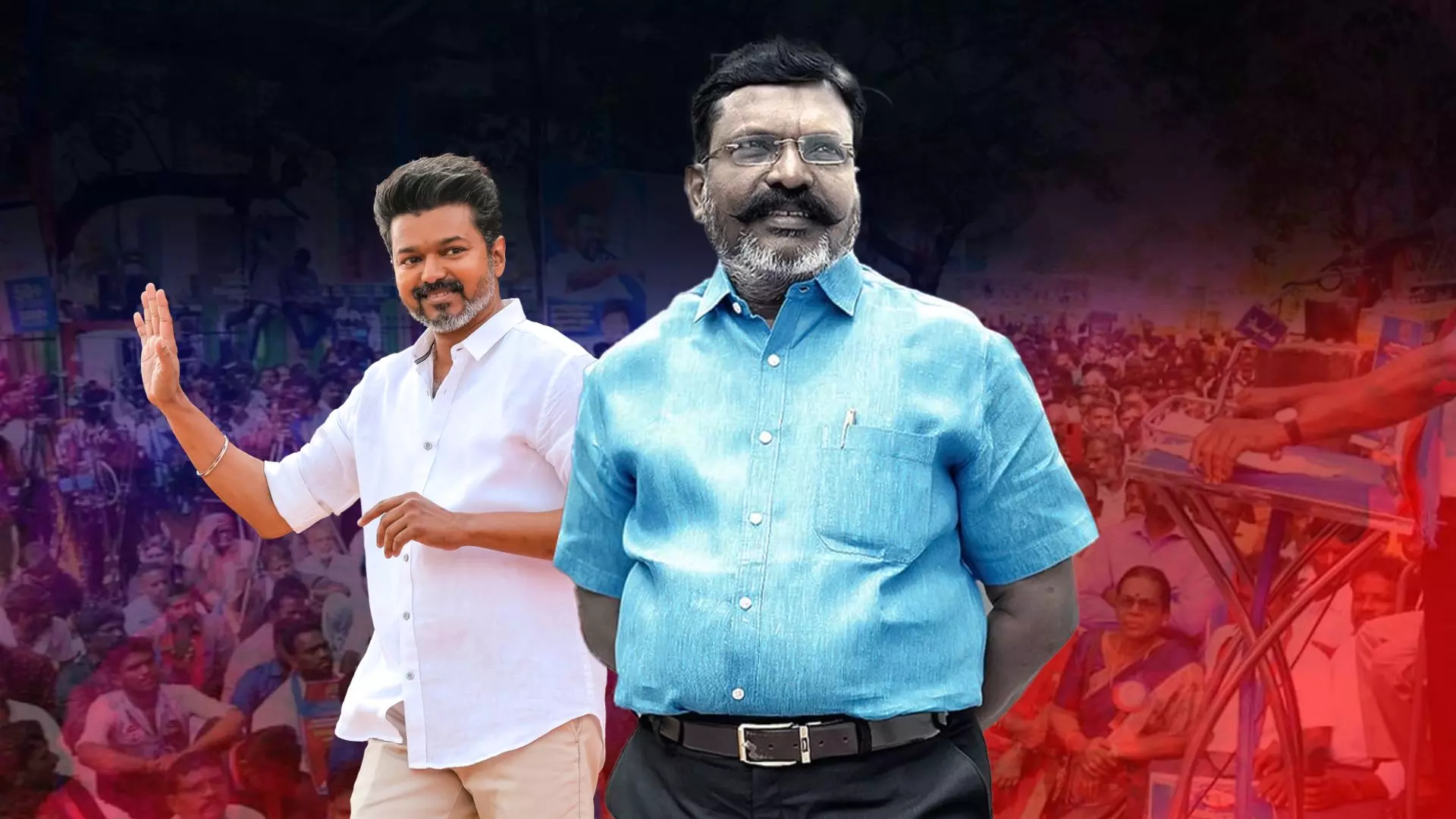
Why VCK chief Thirumavalavan is taking the plunge into TN election
Vijay's entry and Dalit vote dynamics may have had a hand in the party's long-term gameplan. Here is a deep dive into the development

VCK president and Chidambaram MP Thol Thirumavalavan’s decision to contest the 2026 Tamil Nadu Assembly election from Kattumannarkoil has triggered widespread political discussion. While it may appear sudden, the move reflects a deeper strategic shift within the party.
Thirumavalavan himself has clarified the reasoning behind the decision. “I need to focus on Tamil Nadu politics. The political situation in the Assembly is going to change significantly after this election. In this context, I am contesting from Kattumannarkoil,” he said.
The move signals a shift from national to state-level engagement. While Parliament offers a platform for national issues, the Assembly provides a more direct space to address Tamil Nadu-specific concerns, especially those affecting marginalised communities.
State focus
This decision is not abrupt. The VCK has been steadily expanding its organisational structure across all 234 Assembly constituencies. District-level leadership has been strengthened, indicating long-term preparation for a larger political role.
The party leadership believes that growth beyond its current scale requires a stronger presence in state politics. Contesting Assembly elections is seen as essential to that transition.
Thirumavalavan’s move, therefore, reflects both organisational readiness and a calculated political step toward deeper state engagement.
Internal shift
The VCK chief also made a significant announcement regarding internal party functioning. While releasing the list of eight candidates in the DMK-led alliance, he indicated a change in decision-making processes.
“This is the last election where I personally select candidates. Starting with the next cycle, the party will follow a more democratic model similar to communist parties,” he said.
Sources suggest this decision is linked to dissatisfaction over limited seat allocation and challenges in distributing tickets among party members. It signals a transition toward institutional decision-making within the party.
Dalit votes
Another key factor is the evolving political landscape, particularly the emergence of Vijay’s TVK. The new party is expected to attract younger voters, including sections of the Dalit electorate.
VCK’s core support base in northern and central Tamil Nadu could face some fragmentation. By contesting a high-visibility seat, Thirumavalavan is reinforcing VCK’s position as a primary voice for Dalit aspirations within the DMK alliance.
Whether this strategy prevents any potential vote split will become clear only after the election results.
Long-term plan
The move also has implications beyond the Assembly election. There is speculation that Thirumavalavan is positioning VCK for greater bargaining power in future political negotiations.
If he secures a strong victory and the party performs well in the alliance, it could enhance VCK’s independent political weight. This, in turn, may translate into a stronger claim for more Lok Sabha seats in the 2029 parliamentary elections.
Seen in this light, the decision appears to be a long-term political investment rather than a short-term electoral gamble.
Seat choice
Kattumannarkoil is not a random choice. The constituency has a significant Dalit population of around 40 per cent, with Paraiyar and Vanniyar communities forming key voting blocs.
The internal rift within the Pattali Makkal Katchi (PMK), particularly between S. Ramadoss and Anbumani Ramadoss, has weakened Vanniyar consolidation. This creates a more favourable electoral environment.
Thirumavalavan has prior experience in the constituency, having won in 2001 and performed strongly in 2016. With alliance support and party recognition, the seat offers a viable, though not guaranteed, path to victory.
Power play
Speculation has also emerged around a possible Deputy Chief Minister ambition in the event of a hung Assembly. However, this remains unconfirmed.
Neither Thirumavalavan nor VCK leaders have publicly articulated such ambitions. Yet, in a fragmented verdict, smaller parties can play a decisive role in post-poll negotiations.
A strong individual performance could position VCK as a key player in alliance dynamics, though any leadership role would depend entirely on electoral numbers.
Thirumavalavan’s decision reflects a calculated shift toward state politics, organisational growth, and evolving electoral dynamics. It combines immediate electoral strategy with long-term political positioning.
As Tamil Nadu heads into a crucial election, this move could reshape both VCK’s trajectory and the broader political landscape.
The content above has been transcribed from video using a fine-tuned AI model. To ensure accuracy, quality, and editorial integrity, we employ a Human-In-The-Loop (HITL) process. While AI assists in creating the initial draft, our experienced editorial team carefully reviews, edits, and refines the content before publication. At The Federal, we combine the efficiency of AI with the expertise of human editors to deliver reliable and insightful journalism.
