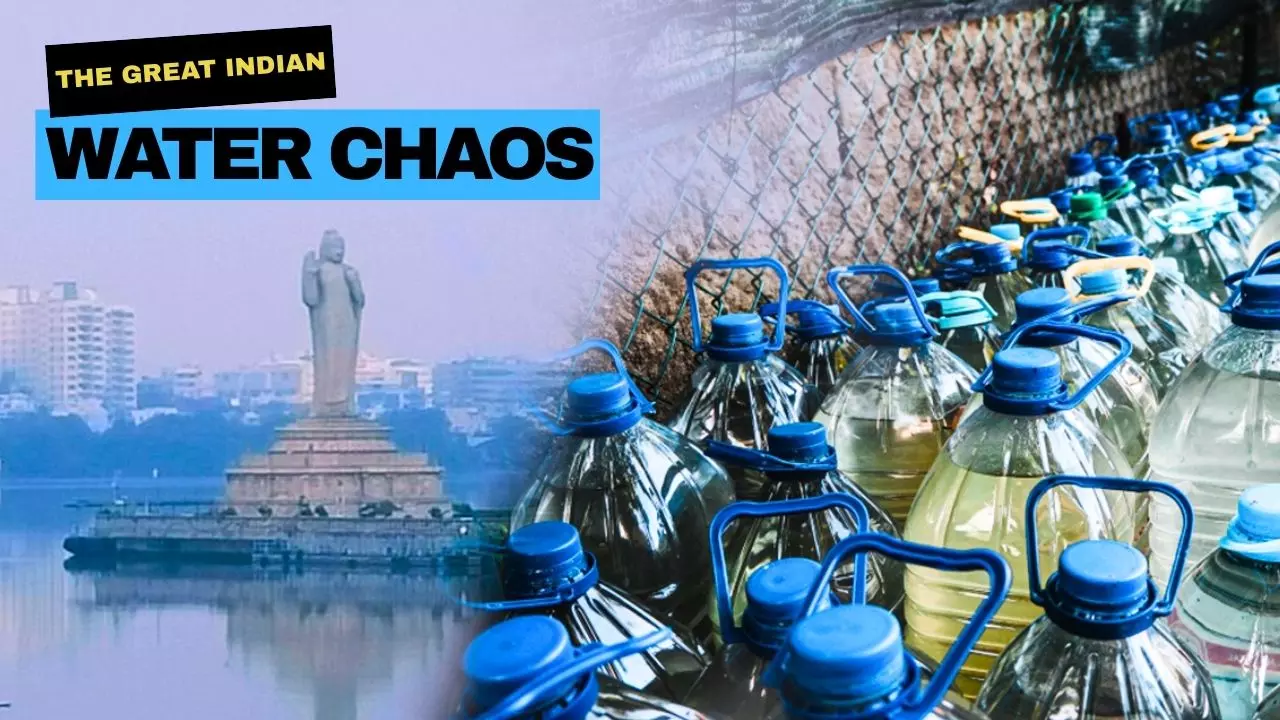
Hyderabad scores well on piped water but pockets of problem remain
Saroornagar residents report contaminated supply as experts warn of storage risks despite Hyderabad tap water being ranked second safest in India by BIS

With the tragedy in Indore still fresh in their minds, residents of a Hyderabad neighbourhood complained of contaminated drinking water supply on Monday (January 5). The locals of road nos. 2,3 and 4 of Saroornagar’s Bapunagar said this had been the condition of the water for a week and complaints to the authorities had fallen on deaf ears.
They alleged that the water board authorities dismissed their concerns on water quality and asked them to either let the water flow for 20 minutes before using it or boil it before drinking. This, despite the city having a history of an Indore-like tragedy, when 14 people in Bholakpur died of water contamination in 2009, courtesy a deadly mix of poisonous heavy metals and dangerous coliform bacteria.
A tragedy fresh in Bholakpur’s mind
The situation is, however, better in Bholakpur currently, with the residents of Bangladesh Market (once home to Bangladeshi migrants) reporting supply of clean drinking water. Mohammed Shakeer (54), who lost his five-year-old son in 2009, is confident of the water quality and demonstrates that by drinking water sourced directly from the pipeline.
Also read: Reckless urban growth under scanner as water quality of Hyderabad lakes plummets
“The water supplied now is clean, its quality is checked, and if the authorities fear the quality may not be up to the mark, we are warned. After the 2009 incident, the new water pipelines were laid two feet underground and the sewer lines were taken further down by four feet. For many years afterwards, we panicked at the sound of an ambulance. The YSR government then had given Rs 2 lakh as ex-gratia to the kin of the dead. However, those who were treated in Care Hospital were not reimbursed as promised,” Mohammed said.
Syed Amir (36), who was a teenager when his uncle Syed Ghani died in the Bholakpur tragedy, said he, too, had fever and vomiting. “My elder brother also fell sick but recovered,” he said, revealing that they have opted for a water purifier.
Brisk business for water jars
But not everyone can afford a purifier. K Sivaiah, who works as a watchman at a house in West Marredpally area of Secunderabad, said his family drinks water after filtering it with just a plain piece of cloth. “The water quality used to be bad two years back. New pipelines were laid after complaints to higher authorities. There has been no quality issue after that,” he said.
Also read: Chennai’s drinking water crisis mirrors deeper urban failures across India
However, a few feet away from the house where he lives, Ravula Vinod, who runs the water plant Tuljhabhavani Enterprises, said that all residents of the surrounding apartments buy water jars from him. He also supplies jars of water to hotels, hostels and private functions.
“We fill 20-litre jars with normal purified water and sell these for Rs 40 and those from branded companies for Rs 110. I have been running this business for four years now. I sell 70 cans of normal water and 40 cans of branded water per day,” Vinod said, adding that the demand increases during summer.
Multiple sources of water
Hyderabad relies on lakes like Osman Sagar, Himayath Sagar, Singur, and rivers Manjira, Krishna and Godavari for drinking water supply. The lakes were built during the tenure of the last Nizam, after the devastating floods in 1908, to prevent such calamities and also to supply drinking water.
While, water from the lakes comes to the city by gravity, that from Manjeera and Singur reservoirs comes through a combination of gravity and pumping. Water from the Krishna and Godavari is pumped and involves additional cost. A study conducted by the Centre for Science and Environment pegged the cost of bringing water from Nagarjunasagar to the city at Rs 6.4 to 18 per kilo litre.
Also read: Indore-like water contamination scare hits Bengaluru’s Lingarajapuram
A private employee and water activist Sai Teja, who lives in the Madhapur area of the city, complained that the supply is not timed properly. “The timings vary from 5 pm to 9 pm every day. Of late, the Hyderabad Metropolitan Water Supply and Sewerage Board (HMWSSB) has created a WhatsApp group to inform about non-availability of water. Areas like Kukatpally, Miyapur, KPHB, Kondapur, and Gachibowli depend on tankers. The surfaces of the tankers that supply water are all rusted,” he said.
However, of late, the demand for tankers has subsided thanks to good rains received in the monsoon. B Bharat Rao, resident of Janapriya West City in Miyapur, vouched for it. “We are getting Manjeera water every day. But some residents draw water using motors from the main lines; that is a problem,” he said.
Tap water second safest after Mumbai
The HMWSSB started a scheme to supply 20,000 litres of drinking water to every household for free from December 1, 2020. Residents who registered by December 31, 2021, are enjoying its benefits. It mandates fixing of water meters in all households and usage beyond that amount is charged.
A study by the Bureau of Indian Standards done across 21 cities pegged tap water supplied to Hyderabad households as the second safest for drinking in the country after Mumbai.
Also read: Bengaluru’s water crisis deepens as cases of contaminated drinking water surge
A study conducted by the Administrative College of India, Hyderabad, pegs the coverage of the water network at 90 per cent of the city, but only 70 per cent of residents actually receive piped water. In peripheral municipalities, coverage drops to 65 per cent, serving just 40 per cent of the population. The intermittent supply — often limited to a few hours every other day—forces households to store water, creating a critical point of vulnerability.
Stored water contaminated
The study in Hyderabad’s low-income neighbourhoods revealed that while supplied tap water met safety standards, stored water at the household level was frequently contaminated. It recommended awareness about unsafe handling with bare hands introducing pathogens like Coli.
Water quality is shaped by a complex interplay of factors—climatic conditions, biological activity, landforms, and the chemical composition of surrounding soils and rocks.
Also read: How a newspaper campaign exposed Indore water contamination issue
Anumeha Vats, former senior scientist at the Administrative Staff College of India, Hyderabad, who was part of the study says, “Water provision is not simply about keeping the taps running; it requires comprehensive oversight by relevant authorities who manage distribution, pricing, and accessibility to water resources. While ensuring consistent and equitable supply is foundational, it’s equally critical that water quality adheres to established health and safety standards. The availability of water is insufficient if it fails to meet the necessary criteria for safe consumption.”
Need to conserve water sources
Human actions, such as agriculture, industrial processes, and unregulated waste disposal, further complicate the situation. In underserved or informal settlements across many developing countries, these issues are often compounded due to inadequate infrastructure and ineffective water resource management, leading to even greater challenges in maintaining safe and reliable water supplies, she added.
BV Subba Rao, who has worked on the city’s lake issues for over three decades, stressed the importance of protecting them. “Hussain Sagar was a source of potable water until 1946. Kavuni Cheruvu water was consumed until 2009. Local sources of water need to be conserved. Used water needs to be purified for further usage. We don’t have a central pipeline system for carrying waste water from households. While focusing on flyovers, future cities and tunnels, basic necessities of life like water, air have not been given their due,” he said.
Also read: How India’s water crisis is not just due to climate change, but also governance failure
Provision of safe drinking water to citizen’s figures among the 17 sustainable development goals signed by all nation’s part of the United Nations in 2015. India is also a signatory to the agreement.