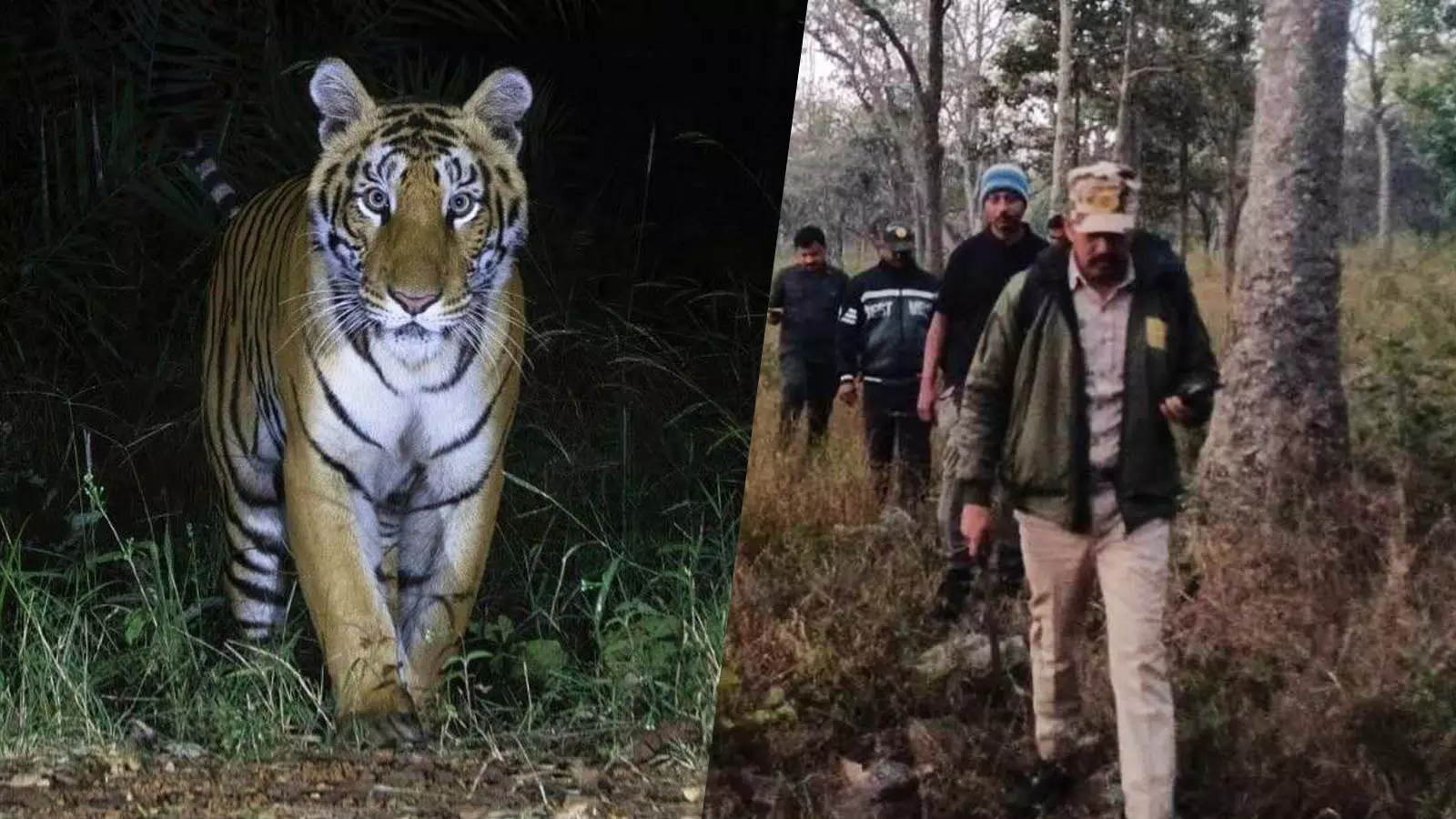
A tiger roams in Amrabad Tiger Reserve (left) and forest officials inside the reserve during the 2026 census. Source: Amrabad Tiger Reserve
From 10 to 42: How a Telangana forest quadrupled its tiger count in 9 years
Success in tiger census 2026 linked to improved grasslands and anti-poaching efforts as the cats migrate from Maharashtra to the southern state forests

Roars and rumbles of tigers are reverberating across the forests of Telangana, more than ever. The latest pan-India tiger census has revealed a significant rise in the animal’s number in the forests of the southern state. Particularly in the Amrabad Tiger Reserve, a well-preserved nature reserve located in the Nallamala Hills in southern Telangana, it has gone up to 42 from just 10 in nine years, speaking volumes about the conservation efforts that have gone in there in terms of controlling forest fires and developing grasslands, besides curbing poaching.
Also read: Tiger spotted on Hyderabad outskirts, first in 50 years
As part of the All India Tiger Estimation (AITE) 2026 programme, a comprehensive scientific survey of tigers and wildlife was conducted across India between January 19 and 25. The data accumulated during the tiger census was sent to the National Tiger Conservation Authority (NTCA) and the Wildlife Institute of India (WII) by senior Indian Forest Services (IFS) officers of the Telangana forest department, S Sunil Hiremath and Shantaram, field directors of Amrabad Tiger Reserve and Kawal Tiger Reserve, respectively.
In the Kawal reserve, five tigers reportedly moved in from the sanctuaries of neighbouring Maharashtra recently, with experts suspecting reasons such as their growing population and shrinking territory.
The AITE 2026, conducted jointly by the NTCA, the WII, the state forest department, and volunteers, revealed the presence of 994 tigers and carnivorous animals in the forest beats across 32 districts. The census also revealed the presence of 552 herbivorous animals in the forests.
Rising green cover, growth in food chain
It has been revealed that the tiger population in Telangana’s forests has increased due to the rise in other grasslands (and with it, other wildlife such as deer and other animals), and water sources in the forests. Roping in 200 members of the local Chenchu tribe to work for the outsourced anti-poaching squads has also curbed the practice.
Also read: Telangana foresters intensify watch as 5 tigers enter from Maharashtra
To prevent the spread of forest fires in Amrabad, check dams and solar-powered borewells have been installed inside the forest land. Water has also been made available to wildlife through ponds.
Hiremath told The Federal that the number of deer and buffalo has increased exponentially with the increase in grasslands, ensuring that the tigers are never short of food. Encroachments in the forest land have been removed, and plantations have been taken up.
The entry point of Amrabad Tiger Reserve, Telangana. Photo: Amrabad Tiger Reserve website
A plantation programme has been carried out in 5,539 hectares of the Achampeta and Amrabad forests in areas such as Vattimukkala Kunta, Dadoni Banda, Pedda Jalu, Dillar Tippa and Pothuraj Tippa.
Sightings of tigers have also increased during safari tours conducted in the state’s forests. It was reported that there were 50 sightings of the striped cat in Amrabad in the last three months during safaris conducted by the Telangana Forest Development Corporation, which left the tourists highly satisfied.
Two officials injured in bear attack
Hiremath said 512 forest department personnel and 1,677 volunteers participated in the national tiger census and completed the counting of tigers and other wildlife in the forest. However, the process was not risk-free as two forest department watchers were injured in a bear attack, while one died of a heart attack.
Also read: Why Kaziranga Elevated Corridor Project is crucial for Assam's wildlife, connectivity
During this census, one forest department watcher died of a heart attack, and two others were injured in a bear attack.
The latest rise in tigers’ numbers in the Amrabad reserve, spread over a size of more than 2,600 square kilometres across the Nagarkurnool and Nalgonda districts and is one of the largest in the country, has left the authorities delighted. The local census has also shown the number of tigers in Amrabad going up.
The 2017 census revealed the existence of only 10 tigers there. Next year, only seven were spotted. The numbers increased to 12 in 2019 and 14 in 2021. By 2024, it had gone up to 33. Last year, there were 36 tigers, and unofficial estimates suggest that, as per the latest census, their count has gone up to 42.
The 2022 national census said 21 tigers were there in Amrabad.
Tigers' migration from Maharashtra
Throwing light upon the migration of the tigers, forest officials said a male predator had walked several hundred kilometres from Tipeshwar Wildlife Sanctuary in Maharashtra’s Yavatmal district bordering Telangana into the southern state in search of a mate. It entered Yadadri Bhuvanagiri district in southern Telangana, causing panic among the local people.
Also read: Why Hyderabad is turning into a hotspot for urban snake encounters
To attract female partners, male tigers use various ways such as spraying urine, rubbing their bodies against trees and scratching their trunks, and defecating in different parts of the forest. The tiger that came from Maharashtra is also indulging in these techniques, convincing the forest authorities that it is in search of a mate in the Yadadri region.
Forest authorities on alert
Telangana’s Chief Conservator of Forests and Chief Wildlife Warden Kshitija said special teams have been formed after it was learnt that tigers were heading towards the Kawal reserve in northern Telangana from the Tadoba sanctuary in eastern Maharashtra due to their growing population.
Also read: How life has altered for residents of Kashmir villages living with the threat of wildlife attack
The Telangana forest department’s recently formed ‘Tiger Cell’ received information about the tigers’ movement in several districts of the state besides Yadadri, including Peddapalli, Karimnagar, Jagtial, Kamareddy, Siddipet, and Yadadri districts.
Shantaram told The Federal that they have alerted tiger trackers in both Kawal and Amrabad reserves, separated by around 400 kilometres.
The forest officials, alerted by the tigers’ movement and their sightings in several districts of the state, including on the outskirts of the capital Hyderabad, set up an expert committee to ensure that no untoward incident happened.
A senior forest officer named Anjaneyulu told The Federal that the department has used trap bones and trackers, including those from the Chenchu and Koya tribes, to track the animals. Drones and personnel with tranquilizers have also been pressed into action. Regional bodies comprising forest officials, veterinary doctors, NGOs, wildlife experts and local government officials have also been formed. Teams from the WTCA and WII have also been involved.
(The article was first published in The Federal Telangana)