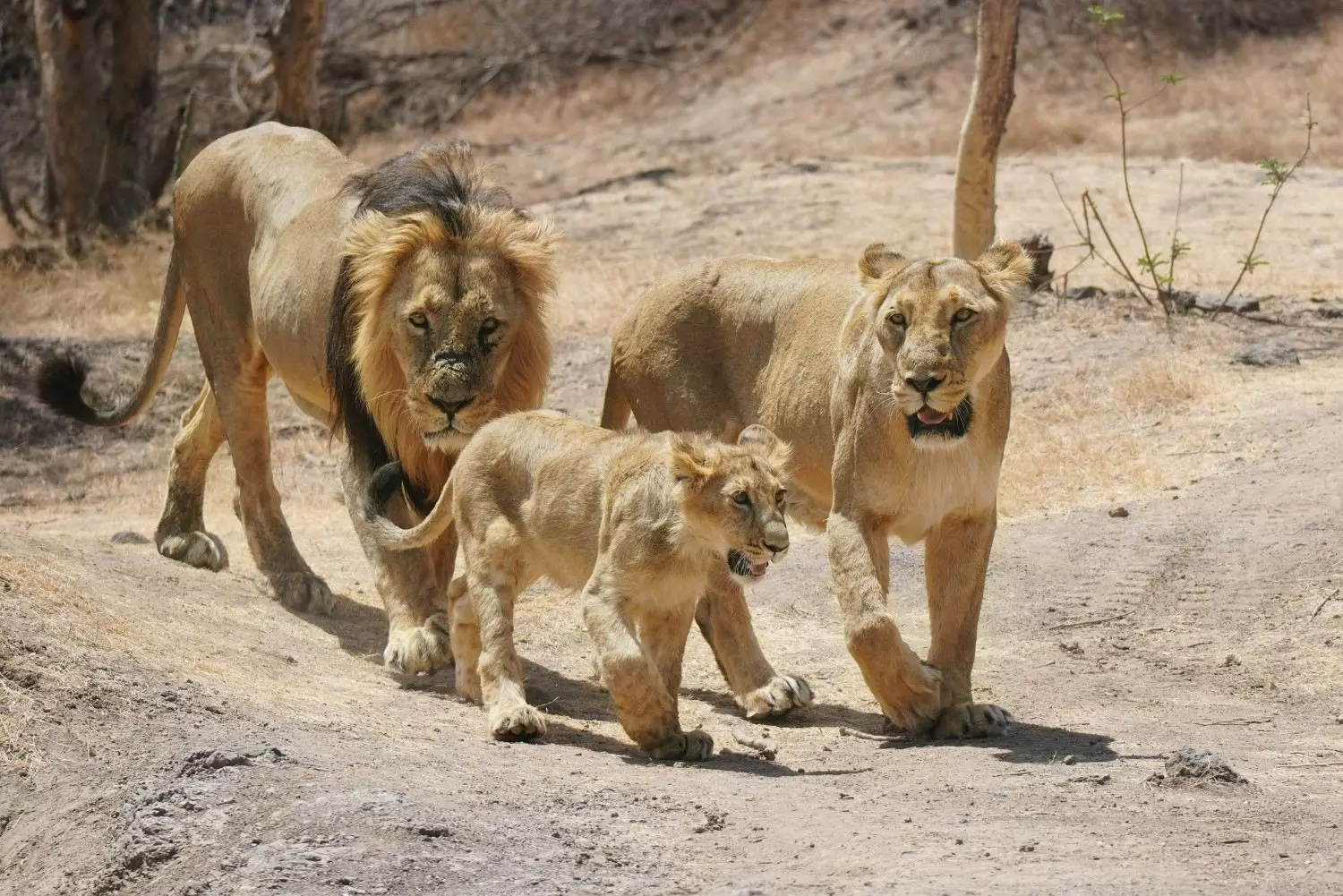
62 lions died in Gujarat in a year: What is threatening big cats in Gir?
The death figures come even as Gujarat’s Asiatic lion population has reached a record 891, up from 359 in 2005. The 2025 lion population estimate recorded 891 lions across Gujarat

Gujarat has reported the deaths of 62 Asiatic lions, lionesses and cubs from various diseases and medical conditions in the one-year period ending July 31, 2026. The deaths included 17 lions, 17 lionesses and 28 cubs, according to data tabled in the state Assembly.
Forest and Environment Minister Arjun Modhwadia said the deaths were linked to conditions including septicaemia, pneumonia, kidney failure, multi-organ failure and myocardial infarction. The government, however, has not identified one single disease as the cause of all 62 deaths.
Also read: Gujarat lion population up by 217 in 5 years; footprint expands too
The figures come even as Gujarat’s Asiatic lion population has reached a record 891, up from 359 in 2005. The 2025 lion population estimate recorded 891 lions across Gujarat.
Saving individual lions
The Forest Department has also highlighted the efforts being made to protect individual lions.
In the Gir forest’s Tulsi Shyam Range near Khambha, a lion critically injured in a fight fell into a 10-foot embankment. Too weak to walk and considered too delicate to tranquilise, the lion had to be rescued through a carefully coordinated operation.
Rescuers lowered a tracker in a cage, restrained the lion using poles and a noose, and 20 personnel hauled him out. The Forest and Environment Department said the lion recovered after 10 days of intensive care and was released back into the wild.
A bigger vulnerability
But while individual rescue efforts continue, wildlife expert Ajay Suri points to a much bigger vulnerability: all of India’s wild Asiatic lions are concentrated in one landscape.
“Of course, you know, it’s like putting all your eggs in one basket. So, if anything happens, both the basket and the eggs are at risk. In India, there has been and in Africa, there have been instances when, you know, the entire population of lions in a particular area got wiped out by a disease called canine distemper.”
The concern is not just the number of deaths, but the concentration of the entire wild population in and around the Gir landscape. A major disease outbreak in such a concentrated population could have consequences far beyond individual deaths.
Cause remains unclear
The government’s Assembly reply does not identify one specific disease behind all 62 deaths. The reported conditions include several illnesses and organ-related complications rather than a single outbreak.
Suri says this makes it difficult to assess the scale of the threat. “And the report which the state government has presented, it does not specify the particular disease or the reason because of which these lions have perished. So, first of all, we really don’t know what has been the cause of these deaths.”
The uncertainty is significant because the 62 deaths were recorded over one year, even as Gujarat’s lion population continues to grow. A disease outbreak in a concentrated population could therefore pose a serious conservation challenge.
There is also the question of disease surveillance — whether illnesses are being detected early enough to prevent them from spreading through the lion population.
No second population
India has taken a different approach with cheetahs. Since 2022, the country has brought cheetahs from Africa and introduced them into Kuno National Park in Madhya Pradesh, creating another population outside their original range.
For the Asiatic lion, however, there is still no comparable second wild population. The entire wild population remains concentrated in Gujarat, making the species particularly vulnerable if a major disease outbreak hits the region.
So, while Gujarat’s lions have reached a record population, the 62 disease-related deaths raise a larger conservation question: does India now need a second home for the Asiatic lion to protect the species from a major disease outbreak?