








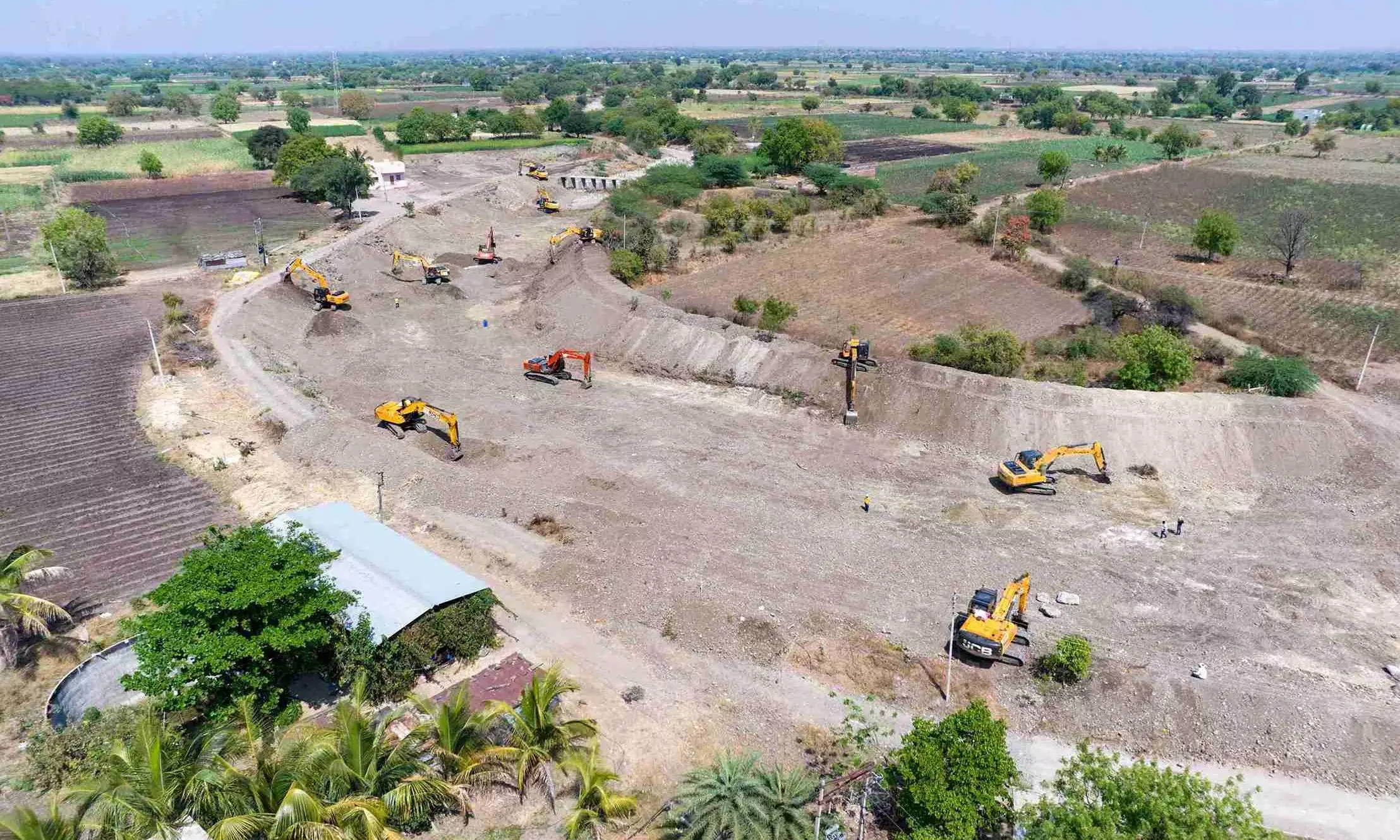
Out of the 108 km of the collective length of the rivers flowing through this region, silt has been removed from 92 km of area. | PTI
40 villages, 5 rivers, one goal: People unite to restore lifelines in parched Beed
Residents of 41 villages in drought-prone Marathwada are desilting five rivers to create capacity for 364.8 crore litres of water and improve groundwater recharge

In Maharashtra’s drought-hit Beed district, residents from over 40 villages have united to revive five rivers through a large-scale desiltation drive aimed at boosting water storage and easing chronic water shortages. The initiative led by the voluntary group Global Vikas Trust (GVT) has brought together residents from Parli, Ambajogai, Dharur and Majalgaon talukas of Beed, for the task.
With a total cost projected around Rs 16 crore, the target is to remove the accumulated silt and sediments from five rivers -- Papnashini, Gunwara, Saraswati, Wan and Lingi -- that flow through these villages and the surrounding areas, with their collective running distance of 108 kilometres in this region.
Also read: Beed leads in Marathwada farmer suicides, but state and central govts silent: Danve
Beed, in Maharashtra’s Marathwada region, is chronically a drought-prone district with village wells hitting rock bottom. The taluks depend on the government-supplied tankers struggle to meet daily demands.
Community participation
"The project started in January this year. Out of the 108 km of the collective length of the rivers flowing through this region, silt has been removed from 92 km of area. The cleared space will help accommodate 364.80 crore litres of water," Dattatray Kale, spokesperson of GVT, told PTI.
The total cost of the project is being provided by private companies as part of the corporate social responsibility (CSR) funding. But the villagers have crowdfunded Rs 54 lakh so that it develops a sense of belongingness and attachment to the project among them, he said.
The villagers held gram sabhas to inform everyone about the project, followed by the formation of coordination committees to address local issues. Demarcation of boundaries for the desiltation work was undertaken before the activity started, he said.
Flood protection measures
Since the riverbeds were earlier covered with silt and left limited space for water storage, during heavy rainfall, nearby farms used to get inundated, which would damage the crops. Now, the debris and stones collected from the sites are used for the construction of embankments.
Also read: World braces for 'Godzilla El Nino'. Should India be worried?
"This will protect the farms located along the rivers during heavy rains. Roads have also been built using this debris," he said.
However, the villagers do not need to contribute to the desilting work in terms of physical labour as the task is done by the machinery and equipment deployed for the task.
The process is not merely limited to making space to store more water in the river. After the silt removal, detailed surveys are conducted using LiDAR (Light Detection and Ranging) technology to identify underground aquifers.
Measures to recharge groundwater
Global River Aquashaft (GRA), a structure designed to recharge groundwater by channelling large volumes of water into underground aquifers, is also implemented here. Installation of 540 GRAs has been completed so far under the project. Each GRA has the potential to recharge approximately eight crore litres of water into the ground, the official said.
Where suitable aquifers are found, borewells are drilled up to a depth of around 200 feet. Perforated pipes fitted with protective mesh are installed within the borewells.
Around the pipe, a pit is excavated and filled with large stones and sand. This filtration arrangement enables clean river water to percolate naturally and flow through the pipes into the underground aquifer, significantly enhancing the groundwater recharge, the official said.
Boosting farmers’ income
Beed Collector Vivek Johnson said the administration has been extending cooperation for the implementation of the project.
Also read: Delhi govt strengthens embankments, desilts drains to prevent Yamuna floods
''This project will help improve the groundwater table and increase water availability there. The district administration will provide saplings to the teams working here to create vegetation along the river banks," he said.
Mayank Gandhi, founder of GVT, said they were working towards improving the income of farmers in the Marathwada region.
''Being a drought-prone area, the income of farmers here is low. The region reports a high number of farmer suicide cases. Availability of water will definitely help raise farmers' income here," he said.
(With agency inputs)