








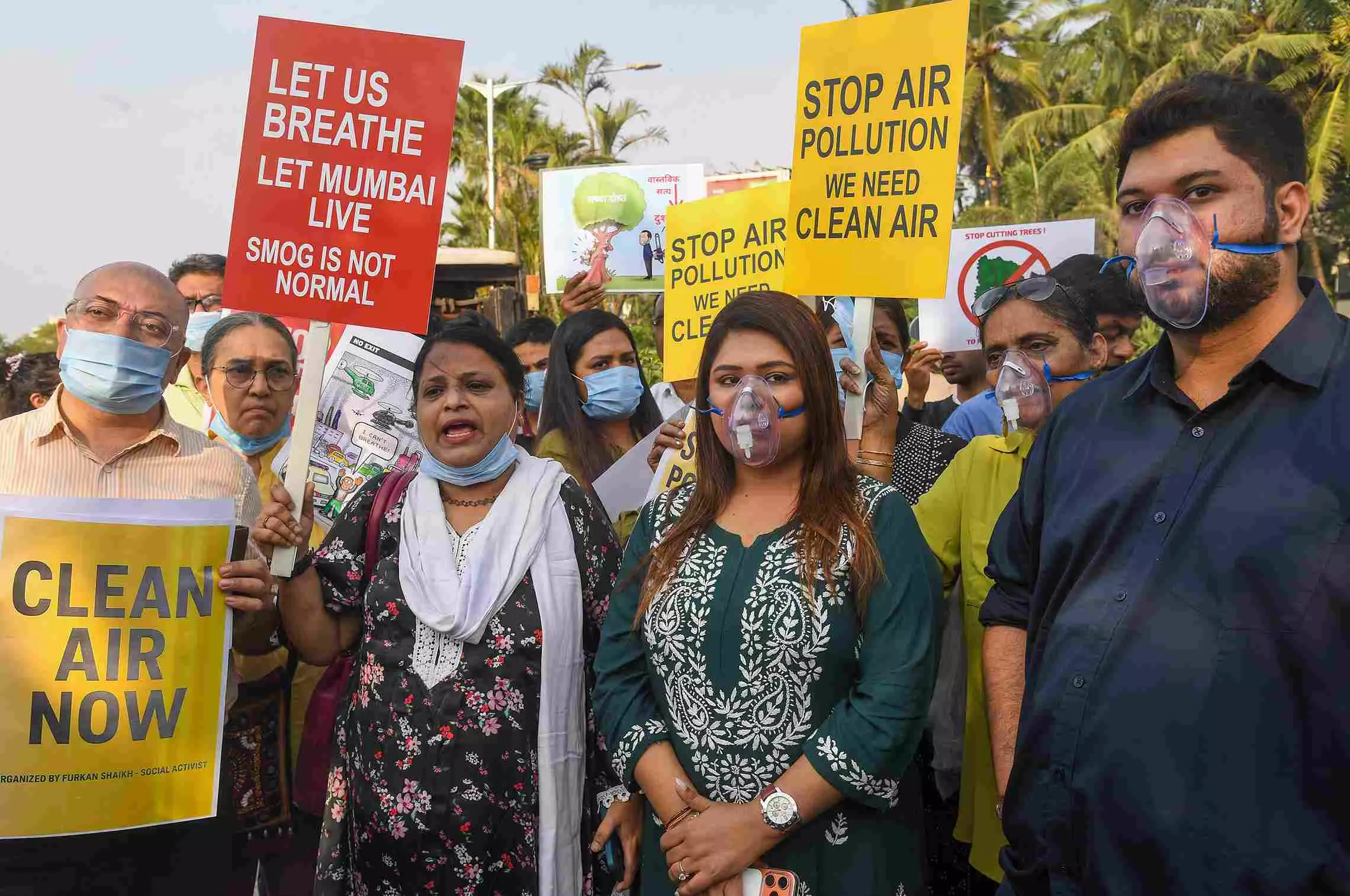
Citizens wearing oxygen and surgical masks hold placards during a protest demanding action against air pollution, in Mumbai, Sunday, Nov. 30, 2025. Photo: PTI
Mumbai joins Delhi in battle against toxic air; enforces GRAP 1V as AQI dips
BMC halts construction and dust-generating activities; city joins Delhi battling toxic air after High Court dismisses link to volcanic eruption in Ethiopia

As Mumbai’s air quality continues to deteriorate, the Brihanmumbai Municipal Corporation (BMC) has enforced GRAP-4 measures across the financial capital, focussing on areas that fall under the ‘very poor’ with AQI between 301 to 400, and ‘severe’ AQI (between 401-500) ranges.
The affected pockets, where the Graded Response Action Plan-4 (GRAP-4) has been implemented, include Mazgaon, Deonar, Malad, Borivali East, Chakala–Andheri East, Navy Nagar, Powai, and Mulund.
Mumbai joins Delhi
With this, Mumbai has joined Delhi on the list of cities battling toxic air, as authorities scramble to check spiralling pollution levels. Delhi has been gasping for air every winter for years — and now Mumbai has joined its ranks.
Urban transformation
According to reports, one of the reasons for Mumbai's poor air quality is that the city and its satellite towns are undergoing rapid urban transformation, with multiple Metro rail projects, roadworks, bridges, and high-rise construction works going on at the same time. Slums, chawls, and the remnants of mills and industrial units are steadily giving way to skyscrapers.
Also read: Mumbai Congress unveils 10-point plan to fight city air pollution
Over the past two weeks, several areas have consistently recorded AQI readings in the ‘very poor’ and ‘severe’ brackets. Residents complain of burning eyes, breathing difficulties, and sore throats, which are symptoms long familiar to Delhiites.
BMC takes measures
BMC has halted construction and dust-generating activities in several areas as part of its pollution-control drive.
Stop-work notices have been issued to around 50 construction and Ready-Mix Concrete (RMC) sites, while small industries such as bakeries, marble-cutting units, and other dust or smoke-emitting operations have been directed to adopt cleaner technologies or face action.
Also read: All major Indian cities recorded unsafe AQI, Bengaluru least affected: Study
To enforce these measures, the BMC has deployed flying squads in every ward. Comprising engineers, police personnel, and GPS-tracked vehicles, the squads are monitoring emissions and scanning for polluting activities. Of the 70 sites inspected so far, 53 were found violating dust-control norms and have been served notices.
Additional pollution-control measures are:
- Mandating cleaner fuels for bakeries and crematoriums
- Expanding the fleet of electric buses in public transport
- Ensuring scientific management of construction debris
- Deploying mechanised water-sprinkling machines to suppress roadside dust
At present, Mumbai has 662 AQI monitoring devices at construction sites, with another 251 being installed; about 400 of these are linked to a unified dashboard.
Differs from Delhi
Unlike Delhi, there is no complete ban on entry of non-essential trucks into Mumbai.
Non-Delhi Light Commercial Vehicles (LCVs), except EVs, CNG and BS-VI diesel, are barred in the capital, which is not the case in Mumbai.
Moreover, in Delhi, schools for classes up to 9 and 11 generally shift to online mode. Mumbai has not taken such measures as yet.
Also read: Delhi air remains 'very poor'; Ethiopian volcano ash may worsen pollution levels
Last year, the BMC implemented several sections of GRAP-IV restrictions in Borivli and Byculla and halted construction activities in a couple of areas due to poor air quality levels.
Volcanic eruption in Ethiopia
Last week, the Bombay High Court rejected the Maharashtra government’s claim that Mumbai’s worsening air quality was linked to the recent volcanic eruption in Ethiopia.
“Even before this eruption, if one stepped out, visibility was poor beyond 500 metres,” the judges observed.
The court has since appointed an independent five-member committee to inspect construction sites and verify whether pollution-control measures are being properly implemented, according to reports.