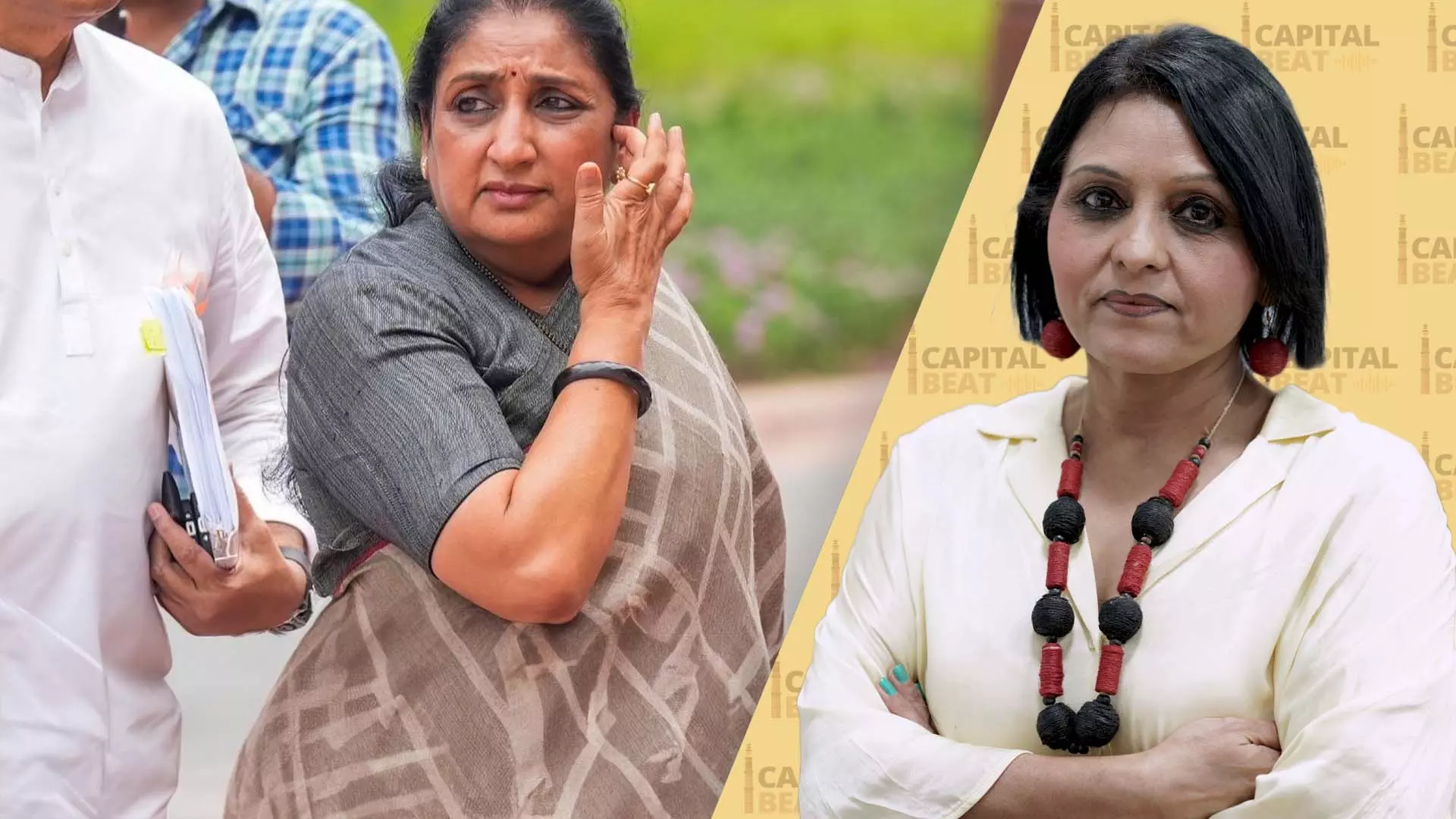
Sunetra Pawar as Maharashtra Dy CM: Why the sudden elevation | Capital Beat
Whether Sunetra can carve out independent authority — or remains a symbolic figure in a larger political script — will shape not just her future, but the trajectory of the state’s politics in the months ahead

The unprecedented speed with which Sunetra Pawar was elected leader of the NCP legislature party and sworn in as Maharashtra’s deputy chief minister barely three days after the death of Ajit Pawar has sparked sharp questions about political compulsions, internal power struggles, and the BJP’s larger game plan in the state.
The Federal spoke to senior journalists Sanjay Jog, Smriti Kopikar, Vivek Deshpande and Rohit Chandavarkar on Capital Beat to decode the forces behind the move and its implications for the future of the Nationalist Congress Party (NCP) and Maharashtra’s fragile political balance.
The panel flagged the timing of Sunetra’s oath as politically loaded, with several leaders openly questioning why the party could not wait for the customary mourning period to conclude. At the heart of the debate lay deeper anxieties about a possible reunion of the NCP factions, pressure from within Ajit’s camp, and the BJP’s determination to keep its allies and rivals firmly under control.
A rushed decision
The panel began by underscoring the sheer pace of events following Ajit’s death. Jog, who has closely tracked developments on the ground, described the sequence as “puzzling,” pointing out that meetings with senior leaders like Praful Patel, Sunil Tatkare, Chhagan Bhujbal and Dhananjay Munde began almost immediately after the funeral.
Also read: Who is Sunetra Pawar, NCP’s new Deputy CM in Maharashtra?
According to Jog, there was intense pressure from within the Ajit faction that unless someone from the Pawar family assumed formal leadership quickly, the party risked splintering. Legislators, he said, were uneasy about the prospect of a non-Pawar leader taking charge at a moment of uncertainty.
Jog also noted that Sharad Pawar publicly distanced himself from the decision, repeatedly stating that he was neither consulted nor informed. The veteran leader’s insistence that “politics and family matters are separate” was, in Jog’s reading, a pointed signal towards Patel and Tatkare as the key drivers of the move.
Fear of reunion
A central theme running through the discussion was the fear — within sections of Ajit’s NCP — that a reunion with Sharad was imminent. Jog argued that leaders who had broken away once were reluctant to return to Sharad’s leadership, particularly after establishing a working relationship with the BJP.
Also read: Baramati talks, Mumbai moves: NCP factions diverge over Sunetra Pawar’s elevation
The haste, he said, was about foreclosing options. By installing Sunetra swiftly, the faction could block any move towards a merger and consolidate control over the party symbol and organisation.
The panel agreed that the speed of the decision suggested strategic anxiety rather than administrative necessity, especially given that no immediate legislative deadline demanded such urgency.
BJP’s invisible hand
Chandavarkar framed the episode as part of a broader pattern in Maharashtra politics, where splits within Opposition parties have often coincided with BJP interests. He argued that the BJP had little incentive to allow the two NCP factions to reunite, especially after seeing how opposition unity had altered political equations in recent local body elections.
Chandavarkar pointed to upcoming zilla parishad polls as a crucial factor. With a sympathy wave expected following Ajit’s death, control over the NCP symbol and organisation could translate into electoral leverage. For leaders like Patel and Tatkare, securing that leverage before the polls was critical.
He also underlined that regional media reports and leaked visuals of meetings between Ajit and Sharad had already unsettled the BJP, heightening the urgency to lock the faction firmly into place.
Family fault lines
Beyond party politics, the panel delved into the visible rift within the Pawar family. Chandavarkar described the unfolding drama as a “soap opera”, with an underlying tussle between Supriya Sule and Sunetra over future leadership.
If the NCP were to reunite under Sharad, Chandavarkar argued, Sule would inevitably emerge as the central figure — something the Ajit faction’s leadership was keen to prevent. Elevating Sunetra pre-emptively altered that equation.
Lessons from past splits
Kopikar placed the developments in a longer historical context, drawing parallels with the Shiv Sena split of 2022. She argued that since then, the BJP has consistently worked to ensure that opposition parties remain divided, using splits as instruments of political management.
Kopikar noted that recent municipal election results had shown limits to the BJP’s electoral dominance, reinforcing its need to weaken potential united fronts. A reunited NCP, she said, would pose both numerical and strategic challenges for the ruling party.
She also highlighted the cultural and emotional dissonance of the moment, pointing out that even families not bound by strict ritualism usually observe a brief mourning period. The absence of even that pause suggested, in her view, “a forceful political impulse” overriding personal considerations.
Who persuaded Sunetra?
Addressing the question of who ultimately convinced Sunetra to accept the post, Jog pointed squarely to her son Parth Pawar. Drawing from past precedent, Jog recalled that Parth had earlier insisted on his mother’s nomination to the Rajya Sabha.
This time too, Jog said, Parth played a decisive role, pressing the case that in Ajit’s absence, Sunetra was the “natural choice.” Conversations involving Patel and Tatkare, he added, culminated in Parth’s intervention tipping the balance.
Jog suggested that this move could also pave the way for Parth’s own political ascent, possibly to the Upper House, reshaping the family’s political future.
Questions of competence
As the discussion moved forward, panellists raised questions about Sunetra’s administrative experience and political autonomy. Deshpande argued that her elevation was less about governance capability and more about political arithmetic.
Comparisons with Ajit’s formidable administrative track record were inevitable, but Deshpande stressed that performance was not the BJP’s primary concern. The goal, he said, was to prevent the consolidation of secular votes and keep opposition forces fragmented.
Control over portfolios
Chandavarkar revealed that the BJP had already made it clear that Maharashtra Chief Minister Devendra Fadnavis would retain the finance portfolio, signalling limits to Sunetra’s authority. Ajit’s extensive control over key portfolios, guardian minister roles, and cooperative institutions had left a vacuum that the BJP was keen to manage tightly.
He argued that while Sunetra would hold the title of deputy chief minister, real decision-making would remain with senior leaders aligned closely with the BJP.
Shinde factor
The panel also examined the implications for Deputy Chief Minister Eknath Shinde. Deshpande noted that Ajit’s induction into government had earlier served to balance Shinde’s influence. With Ajit gone and Sunetra elevated under constrained terms, Shinde’s room for manoeuvre would narrow.
However, the panel largely agreed that Shinde was unlikely to break away in the near future, given his dependence on power and the BJP’s continuing leverage.
An uncertain road ahead
As the discussion concluded, panellists agreed that Sunetra’s elevation marked a turning point but not a resolution. The NCP remains divided, alliances fragile, and Maharashtra politics deeply volatile.
Whether Sunetra can carve out independent authority — or remains a symbolic figure in a larger political script — will shape not just her future, but the trajectory of the state’s politics in the months ahead.
(The content above has been transcribed from video using a fine-tuned AI model. To ensure accuracy, quality, and editorial integrity, we employ a Human-In-The-Loop (HITL) process. While AI assists in creating the initial draft, our experienced editorial team carefully reviews, edits, and refines the content before publication. At The Federal, we combine the efficiency of AI with the expertise of human editors to deliver reliable and insightful journalism.)