








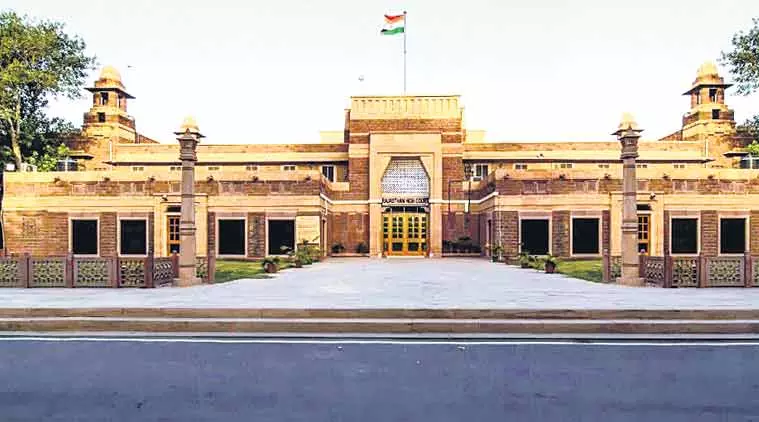
Rajasthan HC grants divorce to woman, slams ‘Aata-Saata’ marriage custom
The Rajasthan High Court said matrimonial cruelty need not meet criminal proof standards and criticised the Aata-Saata system as coercive and inhuman

The Rajasthan High Court has set aside a family court order and granted divorce to a woman from Bikaner, holding that cruelty in matrimonial disputes need not be proved “beyond reasonable doubt” as required in criminal trials.
A division bench comprising Justice Arun Monga and Justice Sunil Beniwal observed that matrimonial disputes are to be decided on the principle of “preponderance of probabilities” and not on the stricter criminal law standard.
HC condemns marriage custom
In a strongly-worded judgment, the court’s Jodhpur Bench also condemned the traditional “Aata-Sata” marriage arrangement, terming it “legally and morally bankrupt” and describing it as an “inhuman barter system involving human lives”. The “Aata-Sata”, or “give and take” marriage, is an age-old custom practised in Rajasthan where two families exchange their daughters, including minors, for marriage.
Also read | How Rajasthan's Sikar became ground zero of the NEET 2026 scandal
The woman was married under an “Aata-Sata” arrangement in which her husband’s minor sister was married to her brother. However, after attaining majority, the girl refused to accept the child marriage, triggering disputes between the two families.
The woman alleged that she was subsequently subjected to physical and mental cruelty over dowry demands and was eventually thrown out of her matrimonial home along with her minor daughter. She later lodged FIRs against her husband and father-in-law on allegations including dowry harassment, following which the police filed a chargesheet.
Amid the dispute, the woman approached the family court in Bikaner seeking divorce. However, the court dismissed her plea in September 2025, after which she challenged the order before the high court.
HC upholds woman’s rights
The counsel for the appellant woman argued that she suffered continuous mental and physical cruelty linked to dowry demands.
Disagreeing with the family court’s findings, the high court held that the lower court committed a “serious error” by conflating the external family dispute arising from the “Aata-Sata” arrangement with the issue of matrimonial cruelty between the spouses.
Referring to the Prohibition of Child Marriage Act, 2006, the court made severe observations against the “Aata-Sata” practice, observing that when marriages are arranged as reciprocal exchanges between families, especially involving minors, the practice turns into a coercive social mechanism where children, particularly girls, are reduced to a “marital barter”.
The court further said such arrangements resemble “matrimonial hostage taking”, where the life and liberty of one daughter becomes dependent upon the obedience of another.
“No custom is above the law,” the court observed, adding that consent obtained after years of social conditioning during childhood cannot be treated as “free consent” once the individual attains majority.
Inside Rajasthan’s Aata-Saata custom
The Aata Saata marriage custom in Rajasthan originated as a traditional practice involving the exchange of goods, primarily food items such as wheat (aata) and salt (satta), between the families of the bride and groom. The custom symbolised the union of two individuals and reflected the social, economic and cultural dynamics of Rajasthani society.
While it originated centuries ago as a benign system of ritualistic economic reciprocity, modern socioeconomic pressures have turned it into a rigid system of reciprocal bride exchange that has major legal, ethical, and human rights implications. For instance, when a marriage is arranged between a boy and a girl, the bride’s family may insist that the groom’s sister marry the bride’s brother. This practice, also referred to as Aata Saata, is now primarily associated with the exchange of girls in marriage.
Also read | Diktats by khap panchayats unconstitutional, undermine rule of law: Rajasthan HC
Rajasthan has historically suffered from skewed child sex ratios due to deep-rooted patriarchy. In some rural communities, the shortage of women has made finding brides difficult, especially for men who are uneducated, unemployed or landless. The Aata-Saata system often ensures that even a “less eligible” son can find a wife, provided the family can offer a daughter in exchange through a reciprocal marriage arrangement.
(With agency inputs)