- Home
- India
- World
- Premium
- THE FEDERAL SPECIAL
- States
- Perspective
- Videos
- Sports
- Education
- Entertainment
- Elections
- Features
- Health
- Business
- Series
- In memoriam: Sheikh Mujibur Rahman
- Bishnoi's Men
- NEET TANGLE
- Economy Series
- Earth Day
- Kashmir’s Frozen Turbulence
- India@75
- The legend of Ramjanmabhoomi
- Liberalisation@30
- How to tame a dragon
- Celebrating biodiversity
- Farm Matters
- 50 days of solitude
- Bringing Migrants Home
- Budget 2020
- Jharkhand Votes
- The Federal Investigates
- The Federal Impact
- Vanishing Sand
- Gandhi @ 150
- Andhra Today
- Field report
- Operation Gulmarg
- Pandemic @1 Mn in India
- The Federal Year-End
- The Zero Year
- Science
- Brand studio
- Newsletter

Before AI takes a job, it learns by watching. How that buys time for Indians earning from their handiwork
From garment floors in Gurugram to call centres, AI is creeping into Indian jobs. But most Indian workers earn their living with their hands, on farms and building sites and AI barely reaches that work. For now, that is India’s shield. Outside the shield stands the country’s most prized workforce, those employed in the technology industry.

In March 2026, workers at a textile unit in Ichalkaranji, Maharashtra, reportedly came in for their shift and were handed cameras to wear on their heads.Weeks later, it happened again, at an apparel company in Gurugram. For about two weeks, between 10am and 4pm, men and women reportedly sat at their sewing machines, a white band across their foreheads holding a camera that recorded every cut...
In March 2026, workers at a textile unit in Ichalkaranji, Maharashtra, reportedly came in for their shift and were handed cameras to wear on their heads.
Weeks later, it happened again, at an apparel company in Gurugram. For about two weeks, between 10am and 4pm, men and women reportedly sat at their sewing machines, a white band across their foreheads holding a camera that recorded every cut and stitch. Even the factory’s own staff purportedly did not know what the footage was for.
As news reports have since revealed, the recordings were being sent to a startup whose business is collecting what it calls ‘first-person footage’ — video that sees the work exactly as the worker sees it, the hands, the cloth, the needle. The videos are packaged and sold to companies building robots.
A young tailor, who learned of this later from a journalist, said, “I would prefer not to wear it”, and then asked the obvious question. If they want a robot to do this work, why not just buy one that already stitches?
According to reports, the almost 10,500 robots India installed across its factories in 2025 weld a car door or lift a crate — the same movement in the same place, thousands of times a day. Cloth is different. Handling it takes human skill. It slips and bunches and no two pieces behave alike. To learn that skill, an AI-powered machine has to watch people do it for hundreds of hours. Collecting that footage reportedly costs about Rs 3,000 an hour in the United States and under Rs 500 in India.
So are AI and robots taking over all factory work?
We have been in this situation before, in an office rather than a factory.
Ten years ago, Indian back-office work was told it was finished. The threat had a name; robotic process automation (RPA). There was no robot. It was software that watched how a clerk used a computer and then repeated the clicks: open this file, copy that number, paste it there, approve, next. It was a clerk who never slept, never complained and never needed an increment.

Most Indians will not feel the risks of AI exposure soon and the reason is the kind of work they do. Photo: Representative, iStock
In July 2016, the research firm HfS forecast that the global technology services and outsourcing industry would lose about 1.4 million jobs by 2021. Indian newspapers ran the Indian share for months; six lakh jobs or seven lakh jobs, depending on who was counting.
It did not happen. By March 2021, NASSCOM reported India’s technology and business-process industry had added 138,000 people in a single year, taking it to 4.5 million.
But something did happen. Infosys reportedly told its shareholders in 2017 that automation had freed up about 11,000 people’s worth of work over the year. Wipro said its software had delivered the output of more than 12,000 people. Neither company sacked thousands. The work was absorbed, and the people were moved elsewhere.
The saving was real. It was simply buried under growth. A booming industry had more work than people, so the lost work never showed up as layoffs. If it showed up anywhere, it was in slower hiring, and then the pandemic set off a rush of digital work that hid even that.
Remember this, because it matters for what comes next. Automation’s effect on jobs is hardest to see when times are good.
So will AI be any different at taking away jobs?
With robotic process automation, every time it was used, the screens had to look exactly the same and the steps had to come in the same order. If a supplier changed its date format, or an email ID moved one column to the left, the software stopped and a person had to fix it. Office work is full of that kind of mess. Documents and websites change constantly and so the software needed constant fixing. Clerical work survived the RPA invasion because the software couldn’t handle the mess of office work. AI can.
AI also fails differently. When RPA broke, it stopped and someone noticed. When AI gets something wrong, it carries on confidently. Left unchecked, it can produce the wrong result and declare it right.
Generative AI, the kind behind ChatGPT, does not work from rules. It has learnt from enormous amounts of human writing, so it can read a badly typed complaint or a call recorded in two languages and write a sensible reply. The same method is now moving from words to hands. Show a machine enough examples of people doing a job and it starts to do the job itself.
That is what the cameras in Ichalkaranji and Gurugram were for. Before AI takes over a job, it learns it by watching people do it.
Go back to the lesson of the RPA years, because times are slower now. Between April 2024 and March 2025, NASSCOM estimated, India’s technology industry grew its revenue by about five per cent and its workforce by about two per cent, adding 126,000 people. When growth slows, the savings from automation are no longer buried. It shows up as hiring that doesn’t happen.
At India’s ‘largest IT employer’, Tata Consultancy Services (TCS), it has shown up in the middle. In July 2025, TCS reportedly announced about 12,000 job cuts, mostly in middle and senior grades. By March 2026, its headcount was down 23,460, even though it took on 44,000 freshers during the year. Its chief executive was quoted as saying that the cuts are about skills that no longer match the work, not about AI.
Back offices and call centres, where RPA was once meant to strike, show it most clearly. India’s business-process industry added about 130,000 people in 2022-23. In each of the next two years it added fewer than 17,000, according to the staffing firm TeamLease Digital. In the same period, a Bengaluru AI startup reportedly helped one insurer make 40 million automated calls.
The United States shows what may come next. In August 2026, Stanford researchers studied the payroll records of millions of American workers and sorted jobs by how much of the daily work AI can already do. Since late 2022, the number of 22-to-25-year-olds employed in the most exposed jobs has fallen by about 11 per cent. In less exposed jobs, it has grown by about 10 per cent. Older workers in the exposed jobs were largely unaffected. Among the most exposed jobs are software developers and customer service agents, the two kinds of work at the heart of India’s technology industry.
In India, the first signs are in the middle layer and in back-office hiring. The loss of first jobs, so far, has been measured only in America.
Most Indians will not feel any of this soon, and the reason is the kind of work they do.
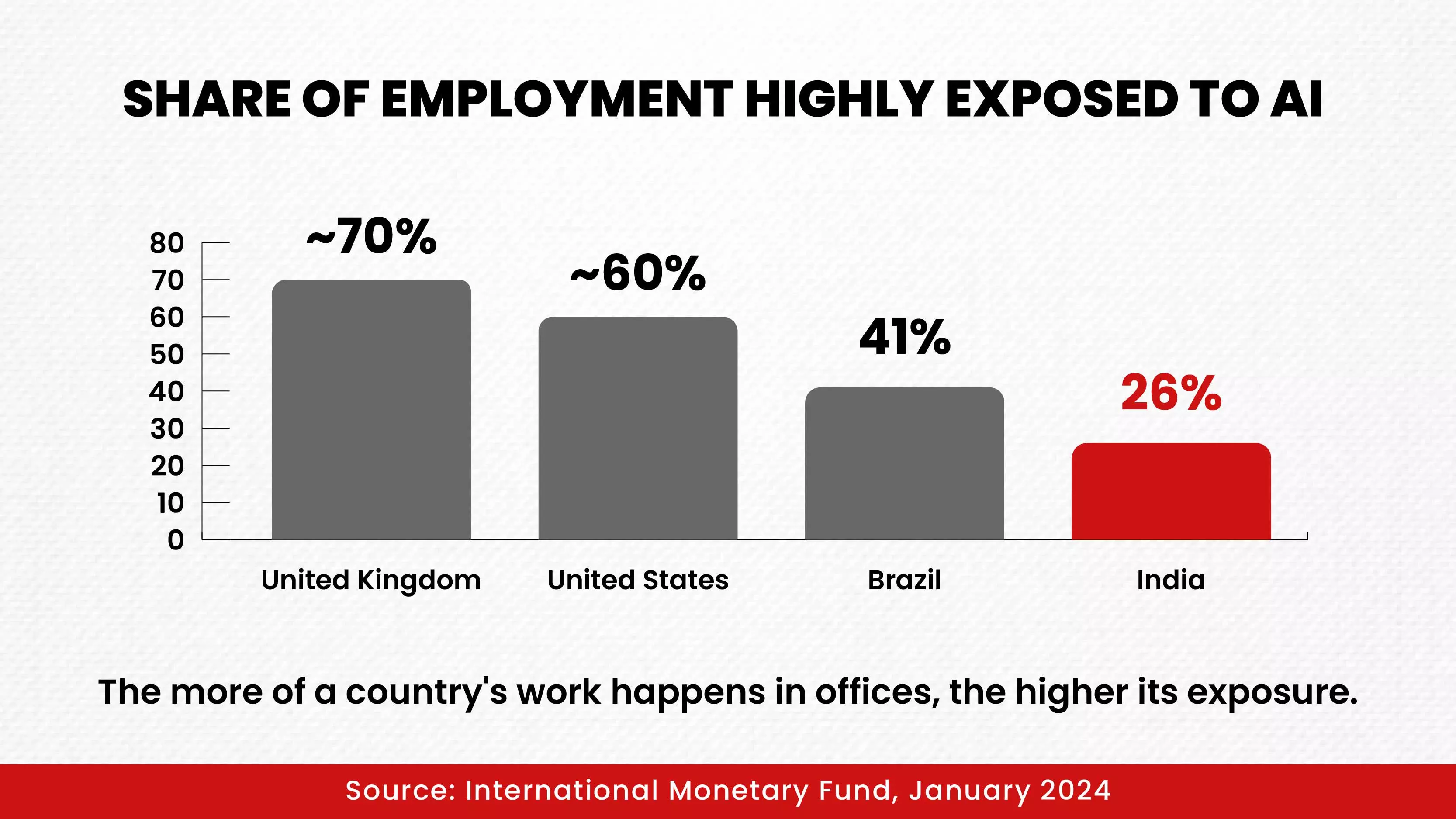
The International Monetary Fund (IMF) estimates that only 26 per cent of Indian employment is highly exposed to AI, against about 60 per cent in the United States and 70 per cent in Britain. Most Indian workers earn their living with their hands, on farms and building sites, and AI barely reaches that work. For now, that is India’s shield.
Outside the shield stands the country’s most prized workforce. About 5.8 million people reportedly work in India’s technology industry, with around 1.65 million of them in back offices and call centres. Their work is done in English, over documents and conversations, for clients in other countries. That is a precise description of what AI does well.
Unlike earlier waves of automation, the AI wave reaches the educated and the literate first. The slice it reaches earns much of India’s foreign exchange and drives spending in its cities.
And the shield has a crack in it. The cameras in Ichalkaranji show that AI has started learning the work of hands too.
On 8 October, TCS is expected to report its results for July to September. The headlines will be about revenue and deals. The more telling numbers sit further down: how many freshers joined and how many experienced people left.
That is how this technology creeps in. It rarely arrives as a layoff announcement. It arrives as a smaller intake, or a team that is not replaced when people move on.
The young tailor in Gurugram asked why nobody simply buys a robot that already stitches. The answer is that someone is trying to build one and he was helping to teach it.