- Home
- India
- World
- Premium
- THE FEDERAL SPECIAL
- States
- Perspective
- Videos
- Sports
- Education
- Entertainment
- Elections
- Features
- Health
- Business
- Series
- In memoriam: Sheikh Mujibur Rahman
- Bishnoi's Men
- NEET TANGLE
- Economy Series
- Earth Day
- Kashmir’s Frozen Turbulence
- India@75
- The legend of Ramjanmabhoomi
- Liberalisation@30
- How to tame a dragon
- Celebrating biodiversity
- Farm Matters
- 50 days of solitude
- Bringing Migrants Home
- Budget 2020
- Jharkhand Votes
- The Federal Investigates
- The Federal Impact
- Vanishing Sand
- Gandhi @ 150
- Andhra Today
- Field report
- Operation Gulmarg
- Pandemic @1 Mn in India
- The Federal Year-End
- The Zero Year
- Science
- Brand studio
- Newsletter

How a film in a ‘nearly extinct’ tongue turns the focus on Kerala’s ‘vulnerable’ Cholanaikkan tribe
Unnikrishnan Avala's Thanthapperu, made in Cholanaikka, the language of a community designated as a ‘Particularly Vulnerable Tribal Group', includes members from the tribe as actors. With a population estimated to be below 200, Cholanaikkans are considered Asia’s last surviving cave dwellers.

In 2010, when Unnikrishnan Avala travelled to the secluded villages of the Cholanaikkans, an indigenous group consisting of barely 200 individuals living in the Nilambur area of Kerala’s Malappuram district, he met, among the community members, many children. He couldn’t possibly have known then, however, that a few of them would go on to star in a feature film that he would be feted for...
In 2010, when Unnikrishnan Avala travelled to the secluded villages of the Cholanaikkans, an indigenous group consisting of barely 200 individuals living in the Nilambur area of Kerala’s Malappuram district, he met, among the community members, many children. He couldn’t possibly have known then, however, that a few of them would go on to star in a feature film that he would be feted for more than a decade later.
Titled Thanthapperu, or Life of a Phallus, the film made in Cholanaikka, the language of the Cholanaikkans, received the ‘Jury Prize’ under the International Competition category, recognising it as a distinctive and singular cinematic experience, at the recently held 30th International Film Festival of Kerala (IFFK). It also won the audience poll award and the Network for the Promotion of Asian Cinema (NETPAC) Award for best Malayalam film.
“The children I met back then [in 2010] lead this film as young adults, sharing their lived experiences on screen,” said Unnikrishnan, the director of Thanthapperu.
The 117-minute film, initially conceived as a video documentation of the community and which made the transition to feature production without any producer backing — Unnikrishnan secured a producer for Thanthapperu only after the film's completion — revolves around the character of Nari Monchan, a member of the Cholanaikkan tribe for whom every facet of life is bound by traditions.
Also read: What Telangana’s Mudumal Menhirs say about India’s past astronomical prowess
Officially recognised as a ‘primitive tribal group’ by the Indian government in 1976, the Cholanaikkans are considered Asia’s last surviving cave dwellers, found only in the Nilambur valley of the Nilgiris Biosphere Reserve in the Western Ghats.
“They live deep in dense forest, mostly in rock caves called Kallulai (kallu means rock, aalai cave), near the banks of streams. They speak the Cholanaikka language, which is categorised into the Dravidian family by linguistic experts, though it is not directly related to any modern Dravidian language. They used to add their cave names as affixes to their names, as surnames used by common people in India,” write researchers Aleem Yoosuf and Unaisudheen TP in a 2024 paper titled “Ethnic knowledge and practices of Cholanaikkan of Southern Western Ghats of India”.
Interestingly, the presence of the Cholanaikkans was undocumented till the 1971 Census. According to the 1991 Census, the tribe had a population of 360 at the time, but researchers estimate the number has now dropped to below 200. Some estimates peg the number at 56 families, comprising a total of 179 people.
Since the government of India designated the community as a ‘Particularly Vulnerable Tribal Group (PVTG)’ in 2006, owing to their declining population and deteriorating way of life, there has been greater research on Cholanaikkans, resulting in increased awareness about their way of life.
The Cholanaikkans are now known to be hunter-gatherers who lack knowledge of agriculture. For a Cholanaikkan, the day begins with sunrise and ends with sunset. Household chores are typically performed by women and in their absence, men assume responsibility for these tasks. Their diet is a blend of vegetarian food, along with fish, birds, rabbits, pigs and wild buffalo — animals which are easily found in their surroundings. According to researchers, the tribe is led by a community leader, referred to as Mooppan, who oversees community activities alongside a council of elders.
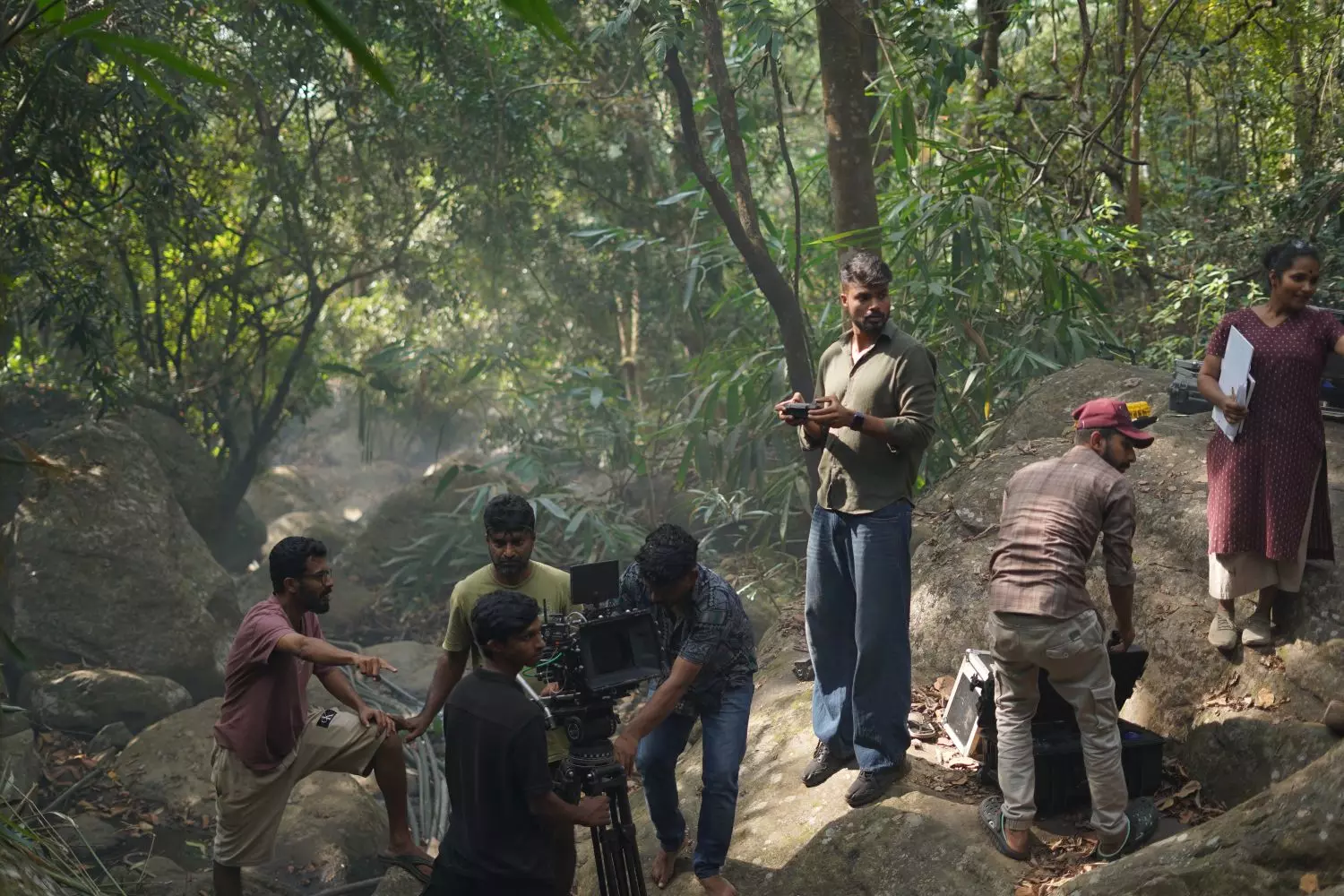
Unnikrishnan wanted to preserve the “nearly extinct” language of the community, along with its ancient customs and practices, but execution became a challenge. Help came in the form of Vinod Chellan, a member of the Cholanaikkan community, who collaborated on the script. Photo: By special arrangement
They are a community of animists who worship ‘ancestral spirits’. According to scholars Mayank Nalinkant Vahia (of the Tata Institute of Fundamental Research) and Jayant Gangopadhyay (of the Regional Science Centre), “They don’t have any idols or images but go behind a big tree and whisper something. Cholanaikkans abide by a set of rules framed by their ancestors. For worship, they take an undressed stone with a curved top (shaped like the head of a snake), keep it under a large tree and worship it. But have no great expectations from their god. The tree is called the ‘Dheivamaram’, which means [the] tree of god.”
In “Astronomy of Cholanaikkan tribe of Kerala”, a 2017 publication, the duo write, “They worship [the] god of the jungle (Malallidiavam), metal image of a tiger (Uliuruvu), and images of ox (Kalaiuruvu) and snake god. They refer to [the] Sun as nyaram or dinga and [the] moon as thinkam. They celebrate their own forest festivals with percussion instruments of their own. One of their traditional feasts, which can be compared with the harvest festival of farming communities, is Dheivaoottu (feeding the deity).”
To safeguard and preserve their way of life, the state government has imposed restrictions on the entry of outsiders into Cholanaikkan villages. Anyone wishing to visit the area must obtain permission from the forest department, which will assign a guard to accompany the visitor to the secluded villages.
Also read: Why restoring Kannada classic Samskara would help preserve a landmark in Indian cinema
A few younger members from the community are, however, now stepping beyond the boundaries of their village to pursue education and a modern life. These young members even use mobile phones, a ubiquitous appendage of modern existence, which, however, has no place in the traditional life of the Cholanaikkans.
It was one such Cholanaikkan, Vinod Chellan, a young member of the community who contributed to the screenplay of Thanthapperu and helped with the overall coordination for the film, proving to be of material assistance in giving shape to Unnikrishnan’s dream of making a film on the community.
For the filmmaker, it was his tenure as a teacher in Nilambur in 2009 that got him to start observing the life of the indigenous populations from various tribes. He felt a strong urge to document their lives and the challenges they faced daily. This resulted in the making of two documentaries, Last Page and Womenses. While Last Page focused on three tribal groups: the Cholanaikkan, Aalar, and Aranadar, Womenses addressed the topic of menstruation among tribal women.
Following these documentaries, Unnikrishnan’s meeting with a transwoman from the Paniya tribal community motivated his first feature film, “Udalaazham”. The film had its world premiere at the 20th MAMI Mumbai Film Festival in 2018 and its Indian premiere at the IFFK in the same year. Inspired by Udalaazham’s success, Unnikrishnan finally embarked on realising his long-cherished dream of making a film on the Cholanaikkans.
While for Unnikrishnan, at the heart of the project was his desire to preserve the “nearly extinct” language of the community, along with its ancient customs and practices, the execution became a challenge.
The filmmaker recalls that those he had initially approached to produce the film advised him against making the feature in Cholanaikka, suggesting that he make it in Malayalam or Hindi, instead. “But I was determined not to change my decision. So, I resolved to proceed without a producer. Ultimately, the project evolved into a collaborative effort,” said Unnikrishnan.
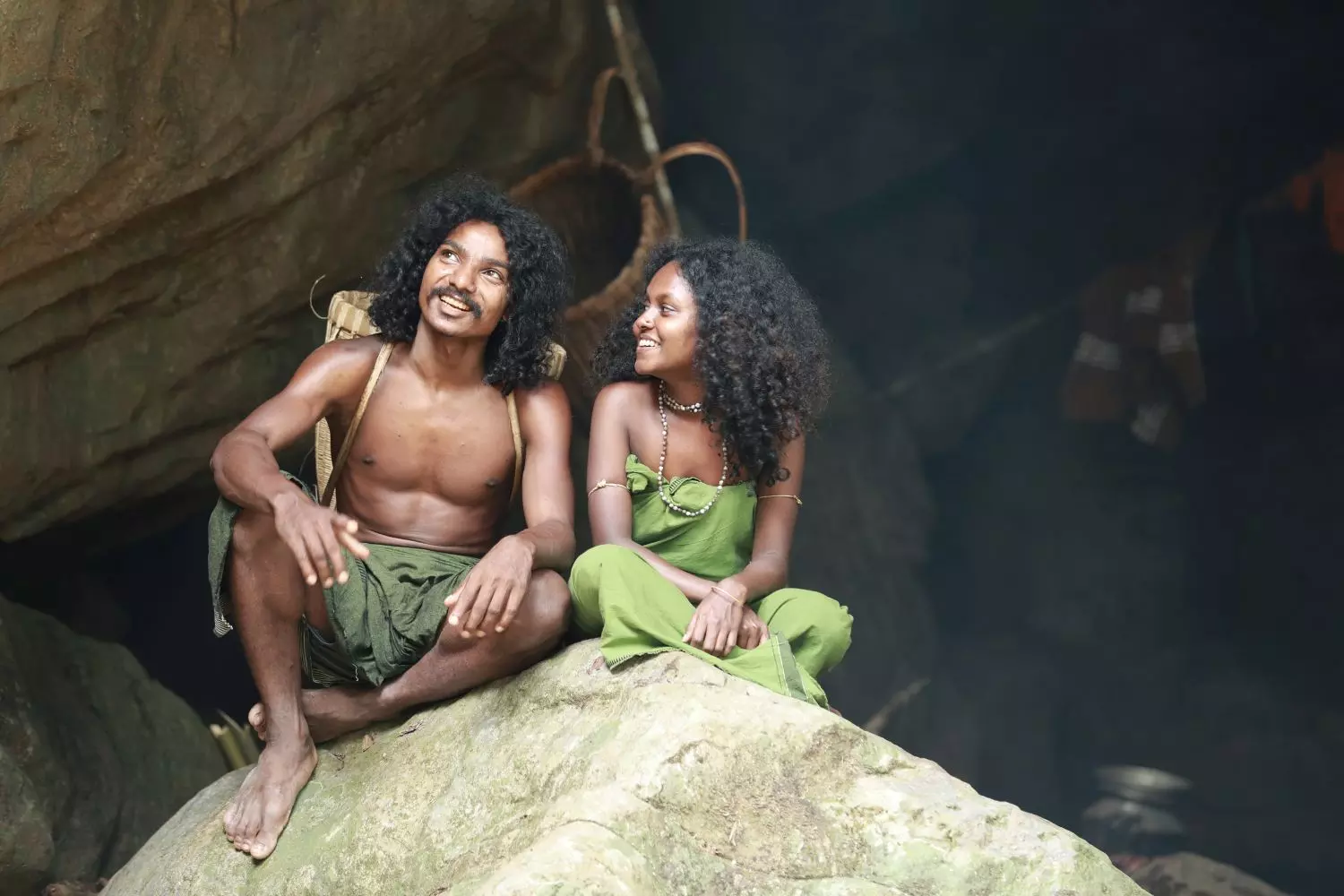
At least eight Cholanaikkans have acted in Thanthapperu. For Vinod, convincing his people to act in the film was no mean feat. They had never seen a camera before. Photo: By special arrangement.
It was around this time that a friendship with Vinod, a member of the Cholanaikkan community who was pursuing his PhD at Cochin University of Science and Technology (CUSAT), proved providential.
“When I discussed the idea of making a film on the Cholanaikkans with Vinod Chellan, he readily agreed to assist. Being a member of the Cholanaikkan community, he possessed extensive knowledge about the tribe. We began developing the script in two distinct approaches: one from an internal perspective and the other from an external viewpoint,” added Unnikrishnan.
Cholanaikka, according to the filmmaker, is a blend of Kannada, Tamil, and Telugu.
“Each tribal community possesses its own native language. In numerous instances, several of these historic languages have become extinct due to the dominance of more widely spoken languages such as Malayalam and Kannada. Today, only a small number of individuals communicate in the Cholanaikka language,” he said.
Vinod dedicated numerous hours to finding the appropriate words in the Cholanaikka language. “We tackled the script from two different angles. I concentrated on the community viewpoint, whereas Unnikrishnan introduced the social dimension to the narrative. We engaged in extensive discussions, translations, and casting sessions,” he recalled.
The language was a hurdle also for Chinchina Bhamini, the young artist-actor who plays a significant role in the film. “Initially, they believed they could film my scenes without any dialogue. However, that was not feasible since my character was crucial,” she recalled. “Ultimately, I chose to learn the language. Although it required some time, I was eventually able to grasp the language with ease. It was a great experience for me to learn a language that is on the brink of extinction.”
Also read: Why the death of a bird in his rehearsal space made theatre personality Prasanna give up direction
Thanthapperu opens with a prologue that takes place during the Emergency years (1975-1977) — a period when the Centre-initiated forced sterilisation campaigns as part of a population control policy significantly impacted the lives of many poor and marginalised communities.
The protagonist, Nari Monchan, is a member of an indigenous tribe, in which, as the population of women dwindles, young men find it difficult to get married, barred as they are by the tribe’s customs to marry outside the fold. Observing this predicament, Monchan becomes increasingly possessive within his own marriage.
His life begins to disintegrate when he discovers disturbing truths about his father – a revelation that shatters his pride and identity. As he digs deeper into the secrets of his family’s past, he realises how society and the history of the Indian Emergency played a role in shaping his life. It is during this period of enlightenment that Monchan contemplates his firmly held belief — that his wife’s breasts, intended for the nourishment of children, should never be touched by her husband. As he grapples with the burden of both personal and familial obligations, his quest for understanding propels him toward a new phase, a search for a partner influenced as much by his own anxieties as by the hidden truths of his ancestry. The film chronicles his journey as he navigates the conflict between tradition and identity.
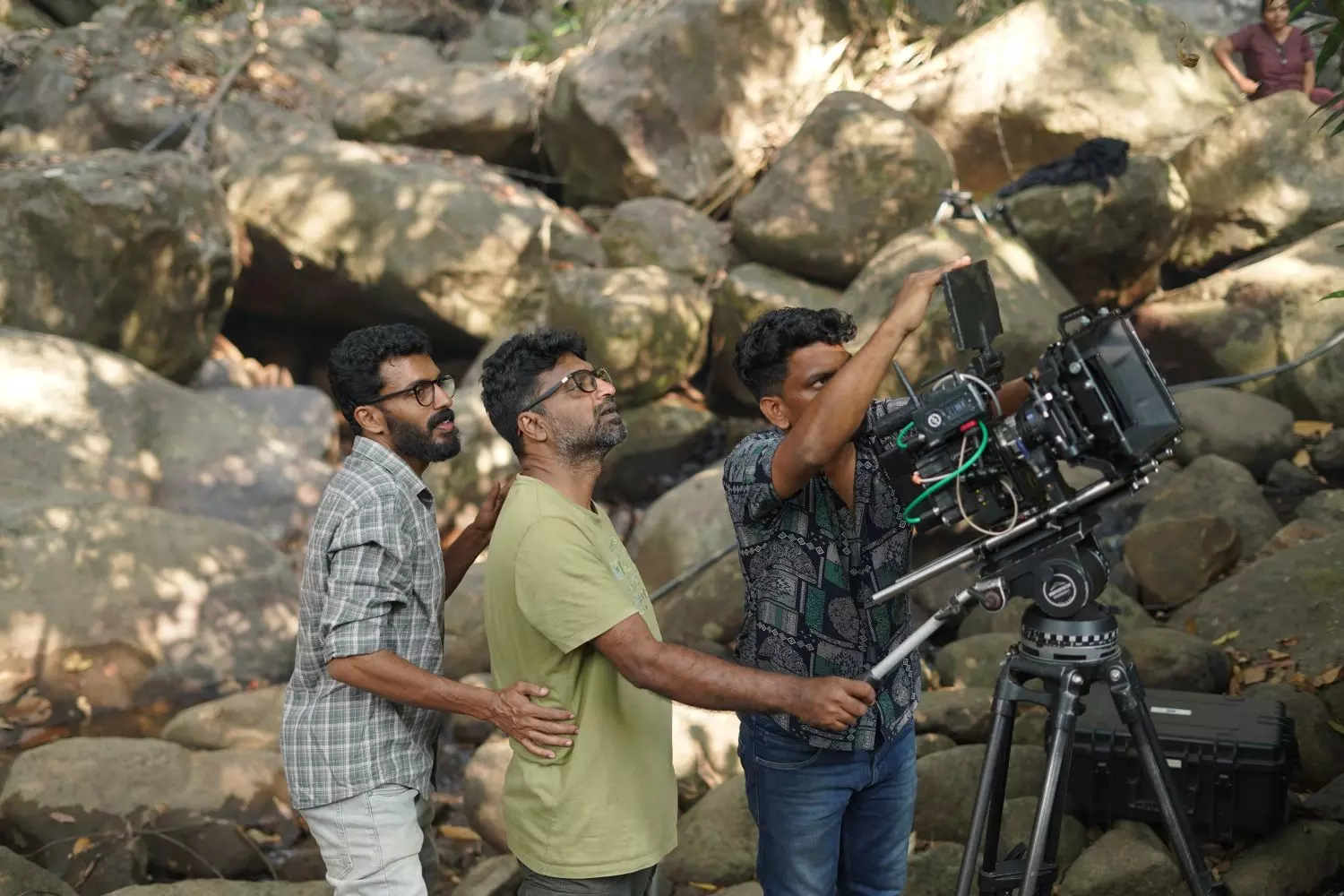
Filming in the dense forest of the Karimpuzha Wildlife Sanctuary, near Nilambur, in the Malappuram district of Kerala, too, presented challenges such as elephant attacks and relentless rain. Photo: By special arrangement
The Cholanaikkans are an endogamous group, where it is the tradition for a young man to seek out his partner. “Should they desire to maintain their relationship, the husband (gunda) and the wife (ennu) permit themselves to be seen by the girl’s parents or the local chieftain. Consequently, the relationship is acknowledged as a marital bond. In cases where multiple men are interested in the same bride, the community selects the groom through specific competitions,” write Aleem Yoosuf and Unaisudheen TP.
While traditionally forbidden from marrying outside the community, of late, Cholanaikkans have started marrying members of other tribal communities, such as Kattunaikkans and Paniya.
At least eight Cholanaikkans have acted in Thanthapperu. “Since it was their first experience, we had a tough time when it came to convincing them. If they lose their temper, then they react fast. Fortunately, those tiny mood swings didn’t last long,” recalled Unnikrishnan.
For Vinod, convincing his people to act in the film was no mean feat.
“Our community has never encountered a camera before and members are unaware of anything related to cinema. Only students like us, who have ventured into the towns, have any knowledge of it. Therefore, persuading my own people to act in the film was quite challenging. We adhere to our traditions and customs, which made them uncertain about whether acting was considered taboo,” he said.
Filming in the dense forest of the Karimpuzha Wildlife Sanctuary, near Nilambur, in the Malappuram district of Kerala, too, presented challenges such as elephant attacks and relentless rain. “Tragedy struck when Poochappara Mani, a key character in the film, was killed by an elephant,” shared Unnikrishnan.
However, it was a small team with a vision, so they quickly dried their tears and moved forward.
"Traversing from one site to another proved to be challenging. There was no trolley available and navigating through the small rocks while carrying the camera was quite difficult. As the Cholanaikkans moved effortlessly through the rocky terrain, many of us struggled. However, they were extremely helpful and cooperative," Unnikrishnan added.
The filmmaker’s informal treks with cinematographer Mohamed A to the forests, often with a camera in hand, ultimately fostered a profound sense of time within the visuals.
“Unnikrishnan and I explored the forests numerous times to scout locations for the film. Once filming started, we faced several limitations. The forest department imposed a significant fee for a day's shoot, which was restricted to the hours between 6am and 6pm. Consequently, we filmed as many scenes as possible in the Cholanaikkan habitat, while the remainder was captured in similar forest environments nearby,” shared Mohamed.
Talking about the members of the Cholanaikkan community who participated in the film, he added, “They transported our camera and other equipment in their bamboo baskets. What amazed me was their ability to predict rain by observing the shifting clouds. I am certain that I may not have another opportunity to film in such a breathtaking location, as it was incredibly rich in natural beauty. It was a great experience.”
Also read: Why Vembanad's houseboats, a pillar of Kerala tourism, have environmentalists worried
Following the film’s critical acclaim, Unnikrishnan and Vinod are attempting to organise a special screening of the film for members of the Cholanaikkan community.
“Once the censor board clears it, we will hold a special screening of Thanthapperu for the Cholanayikkan community members. Since many of them are not accustomed to travelling, we will arrange the screening close to their habitat with the necessary permissions from the relevant authorities,” Unnikrishnan said.
For the filmmaker, it will be a culmination of sorts of his relationship with the community that started more than a decade back with a foray into their habitat and will climax with him presenting his vision of the Cholanaikkans to the tribe.