- Home
- India
- World
- Premium
- THE FEDERAL SPECIAL
- States
- Perspective
- Videos
- Sports
- Education
- Entertainment
- Elections
- Features
- Health
- Business
- Series
- In memoriam: Sheikh Mujibur Rahman
- Bishnoi's Men
- NEET TANGLE
- Economy Series
- Earth Day
- Kashmir’s Frozen Turbulence
- India@75
- The legend of Ramjanmabhoomi
- Liberalisation@30
- How to tame a dragon
- Celebrating biodiversity
- Farm Matters
- 50 days of solitude
- Bringing Migrants Home
- Budget 2020
- Jharkhand Votes
- The Federal Investigates
- The Federal Impact
- Vanishing Sand
- Gandhi @ 150
- Andhra Today
- Field report
- Operation Gulmarg
- Pandemic @1 Mn in India
- The Federal Year-End
- The Zero Year
- Science
- Brand studio
- Newsletter

Heat waves to hazardous air — why Delhi’s school system seems ill-equipped for the climate crisis
In summer, classrooms turn into spaces of physical strain — headaches, dehydration, nosebleeds and even fainting are no longer unusual. By winter, the same children are breathing air that limits stamina and attention. Both situations are being treated as seasonal disruptions. But raises the question, is Delhi's school system designed for a climate that no longer exists?

“I don’t feel like going to school anymore,” cribs 11-year-old Nishant (identified by first name only), a student of class 5 at a Delhi school. “The sun gets extremely hot early in the day and the heat is intense in the classroom. We are not even allowed to play outside during the lunch break; the teachers stop us.”Last week, the Directorate of Education (DoE), Delhi, announced...
“I don’t feel like going to school anymore,” cribs 11-year-old Nishant (identified by first name only), a student of class 5 at a Delhi school. “The sun gets extremely hot early in the day and the heat is intense in the classroom. We are not even allowed to play outside during the lunch break; the teachers stop us.”
Last week, the Directorate of Education (DoE), Delhi, announced that government schools in the national capital would remain closed for summer vacation between May 11 and June 30. However, for students of classes 9, 10 and 12, these schools would hold special classes between May 11 and May 23, the DoE circular reportedly added. Meanwhile, private schools in Delhi can, according to sources, make their own decisions about the vacation period within this window, with some schools choosing to close further down in May.
Incidentally, however, the national capital had already experienced heat wave conditions in April, with the maximum temperature crossing 40 degrees more than once.
Which raises the question, is Delhi's school system designed for a climate that no longer exists?
From heatwaves in April-May to hazardous air in November, school students in the national capital are now moving through an academic year defined not by learning rhythms, but by environmental extremes.
In summer, classrooms turn into spaces of physical strain — headaches, dehydration, nosebleeds, and even fainting are no longer unusual. Most classrooms are not air-conditioned. Two to three ceiling fans struggle to cool a room packed with 30 or more students, while heat accumulates faster than it can escape.
Some adjustments are being attempted in other states — even in neighbouring Noida, part of the National Capital Region. These include earlier school hours, and shorter school days. These are not perfect solutions, but perhaps a reflection of a willingness to respond to these changing conditions. The question is not whether such measures are sufficient, but why similar conversations struggle to translate into action in Delhi, which faces some of the country’s most extreme conditions.
The Federal has reached the secretary (education) and director, Directorate of Education, Education Department, Government of National Capital Territory, Delhi for comment on measures being planned to tackle the disruption in education by climate extremes.
Meanwhile, as yet, in the absence of structural change, smaller measures begin to fill the gap — hourly water bells, reminders to hydrate, checks to ensure children carry filled bottles, sometimes even with ORS before they leave for home. These steps acknowledge the risk, but they do not reduce it. They are safeguards within a system that remains fundamentally unchanged.
Also read: Why a 7-year-old’s prayer to Shiva has a lesson on restraint and accountability for adults
“I carry two bottles of water with me to school,” says Jiya (identified by first name only), a student of class 9 at a government girls’ school in Delhi’s Okhla Phase 2. The 14-year-old also describes what happens when a classmate falls ill: “When someone feels unwell in class, the teacher tells them to put their head down and sit quietly.”
There is something deeply unsettling about how normal these responses have become. A child feeling faint in class is no longer enough to interrupt the system.
The distress is not limited to government schools.
“Our classrooms only have ceiling fans, no coolers. The only air conditioner is in the principal’s room,” says 8-year-old Sanskar (identified by first name only), a class 2 student at a private school in the national capital.
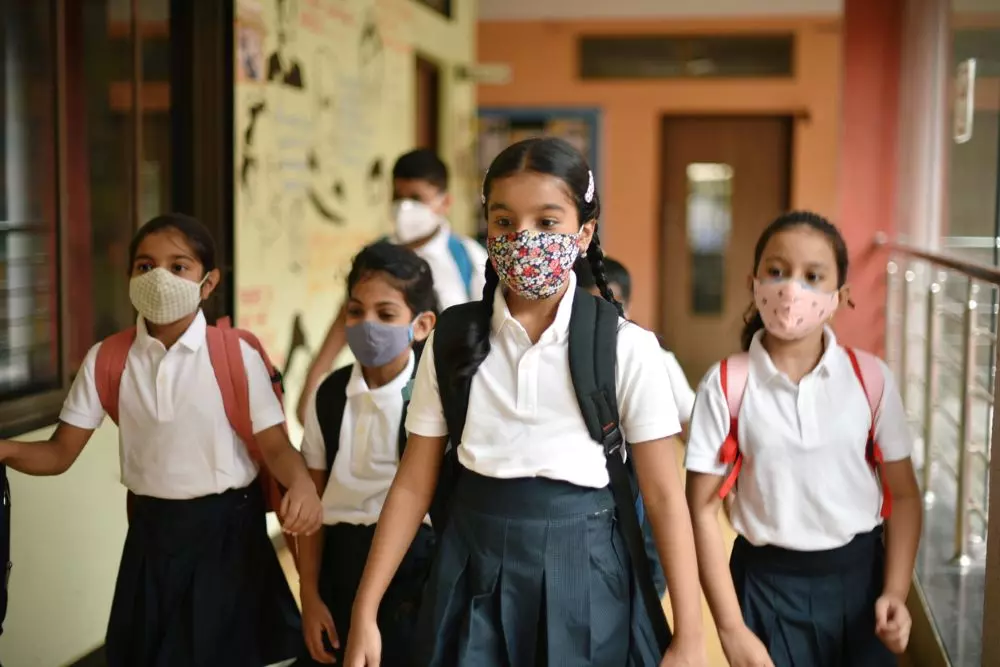
By winter, the same children sit indoor, hidden behind face masks, breathing in hazardous air. Photo: iStock
Increasingly, the school day itself is being reorganised around survival — avoiding the sun, reducing movement, sitting quietly under fans and waiting for the heat to pass.
By winter, the same children sit indoors, cut off from movement, breathing air that limits stamina and attention. The distress here is quieter — masked behind persistent coughs, burning eyes, inhalers and nebulisers — but its implications run deeper and longer.
Both situations are being treated as seasonal disruptions. But experts say they are becoming the conditions in which schooling is expected to continue.
“The human body responds to climate change long before institutions do,” says Dr. Reshmi Rajan, consultant specialist and mother of two school-going kids aged 12 and 3 years. “During periods of extreme heat and poor air quality, symptoms such as fatigue, headaches, dehydration, respiratory irritation and reduced concentration become increasingly common in children. Yet many of these are still treated as seasonal inconveniences instead of signs of environmental stress.”
What is often missed is the cumulative effect. A child is not merely “missing a few days” or “adjusting to weather”. The body is repeatedly pushed between extremes — overheated classrooms, polluted air, abrupt shifts between indoor and outdoor exposure. The mind follows. Fatigue, irritability and reduced attention are not behavioural issues, but responses to instability.
The system seems to only react, but does not respond.
“The psychological impact of climate stress on children is often subtle before it becomes visible,” says Nayamat Bawa, psychotherapist. “Children may not always have the language to explain what they are feeling, but it often shows up in small everyday ways — irritability, tiredness, difficulty concentrating, disturbed sleep, or simply not wanting to go to school. When a child spends long periods physically uncomfortable or anxious, learning itself begins to feel exhausting. What is worrying is how quickly these conditions start becoming normalised around them. Parents adjust, schools adjust, society adjusts — and children quietly learn to accept heat, fatigue, polluted air and discomfort as just another ordinary part of growing up.”
The exposure, for children, does not end at the school gate.
A school day moves through the city — through roads that radiate heat, through traffic-dense corridors, through an environment shaped as much by infrastructure as by weather. Vehicular emissions remain a primary contributor to urban air pollution, while dense concrete surfaces trap and intensify heat through the urban heat island effect. In effect, a child’s school day unfolds within a constructed climate, not a natural one.
“Recent studies suggest that more than half of India’s top-tier cities fall short of the 12–18 per cent green-cover benchmark recommended under the URDPFI [Urban and Regional Development Plans Formulation and Implementation] Guidelines, 2014. Reduced green cover, along with increased impervious surfaces, is making Indian cities hotter and intensifying urban heat island effects. As temperatures rise, people rely more on air-conditioning, leading to increased power demand. Since several Indian cities still depend on electricity generated from fossil fuels, this can further add to emissions. Furthermore, hot and dry conditions can stir up more road dust and construction dust, worsening the overall air quality,” says Dr. Umamaheshwaran Rajasekar, urban resilience expert.
While some parts of Delhi have green cover, it is also unevenly distributed, thus making the city itself part of the problem.
For children, these structural failures are often experienced in very immediate ways.
“There are no big trees in our school where we can sit and rest during lunch,” complains 13-year-old Sidra, a Class 8 student at a government school in Delhi’s Harkesh Nagar.
Also read: Why Delhi moms across economic and social groups are losing out to a common fear
Teachers are caught in the same bind. Anjali Bhati, a teacher at a private school in the Badarpur area, says they are rarely consulted during discussions relating to ways to combat the weather extremes. “The heat is definitely a problem. We often think that schools could run alternate-day classes at 50 per cent capacity to keep classroom numbers lower. At least then the children will get space to sit under the fan.”
In the absence of any concrete measure, teachers too are left to battle the intense conditions — heat, pollution, disrupted schedules, and an unforgiving academic calendar, under pressure to finish the syllabus even as classrooms become increasingly difficult to endure physically .
There are conversations every winter about restructuring the academic calendar — front-loading instructional days, advancing annual functions and sports events, extending winter breaks to avoid peak pollution, and reducing the uncertainty of toggling between online and offline learning in a failing hybrid system.

While most people talk of climate change as a future occurence, in Delhi classrooms, students are already battling its impacts. Photo: iStock
But before such a framework can settle, summer arrives. Heatwaves return with equal force, calling into question whether a shorter summer break for a longer winter pause is even viable. The system oscillates between two crises, without adapting meaningfully to either.
The strain created by these conditions eventually travels home, leaving families, particularly mothers, in a space of quiet desperation.
Rubani Kapoor, mother of a seven-year-old studying in a private school in South Delhi, says she increasingly feels “absolutely helpless” and emotionally distressed watching her child struggle through extreme heat and exhaustion during the school day. “The children come back with warm foreheads and complete fatigue,” she says. “My child often tells me she has had to take special permission from the teacher just so she can sit closer to or directly under a fan.”
According to Kapoor, there is a growing fear among parents that children are unable to properly concentrate in classrooms and are returning home with incomplete classwork because the physical discomfort itself becomes overwhelming. “Regular trips to the medical room have become common. Someone is vomiting, someone develops a high fever, and someone feels faint. Even nosebleeds have become far too common now.”
“What do parents really do in a situation like this?” she asks. “When heat and smog themselves begin shaping a child’s ability to sit, learn and simply get through the school day, it makes you question the larger system we are all part of. We know what is happening to children, yet it often feels like nothing meaningful is changing.”
Even something as ordinary as a school uniform now reveals how institutions are designed for an older climate.
“School uniforms were historically designed with durability, affordability and ease of maintenance as key priorities, which is why blended fabrics became common,” says Sucharita Beniwal, Textile Design faculty at the National Institute of Design, Ahmedabad. “However, climatic conditions are changing rapidly. When children are spending six to eight hours a day commuting, attending assemblies, physical education classes and sitting in classrooms during extreme heat, comfort and breathability can no longer remain secondary considerations in uniform design. Schools need to start thinking more seriously about lighter, climate-responsive fabrics and designs that support children’s physical comfort through the school day.”
The school year itself is beginning to fracture under the pressure of climate change — interrupted by heatwaves, compressed by pollution.
“Childhood is synonymous to routine. The first thing that climate change, higher AQIs or disruptive weather impacts is a break in learning momentum. Schools go offline and there's unpredictability in schedules. This can lead to anxiety, irritability and reduced focus. Outdoor play is also highly interrupted, impacting the physical and mental health of growing children. Introducing climate education can be a big step in creating awareness to build a healthier planet by and for the future generations,” says Anushree Shukla, psychologist.
Also read: Why Delhi moms fear their children are becoming collateral damage to the city's smog apathy
The disruption is experienced very differently depending on where a child studies. A small section of children in elite private schools move through air-conditioned classrooms, filtered air and shaded campuses. For the rest, education is increasingly becoming another struggle against the odds. Alongside academic pressure, economic inequality and competition, children are now expected to battle heat and polluted air simply to remain present in class, as though learning itself were an act of endurance against forces far larger than them.
Nidhi M (name changed on request), a private school teacher from South Delhi with over a decade of experience, agrees that repeated environmental disruptions gradually affect a child’s engagement with learning, creating a pattern of compromised attention and continuity. While private schools may be relatively better equipped to handle the scenario, she says, even these institutions struggle when children must constantly be warned against playing outdoors. “A cancelled sports class almost feels like robbing children of their childhood,” she says.
According to Nidhi, while measures like frequent water breaks and increased vigilance help, a more systemic response is needed. The teacher pushes for shifts in timings — not just for schools, but even for offices — which she feels could help families and institutions work together more effectively towards creating a safer learning environment for children.
Most people continue to speak of climate change as a future risk. But in Delhi’s classrooms, it has already entered the body. And as heat, pollution and unequal access to protection reshape the experience of schooling, the question one must consider is how many children are slowly being pushed out of a fair chance to learn by an environment that our academic system still fails to account for.