- Home
- India
- World
- Premium
- THE FEDERAL SPECIAL
- States
- Perspective
- Videos
- Sports
- Education
- Entertainment
- Elections
- Features
- Health
- Business
- Series
- In memoriam: Sheikh Mujibur Rahman
- Bishnoi's Men
- NEET TANGLE
- Economy Series
- Earth Day
- Kashmir’s Frozen Turbulence
- India@75
- The legend of Ramjanmabhoomi
- Liberalisation@30
- How to tame a dragon
- Celebrating biodiversity
- Farm Matters
- 50 days of solitude
- Bringing Migrants Home
- Budget 2020
- Jharkhand Votes
- The Federal Investigates
- The Federal Impact
- Vanishing Sand
- Gandhi @ 150
- Andhra Today
- Field report
- Operation Gulmarg
- Pandemic @1 Mn in India
- The Federal Year-End
- The Zero Year
- Science
- Brand studio
- Newsletter

What the world would look like in 2026 if moulded by Trump’s efforts to make America great
The US economy will continue to register reasonably robust growth and the Chinese economy is likely to grow faster than most official projections. India’s growth is likely to gasp for breath in 2026, although the release of a new series of GDP numbers could flatter to deceive.

The coming year will be moulded by the continuing unilateral efforts by the Trump administration to make America great again. The US economy will continue to register reasonably robust growth, as projected — two per cent is reasonable growth for a $31 trillion economy — but the Chinese economy is likely to grow faster than most official projections, and register a growth rate of five per...
The coming year will be moulded by the continuing unilateral efforts by the Trump administration to make America great again. The US economy will continue to register reasonably robust growth, as projected — two per cent is reasonable growth for a $31 trillion economy — but the Chinese economy is likely to grow faster than most official projections, and register a growth rate of five per cent or more. India’s growth is likely to gasp for breath in 2026, and not just because of air pollution, although the release of a new series of GDP numbers could flatter to deceive.
President Donald Trump has not quite made the world in his own furious image, but he is trying. He has relatively more success with his own country. Hispanics, Black Americans and immigrants from countries outside Europe get a taste of the discrimination White Anglo-Saxon Protestants had traditionally meted out to relatively new immigrant groups — the Chinese in the late 19th century, the Irish, the Italian, Jewish and Polish immigrants in the early decades of the 20th century, and the Japanese after Pearl Harbor. Some 120,000 people of Japanese origin were held in so-called internment camps and administered loyalty questionnaires.
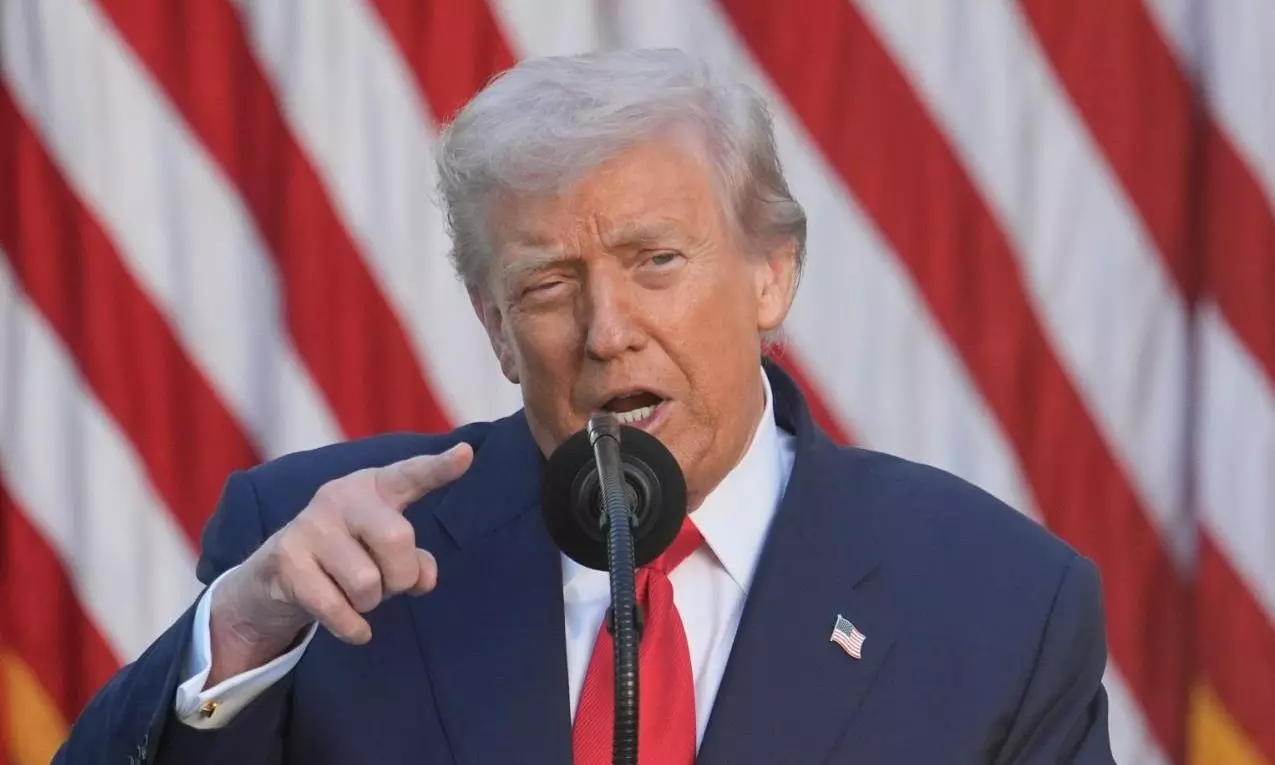
President Donald Trump has not quite made the world in his own furious image, but he is trying. He has relatively more success with his own country. File photo
When Trump asks, who has heard of Lesotho, and terms African countries “shithole countries”, when his National Security Strategy document describes Europe’s acceptance of immigrants from Asia and Africa as the route to civilisational erasure, he signals not just prejudice against people of colour but also disdain for globalisation. The Trump government’s framework for engaging with the developing world has an old name that had receded under layers of ‘rules-based world order’, ‘global interdependence’, and ‘North-South Cooperation': imperialism.
Imperialism rides again. It has attacked fishing boats and killed their occupants off the coast of Venezuela in illegal acts, in the name of stopping drug smugglers, seized Venezuelan oil tankers and attacked Muslim bandits in Nigeria in the name of defending Christians against violent religious persecution.
It might be prudent for the Hindutva thugs beating up Christians and attacking Churches and Christmas celebrations in different parts of the country to ask the Modi government to shield them from Trump’s possible extra-territorial wrath.
Also read: GDP growth rebounds, but average Indian’s living standard dips — How Indian economy fared in 2025
Europe and Japan are spending way more on arms than they used to. This additional defence spending leads to smaller international aid budgets and reduced welfare spending internally. It would spell initial hardship for the people of Africa, but would begin the process of weaning them off excessive aid dependence. China does spend on aid, but is hard-nosed about such spending.
Pressure to curb spending in Europe, even as countries step up defence outlays, would feed popular unrest and populist, xenophobic politics. Mainstream liberal parties of Europe can hold their ground only by appropriating parts of the hard right’s agenda that resonate with the populace at large. Groups that want to migrate to Europe but wish to retain their insularity and medieval customs and mores would come under hard pressure to assimilate.
The kind of patronage of multiculturalism that Britain has been following, which allowed an Islamic zealot to kill an Ahmadi shopkeeper for no crime other than being an Ahmadi, will not survive. It is difficult to mourn such a rightward shift in politics. Humanity has progressed by sharing and absorbing what is good in cultures other than their own. That openness would probably survive, but not tolerance for behaviour or ritual that is grossly out of step with norms of democratic equality, whether of gender or caste, or norms of moderation and respect for others’ rights in the public sphere.
Also read: How fresh finds, research progress made 2025 a significant year for science and technology
The Ukraine war would come to an end: Ukraine’s drone-powered resistance hinges on satellite intelligence from the US, and if and when the US decides to withhold it, the war would be over in no time. Ukraine understands this and is now ready for the territorial concessions it had ruled out earlier. Russia wants control of not just Crimea, where its only warm-water naval base is located, at Sevastopol, but also the Don Bas region, through which runs access via land from St Petersburg or Moscow. Putin will not compromise on this demand.
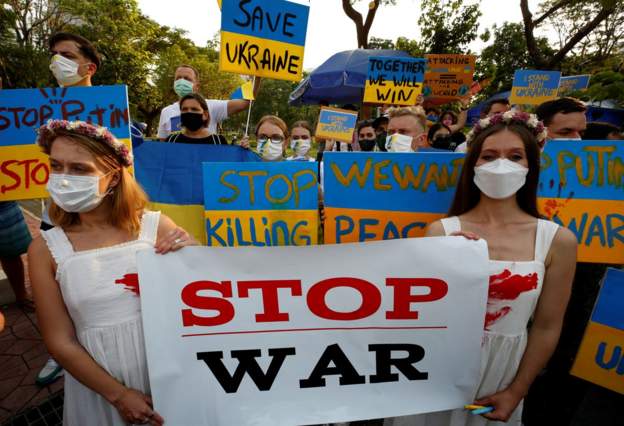
Ukraine’s drone-powered resistance hinges on satellite intelligence from the US, and if and when the US decides to withhold it, the war would be over in no time. File photo
Once the Ukraine war gets over, commodities from Russia would start flowing again — oil, gas, fertiliser, and wheat. Their prices would soften. Reconstruction would start in Ukraine. Reconstruction will start in Syria as well, and, on a more modest scale, in Lebanon and Iran. Gaza would not be ready for reconstruction in the near future. This would help excess Chinese industrial capacity cease to be excess capacity and turn into vital supplies. Expect the Chinese to subsidise such rebuilding to a certain extent, undercutting European and American companies also eager for a share of the reconstruction pie. These multi-billion-dollar reconstruction orders would help boost Chinese growth above current projections.
Artificial Intelligence (AI) companies cross-subsidised by other robust revenue streams, as in the case of Google, Microsoft, Meta, and Amazon, would withstand the bursting of the AI bubble in the stock market. It is not clear that stand-alone AI companies such as OpenAI would manage to, although Palantir would survive, even if at a fraction of its current market valuation. The dollar capex on AI infrastructure is in the hundreds of billions, the revenues are tiny in comparison. The mismatch can stay aloft on the wings of irrational exuberance only for so long.
Also read: Politically vocal but electorally outfoxed — what 2025 has been like for India's Opposition parties
India is the second most overpriced market after America. The twelve-month forward-looking price-earnings (PE) multiple (the ratio of the current price of a share to the anticipated per-share earnings of the company over the next 12 months) is over 25 for the S&P 500 (Standard and Poor's 500, a stock market index), and just short of that figure for India’s Nifty Fifty. A whopping 46 per cent of the listed shares on the Bombay Stock Exchange have a PE above 25, and about 15 per cent of the shares have a PE above 80. Such PEs represent, in non-technical language, pie in the sky. If the AI bubble bursts in the coming year, the pie would splat on the ground.
The Indian economy’s seeming fast growth would be revealed to be seeming, even after Trump deigns to remove the Russian-oil linked tariff slab of 25 per cent on imports from India. If food price inflation is near zero, as it is at present, farm incomes are stagnant or regressing. That does not bode well for rural demand. Only if private investment goes up will Gross Fixed Capital Formation break the jinx of being stuck at or below 30.5 per cent of GDP since 2014, well below the 35 per cent of GDP that was routinely achieved when the UPA government’s much-maligned public-private-partnerships (PPP) in infrastructure were being implemented.
Capacity utilisation, reveal the Reserve Bank of India’s (RBI’s) surveys, is below 75 per cent for manufacturing. There is no reason for industry to massively increase capacity. The only place where private investment can be absorbed is infrastructure. If the government makes good on its Budget promise to announce PPP for infrastructure, capital formation can pick up. That alone can boost growth. If PPP policy keeps company with the policy on storage of renewable power, promised in 2024 and not yet announced, growth in 2026 will be tepid. The climate alone will continue to be hot.