


- Home
- India
- World
- Premium
- THE FEDERAL SPECIAL
- States
- Perspective
- Videos
- Sports
- Education
- Entertainment
- Elections
- Features
- Health
- Business
- Series
- In memoriam: Sheikh Mujibur Rahman
- Bishnoi's Men
- NEET TANGLE
- Economy Series
- Earth Day
- Kashmir’s Frozen Turbulence
- India@75
- The legend of Ramjanmabhoomi
- Liberalisation@30
- How to tame a dragon
- Celebrating biodiversity
- Farm Matters
- 50 days of solitude
- Bringing Migrants Home
- Budget 2020
- Jharkhand Votes
- The Federal Investigates
- The Federal Impact
- Vanishing Sand
- Gandhi @ 150
- Andhra Today
- Field report
- Operation Gulmarg
- Pandemic @1 Mn in India
- The Federal Year-End
- The Zero Year
- Science
- Brand studio
- Newsletter

Fewer hands, bigger pandals: Durga Puja’s volunteer problem
Work and studies keep the young away; external agencies fill the void but bring headaches, and committees from Golpark to CR Park are finding their own answers

For generations, neighbourhood Pujas have run on the collective effort of residents: collecting subscriptions, bringing home the idol, decorating the pandal, preparing bhog and staging cultural programmes. The preparations began long before the Goddess arrived, and they were often as important as the celebrations themselves, forging bonds across generations and households.These traditions are...
For generations, neighbourhood Pujas have run on the collective effort of residents: collecting subscriptions, bringing home the idol, decorating the pandal, preparing bhog and staging cultural programmes. The preparations began long before the Goddess arrived, and they were often as important as the celebrations themselves, forging bonds across generations and households.
These traditions are now being tested. Younger residents leave home for education and jobs, professional commitments leave little time for voluntary work, and rising costs have made corporate sponsorship ever more important.
Chorbagan tragedy: Why organisation matters
A stampede at the Chorbagan (Sarada Park) pandal on Saturday left 19 people dead and 25 others injured. The tragedy has put the spotlight on how a pandal is conceived and built, how accessible it is for devotees, and what safeguards are in place. Note that other factors also contributed to this particular tragedy.
Artists, event management companies and political figures are also shaping how some celebrations are run, raising a question: who ultimately controls the festival, and how much of its community character can be preserved?
Whose job is it?
The shift is not just about elaborate themed creations replacing traditional pandals. It is about who does the grunt work, who makes the tough calls, and how far residents stay involved once professional artists, sponsors and political representatives join the organising process. Councillors and party workers are increasingly visible on some committees, while artists take on responsibilities well beyond designing a pandal.
The picture varies from one neighbourhood to the next. In some localities, a handful of organisers now carry burdens once shared by dozens. Elsewhere, committees have found ways to keep residents involved, sometimes by bringing women into leadership or drawing on traditions that have endured for decades.
Also read | Durga Puja 2026: 10 fascinating facts about Bengal's biggest festival
The experiences of organisers, residents and artists across Kolkata, its suburbs and Delhi reveal a festival adapting to changing times, and a growing tension between making the celebrations bigger and keeping them rooted in the community.
A century of shared work
At the 100-year-old Adi Ballygunge Sarbojanin Durga Puja Parishad in Golpark, preparations carry the weight of a century of neighbourhood memories. Film director Satyajit Ray was associated with the Puja when he lived in the area with his mother, and several other eminent artists have been connected with it over the years.
The Puja has traditionally followed the sabeki style, retaining the familiar look and rituals of a conventional Bengali celebration. This year, to mark its centenary, the committee introduced a theme for the first time. The idol, however, remains traditional, preserving a link with the past even as the organisers try something new.
What continues is the emphasis on collective responsibility. Joint secretary Abhirup Roychowdhury says finding young people willing to pitch in through the year has become a challenge. Many leave for education or work and return only for the Puja, when senior members hand-hold them through the preparations and teach them the ropes.
Abhirup Roychowdhury (left) with other organisers of the Adi Ballygunge Sarbojanin Durga Puja Parishad in Kolkata's Golpark.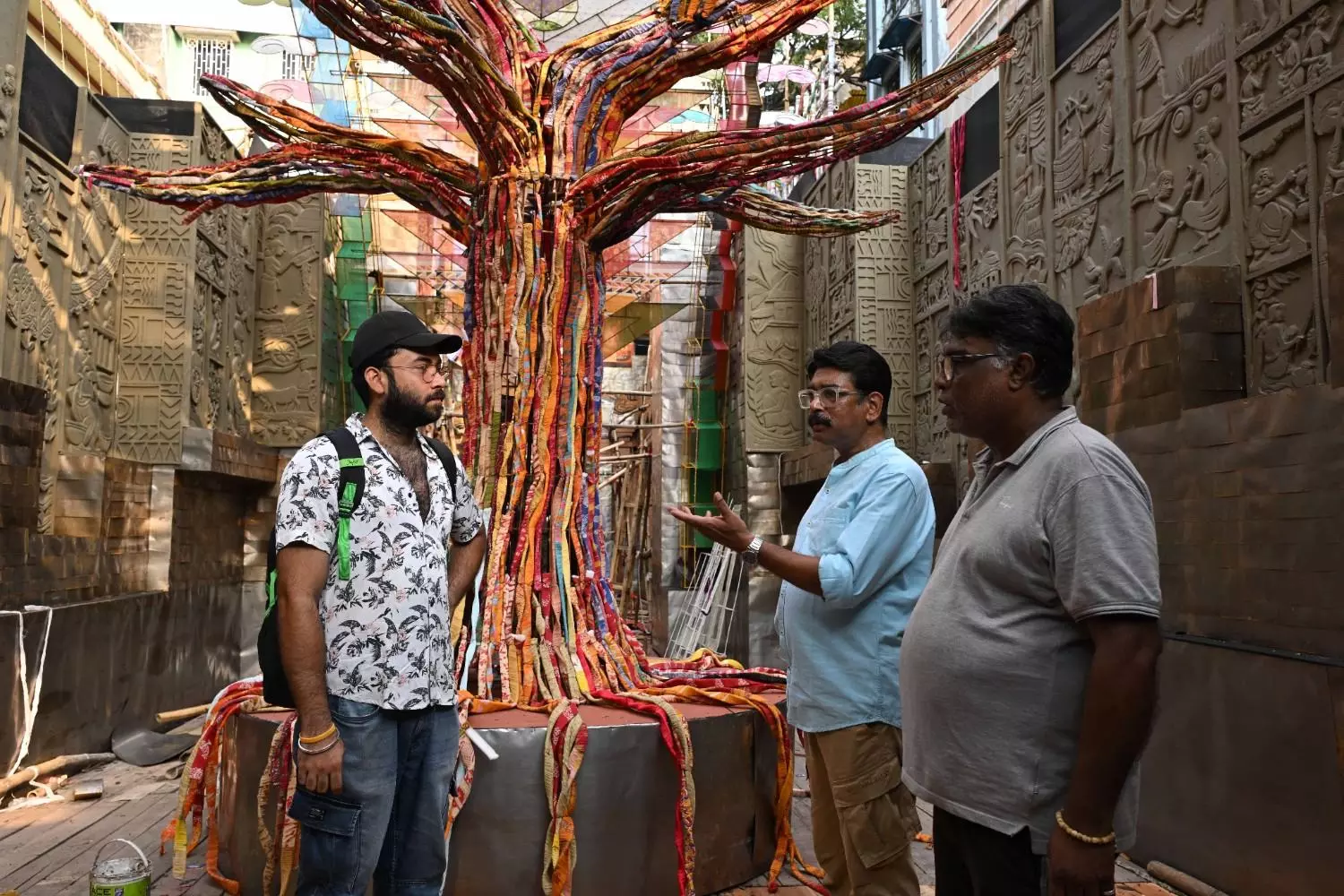
“The puja does not belong to any one person. It is not anyone’s personal puja. It is the puja of every member of all 314 households,” Roychowdhury told The Federal.
Residents collect subscriptions themselves and travel to Kumartuli to bring home the idol. On Saptami, Ashtami and Navami, around 550 people from the neighbourhood gather to share bhog. Cultural programmes bring together participants of all ages, while women collectively organise the rituals and assist the priest.
Also read | Kolkata Durga Puja 2026 top 10 theme pandals: Lotus, SP Mookerjee, Partition and more
For Roychowdhury, outsourcing these tasks would weaken the sense of ownership that binds the neighbourhood to the festival. Residents may take a day or two longer to finish a job a professional agency could do faster, but the time spent working together is itself part of the Puja’s value. The aim, he believes, is not merely to put up a pandal or conduct rituals on schedule, but to ensure residents continue to feel responsible for the celebration.
Awards, artists and absent residents
At Samaj Sebi Sangha in south Kolkata, general secretary Arijit Maitra sees the growing focus on awards and recognition as a reason residents are withdrawing from organising duties. He recalls the 1980s and 1990s, when residents collected subscriptions, decorated their neighbourhoods and staged cultural programmes with local talent. Today, he says, committees get drawn into a contest for prizes, which helps attract sponsors, expand budgets and bring prominent performers on stage.
Arijit Maitra of Samaj Sebi Sangha in south Kolkata. 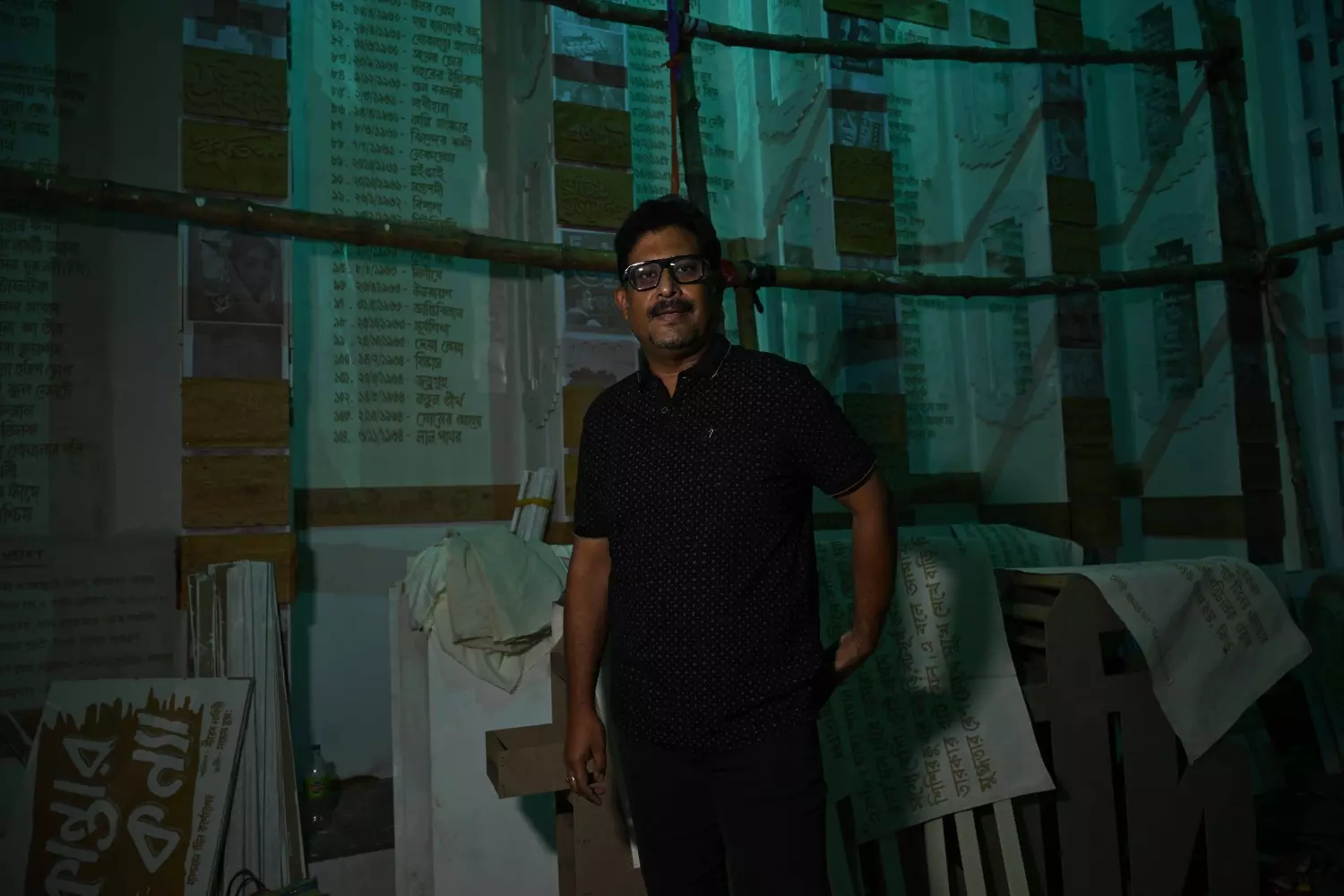
The way pandals and idols are made has changed too. Local decorators once handled much of the work, and residents went to Potuapara, the potters’ colony, to bring home the idol. Now artists, including young art college graduates, increasingly see Durga Puja as a chance to make aname. A striking pandal or an innovative idol can bring recognition that might take years to achieve through gallery exhibitions.
That has widened the festival’s artistic possibilities, but Maitra believes it can also leave residents with little say in the celebrations.
“When artistic ambitions and the pursuit of awards become the main priorities, some residents begin to feel disconnected. The work then falls on a small group of organisers,” he told The Federal.
Also read | Where the azaan meets the arati: Bengal’s shared Durga Puja traditions
He estimates that 60 to 70 per cent of Kolkata’s Pujas now depend on corporate sponsorship, while smaller committees still rely largely on residents’ contributions. At Samaj Sebi Sangha, four or five people shoulder most of the responsibility. Maitra still refuses to hand over the organisation to event management companies. He adjusts his professional commitments to make time for the festival, and a small group of younger members continues to collect subscriptions. They may not reach as many households as earlier generations did, but the practice survives.
Maitra believes the next five years will show how far this transformation goes. He hopes Samaj Sebi Sangha will keep its community character rather than become a corporate production run by an outside agency.
Where the pandal begins
Much thought goes into a pandal’s conception. Artist Abhik Sen, who has worked on the Pujas at Dhakuria Shahid Nagar, Kendua Club in Patuli and 74 Pally in Khidirpur, says discussions about the next year’s theme often begin as soon as the current celebrations end. Club members either approach artists with ideas or ask them to propose concepts of their own. Artists then present their suggestions as drawings or, increasingly, as digital visualisations created with AI tools.
People enjoy visually appealing creations, Sen says, and artists develop themes with that in mind, though some committees prefer concepts inspired by current events.
The work goes well beyond the pandal’s design. Artists may also create the idol and arrange the materials needed to realise the concept. During the Puja season, Sen works with teams of 50 to 60 people. He describes two common arrangements. In one, the artist takes complete charge of the idol, pandal and materials, buying everything required and executing the work while the residents’ club foots the bill. In the other, the club buys the materials, leaving the artist to build the pandal and make the idol. In both cases, residents arrange suitable workspaces, secure permissions and provide other support.
Such arrangements can relieve organisers of much of the technical and execution work, particularly when a theme demands specialised materials, a large workforce and elaborate construction. But they do not necessarily transfer responsibility for the entire Puja to the artist. The committee continues to handle the rituals and other arrangements, and the division of labour varies with each agreement.
Event management firms in the fray
Event management companies are often roped in for specific services or a wider brief, depending on what a committee wants to outsource.
“Durga Puja has traditionally been a community-driven celebration, but changing lifestyles and the growing scale of celebrations are making professional support increasingly important,” observed Aditya Kathotia, founder and CEO of event management firm Nico Digital.
“Some puja committees seek help in planning and execution, vendor coordination, branding and visitor experience. However, the emotional connect and community spirit must always remain at the heart of the celebration,” he told The Federal.
For committees, the question is whether professional support fills gaps volunteers can no longer manage, or gradually takes over what residents once did themselves. Pritam Dutta, a member of the Shahid Nagar Puja Committee, draws the line clearly. “We are worshipping Goddess Durga, we are not organising an event here,” he told The Federal.
The volunteer shortage
The difficulty of finding volunteers is not limited to committees worried about commercialisation. At Ballygunge Cultural, now in its 76th year, secretary Saptarshi Basu points to the combined effects of migration and professional commitments. Many young people leave Kolkata for education and jobs, and those who stay have little time for voluntary work. Basu and his contemporaries, who have been associated with the Puja since childhood, now organise the celebrations alongside senior members, with some help from younger participants.
Also read | How a simple plate of khichuri became a symbol of Bengal’s Durga Puja
Corporate support has become important, particularly for branding and marketing, but running the Puja remains the committee’s responsibility. In earlier years, local boys took turns guarding the pandal through the night. The committee still draws up a roster, but private security personnel have increasingly taken over tasks once performed by residents, including managing crowds and helping stall owners.
The scale adds to the demands. The Maha Ashtami bhog alone draws around 2,000 people and requires extensive preparation. Organisers must also balance residents’ differing expectations while keeping arrangements running smoothly. What keeps them going is attachment. “This puja is like oxygen for us,” Basu said.
Politics at the pandal
The question of who organises a neighbourhood Puja grew more complicated once local political figures became involved. Councillors and other elected representatives offer access to workers, resources and local networks at a time when committees are struggling for volunteers.
But the involvement has its pitfalls. The non-partisan character of Puja committees is often the casualty, with members from opposing political camps sidelined. Political divisions spill into the committee and the wider neighbourhood, one organiser said on condition of anonymity.
Nari power takes over
To address the manpower shortage without turning to local politicians, a few committees have turned to women, consummate multi-taskers, to run the festival.
At Mousumi Club in Uttarpara, Hooghly district, a change in leadership structure was the answer. The 50-year-old club is being managed by women for the past six year. Secretary Ananya Pal says the earlier male organisers had grown old and could no longer contribute actively, while the younger men were caught up with studies and work. Rather than let the Puja suffer for want of volunteers, around 15 to 20 women decided to take charge.
Ananya Pal (sitting) and others members at the Mousumi Club in Uttarpara, Hooghly district.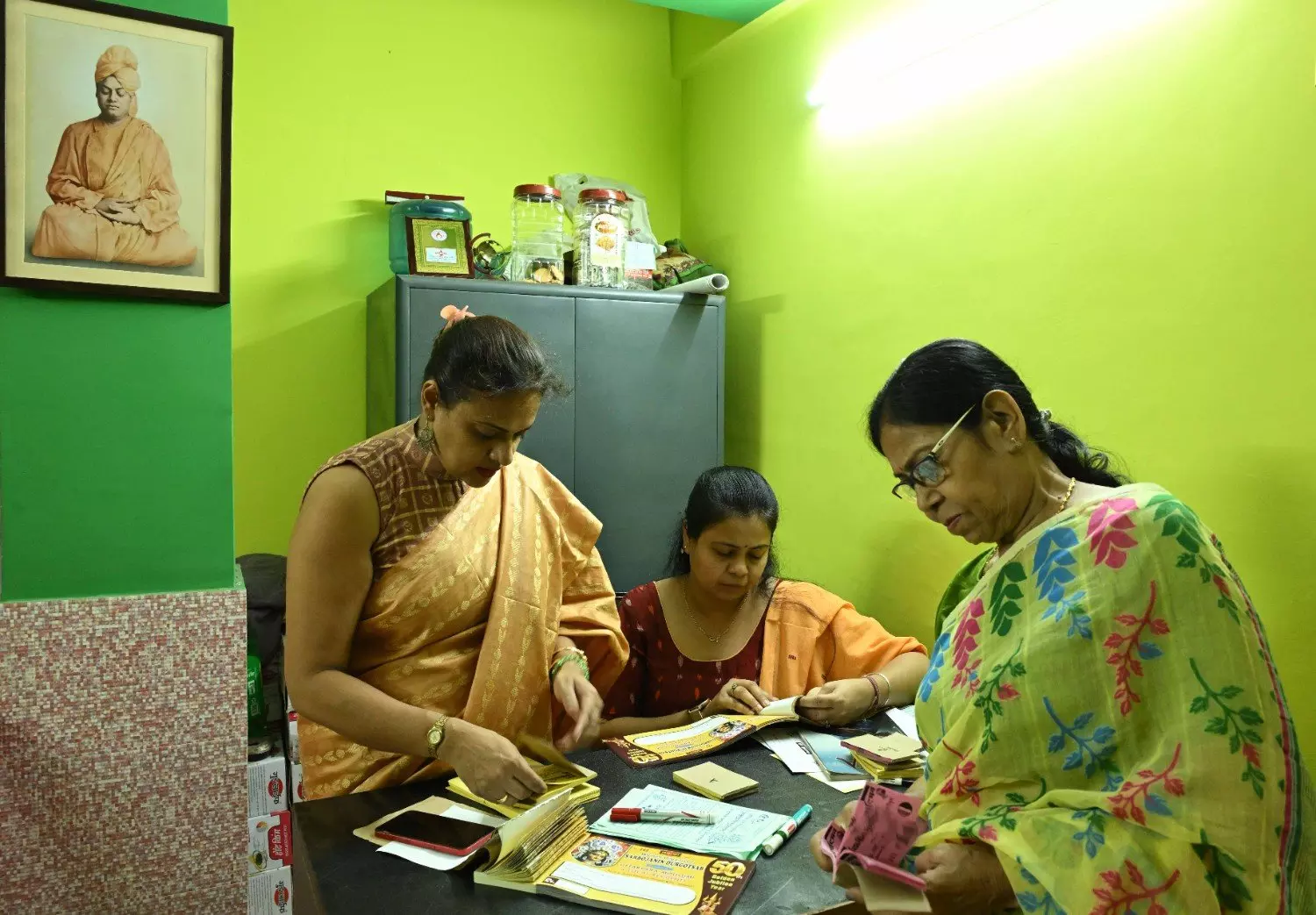
Many of them work full-time. Yet after returning from their jobs, they go from house to house collecting donations and continue with the preparations. Their experience echoes the Bengali adage Je radhe, se chul bandhe, which suggests that a woman who can manage one responsibility can take on many more.
The women seek advice from senior organisers while doing the physical labour themselves. Their children pitch in, distributing prasad and handling smaller tasks, opening a path for the next generation. Pal believes the Puja will survive as long as young people are willing to carry it forward.
Club member Sanjukta Chatterjee explains why they will not outsource the celebrations. “Handing over the puja to an event management company means becoming puppets in their hands,” she said.
Sponsors can be harder to find in the suburbs than in Kolkata, making government grants an important source of funding for committees such as Mousumi Club. Pal’s appeal to younger residents rests on the belief that Durga Puja belongs to Bengali heritage and culture, and that people should work shoulder to shoulder to sustain it.
Delhi’s different story
Corporate funding and community participation are not always at odds. Delhi’s CR Park offers a different picture. Sushobhan Rakshit, a member of the Mela Ground committee, says the celebrations continue to draw active participation from residents, including the young. Volunteers collect donations door to door even though corporate sponsors, particularly builders, provide a substantial share of the funding.
Themed pandals have grown popular in the capital too. This year, the Mela Ground Puja has chosen Mati, Manush O Mohon, a celebration of earth, people and culture. Pocket 40 Nabapally draws inspiration from Jamdani sarees, and CR Park B-Block has picked Jorasanko Thakur Bari.
Milani Cultural Society in Mayur Vihar Phase I focuses on plastic recycling, while the Puja in Greater Kailash II features Vande Mataram. Unlike in Kolkata, Delhi’s themes are less often built around current affairs; architecture and cultural subjects remain common sources of inspiration. Bhog and afternoon cultural programmes remain central, and residents and visitors can freely partake of the bhog prasad through the Puja days.
Ties with Bengal remain strong. Pandal construction teams and idol makers travel from Kolkata and stay in Delhi for three to four months to finish their work. Dhakis, too, arrive from Kolkata, and the celebrations begin on Shashthi, the sixth day of Dussehra.
Despite the popularity of themed pandals and the availability of corporate money, event management companies are not a major consideration for these committees. Delhi’s experience suggests that corporate sponsorship need not displace community participation, as long as residents keep playing an active part.
Continuity in north Kolkata
A similar sense of continuity marks Bagbazar Sarbojanin Durga Puja in north Kolkata, now in its 108th year, which has been spared the manpower problems reported by several other committees. According to managing committee member Jayanta Roychowdhury, residents volunteer willingly and the organisers do not need to collect subscriptions door to door.
The committee draws income from several sources: stalls at the fair on the Puja grounds, banners, souvenir publications and corporate advertisements. This lets it raise funds without depending entirely on household contributions.
Bagbazar also has a distinctive link with the Swadeshi movement. Netaji Subhas Chandra Bose once served as its president, and the neighbourhood became associated with physical training, a tradition the Puja still honours with demonstrations of lathi khela, judo, karate, wrestling and boxing. Corporate contributions are part of its funding mix, Jayanta Roychowdhury says, but sponsors have never been allowed to dictate decisions.
The belonging that remains
Each committee has found its own way of responding to changing circumstances. The future of Durga Puja will inevitably bring changes in funding, design and organisation, but its character will depend on whether residents continue to see it as their own.
The grandeur of a pandal may draw visitors, an innovative idol may make an artist’s name, and an award may bring recognition. None of these, on its own, can replace the sense of belonging created when a neighbourhood comes together to welcome the Goddess.