- Home
- India
- World
- Premium
- THE FEDERAL SPECIAL
- States
- Perspective
- Videos
- Sports
- Education
- Entertainment
- Elections
- Features
- Health
- Business
- Series
- In memoriam: Sheikh Mujibur Rahman
- Bishnoi's Men
- NEET TANGLE
- Economy Series
- Earth Day
- Kashmir’s Frozen Turbulence
- India@75
- The legend of Ramjanmabhoomi
- Liberalisation@30
- How to tame a dragon
- Celebrating biodiversity
- Farm Matters
- 50 days of solitude
- Bringing Migrants Home
- Budget 2020
- Jharkhand Votes
- The Federal Investigates
- The Federal Impact
- Vanishing Sand
- Gandhi @ 150
- Andhra Today
- Field report
- Operation Gulmarg
- Pandemic @1 Mn in India
- The Federal Year-End
- The Zero Year
- Science
- Brand studio
- Newsletter

Why countdown to Gaganyaan launch, India’s 1st crewed space mission, is still likely to take a while
Initiated in 2018, the crewed mission was originally scheduled for August 2022. Initially, the global Covid-19 pandemic caused delays. Since then, technical preparations, the rigorous process of human-rating systems, 'erratic fund flows' and 'inadequate recruitment of scientists and engineers' have each taken their toll. Last month, ISRO chairman V Narayanan announced a delay of Gaganyaan's first uncrewed mission.

On July 3, the Indian Space Research Organisation (ISRO) successfully completed the first ground test of the Sub-Orbital Launch Vehicle for Experiments (SOLVE), a new rocket developed for the Gaganyaan mission. The rocket will eventually carry a mock crew module to an altitude of over 100 km before releasing it for descent. During the fall, ten parachutes must deploy in a precisely timed...
On July 3, the Indian Space Research Organisation (ISRO) successfully completed the first ground test of the Sub-Orbital Launch Vehicle for Experiments (SOLVE), a new rocket developed for the Gaganyaan mission. The rocket will eventually carry a mock crew module to an altitude of over 100 km before releasing it for descent. During the fall, ten parachutes must deploy in a precisely timed sequence to ensure a safe landing. While only the rocket has been tested so far, the mission marks another milestone in ISRO's preparations for India's first human spaceflight.
However, days earlier, at an event in Bengaluru last month, ISRO chairman V Narayanan had announced a delay of the first uncrewed Gaganyaan mission, which, he hinted, may now slip to the third quarter of 2027. The delay could potentially push the Gaganyaan crewed flight to 2028 or beyond.
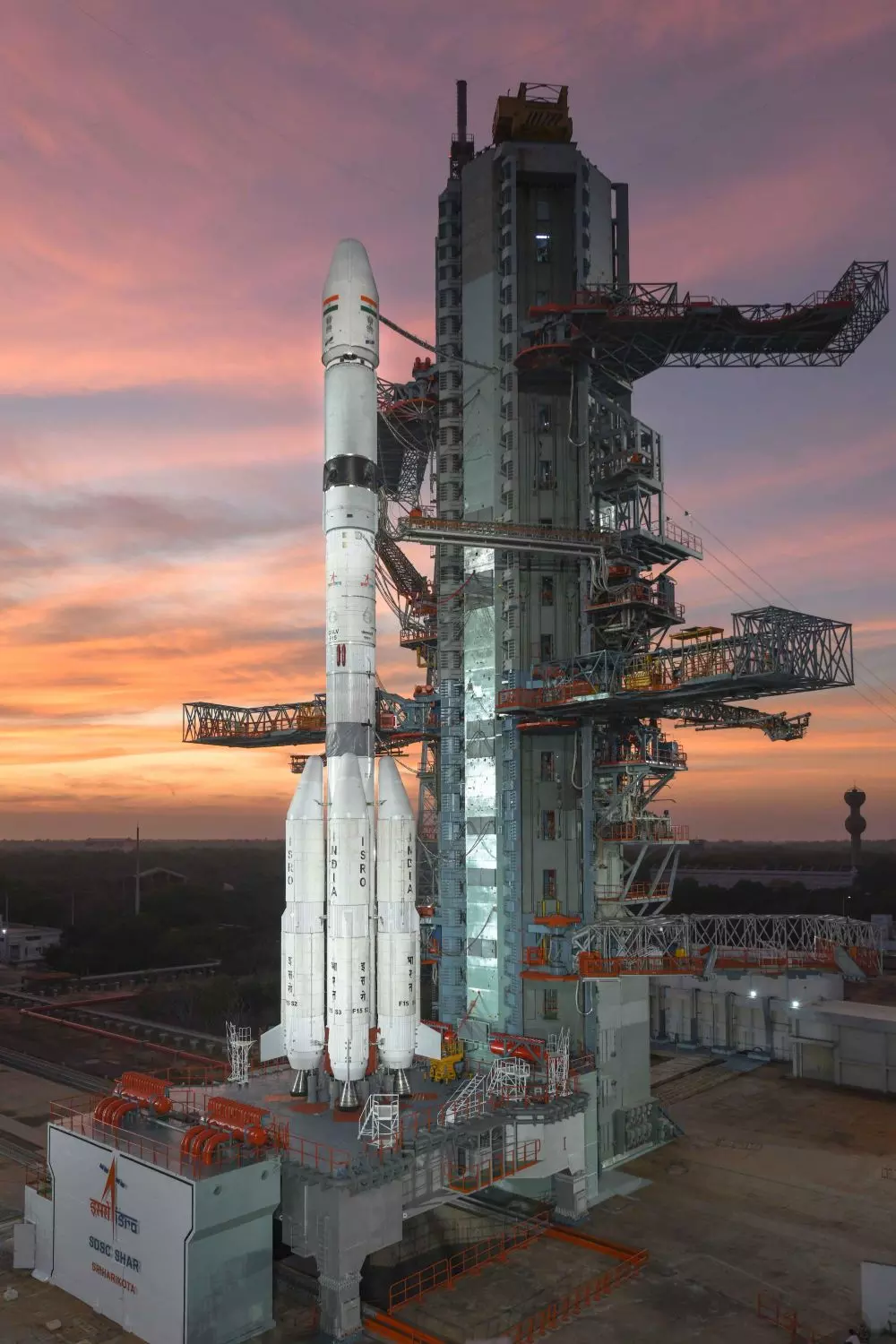
Ongoing preparation for the Gaganyaan mission. Photo: ISRO
Just months before, in November 2025, on the sidelines of the Emerging Science, Technology and Innovation Conclave (ESTIC-2025) in Delhi, Narayanan had declared that "nearly ninety per cent of the progress at the subsystem level has been achieved". The next phase, he had then said, would involve comprehensive integrated testing and verification. Every component, he emphasised, has to withstand the thunderous roar of launch, the vacuum of space, and the searing heat of re-entry. He had also informed that the first fully uncrewed orbital flight, designated Gaganyaan-1 (G1), was scheduled for December 2025.
That was then. Now, once again, the launch of G1 has been delayed.
Also read: How the Chandrayaan-3’s little ‘hop’ changed our insight into building lunar habitats
ISRO hopes to conduct at least three uncrewed test launches, G1, G2, and G3, before the human mission, or H1, is launched. Each uncrewed mission will carry Vyommitra, a robotic humanoid designed to monitor the environment the crew will eventually experience. The logic is to ensure the launch vehicle and spacecraft are safe and trustworthy before placing astronauts aboard.
The ambitious project was initiated in 2018. According to the original plan, the crewed mission was scheduled for August 2022, a date chosen to coincide with the 75th anniversary of India's independence.
Initially, the global Covid-19 pandemic (of 2021-22) caused delays. Then, inexplicably, the project has faced further delays. Technical preparations, the rigorous process of human-rating systems, “erratic fund flows” from the Union government, and, as some insiders say, inadequate recruitment of scientists and engineers have each taken their toll.
And it is not just the timeline that is shifting. The mission goals are also evolving.
Initially, the proposal was to send a three-member Indian crew into space, conduct experiments for about a week, and return them safely aboard an entirely indigenous spacecraft launched by an Indian rocket. A grand vision. Now, the mission will be more modest: a single crew member, perhaps just a few orbits around the Earth.
Human spaceflight is difficult. Delays in space missions are common. They happen to every spacefaring nation. Just look at how much the Artemis project (NASA’s moon exploration mission) or SpaceX's Starship were delayed. Delays in rocket science are inevitable.
And that is precisely the point. Delays are better than loss of mission. Better to see it launch later than to rush it and have a tragedy on our hands. Space does not forgive haste or cutting corners.
Until now, ISRO has been a reliable transporter, moving cargo to space. Gaganyaan changes that. It is a trucking firm becoming a passenger airline. The payload is no longer a machine; it is a human being. ISRO takes care even with satellites. But with humans, we need much better safety standards. A single failure means a life lost.
In rocket science, this transformation has a name: human rating. It is the process of ensuring every component, launch vehicle, escape system, life support, even a single nut and bolt, is safe enough for human travel. It is the difference between a goods lorry and a passenger bus. Both can be reliable, but only one is expected to bring its cargo home alive.
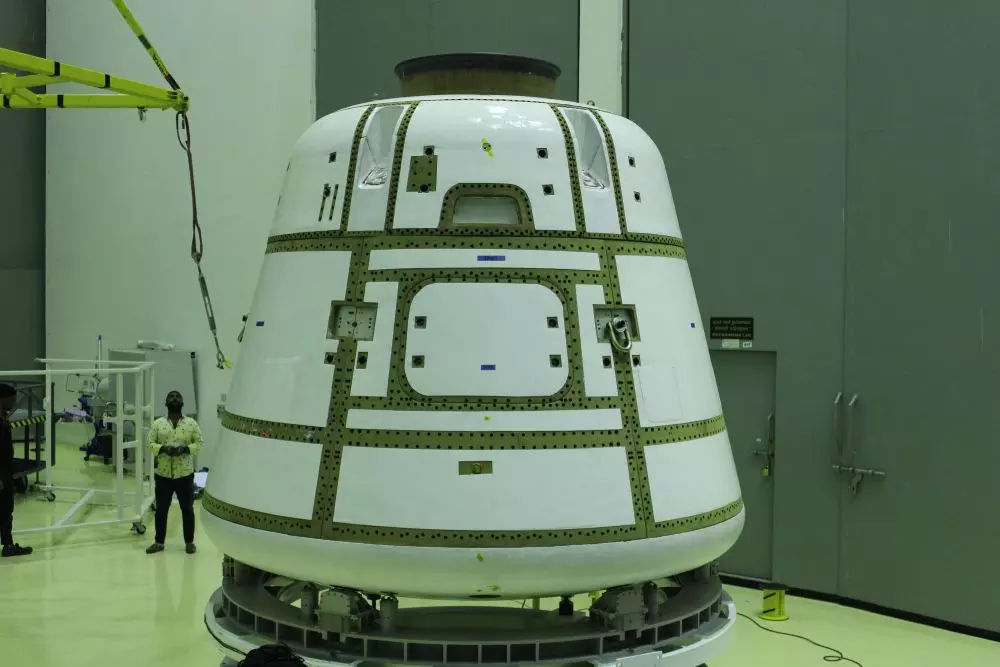
First crew module for Gaganyaan test flight. Photo: ISRO
So let us begin with the launch pad, where the journey starts.
A launch pad built for humans is a different beast from one built for satellites. It must be equipped with emergency escape systems, ready for trouble before liftoff. For Gaganyaan, ISRO has upgraded the Second Launch Pad at the Satish Dhawan Space Centre (SDSC-SHAR) in Sriharikota, Andhra Pradesh to host the Human Rated LVM3, or HLVM3. Among the new safety features is a NASA-style slide-wire, a zipline that can whisk astronauts from the tower to safety within seconds. The high-speed baskets will carry them to an underground blast-protected bunker in the blink of an eye. The ziplines are installed. The bunker is nearing completion. The tests, however, are yet to be done.
There is another addition in the launch pad. A "white room". It sounds clinical, but it is where the final act of preparation unfolds. On launch day, the astronauts step out of a special van, take a lift up the tower, and walk across the Crew Access Arm. They step into the white room, put on their final gear, check their suits and climb through the hatch. Then they sit. Strapped in. Ready for take-off. If there is a delay in launch and the countdown is halted, it is in this sterile antechamber that they will rest before again entering the craft. Construction is ongoing. Only after several quality tests will it be used in the Gaganyaan mission.
ISRO has built an ‘Astronaut Facility’ at the Sriharikota space centre for the Gaganyaan mission. It is the last stop before space. Many days before launch, the crew and their backups will be housed here, isolated from the outside world. No visitors. No infections. No risks to their safety. The logic is clear: a cold or a fever could derail a mission that has cost thousands of crores and years of effort. Inside, the facility has medical rooms for final health checks, preparation spaces where astronauts don their pressure suits, briefing rooms and secure transport to the launch pad.
Alongside, ISRO has established the Orbital Module Preparation Facility, the Gaganyaan Control Centre, and the Gaganyaan Control Facility. In short, the buildings are up. The systems are in place. All that remains is for Indian astronauts to walk through them.
Also read: Why the familiar-sounding warning of a potential super El Niño sounds shriller this time
Now comes the launch vehicle. One misconception about Gaganyaan is that ISRO has built an entirely new rocket. It has not. Instead, it has taken its proven heavy-lift workhorse, the LVM3, popularly known as 'Bahubali', and transformed it into a Human Rated Launch Vehicle, or HLVM3.
The LVM3 has already flown successfully seven times.
The HLVM3 will retain the core architecture but with critical upgrades: human-rated HS200 boosters, an upgraded L110 core stage, and a new C32 cryogenic upper stage. The C32 is a significant leap; it carries about 32 tonnes of cryogenic propellant, up from the earlier version's 25 tonnes. Even the major propulsion systems — the High-Thrust Vikas liquid engines, the large S200 solid boosters, and the CE20 cryogenic engine — are based on hardware with years of flight heritage. What is new is not their basic design, but the way they have been redesigned, qualified, and certified for human spaceflight.
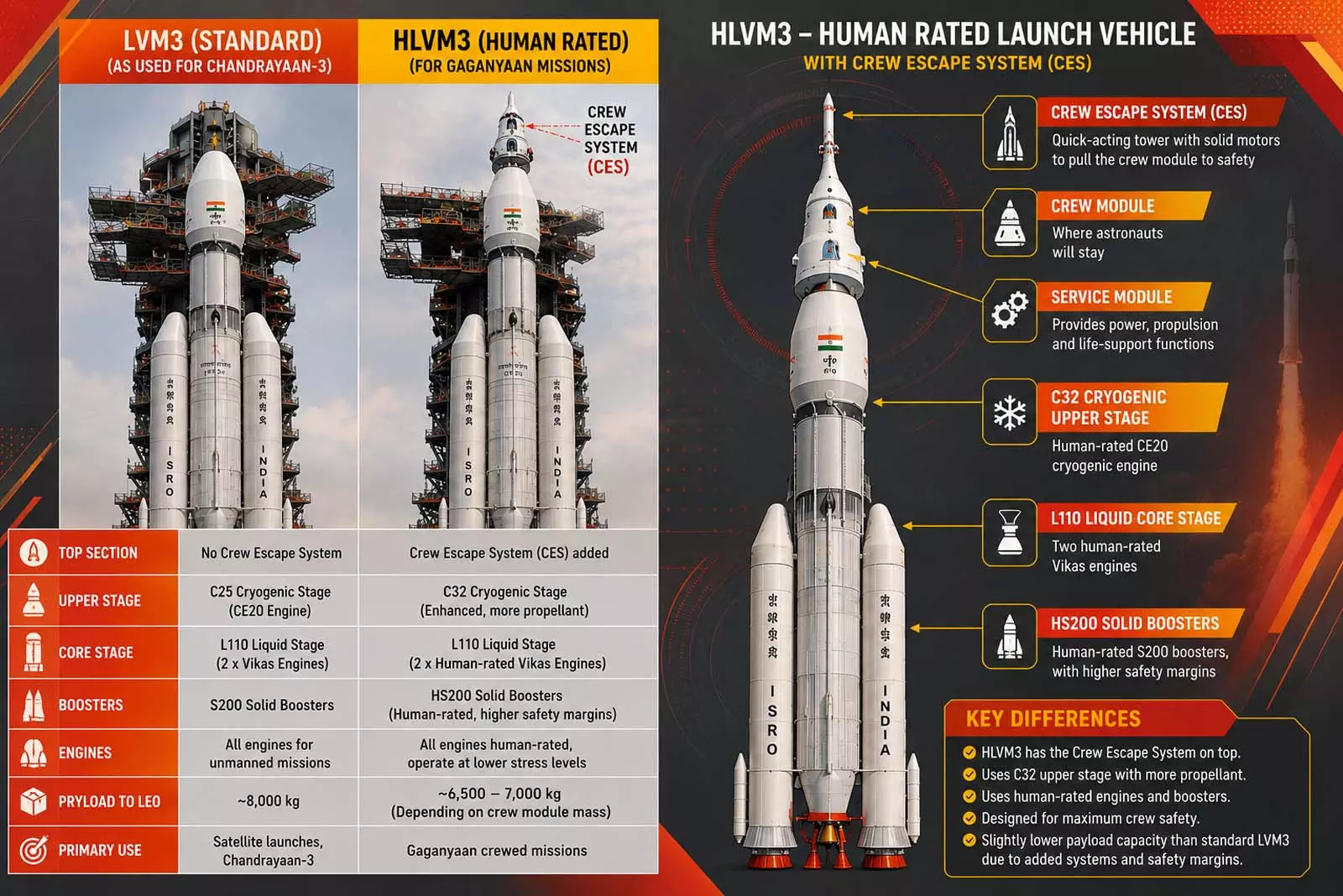
ISRO has taken its proven heavy-lift workhorse, the LVM3, popularly known as 'Bahubali', and transformed it into a Human Rated Launch Vehicle, or HLVM3.
Human-rating is rigorous quality control and redundancy to minimise the chance of failure. It is the process of ensuring a rocket is safe enough to carry people. A standard version might be built to handle 100 units of force. For the human-rated version, engineers build in extra margins so it can handle 150 units.
The testing is rigorous. For certification, the CE20 cryogenic engine was needed to burn for 6,350 seconds. But ISRO engineers tested it for 8,810 seconds, an extra margin that acts as a vital safety net.
The testing goes beyond ground. These human-rated systems are also validated during actual satellite launches. The HS200 boosters, for example, underwent thorough ground tests and were then used on the LVM3-M3/OneWeb India-2 mission in March 2023.
One of the most crucial modifications is the addition of a Crew Escape System, or CES. Think of it as an ejection seat for the entire crew capsule. It is a special tower fitted with powerful quick-acting engines at the very top of the rocket. If something goes wrong during liftoff or ascent, the CES fires instantly, pulling the crew module away from the failing rocket and carrying the astronauts to safety.
ISRO planned four Test Vehicle Abort Missions, designated TV-D1 through TV-D4. The first of these, TV-D1, was successfully conducted in October 2023. The Crew Module separated from the test vehicle and was swiftly carried away as planned. Parachutes deployed, slowing its descent. It splashed down safely in the Bay of Bengal. The test was a success.
Before astronauts can safely return to Earth, ISRO must ensure that the crew module's parachute system works flawlessly. The Sub-Orbital Launch Vehicle for Experiments (SOLVE) is a series of missions designed to validate the sequential deployment of the crew module's ten parachutes during atmospheric re-entry. So far, ISRO has tested individual parachutes and carried out air drop tests using a mock crew module released from helicopters at altitudes of about three kilometres. While these tests verify the basic functioning of the parachutes, they cannot fully reproduce conditions encountered during an actual re-entry.
To bridge this gap, ISRO has developed SOLVE, a solid-propellant rocket derived from the Polar Satellite Launch Vehicle (PSLV) strap-on motor. It can carry a test payload to sub-orbital altitudes of over 100 kilometres, allowing engineers to evaluate the complete parachute deployment sequence under conditions much closer to those of an actual mission. The rocket just completed its ground tests on July 3, 2026. In due course using SOLVE ISRO will test the parachute de-acceleration systems.
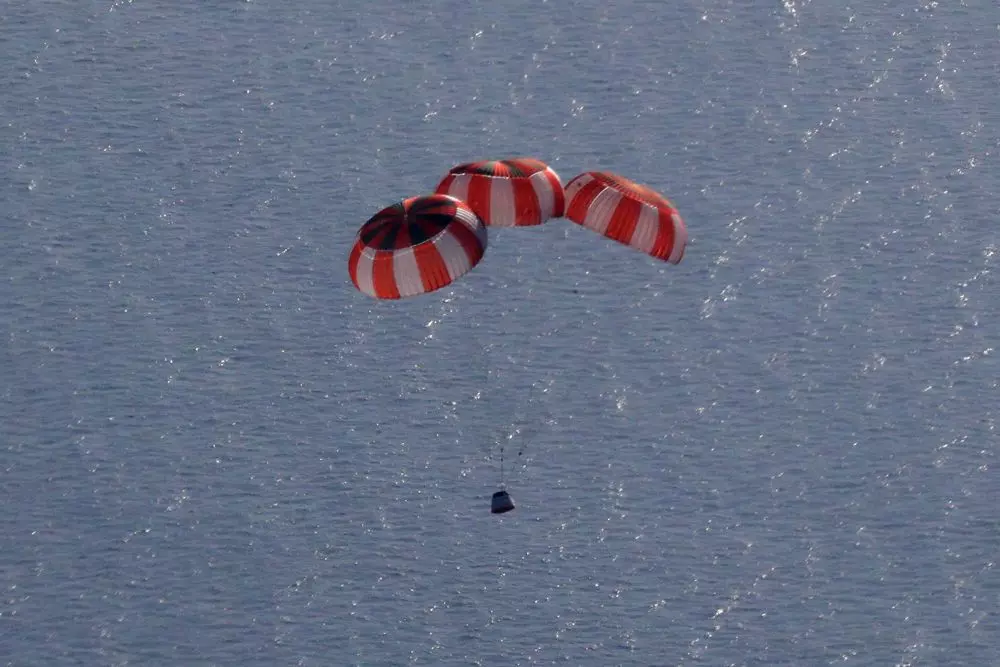
Integrated air drop test for Gaganyaan mission. Photo: ISRO
But the work is far from over. Several critical tests remain, including the subsequent abort missions TV-D2 through TV-D4. ISRO must also demonstrate crew module recovery in challenging sea conditions, rough weather, high waves, and the unpredictable realities of the ocean.
Under the earlier plan, the G1 mission was to take place even before the second test vehicle abort mission, TV-D2. TV-D2 is designed to test the Crew Escape System under more challenging conditions than the first successful test, TV-D1, conducted on October 21, 2023. It is not clear whether the revised schedule change is a deliberate decision to complete all tests sequentially before the uncrewed mission launches.
At the heart of the Gaganyaan mission is the spacecraft itself, a complex, high-tech structure comprising two main segments, attached like railway bogies: the Crew Module and the Service Module.
The Crew Module is the habitable core, the place where the astronauts will live and work. Paired with it is the Service Module, which provides propulsion and power. From launch until the spacecraft reaches orbit, the two function as a single unit. But once the re-entry manoeuvre begins, the Service Module is jettisoned. Only the head-shielded Crew Module returns, bringing its passengers safely back to Earth.
The living space inside the Crew Module is eight cubic metres. Picture a cube slightly taller than a person, just wide enough for four individuals to stand shoulder to shoulder. It is compact, but the interior has been thoughtfully designed. A dashboard with screens and control knobs sits at the front. The seats are specially engineered to absorb extreme G-forces during launch and re-entry. Three porthole windows offer a view of the outside, the Earth, the stars, the vast darkness beyond. Behind the seats, there was to be a dedicated area for work and rest, including a human waste disposal system. However, in H1, due to the HLVM3's limited payload capacity, some of these features may be absent. Some say even the human waste disposal system will be very minimal. ISRO is planning the next upgrade to the LVM3, called the Next Generation Launch Vehicle (NGLV), with greater payload capacity for future human missions.
Initially, ISRO proposed sending a three-member crew, as mentioned above. What changed? The maximum weight capacity of the human-rated launch vehicle has forced a rethink. The maiden mission may now carry a solo crew member, spending approximately one day in space and completing nearly 16 orbits of Earth. That will be enough time to thoroughly assess the performance of the indigenously developed Environmental Control and Life Support System, or ECLSS, and other critical control systems.
The ECLSS is the unsung hero of human spaceflight. It will maintain a comfortable, Earth-like environment inside the crew cabin. Temperature will be regulated between 18 and 27 degrees Celsius. Air pressure will be maintained at a single atmosphere, identical to what we experience on the ground. The air mixture will be nearly 21 per cent oxygen and 79 per cent nitrogen, just like the air we breathe. Oxygen will be generated through the electrolysis of water. Carbon dioxide exhaled by the crew will be scrubbed using lithium hydroxide canisters. A Sabatier reactor will recycle carbon dioxide and hydrogen to produce methane and water. That water can be electrolysed again to produce more oxygen, creating an efficient cycle that reuses precious resources. A portion of the water can even be used for drinking. Methane has potential as a propellant in future missions. For crew comfort on longer missions, an integrated toilet and hygiene system designed for three-day missions will also be part of the cabin. A report to a parliamentary committee this year stated that the engineering design of the ECLSS is complete. That means actual fabrication and ground testing is still ongoing.
Also read: How the failure of a satellite’s atomic clock has put India’s national security at risk
Here is the question that lingers. On many occasions, ISRO officials have indicated that for G1, only a non-pressurised crew module will be flown, a dummy of the same mass and size, not the actual spacecraft. For testing the system, it may be adequate. But the earlier plan was to fit G1, G2, and G3 with Vyommitra, a robotic humanoid designed to assess the functionality of the crew module and ECLSS.
For example, during lift-off, the rocket will develop G-forces, and Vyommitra would have been able to assess the functionality of the crew seats. During re-entry, it would have measured the turbulence experienced inside the craft. That plan appears to have been quietly revised. The question is why. And whether a dummy module can truly replicate the conditions that Vyommitra would have experienced.
Then comes the most dangerous phase: re-entry, descent, and landing, or EDL. This is where the crew will splash down near the Andaman Islands after their space sojourn. One of the critical tests is the qualification of individual parachutes, which is nearly completed. Through Integrated Parachute Air-Drop Tests, or IADTs, the splashdown sequence is simulated, with each parachute deploying in a precise, choreographed order. Two such tests have been completed. A number of them remain. As part of the abort flight tests, one re-entry test is still pending. Of course, a full-scale orbital re-entry can only take place with G1, G2, and G3, which will test the entire mission end-to-end.
The Gaganyaan mission has faced several delays, repeatedly pushing back India's crewed journey to space. As the Parliamentary Standing Committee on Science and Technology noted in a report submitted to the Rajya Sabha earlier this year, significant budget reductions in recent years have hampered consistent progress.
We are getting there. But we are not quite there yet. That, in essence, is the story of Gaganyaan so far.