- Home
- India
- World
- Premium
- THE FEDERAL SPECIAL
- States
- Perspective
- Videos
- Sports
- Education
- Entertainment
- Elections
- Features
- Health
- Business
- Series
- In memoriam: Sheikh Mujibur Rahman
- Bishnoi's Men
- NEET TANGLE
- Economy Series
- Earth Day
- Kashmir’s Frozen Turbulence
- India@75
- The legend of Ramjanmabhoomi
- Liberalisation@30
- How to tame a dragon
- Celebrating biodiversity
- Farm Matters
- 50 days of solitude
- Bringing Migrants Home
- Budget 2020
- Jharkhand Votes
- The Federal Investigates
- The Federal Impact
- Vanishing Sand
- Gandhi @ 150
- Andhra Today
- Field report
- Operation Gulmarg
- Pandemic @1 Mn in India
- The Federal Year-End
- The Zero Year
- Science
- Brand studio
- Newsletter

How the Gen Z protest may have impacted campus politics in the country
The recent students' agitation for accountability and reforms in education saw a spontaneous outpouring of support from Gen Z across the country, as they rewrote the language of dissent with their memes and Korean heart gestures. Now, back on campuses, in colleges and universities, will it result in greater political involvement? The Delhi University Students' Union polls this month saw higher voter turnout than in several past years and youth organisations talk of ‘change’.

When elections to the Delhi University Students’ Union (DUSU) were held earlier this month, it achieved a record 40.46 per cent voter turnout, the highest in three years. The run-up to the polls had seen candidates and parties engaged in a pitched campaign on issues ranging from accommodation for students — in the aftermath of the Satya Niketan building collapse in Delhi, which resulted...
When elections to the Delhi University Students’ Union (DUSU) were held earlier this month, it achieved a record 40.46 per cent voter turnout, the highest in three years. The run-up to the polls had seen candidates and parties engaged in a pitched campaign on issues ranging from accommodation for students — in the aftermath of the Satya Niketan building collapse in Delhi, which resulted in the death of five Delhi University students — to concerns regarding education and examination.
The Akhil Bharatiya Vidyarthi Parishad (ABVP), the students’ wing of the Rashtriya Swayamsevak Sangh (RSS, the ideological fountainhead of the ruling Bharatiya Janata Party at the Centre), won three of the four central panel positions, including that of the president, secretary and joint secretaries. According to reports, however, the results revealed fragmented voting patterns.
And despite the ABVP victory, opposition parties such as the Left-aligned Students' Federation of India (SFI) and the National Students’ Union of India (NSUI), the Congress’s students’ wing, are holding on to one “inspiring trend” — what appears to be increased participation of students in campus politics, as indicated by the higher voting numbers.
“There has definitely been a politicisation of students and youth and we believe it to be a result of the recent students’ agitations [for greater accountability and reforms in education],” says Anshul Trivedi of the Congress. He cites the example of his own “13-14 year old niece”, who he says recently forwarded him a video purportedly “mocking” former Union education minister and Bharatiya Janata Party (BJP) member of parliament (MP), Dharmendra Pradhan. “She knows what I do, but for her to co-relate the two and send me the video…There is an awareness that has been triggered by the students’ agitation,” he adds.
Student leaders on the campus too talk of visible ‘change’.
“Students who have so far been apolitical, perhaps fearing repression, or fear of labelling, some of them have now got the confidence to join protests or campaigns,” explains Simran, vice president of the Delhi chapter of SFI and the party’s DU convenor. According to her estimates, if before the students’ agitations 70 to 80 freshers would attend a short-notice protest called by the party on campus, the number since the June-July students’ agitation has gone up to “100 to 120”.
At Jawaharlal Nehru University (JNU), the university’s students’ union vice president and SFI member, 25-year-old Gopika Babu, a PhD scholar in law and governance, shares similar insights. “There is definitely greater interest and awareness. At protests now, there is more attendance and 60 per cent would be freshers,” she says.
Following the National Eligibility Cum Entrance Test (NEET) paper leak scandal which broke out in May this year, forcing a re-examination, the Cockroach Janata Party (CJP) sounded a call for protest, demanding educational reforms and accountability. The CJP was born as an online movement against Chief Justice of India (CJI) Surya Kant’s purported likening of the country’s unemployed youth with cockroaches (the CJI has since reportedly claimed he only used the term for ‘fake’ law degree holders). The protest spearheaded by the CJP demanded the resignation of then Union Education Minister Pradhan. By July, the protest, which had started the month before from Delhi’s Jantar Mantar, was not only drawing Gen Z (those born between 1997 and 2012) from across the country to the demonstration site, but solidarity agitations were being staged by students in other cities and towns.
When the protest, which saw the resignation of Pradhan, finally concluded in end-July, a new language of dissent had been scripted — using humour, Korean figure heart gestures and a meme language that the system had no ready response to — and the Gen Z had established itself not just as an important vote bank that all parties were eager to woo, but a demographic segment that is alert, aware and not afraid to question.
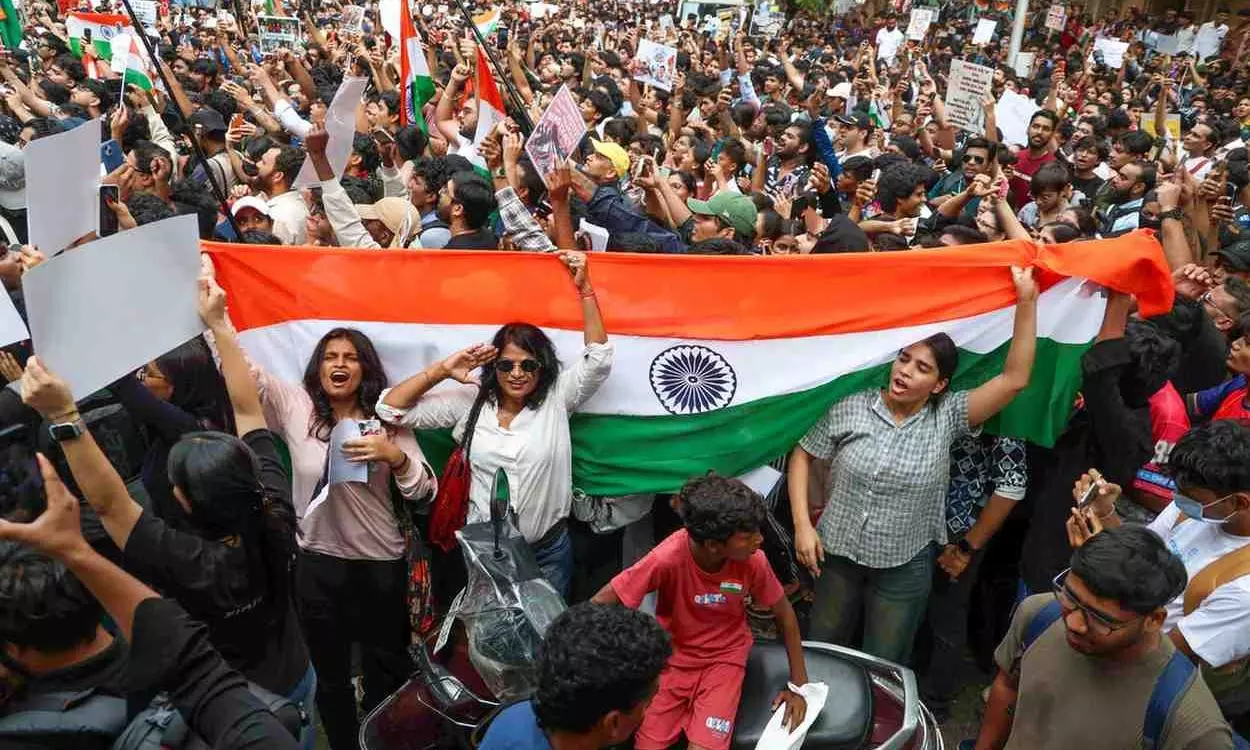
A Gen Z protest in Mumbai in support of the Jantar Mantar agitation. File photo
“The increase in DUSU voting appears to be a likely impact of the Gen Z protests. But it is one election. We cannot know for sure if it [the impact of the agitation on campus politics] is a trend unless we see other student elections,” says Sanjay Kumar, professor and former director of the Centre for Study of Developing Societies (CSDS), whose core area of specialisation is electoral politics. He adds: “However, in my opinion, the youth is certainly more politically aware [after the agitation]; they are aware of their rights and they are going to come out in greater numbers not just in student elections but in all future elections.”
Like mainstream political parties, student organisations too have started outreach programmes keeping Gen Z aspirations in mind.
In Keralam, the old vocabulary of student politics, built around long speeches, ideological debates and rigid organisational loyalties, may have to make room for shorter, sharper and more relatable forms of communication, say youth leaders. Meme culture, social media and issue-based alliances could become more central to mobilisation, while students may increasingly judge organisations by their ability to deliver results rather than simply by their ideological positions. The emerging politics could therefore be less about permanent camps and more about flexible alliances around specific student concerns, forcing even Keralam’s deeply entrenched campus organisations to rethink how they speak to and organise a new generation.
“The agitation at Jantar Mantar, along with the massive protests that erupted across the country against alleged irregularities in the NEET examination, have given students and student organisations a great deal of enthusiasm and confidence. They have created a new energy in student activism,” says Adarsh M Saji, all-India president of the SFI.
He adds: “In the past, we have used certain conventional methods to take political issues to students and make them aware of them. But what we have learnt from this movement is the need to communicate beyond those methods — to reach students in a crisp, point-by-point manner.”
The observation is iterated by Aloshious Xaviour, state president of the Kerala Students’ Union (KSU), a wing of the Congress. “Traditionally, political activism used a nuanced and polished [formal] language to take issues to the people. But there has been a shift from that. The language of communication has become much simpler and more localised,” he agrees.
Across states, the impact of the Gen Z protests is being felt in varying ways, say those The Federal spoke to.
In West Bengal, since the coming to power of the Trinamool Congress in 2011, the Trinamool Chhatra Parishad (TMCP) dominated much of campus politics, with Left-leaning student groups like the SFI, All India Students’ Association (AISA), All India Students’ Federation (AISF), Democratic Students’ Federation (DSF) and others like the All India Students’ Democratic Organisation (AIDSO) retaining influence in some institutions.
The BJP’s victory in the state in this year’s assembly elections has altered that equation, giving the ABVP a significant organisational push. The organisation has since been expanding rapidly in Bengal, including at Jadavpur University (JU), one of the state’s most politically active campuses.
New ABVP recruits The Federal spoke to say they feel more confident identifying with the organisation now after the change of government. One such JU student, Avishek Patra, claimed the university campus had earlier been dominated by the TMCP and Left and that students with different political views had found little space. Another student, Tapan Das, said he had supported ABVP’s ideology but had stayed away earlier because of the prevailing political atmosphere in the state; he added that “the atmosphere has changed”. ABVP has claimed a substantial rise in membership (though figures are not yet available) and an ambitious expansion across campuses.
The Gen Z mobilisation has now added another dimension to this turf war. Kolkata witnessed large protests around the CJP movement, with Left student organisations playing a prominent role, while ABVP organised counter-mobilisations. The development has brought established student organisations into contact with politically active young people who are not necessarily affiliated to any union. At JU, a confrontation last month between the SFI and ABVP over a Faculty of Engineering and Technology Students’ Union general body meeting demonstrated the political power play between the different student organisations.
The Prajonmer Dak (the generation’s call), a CPI(M)-backed initiative designed to engage the next generation, is now attempting to tap into this newly-politicised demographic. “The initiative suggests that the Left recognises that Gen Z cannot simply be approached through the traditional SFI-CPI(M) organisational structure. Its use of rap, social media language and direct digital questioning represents an attempt to make the political conversation more accessible to young people who may be willing to protest but reluctant to become conventional party or union members,” explains Debashis Chakrabarti, a Kolkata-based political columnist and Commonwealth Fellow (UK).
This attempt was particularly visible in the use of technology and other unconventional outreach methods at a Barasat event where young participants were given a QR code through which they could send questions on the latest political situation in the country and the state. The queries raised were answered by SFI leaders Akash Kar, Dipshita Dhar, Aishi Ghosh and Afrin Begum. The format was a deliberate departure from the conventional one-way political meeting, with the organisers using a digital interface to allow young people to determine at least some of the subjects of discussion.
The combination of Rabindra Sangeet, rap and QR-code interaction as an indication that “politics is learning to speak in the language of young people,” says Debargh Dutta, an anthropology student at West Bengal State University, Howrah, who attended the programme. “Students are raising demands for education and schools. Why should they be suppressed? No society can function by suppressing dissent. That is why there is a message of resistance.”
Eshana Sen, an SFI student leader from Jadavpur University, further claims, “This generation is fighting with the Constitution in its hands, at a time when the Constitution is under attack.” Her remarks sought to connect the new generation’s mobilisation with Jadavpur’s older tradition of student protest.
Aishi Ghosh, the former JNU students’ union president, similarly sought to frame the Prajanmer Dak mobilisation as part of a wider student movement, saying that “the new generation will resist attempts to impose divisive and ‘Manuvadi’ education” and that it would continue the fight for the right to education.
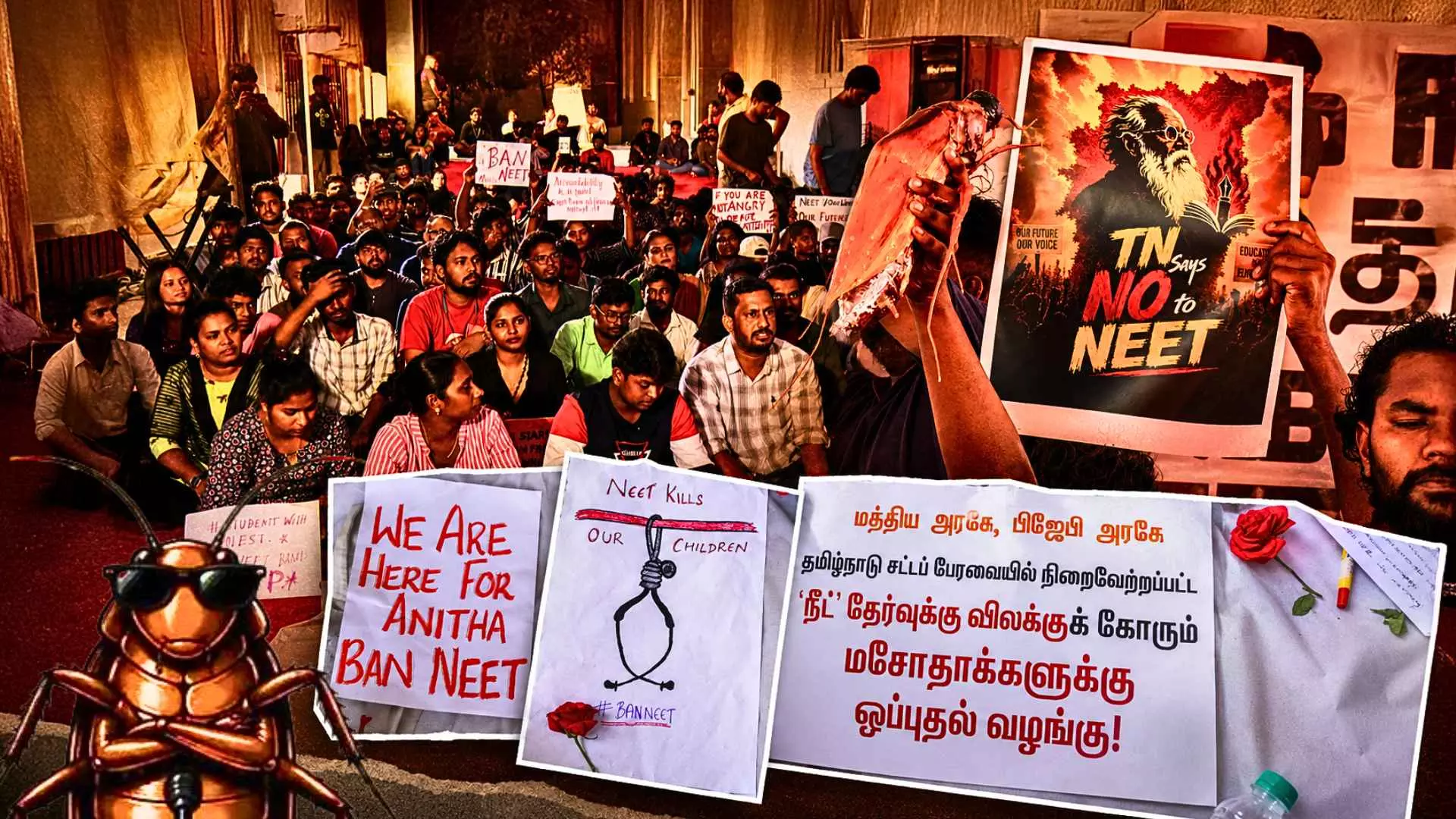
A protest in Chennai during the NEET agitation. File photo
The Gen Z focus on issues relating to education and employment — soon after the Jantar Mantar protest came an agitation in Jharkhand against alleged irregularities in recruitment examination for government jobs — and their demand for accountability in politics and governance has also effected issue-based alliances between non-ABVP student organisations.
The political mobilisation of Gen Z students comes despite student union elections in many states having not taken place in years.
In West Bengal, student-union elections have not been held in most state colleges and universities for years. At Jadavpur University, one of Bengal’s most politically active campuses, the last elections were held in February 2020 and the elected bodies ceased functioning in 2021.
In Telangana, student union elections have not been held in state educational institutions ever since it was carved out of undivided Andhra Pradesh in 2014. In 1988, student union elections were banned in undivided Andhra Pradesh. The ban followed clashes between ABVP and Radical Students Union (RSU) leaders during student union elections at Osmania University, resulting in the killing of RSU leader Chandra Reddy. Following violent incidents across the state, the then Andhra government banned student union elections in educational institutions, which continues to be followed in Telangana even today. Six months back, retired IAS officer Akunuri Murali, who studied the conditions in educational institutions in Telangana, submitted a report to the Revanth Reddy government in the state recommending that student union elections be conducted in colleges, but the government is yet to act on it. However, the central University of Hyderabad held union elections earlier this week.
Talking to The Federal, SFI state general secretary for Telangana, Thaalla Nagaraju, said all student organisations too had repeatedly urged the government to conduct student union elections, but the government had failed to respond. He claimed that successive governments in the state have cited law-and-order concerns and the possibility of political interference affecting the academic environment as reasons for not holding the elections.
In Tamil Nadu, campus elections were stopped in 2015 following violent clashes, including incidents at Presidency College, Chennai. However, following the CJP protests, demonstrations by student organisations such as the SFI have gained significance in various parts of Tamil Nadu. Weeks back, the Tamil Nadu Education Department issued a circular to all educational institutions banning students from participating in political protests, particularly those organised by Left parties and the CJP, but the circular was withdrawn following opposition from various political parties.
Speaking to The Federal, SFI state president S Mirudhula said that the circular had been a violation of students' democratic rights to engage in peaceful dissent and raise institutional or public issues. “It is unconstitutional to tell us not to take part in protests. We are pushed to protest even to establish our right to protest. Student movements should be allowed to function freely, which would improve the participatory approach to democracy,” she said.
Political analyst and writer A Jeevakumar highlights the paradox of a situation where political parties “do not want students to take part in politics in educational institutions, but want their votes and establish separate units within their own parties” to reach out to the youth.
In some states now, faculty are coming out in support of students’ right to protest.
“It is essential for the younger generation to raise its voice socially. More than 65 per cent of the country’s population consists of young people, and they are focusing on their careers. It is a welcome development that they are raising their voices when problems arise,” BK Ravi, vice-chancellor of Bangalore North University, told The Federal. He, however, highlighted the need for making “legitimate demands”. Sudheer Krishnaswamy, vice-chancellor of the National Law School of India University (NLSIU), Bengaluru, added that “when a protest is a student’s right and involves legitimate demands, the administration should listen to it”. Sharath Ananthamurthy, vice-chancellor of Kuvempu University in Shivamogga, is even more vocal. “Students are highlighting the shortcomings in the entire education system…the teaching community should introspect,” he says.
India has had a long tradition of active campus politics, dating back to the pre-Independence period, when the first youth leagues were set up. Across parties, there are examples of veteran leaders who have risen through the ranks from student activism. Arun Jaitley, Sitaram Yechury and Lalu Prasad Yadav are some examples.
In recent years and decades, however, the issue of non-holding of union elections has dealt a blow to campus politics. In a 2017 ‘Dialogue on Student Politics in India: Issues and Challenges’, jointly organised by the CSDS and Konrad Adenauer Stiftung (KAS) with student leaders from across prominent Indian universities, one of the observations was that a student union in “many ways is a platform for the young leaders for future political leadership or a preparing ground for future parliamentarians. There was a total consensus on the importance of [the] student union in universities and the need to conduct elections to elect student bodies as a must”.
Even where union elections are held, in JNU for example, there have been allegations of diminishing space for dissent. During the June-July protests, there were appeals for calm made by DU, and the university had also purportedly cited “vested interests” behind the agitation.
Since the conclusion of the protest, however, both the Opposition and the ruling BJP have made efforts to reach out to Gen Z. But this may not automatically open up the space for political agitations in campuses, or push for reinstating union elections where they have been pending for years, feel experts.
Also read: Jantar Mantar to South Mumbai, can Neha Bora's Gen Z campaign penetrate beyond Left liberal camps?
In Maharashtra, the Devendra Fadnavis-led government this month constituted a committee to draw up a framework for student union polls, last held in the state in 1993.
Anshul Trivedi, however, cites the example of another state, Madhya Pradesh. Last month, the state high court directed the state to hold student union elections in state universities after an eight-year freeze. While the state has announced that elections will be held, Trivedi claims no concrete steps have been taken yet to that effect.
“Student politics has always worked as a pressure group on the administration. That pressure has intensified since the Gen Z protest,” says Akhilesh Yadav, a PhD scholar at JNU and a member of the NSUI. Having "closely watched and overseen" the DUSU elections, he adds, “Freshers' participation has increased; they have become part of the political discourse at campuses and they are demanding accountability.”
For now, that word is the most commonly cited outcome of the Gen Z protest and one of the most acclaimed developments in campus politics in the country.
It's something that student unions and organisations too would have to take into account in the long run. In the run-up to the DUSU elections, many of the students The Federal spoke to dismissed the polls as a "show of money and muscle power". They also accused student leaders and organisations of being out-of-touch with the real issues affecting students — wi-fi access, condition of hostels, attendance problems, examination-related concerns... "whether it is NSUI or ABVP, no one even comes and talks to students", was a common refrain heard.
(With inputs from Rajeev Ramachandran, Samir K Purkayastha, Phani Kumar, Chandrappa M, Pramila Krishnan and Abhishek Rawat)