- Home
- India
- World
- Premium
- THE FEDERAL SPECIAL
- States
- Perspective
- Videos
- Sports
- Education
- Entertainment
- Elections
- Features
- Health
- Business
- Series
- In memoriam: Sheikh Mujibur Rahman
- Bishnoi's Men
- NEET TANGLE
- Economy Series
- Earth Day
- Kashmir’s Frozen Turbulence
- India@75
- The legend of Ramjanmabhoomi
- Liberalisation@30
- How to tame a dragon
- Celebrating biodiversity
- Farm Matters
- 50 days of solitude
- Bringing Migrants Home
- Budget 2020
- Jharkhand Votes
- The Federal Investigates
- The Federal Impact
- Vanishing Sand
- Gandhi @ 150
- Andhra Today
- Field report
- Operation Gulmarg
- Pandemic @1 Mn in India
- The Federal Year-End
- The Zero Year
- Science
- Brand studio
- Newsletter

How a teacher-turned-entrepreneur is using social media to help Telangana weavers find customers
Sangeetha Rajesh, an Indian School of Business and NIFT alumna, has been using social media to tap into a limitless market. Over the years, she claims to have sold over one million sarees via Facebook Live, while helping weavers remove middlemen involvement in sales.

The most conspicuous item at 51-year-old Praneetha Ramaiah’s small tiled hut at the edge of Telangana’s Pochampally village is the handloom with its tangle of colourful threads. For years, Ramaiah has sat at that loom, weaving sarees that have adorned women across India, possibly even abroad. Afterall, the village is known for its eponymous ikat weave, the Pochampally sarees.It is...
The most conspicuous item at 51-year-old Praneetha Ramaiah’s small tiled hut at the edge of Telangana’s Pochampally village is the handloom with its tangle of colourful threads. For years, Ramaiah has sat at that loom, weaving sarees that have adorned women across India, possibly even abroad. Afterall, the village is known for its eponymous ikat weave, the Pochampally sarees.
It is laborious work, a single saree taking days to be completed. His fingers crack, his back aches from hours at the loom. But the smile that lights up his face when he beholds each finished weave is radiant.
Life had been the same for him for decades, and for his father and grandfather before him, as the art of weaving is lovingly passed down generations in this village, which gets its identity from its handlooms.
But something changed for Ramaiah a few years back. A chance meeting with teacher-turned-entrepreneur Sangeetha Rajesh opened up the possibilities of e-commerce.
“First one order came, then another, then a few more. For the first time, I was connecting directly with customers, without the involvement of middlemen who had traditionally decided the price of my craft. For the first time, I was receiving the true dues of my work, but I was also getting recognised for it,” he recalls.
Today, Ramaiah is one of the hundreds of weavers associated with Rajesh as she uses social media to not just sell sarees, but narrate the legacy behind each weave.
Also read: How GI tag has brought fresh focus to ‘Kutch Ajrakh’, helped find new platforms for promotion
For the former teacher working with children with intellectual disabilities and an Indian School of Business (ISB) alumna, the foray into the world of textiles happened with a single question — “Why is the market so far away from the weaver who creates such extraordinary art?”
What followed was not only the founding of Sangeetha’s Saree Emporium, but a NIFT degree and using social media to tap into a borderless market.
In 2012, she set up a small shop near her Hyderabad residence, but online sales were her mainstay. Armed with a mobile phone, storytelling skills, patience and the ability to connect on social media, she built a business that today runs into crores.
In the interim, in 2014, she joined the National Institute of Fashion Technology (NIFT) to better understand the craft.
“Sales are the biggest problem for weavers. Production exists, but selling doesn’t. There’s little awareness about things like GST [goods and services tax]. Weavers are leaving the profession, and it’s becoming difficult for the next generation to continue,” says Rajesh, explaining the motivation behind her business.
For the 49-year-old entrepreneur, the business model mostly revolves around sales through Facebook Live sessions, during which she showcases a range of sarees, from designer drapes to traditional handloom weaves and contemporary collections. Prices range from Rs 645 to Rs 45,000, catering to people with varying budgets.
With a Facebook following of over 8.5 lakh, Sangeetha Rajesh claims to have sold over a million sarees via Facebook Live. Milestones include selling 3,000 sarees in a single session and sales worth Rs 35 crore in one live. Photo: By special arrangement
It’s a veritable marketplace out there and Rajesh, with her twin training in business and fashion, knows just how to make an impact.
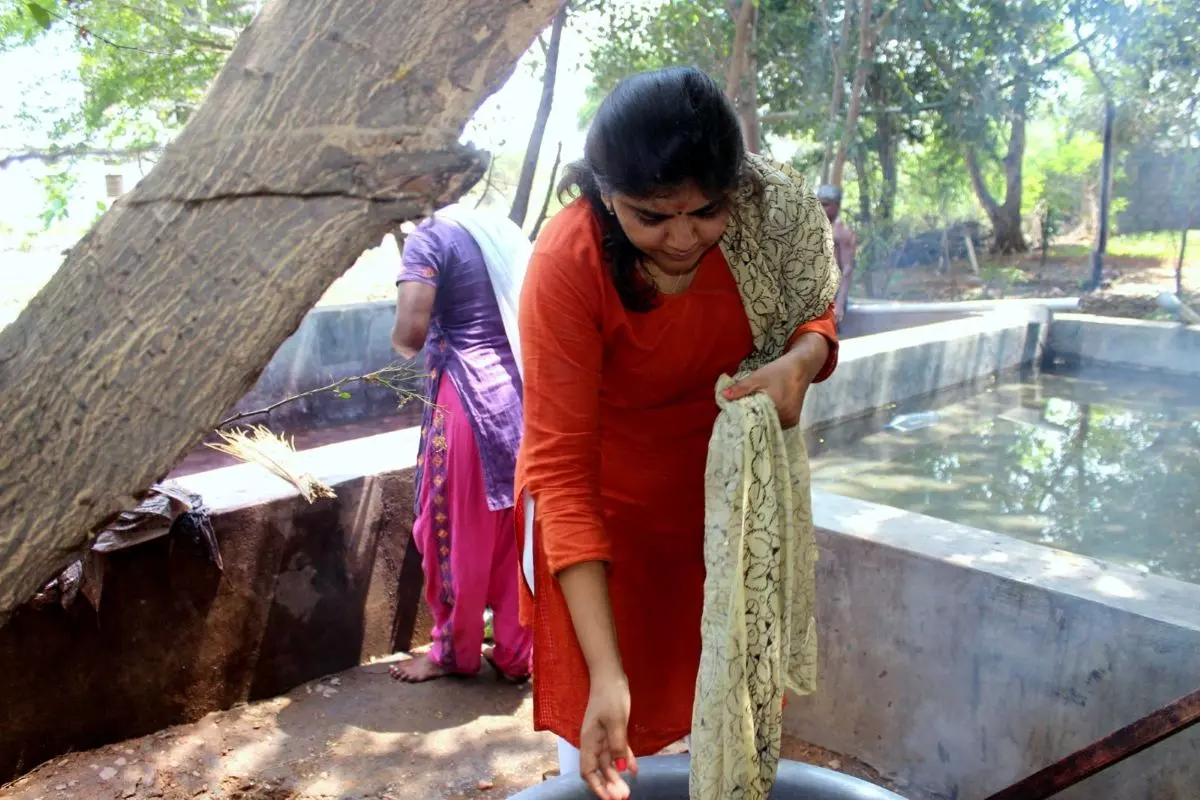
The entrepreneur says she does not “sell” sarees on her Facebook Live sessions, she tells people the stories behind the weaves — where was the saree woven, in which village, the techniques and designs involved in its making, the days of labour behind the finished product. “Such narratives build curiosity and trust among buyers,” she explains.
With a Facebook following of over 8.5 lakh, Rajesh claims to have sold over one million sarees via Facebook Live. Milestones include selling 3,000 sarees in a single session and sales worth Rs 35 crore in one live.
Her online customers are not restricted to Telangana.
“There is about a 40 per cent price difference between sarees and dresses bought from outside shops and those sold through Sangeetha’s Facebook Live sessions. I have been watching her Facebook Live(s) for the past five years. My friends and relatives also like her collection. I have developed trust in her, and that is why I continue to buy from her regularly,” says Radha Ganesh, from Mangaluru, Karnataka.
Also read: A prized possession for generations, why Mysore silk sarees are failing to keep up with demand
Over the years, Rajesh has built not only a coterie of loyal customers but a core group of 200 weavers, for whom she has managed to boost incomes by cutting out middlemen involvement.
“Many of the weavers are women, often living in distress, widowed. I document their lives and use Facebook as a tool. I show customers the labour behind every weave. By selling their products, I’ve been able to increase weavers’ incomes by about 25 per cent, which gives me immense satisfaction,” she says.
One of those to have been benefited by her intervention is, of course, Ramaiah.
He recalls the time when a middleman would arrive, decide the price of his weaves and placing a small amount of money in his hand, leave. The weaver lacked the courage to bargain because he knew of no other way to sell his product.
“After a month of hard labour, the money left was not even enough to repay debts. Children’s education, household expenses and health issues were constant worries. The question, ‘Can we really survive with this profession?’ popped up in my mind every day,” says Ramaiah.
Then Rajesh helped him start online sales. Photos of his handwoven saris were uploaded to an online platform. The first notification, "Your product has received an order", brought tears to his eyes, he remembers.
“Slowly, life has changed. There are middlemen now, no underpricing. I decide the worth of my work. Debt conversations at home have reduced,” says Ramaiah.
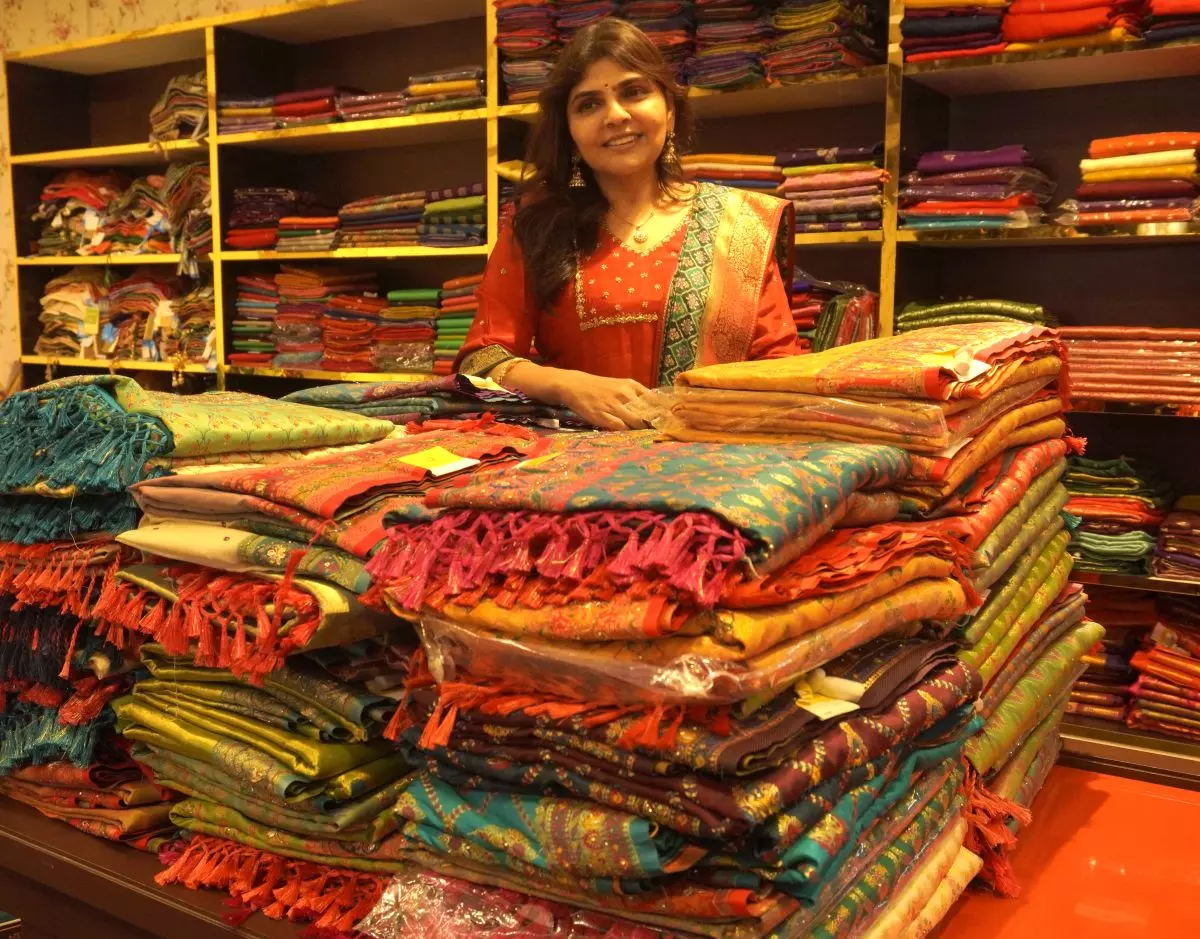
Sangeetha Rajesh recently launched a 5,000 square feet flagship saree shop in Hyderabad’s upscale Banjara Hills, with a stock of over 15,000 sarees. Yet, she sees the store as just an extension of her online brand. Photo: By special arrangement
Goli Ramesh, a 42-year-old weaver from Narayanpet, shares a similar experience. Born into a family of weavers, Ramesh recalls that even after working 10-12 hours everyday, along with his wife, their monthly income would barely touch Rs 9,000.
“After spending three to five days weaving a single saree, at an investment cost of Rs 1,200, we would receive only Rs 1,400 for it. By 2023, I had accumulated debts to the tune of Rs 1.8 lakh,” he says.
It was around this time that he connected with Rajesh and started selling his sarees online.
“In the very first session, I received four orders. Each sari sold for Rs 2,800 to Rs 3,500. Within three months, our monthly income rose from Rs 9,000 to Rs 25,000,” Ramesh adds.
By 2025, Ramesh had repaid 90% of his debts. Today, not only has his average monthly income touched Rs 40,000, but he has formed a small group with six other weavers from his village, selling around 120 sarees online every month.
“I wanted to quit this profession. But it has now given me dignity,” says Ramesh.
Also read: How a nondescript Odisha village has found identity with a weekly haat for Sambalpuri sarees
Meanwhile, Rajesh recently launched a 5,000 square feet flagship saree shop in Hyderabad’s upscale Banjara Hills, with a stock of over 15,000 sarees. Yet, she sees the store as just an extension of her online brand; the heart of her business still beats in live commerce.
While the entrepreneur declines answering questions on her own profits from the business, she says, “By selling online through Facebook, I earned more than I had ever imagined. I do not aspire to earn endlessly or open multiple stores. I share tips with weavers who want to increase their online sales. With my experience, I want to help them build a better future. In the beginning, I lost some money myself — I don’t want that to happen to them.”
When Rajesh had first told Ramaiah about online sales, he recalls laughing. “I had told her that all that was not for people like us.” Today that incredulity has been replaced by a quiet confidence born of knowing the true worth of his labour.