- Home
- India
- World
- Premium
- THE FEDERAL SPECIAL
- States
- Perspective
- Videos
- Sports
- Education
- Entertainment
- Elections
- Features
- Health
- Business
- Series
- In memoriam: Sheikh Mujibur Rahman
- Bishnoi's Men
- NEET TANGLE
- Economy Series
- Earth Day
- Kashmir’s Frozen Turbulence
- India@75
- The legend of Ramjanmabhoomi
- Liberalisation@30
- How to tame a dragon
- Celebrating biodiversity
- Farm Matters
- 50 days of solitude
- Bringing Migrants Home
- Budget 2020
- Jharkhand Votes
- The Federal Investigates
- The Federal Impact
- Vanishing Sand
- Gandhi @ 150
- Andhra Today
- Field report
- Operation Gulmarg
- Pandemic @1 Mn in India
- The Federal Year-End
- The Zero Year
- Science
- Brand studio
- Newsletter

How ‘desi fitness’ is changing workout goals and life aspirations in Haryana
Influencers like Ankit Baiyanpuria, Rahul Dhandlaniya and Sunder Sangwan are selling the idea of an Indian diet and simple, low-cost training — including mud tracks, akhara-style drills and home workouts — in reels and YouTube Shorts. Fitness is now a ticket to status, recognition and money.

At 5 am in parts of Haryana, the day now begins with two different kinds of alarms: the first for the run, the second for the reel. A phone screen lights up and a familiar greeting cuts through the quiet morning — “Ram-Ram bhai sareya ne” [Ram Ram to everyone]. The clip is short: shots of a mud track, someone working out with a skipping rope, doing push-ups, engaging in akhara-style...
At 5 am in parts of Haryana, the day now begins with two different kinds of alarms: the first for the run, the second for the reel. A phone screen lights up and a familiar greeting cuts through the quiet morning — “Ram-Ram bhai sareya ne” [Ram Ram to everyone]. The clip is short: shots of a mud track, someone working out with a skipping rope, doing push-ups, engaging in akhara-style drills, eating a quick desi meal and peddling the promise of discipline. But the message is bigger than fitness. It sells a complete identity — local, tough, consistent — and it is landing hardest on young men hungry for recognition, not just health.
Across reels and YouTube shorts, “desi fitness” has turned routine into a format. Training is no longer framed only as sport or long-term wellness; it is framed as status. A well-sculpted body becomes a badge of honour. A schedule becomes a personality. The pitch is simple: you don’t need a metro gym or fancy gear to either build your body or your social media following. All you need is consistency, a camera, and a vibe that appeals.
In Haryana, that vibe is local identity and the moral language of 'mehnat' (hard work). The local salutation (Raam Raam, Jai Baba Ki, Bam Bole, Jai Bajrang Bali), the village backdrop, the akhara references, the “no excuses” tone — all of it signals belonging. It tells followers: this isn’t imported motivation from faraway cities. This is “our own culture”. And because the social media algorithm rewards repetition, the message is repeated until it begins to feel like a movement.
Among those to symbolise this trend is Ankit Baiyanpuria, a 27-year-old from Sonipat’s Baiyanpur village, whose videos — often built around challenge-style routines — have become a national talking point and a template for countless imitations. On March 8, 2024, Prime Minister Narendra Modi presented Baiyanpuria with the first-ever National Creators Award in the Best Health and Fitness Creator category. They also had a brief interaction where Baiyanpuria discussed his fitness routine, including the “75 Hard Challenge” — a no-excuses routine where he commits every day to two sets of workouts, one of them outdoors, a strict diet with no cheat meals, plenty of water, reading 10 pages daily and posting a photo of his progress every day. It was a moment that did more than celebrate a creator; it certified a genre.
What makes Baiyanpuria’s rise even more mindblowing is the sheer scale of his platform footprint. By mid-December 2025, independent analytics and platform snapshots put his Instagram following at about 8.44 million. His YouTube presence sits in the 4.72–4.73 million subscriber band, depending on the tracker and the time of day. On Facebook, his public page shows around 1.47 lakh likes (with engagement that spikes sharply around the time reels are posted). His X profile also shows a sizable audience — roughly 3.95 lakh followers.
But Haryana’s desi fitness is not just about one face.
Rahul Dhandlaniya, 25, of Dhandalan village in Jhajjar district and Sunder Sangwan, a 28-year-old also from Jhajjar, occupy the same ecosystem: creators whose content blends body-building, desi diet advice, motivational talk and a heavy dose of cultural signalling. Their audience isn’t merely watching. It is copied — in hostel corridors, gym mirrors, and WhatsApp statuses.
“Rahul, Ankit and Sunder are all from modest backgrounds. They don’t have any international-level sports medals, but they command an immense following on social media. People watch their reels and in return, they get collaboration offers from companies, selling products related to fitness. The young in Haryana are crazy about them; those short reels are bringing them instant fame, coupled with quick money and a fan-following [recognition,” said Kuldeep Kumar, a student at Maharshi Dayanand University (MDU), Rohtak, explaining the draw.
The rise of the ‘desi fitness’ trend in Haryana can be linked to the boom of the short-video format on social media around 2020. It solidified in 2021–22 and exploded in 2023–24. Ankit Baiyanpuria became the first national breakout via his 75-Hard challenge in mid-2023 and with the 2024 Creators Award. Rahul Dhandlaniya had been building his base since 2017 and Sunder Sangwan came later, in 2023.

Rahul Dhandlaniya, 25, of Dhandalan village in Jhajjar district. Image courtesy Dhandlaniya's YouTube channel
Rahul Dhandlaniya, 25, of Dhandalan village in Jhajjar districtRahul’s reach is now no longer restricted to “small-town” following. By December 2025, his Instagram account tracked around 1.37 million followers (while the platform often rounds it visually to “1M”). His YouTube channel has about 1.5 million subscribers. On Facebook, one of his prominent public pages shows around 3.85 lakh likes, the kind of base that can mobilise crowds offline.
Sunder’s following is more hyper-local, but it is real and visible on the ground. His Instagram shows about 147,000 followers. His YouTube is listed at around 155,000 subscribers. And his Facebook page shows about 94,000 likes.
Also read: How in Haryana villages, dreams of a foreign job are landing young men at Russian battlefields
A video editor who works with multiple influencers in the state explained why this genre sticks. It has a clear production language. A treadmill is not the hero here; the mud track is. A shiny gym is not the scene; the akhara is. The camera is handheld, the edits are quick and the soundtrack is familiar. The “desi diet” shots — milk, gram flour, lassi, eggs for those who eat them — are framed like cultural proof. The workout is not sold as “fitness science”; it is sold as “Haryana ka tareeqa” (the way of life in Haryana).
With time, the online adulation spills over into the offline world. Rahul and Sunder, who have reportedly hardly completed their formal schooling, create a buzz wherever they go in the state and get invited as special guests in state universities during cultural events. College and university students queue up to click selfies with them and try to ape their desi “Ram Ram” and “Jai Baba Ki” salutations.
The influencer effect is visible inside local gyms too. “Every second person has a camera in hand now,” said said Parveen Kumar, a regular gym-goer from a village in Rohtak district. “Youngsters take selfies between sets, record every exercise, and post it. In the gym, social recognition has started competing with training."
According to him, this is exactly why desi fitness creators have become so influential: they understand the language of reels better than most people understand the science of exercise. “They know what looks ‘real’ on camera—mud tracks, akhada drills, desi food—and it sells,” Kumar added.
Ironically, despite their push for ‘desi’ workouts, local gyms often schedule meet-ups with these influencers that resemble mini-rallies. Youngsters turn up early, phones already open, hoping to capture a clip. Selfies are requested. People travel from nearby districts just to meet a familiar face they have watched daily.
In the past, local stardom came from politics or sport. Today, a phone and consist messaging can manufacture it.
Not everyone is in favour of this trend of cashing in on fitness, literally and metaphorically.
“Our mentors used to tell us to stay away from media glare to focus better,” said Naveen Mor, a World Police and Fire Games gold medallist, currently serving as inspector in Haryana Police. “Now, social media is flooded with people presenting themselves as fitness gurus just by showing their physique or stamina. A reel is 30 seconds or one minute. Expecting it to replace real-life trainers and experts is frankly a joke.”
Mor added that young viewers should treat such content as “entertainment” and not confuse popularity with expertise.
But the fans and supporters outnumber the critics.
“Today, youth are on social media. Yes, Rahul is exploiting that, but he is putting them on the ground to be physically fit,” justified Rohit Kumar, who is from the same village.
Meanwhile, the influencers are on a constant quest to remain relevant.
A few months back, Rahul organised a spatte (desi, akhada style dips) competition in his village in Jhajjar district, which attracted hundreds of young participants. The first prize for maximum spattes was Rs. 1 lakh. A video of the competition was uploaded by Rahul on his YouTube channel, which drew more than half a million views.
In the initial years of his journey, Sangwan once shared a video in which he lay down on a bed of ice in winter, wearing only a pair of shorts. His strength, he claimed, came from a desi routine of pull-ups, dips or “spatte” and a diet rich in milk and ghee made from the milk of the local Murrah buffalos.
In the Haryana “desi fitness” scene, churma, a traditional North Indian sweet made by crumbling wheat roti/baati and mixing it with ghee and jaggery, is often presented as a high-energy, calorie-dense food for strength and stamina.
However, Sangram Singh, the Haryana wrestler-turned-actor, cautioned the youth against treating the ‘desi fitness’ formula as a ‘one size fits all’ solution. “Training needs supervision. A good coach reads the body from head to toe—posture, weakness, injuries, recovery. Many influencers may have the right intention, but sometimes they end up recommending exercises in a hurry, more for instant social traction than long-term fitness,” he said.
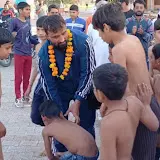
Sunder Sangwan, a 28-year-old from Jhajjar, with his followers. Photo courtesy Sangwan's YouTube channel
In Haryana, what is changing is not only the idea of fitness, or how to achieve it, but life aspirations as well. For years, a government job, a defence posting, a sports breakthrough, or migration for private work were the ‘secure’ life choices here. Today, social media has inserted a parallel ladder — uncertain, uneven, but quick. It offers proof that fame and income can be generated without big-city privilege.
This is not a fantasy economy anymore. India’s influencer marketing industry has expanded rapidly, with multiple forecasts projecting continued growth through the middle of this decade. In a market that size, even a small slice can transform a creator’s finances in a small-town setting.
A fitness influencer, speaking on condition of anonymity, explained the business side of the trend to The Federal. YouTube ad revenue remains the most lucrative stream because views convert into earnings once a channel is monetised. Then there are brand collaborations: a sponsored Reel, a recurring association, a campaign around a product launch. Affiliate commissions add another layer: the “use my code” economy, where each sale routed through a creator’s promotion brings a cut. Many creators also package routines into paid plans, closed groups, or online coaching where followers pay for structure, accountability, and a sense of access.
"Once visibility is high, offline income follows. Gym inaugurations, college events, festivals, meet-and-greets — the creator is paid for crowd-pull", he said.
Also read: Why Centre urging preference for ex-Agniveers in security jobs has triggered fear in Haryana
In Haryana’s dense social geography, a recognisable face can mobilise people quickly. It is also why life upgrades become part of the narrative: a better home, a new vehicle, travel and gym upgrades. The “before-and-after” is not only physical; it is financial, and it is displayed as proof that discipline pays.
Exact incomes are rarely disclosed publicly and third-party tools that estimate earnings from views can only offer rough ranges. Still, the visible signals are hard to miss: sponsorship tags, discount codes, branded content, paid events, and the steady professionalisation of what began as a phone-camera habit.
Sangwan put it in unusually blunt terms. "I was nothing. I had no education, no skill, no access to high society. Social media got me everything. I run a readymade clothes showroom in Rohtak. I now have a pucca house, with separate rooms for my parents, my brother and me. No one would come to our house with marriage proposals now we are flooded with proposals. All thanks to social media, my followers,” he said.
That statement lands with force because it is not merely about money. It is about dignity, mobility, marriage markets, and the long shadow of “status” in small-town life. In Haryana, where reputation is often built or lost faster than an opportunity, a follower count can validate social standing.
For a student in Jind, Bhiwani, Sonipat, Rohtak, Hisar, or a smaller mandi town, it's easy to wonder, “If he can do it with basic resources, why not me?”
Beyond the workout and the income, the deeper shift is cultural. 'Desi fitness' is writing a new script for young men, blending akhara pride with modern visibility. It is not merely “be strong”; it is “be seen being strong”.
That is the real shift: not the exercises, but the architecture of aspiration. The mud track is no longer only where you train. It is where you audition. And for a growing slice of Haryana’s young crowd, that audition is beginning to look like a career.