- Home
- India
- World
- Premium
- THE FEDERAL SPECIAL
- States
- Perspective
- Videos
- Sports
- Education
- Entertainment
- Elections
- Features
- Health
- Business
- Series
- In memoriam: Sheikh Mujibur Rahman
- Bishnoi's Men
- NEET TANGLE
- Economy Series
- Earth Day
- Kashmir’s Frozen Turbulence
- India@75
- The legend of Ramjanmabhoomi
- Liberalisation@30
- How to tame a dragon
- Celebrating biodiversity
- Farm Matters
- 50 days of solitude
- Bringing Migrants Home
- Budget 2020
- Jharkhand Votes
- The Federal Investigates
- The Federal Impact
- Vanishing Sand
- Gandhi @ 150
- Andhra Today
- Field report
- Operation Gulmarg
- Pandemic @1 Mn in India
- The Federal Year-End
- The Zero Year
- Science
- Brand studio
- Newsletter

Why in Himachal, approaching monsoon has those living in the lap of the Himalayas worried
Himachal Pradesh recorded 46 separate cloudburst incidents during the 2025 monsoon season, resulting in an economic loss of Rs 4,000 crore to Rs 4,800 crore, and 448 deaths, according to estimates made by the Himachal Pradesh State Disaster Management Authority and State Emergency Operation Centre. Cloudbursts, flash floods and landslides have become synonymous with monsoon in the state.

The intervening night of June 30 and July 1, 2025, remains clearly stamped in Kaul Ram’s memory as one of the scariest in his life. The resident of Seraj region in Himachal Pradesh’s Mandi district recalls the panic and frenzied rush for survival as a cloudburst-triggered flash flood tore through the village around midnight. The 41-year-old and his family survived the night, but with...
The intervening night of June 30 and July 1, 2025, remains clearly stamped in Kaul Ram’s memory as one of the scariest in his life. The resident of Seraj region in Himachal Pradesh’s Mandi district recalls the panic and frenzied rush for survival as a cloudburst-triggered flash flood tore through the village around midnight. The 41-year-old and his family survived the night, but with little else than the clothes on their backs.
“We lost the house and the five bighas of agricultural land which was our sole source of income,” he says. The shock and heartbreak killed his father, he claims; the 70-year-old, Sher Singh, passed away within a fortnight of the disaster (Kaul Ram is unable to give details of the medical cause of death).
“People ran barefoot in the darkness, screaming, leaving behind all their belongings. It was simply a question of survival. Within minutes, the raging waters and mudslides wiped out the entire village,” says Kaul Ram.
As most of India counts the days to the arrival of the monsoons for some much needed rain relief from the sweltering summer heat — the 2026 monsoons have already arrived in Kerala, the first Indian state to welcome it — communities living in the lap of the Himalayas brace themselves potentially face another round of nature’s fury, even as they pray for protection from the flash floods, landslides and cloudbursts that have characterised almost every monsoon here in recent years.
According to an Observer Research Foundation (ORF) report published last year, India’s 13 Himalayan states and Union Territories (UTs) — Arunachal Pradesh, Assam, Himachal Pradesh, Manipur, Meghalaya, Mizoram, Nagaland, Sikkim, Tripura, Uttarakhand, and West Bengal, Jammu and Kashmir and Ladakh — have experienced extreme weather events on 822 of 1,186 days between January 2022 and March 2025, resulting in the deaths of 2,863 people.
A Centre for Science and Environment report published in November last year, further stated that “In 2025, at least 18 states/UTs recorded their highest number of extreme weather days since 2022”, with Himachal Pradesh seeing the “highest number of extreme weather events”; “almost 80 per cent of the 273 days in the first nine months of 2025” saw the state witnessing such events. The monsoon remained the country’s “most devastating season”, the report added.
Also read: World Environment Day: Why some Indians are giving up jobs, businesses to focus on sustainability
Authorities are not ignorant of the risks. In a response submitted to the Supreme Court last year, the Himachal Pradesh government reportedly stated that the state had experienced “434 extreme weather events in the past seven years”.
According to Himachal Pradesh State Disaster Management Authority (SDMA) and State Emergency Operation Centre (SEOC) data, Himachal Pradesh recorded 46 separate cloudburst incidents during the 2025 monsoon season. The worst-affected areas were Mandi, hard hit by 19 cloudbursts, followed by Kullu (12) and Chamba (6). As many as 10 cloudbursts were reported in a single day in Seraj. The economic loss from last year’s disaster was assessed to be between Rs 4,000 crore and Rs 4,800 crore, with 448 lives being lost across the state.
The concern was reiterated by chief minister Sukhwinder Singh Sukhu at an event in Shimla last week, when he admitted that the entire Himalayan region has become susceptible to extreme weather events due to climate change, rising temperatures, unplanned construction, and shrinking forest cover.
Speaking at the launch of editor-author Tikendra Singh Panwar’s book, City Limits—The Crisis of Urbanisation, Sukhu said, “Global warming has emerged as a major challenge worldwide and its adverse effects are clearly visible. The past three years have been the worst for Himachal Pradesh. Recently, I mentioned to Home Minister Amit Shah that climate-induced disasters will no longer be limited to Himachal or Uttarakhand. Such incidents could increasingly occur in the northeastern states as well as the plains of Punjab and Haryana in the future."
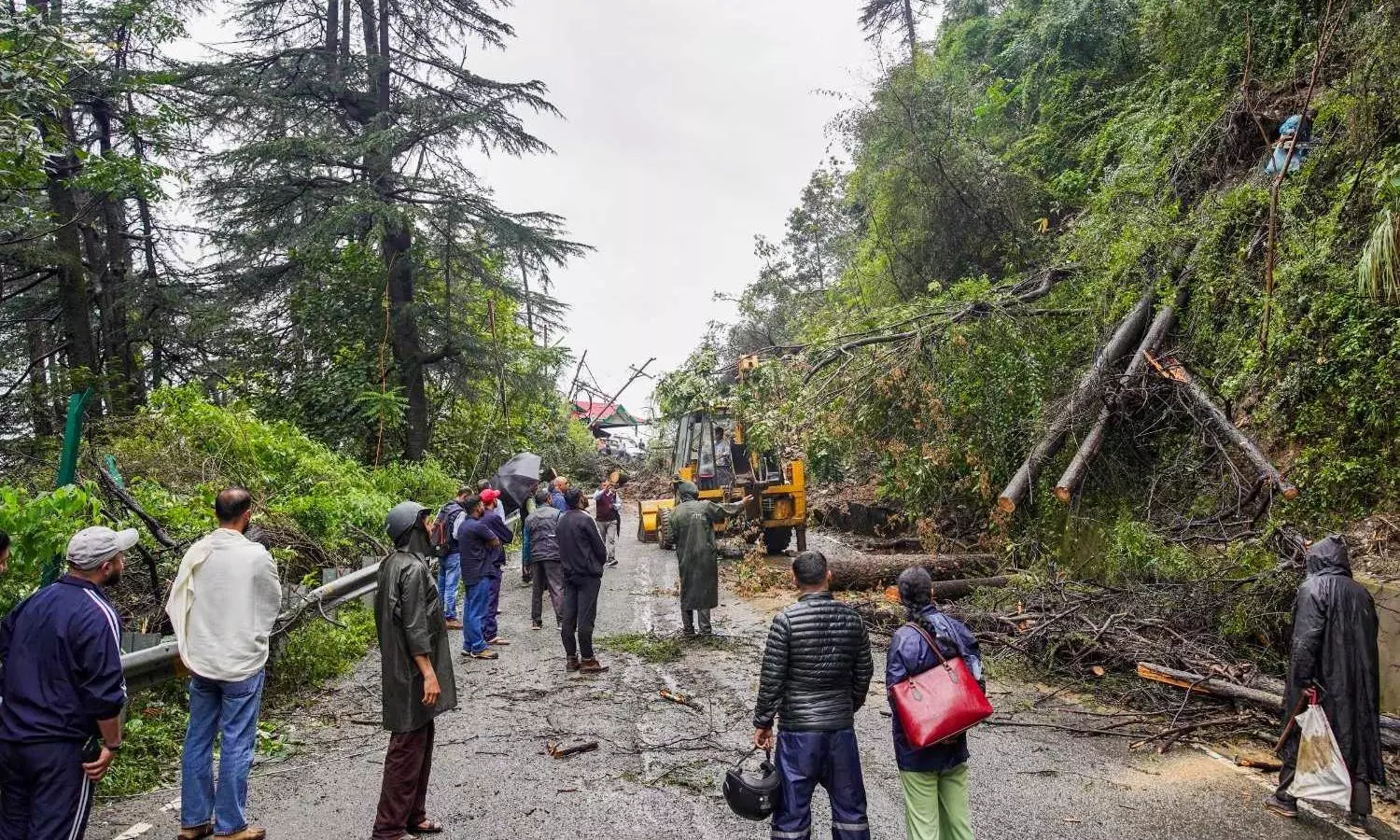
File photo of restoration work in Shimla's Ramnagar area following a landslide last year.
The occurrences are not sudden.
Experts have repeatedly warned of climate change making extreme weather events more severe in hill states. Unplanned and unrestricted development adds to the threats. Studies have revealed diminishing forest cover and the pressures of tourism-related growth on the delicate mountain ecosystem — over-saturated towns, mega infrastructure projects in the mountains, such as four-lane roads, rapid urbanisation and hydropower projects involving large-scale cutting of hills and slopes, diversion of the forest land have made the state highly vulnerable.
According to Tikendra Panwar, former deputy mayor of Shimla and a member of the Samrudh Bharat think tank, “disaster management and environmental vulnerability have become major public concerns alongside the need for sustainable development. Hill cities and towns can handle only limited growth before they become unliveable or environmentally damaging”.
The State Disaster Management Authority’s 2025 findings, too, cite climate-sensitive regions like Kullu, Mandi, Chamba, and the high-altitude tribal belt of Kinnaur and Lahaul-Spiti as being “highly vulnerable to disasters”. “Tourism-related activities contribute to environmental degradation, vehicular pollution, and accelerated melting of glaciers,” the report added.
Another report published in the journal Springer Nature earlier this year rated Himachal districts on the basis of tourism vulnerability. Indicators included “exposure (land use land cover, natural hazards, slope, digital elevation model, normalized difference vegetation index, and tourism demand); sensitivity (forest area, net sown area, gross state domestic product, water availability, population density, and marginal workers); and adaptive capacity (tourism destination, electricity availability, road density, medical facilities, accommodation, and telecommunication)”.
Results identified “Shimla (4.17 per cent), Chamba (4.08 per cent), and Kullu (3.72 per cent) as the most vulnerable districts to tourism growth, whereas Hamirpur (0.43 per cent), Bilaspur (0.54 per cent) and Una (0.80 per cent),” were found to be less so.
In Himachal Pradesh, of a total geographical area of 55,673 square kilometres (sq km), 37,948 sq km is classified as forest (68.16 per cent). However, the state’s forest department website states that the actual forest cover is only 15,580 sq km (27.99 per cent). This, the Sukhu government is keen to increase to 31 per cent by 2030.
According to the State Strategy and Climate Change Action Plan 2021-2030, environmentally sensitive districts such as Kinnaur and Lahaul-Spiti in Himachal Pradesh are increasingly bearing the brunt of climate-related disasters, including landslides, erratic weather patterns, and the loss of indigenous species such as Chilgoza, along with damage to traditional crops. Rising temperatures and unusually intense rainfall in these high-altitude regions have triggered floods and deepened the ecological crisis.
A study done by YS Parmar Horticulture and Forestry University, Nauni (Solan) has revealed that the temperature in the central hilly areas of the state is continuously increasing, while the cold is decreasing rapidly. According to the study report, the maximum temperature in the region has increased by about 2.5 degrees Celsius, and the minimum temperature has increased by 0.55 degrees Celsius in the past 50 years. Further, heat waves are increasing at an average annual rate of 1.11 per cent, raising serious concerns for the future. In contrast, cold wave conditions are declining by nearly 2.86 per cent every year, leading to significant changes in traditional weather patterns. These shifts are directly affecting crops, fruit production, and livelihoods, while also accelerating the melting of glaciers.
Also read: What summer living in Rajasthan can teach new hotspots Banda, Balangir
Warnings of possible disaster are being sounded from across the state.
The district administration at Lahaul-Spiti has issued a state of high alert owing to the rapid expansion of the high-risk Ghepan Lake. Joint studies by ISRO and the State Disaster Management Authority warn that a breach could trigger a Glacial Lake Outburst Flood (GLOF) affecting 34 downstream settlements, including the popular tourist town of Sissu. Reports claim the size of Ghepan Lake has expanded by nearly 178 per cent over the past 33 years owing to accelerated glacier melting.
DC Lahual-Spiti Kiran Badana says authorities are testing a pioneering Glacier Lake Early Warning System (EWS) in the region to provide advanced evacuation notices.
Shimla, once the “summer capital of India” has been ravaged by excessive tourism growth. In a single 72-hour window towards the end of last month, reports showed 70,000 vehicles entered Shimla.
For people in the hills, however, lived experiences spell the threat clearer than any report.
Neel Kamal, 30, a resident of Seraj, talks of “pitch-dark” when the cloudburst and resulting flash floods wreaked havoc last year. “Many people lost their loved ones, and some bodies have still not been recovered,” she says.
She adds: “It was unlike anything we had ever experienced. The memories of that night continue to haunt us.”
A year on, the scars are fresh on their minds even as they struggle to rebuild their lives.
“Thunag market and Pandav Sheela villages suffered some of the worst destruction," says Tikkam Ram, a local leader of the Bharatiya Janata Party (BJP).
Now, another approaching monsoon has already given rise to misgivings amongst the locals.
The local administration claims to have learnt a lesson from last year’s disaster.
“The administration has learned many lessons from the tragedy and rescue operation. Now, as the monsoon season is going to start very soon, we have done an elaborate exercise for preparedness,” says deputy commissioner Mandi Aproov Devgan, though he does not divulge details.
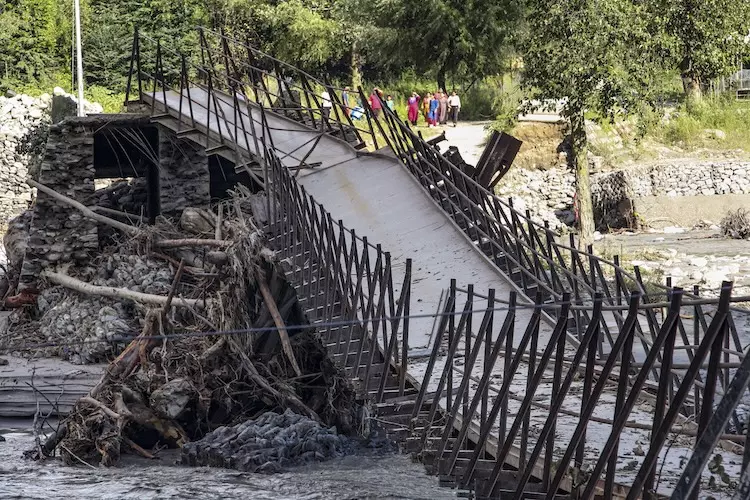
File photo of a damaged bridge near Kullu.
At the state level, a series of review meetings has been convened under the chairmanship of chief secretary KK Pant, with all concerned departments placed on alert ahead of the monsoon season.
Pushpendra Rana, director-cum-special secretary (Disaster Management), claimed the government has activated all concerned agencies to ensure close coordination, timely dissemination of early warnings and a swift response to any disaster situation.
Meanwhile, Kaul Ram talks of a life which is yet to return to normal after last year’s disruption. Having lost his land, he is awaiting government allotment, he says, and working as a labourer in the meantime to make ends meet. He received Rs 4 lakh from the government as relief, but the family — he, his mother, wife and two children — is yet to rebuild the house and is currently living in rented accommodation.
Loss of connectivity is another issue, adds Kaul Ram. He talks of the damage done to roads and bridges in the area. The nearest town to his village, Bekar, in the Seraj area, is the district headquarters, Mandi. “We recently met the deputy commissioner of Mandi and urged the administration to expedite the construction of roads and bridges. Unless connectivity is restored, our worries will only deepen when the rains return,” says the 41-year-old, worrying perhaps about how relief will reach them in case of another disaster.