- Home
- India
- World
- Premium
- THE FEDERAL SPECIAL
- States
- Perspective
- Videos
- Sports
- Education
- Entertainment
- Elections
- Features
- Health
- Business
- Series
- In memoriam: Sheikh Mujibur Rahman
- Bishnoi's Men
- NEET TANGLE
- Economy Series
- Earth Day
- Kashmir’s Frozen Turbulence
- India@75
- The legend of Ramjanmabhoomi
- Liberalisation@30
- How to tame a dragon
- Celebrating biodiversity
- Farm Matters
- 50 days of solitude
- Bringing Migrants Home
- Budget 2020
- Jharkhand Votes
- The Federal Investigates
- The Federal Impact
- Vanishing Sand
- Gandhi @ 150
- Andhra Today
- Field report
- Operation Gulmarg
- Pandemic @1 Mn in India
- The Federal Year-End
- The Zero Year
- Science
- Brand studio
- Newsletter

A country is born: How India evolved in the decades following Independence
As India completes 79 years of Independence,, The Federal asks a Septuagenarian and a Gen Z to write about the India they saw growing up and their visions for the country’s future. In this first of a two-part series, a Septuagenarian recalls a newly independent country’s journey.

As it marks its 80th Independence Day, it seems impossible to conceive of the enormous and comprehensive challenges that India and its leaders faced in 1947. The country had been partitioned on religious grounds; part of the territory was under the Princely States; its society was feudal; the economy moribund and its security apparatus was weak. Amidst all these formidable difficulties, a...
As it marks its 80th Independence Day, it seems impossible to conceive of the enormous and comprehensive challenges that India and its leaders faced in 1947. The country had been partitioned on religious grounds; part of the territory was under the Princely States; its society was feudal; the economy moribund and its security apparatus was weak. Amidst all these formidable difficulties, a new progressive polity needed to be structured in which all citizens, irrespective of their faith, would have equality of opportunity and the right of full participation in all aspects of the country’s life. This fundamental principle was derived from the Freedom Struggle. It distinguished the Congress leadership from the Muslim League. This was even though the Congress accepted partition because in the alternative lay the danger of civil war engulfing the Indian sub-continent.
It was Jawaharlal Nehru who, in wondrous words, gave meaning to these challenges and aspirations as he reminded the Constituent Assembly at the stroke of the midnight hour of India’s tryst with destiny. Even more, it was Gandhiji who while devastated by the partition and the accompanying violence and bloodshed, yet reminded the people that freedom would have little meaning unless it ‘removed every tear from every eye’. And, while the people endured the traumas left by the British, immediately after 1947 Baba Saheb Ambedkar, with vision, skill and dexterity, succeeded in drafting a Constitution that converted India from a dominion to a republic on January 26, 1950.
Also read: Part 2: The Gen Z India: A tale of two Indias: How the country has transformed in the past two-and-a-half decades
The Constitution ensured the unity of the country through a federal structure, a system of parliamentary democracy based on universal adult suffrage and affirmative action for the historically disadvantaged sections of society. It is seldom now appreciated that universal adult franchise, including for women, in a country with such a low rate of literacy was a revolutionary measure. For many long years Western academics asserted that India could not sustain a democracy. But the ordinary Indian, even when illiterate and poor, showed to the world that he was perfectly capable of understanding his interests and prudently exercising his precious right to vote. In this process he proved the sceptics wrong.
While these processes were on, Sardar Patel had cemented the integration of the Princely States into the Union. Thus, as the country celebrated its first Republic Day the vestiges of mischievous British division had been extinguished, though troubles in one large former princely state remained. This was Jammu and Kashmir. It had been integrated into the Union but the difficulties came from Pakistan which remained unreconciled to it. It was also due to the machinations of the British. The difficulties in J&K have not ended as yet.
To move towards an egalitarian society, it was necessary to remove the vestiges of feudalism in the land tenure systems prevalent during the British Raj. This was undertaken in the early 1950s. It was an essential step both for improvement in agriculture and social equity. In the mid-1950s three other fundamental steps were undertaken largely through the initiative and push of Nehru. The first was to reform Hindu personal law; second set the country on the path to develop a socialistic pattern of society where disparities in wealth and income would be reduced. This process also included a major preference for economic development through state industrial entities which would control the ‘commanding heights’ of the economy. The role of the private sector was dwarfed. The third initiative was to take steps to develop science and technology (S&T) at a rapid pace. Consequently, a vast network of S&T institutions was created so that India could produce a cadre of S&T personnel who would be at the frontiers of knowledge, including in the civil nuclear and space fields.
These decisions put India on a developmental path which continued till the early nineties. They were required when they were taken but, perhaps in time, they could have been modified because in some respects state control under the mixed economy model unduly stifled private enterprise.
The immensity of the task in the economic sphere ranged from ushering in a process of industrialisation to the relatively mundane but significant task of simplifying and modernising Indian currency. Not many of India’s youth today would know perhaps that it was only in I957 that the currency was changed to the metric system and the new coins which were introduced were called ‘naya paisa’ (new paisa) to distinguish them from the old currency. The old system was based on 16 annas making a rupee; this changed to a rupee consisting of 100 ‘naya paisa’. In time, the word naya was naturally dropped.
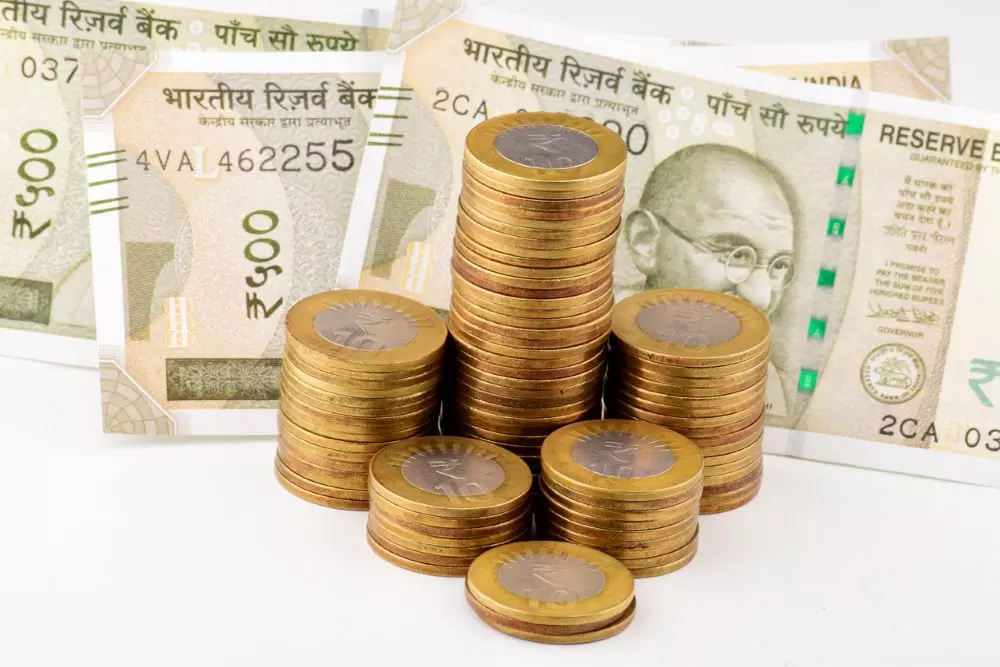
The Indian currency was changed to the metric system in 1957. Photo: iStock
A traumatic event which is etched in national memory is the imposition of the Emergency by then Prime Minister Indira Gandhi in June 1975. It lasted till March 1977 but forever changed political culture, making it less accommodative. Another traumatic event was Indira Gandhi’s assassination in 1984 and the anti-Sikh riots that followed. Ultimately, however, India was able to absorb these shocks, though the scars remain.
All through these first four decades of independence, the ideological contestations which had its roots in the Freedom Movement period did not remain dormant. The essence of the ideological differences lay in what role should faith play in the public culture of India? The national symbols of the Republic derived from India’s ancient past, but an overt display of the majority religion was avoided in public spaces by those who believed in secularism. The other side felt that this constituted the appeasement of the minorities and that public culture should reflect the values and symbols of the majority community.
The appeasement issues surfaced during the Shah Bano case (a Muslim woman’s fight to receive maintenance from her husband after being divorced; the Supreme Court passed an order in her favour in 1985) and provided an impetus for the rise of Hindutva forces who championed comprehensive rightist policies. This ultimately led to the destruction of the Babari Masjid in December 1992. This was a pivotal moment in independent India’s history. It led to communal rioting, but from the beginning of the 21st century the thinking of large sections of the majority community on the minorities began to undergo a change. In this they were influenced by conservative Hindu forces.
In the early nineties, the process of dismantling the socio-economic socialistic structures established by Nehru began. It relentlessly went on till it was completely done away with in all economic areas. This unleashed the potential of the private sector and led to substantial growth but at the cost of growing disparities. Consequently, today India is one of the most unequal countries in the world. Economic growth has also not led to a determination to become one of the world’s leading S&T powers. This is the exact opposite of what Nehru desired. The nation will pay a heavy price for S&T dependencies. The present-day reliance on applications is no substitute for being a world leader of the Fourth Industrial Revolution.
Indian society has transformed during the past decades. This began with the implementation of the Mandal Commission (established in 1979) recommendations, which provided reservation to the OBCs in educational institutions and government jobs. The process went further when the Scheduled Castes decided that they would have their own political leadership. Since 1967 the OBC had found ways to political power. Now, the Sangh Parivar’s has progressed in co-opting the higher OBCs and that is a trend to watch for the future.
The 21st century began with an unexpected defeat of the Bharatiya Janata Party (BJP)-led National Democratic Alliance (NDA), which gave way to the Congress-led United Progressive Alliance (UPA) government at the Centre. This resulted in a decade of high growth and the establishment of giving greater rights to the citizens to question the government. However, the UPA failed to handle allegations of corruption, leading to the victory of the Narendra Modi-led BJP. It has over the past twelve years sought to demolish all aspects of the ‘secular’ systems and the socio-economic models established by Nehru. To a large extent, it has ensured that the minorities have no role in decision-making processes in India. It has also released the old atavistic urges of the Hindus to correct historical wrongs. Modi’s crowning glory was the construction and consecration of the Ram Temple in Ayodhya (where the Babri Masjid had once been). That conclusively signalled the demolition of the public culture established in the early decades of the Republic.
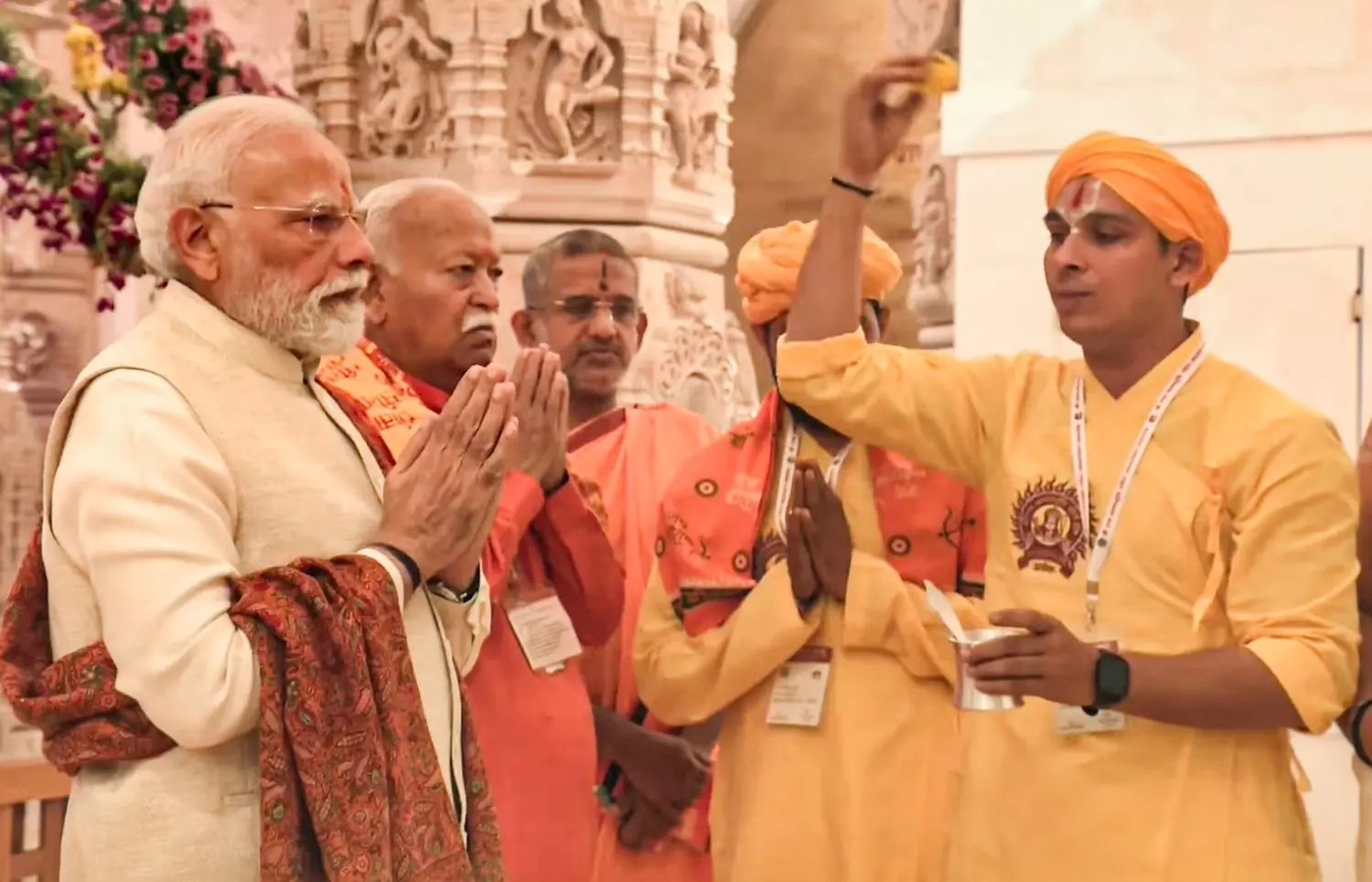
Prime Minister Narendra Modi and Rashtriya Swayamsevak Sangh chief Mohan Bhagwat at the Ram Temple in Ayodhya. File Photo
During these decades, India’s foreign policy moved from Nehruvian non-alignment to beginning with the 21st century multi-alignment, with a tilt towards the United States. While this process was progressing gradually, India tried to maintain its old contacts, especially with Russia, which was the successor state to the Soviet Union. Besides, as the decades went on, India moved its foreign policy to pragmatism and a coldly realistic pursuit of its interests. That is what it should continue with. At this stage, it could be recalled that India’s defeat in its military confrontation with China in 1962 was perhaps the lowest point in the external sphere, while the 1971 victory over Pakistan was its highest point till now. Another high point was India becoming a nuclear weapons power in 1998.
Also read: 79 years after Independence, what a ‘free’ India looks like to Gen Z
With India becoming more prosperous, its market is attracting world powers and it is finding a place in the rule-making tables of the world, though that process is not complete. With the world undergoing a fundamental transition on account of the rise of China, India now faces new and difficult challenges. While it is engaged in multilateral arrangements to meet Chinese assertiveness in the region, it will have to ultimately rely on itself to defend its interests against China and the continuing Sino-Pak nexus. From the early 1990s, India has faced Pakistani terrorism, which has remained a problem though not a strategic challenge.
India’s great asset at present is its youth, but its aspirations are not easy to handle until the political class harnesses its energy productively. Certainly, the present system needs modifications to do so. If that is done, India can become a genuine S&T power and also diverse yet inclusive and above all humane. That will fulfil the promise of the Freedom Struggle and give meaning to the ambition of Viksit Bharat.