- Home
- India
- World
- Premium
- THE FEDERAL SPECIAL
- States
- Perspective
- Videos
- Sports
- Education
- Entertainment
- Elections
- Features
- Health
- Business
- Series
- In memoriam: Sheikh Mujibur Rahman
- Bishnoi's Men
- NEET TANGLE
- Economy Series
- Earth Day
- Kashmir’s Frozen Turbulence
- India@75
- The legend of Ramjanmabhoomi
- Liberalisation@30
- How to tame a dragon
- Celebrating biodiversity
- Farm Matters
- 50 days of solitude
- Bringing Migrants Home
- Budget 2020
- Jharkhand Votes
- The Federal Investigates
- The Federal Impact
- Vanishing Sand
- Gandhi @ 150
- Andhra Today
- Field report
- Operation Gulmarg
- Pandemic @1 Mn in India
- The Federal Year-End
- The Zero Year
- Science
- Brand studio
- Newsletter

Why sprinters Gurindervir and Vishal’s record-breaking runs hint at a bigger shift in Indian athletics
India’s sprinting story has largely survived through isolated moments. Now, Indian sprinters are chasing each other and for the first time, it feels like an ecosystem is beginning to move in the country.

It’s not often that you hear national records in 100 metres sprint being broken in quick succession within hours. Simultaneously, a 400-metre national record falls and there is suddenly a buzz around a string of other remarkable athletics performances across the country.Punjab’s Gurindervir Singh clocked 10.09 seconds at the Federation Cup in Ranchi last week (May 23) to become the...
It’s not often that you hear national records in 100 metres sprint being broken in quick succession within hours. Simultaneously, a 400-metre national record falls and there is suddenly a buzz around a string of other remarkable athletics performances across the country.
Punjab’s Gurindervir Singh clocked 10.09 seconds at the Federation Cup in Ranchi last week (May 23) to become the first Indian man to go below the 10.10-second benchmark in the 100m category. Just a day earlier, Gurindervir and fellow-sprinter Animesh Kujur had traded the national record within minutes of each other. Gurindervir first clocked 10.17 seconds before Animesh responded almost immediately with 10.15. Then came Gurindervir’s historic 10.09-second win.
At almost the same time, Vishal Thennarasu Kayalvizhi became the first Indian athlete ever to run sub-45 seconds in the 400m category.
Indian athletics, particularly Indian sprinting, has rarely witnessed something like this before.
“I knew I was capable of running fast this season,” Gurindervir reportedly said after his record-breaking performance. “But to finally see 10.09 feels special.” The emotional intensity of the moment was visible, too.
Also read: Why Vaishali’s Candidates win is an opportunity to further boost interest in women’s chess in India
India’s sprinting story has largely survived through isolated moments. From Milkha Singh and PT Usha to Dutee Chand and Hima Das, India periodically produced athletes who briefly made the country believe it could compete with the world on the track. But those moments rarely translated into sustained continuity.
Of course, the gap between Indian sprinting and the world’s elite still remains substantial. Olympic medal territory in the men’s 100m still belongs to athletes consistently running in the 9.7 and 9.8 range. And yet, for the first time, it feels like an ecosystem beginning to move in India.
The United States has consistently produced elite sprinters because fast athletes competed against even faster athletes. Jamaica’s sprinting dominance was never only about Usain Bolt. Bolt became the face of a system that already knew world-class sprinting was possible.
Once, running sub-10 in the 100m felt almost mythical. But once athletes like Jim Hines and later Usain Bolt pushed sprinting into new territory, the psychological barriers around the event began changing, too. What once looked impossible slowly started appearing achievable for others as well.
Now, suddenly, Indian sprinters are chasing each other. That may be the biggest shift of all.
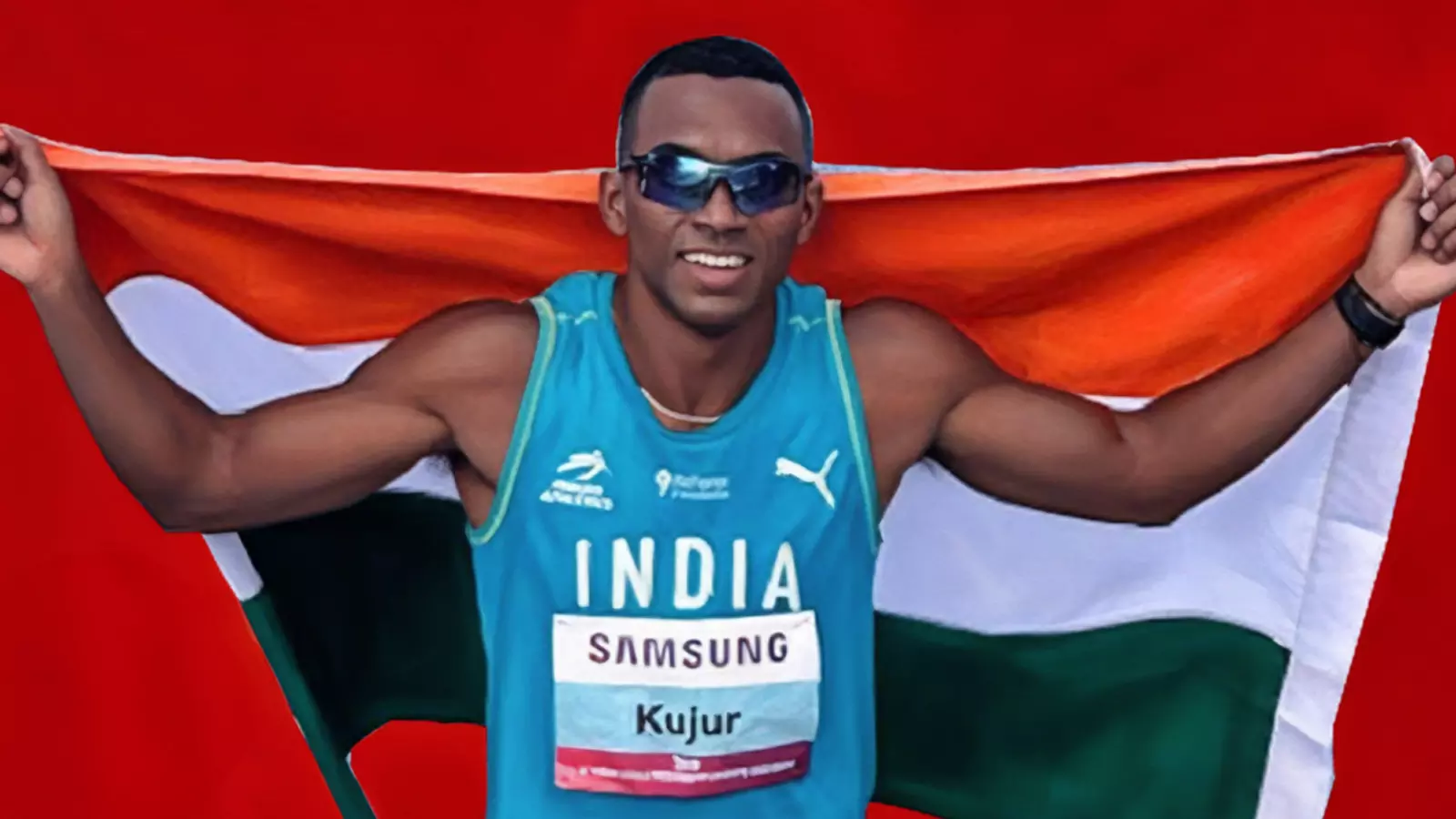
File photo of Animemsh Kujur. Photo: X
After setting the record, Gurindervir held up a handwritten message that read:
“10.10 is not finished yet. Wait, I am still standing.” That statement captured the current mindset within Indian sprinting better than any statistic.
Animesh Kujur, too, has openly spoken in recent months about targeting even faster timings in the future. He has acknowledged the importance of internal competition, saying that “when you run against fast athletes, you automatically improve”.
Sport often works like that. Once one athlete breaks a barrier, others begin believing they can too. That may be one of the most important things unfolding in Indian athletics right now.
There was a time when an Indian running sub-10.5 was an extraordinary achievement. Then came conversations around 10.3 and 10.2. And now, within roughly a year, India has moved from 10.2 territory to 10.15 and now 10.09, with the 2026 season not even halfway complete.
Former national record holder Manikanta Hoblidhar, who trains within the same emerging sprint ecosystem, also speaks about how Indian sprinters now “push each other” constantly in training and competition. That growing culture of internal competition may ultimately be one of the defining shifts behind Indian sprinting’s recent rise.
Behind Gurindervir Singh’s historic 10.09 and Animesh Kujur’s 10.20, Pranav Gurav clocked 10.29, while several others finished in the 10.3 and 10.4 range, timings that would once have comfortably dominated Indian sprinting. That spread of performances may ultimately prove just as significant as the national record itself.
Also read: How maiden Ranji win has given momentum to the J&K youths’ dreams of a professional cricket career
But internal competition is only one part of the story. There are several other reasons why this phase appears different from previous isolated spikes in Indian athletics.
Lalit Bhanot, one of the senior-most administrators associated with Indian athletics and a former Commonwealth Games Organizing Committee secretary general, points towards the decentralisation of Indian athletics as a major reason behind the recent rise. He believes that Indian athletics earlier revolved heavily around a handful of centralised national camps where only the top athletes trained.
“Earlier, there were only a few national camps where mostly top athletes participated,” Bhanot says. “Now, athletes are training regularly with top coaches in different venues like Thiruvananthapuram, Chennai, Madhya Pradesh, Sonepat and elsewhere. This has made the situation much more competitive.”
Bhanot points towards private high-performance initiatives, such as the Reliance Foundation in Mumbai and the JSW-backed ecosystem in Bhubaneswar, as major contributors to the changing athletics landscape. Most interestingly, he speaks about competition among coaches themselves. “There is now competition among coaches and centres too, with everyone striving for excellence,” he says.
The administrator also claims that while the Athletics Federation of India (AFI) earlier actively tracked around 1200 athletes nationally, it is now regularly monitoring nearly 6000 athletes across senior and junior categories based on future potential. It is also organising nearly 40 major events annually to ensure athletes receive regular competition exposure, he says.
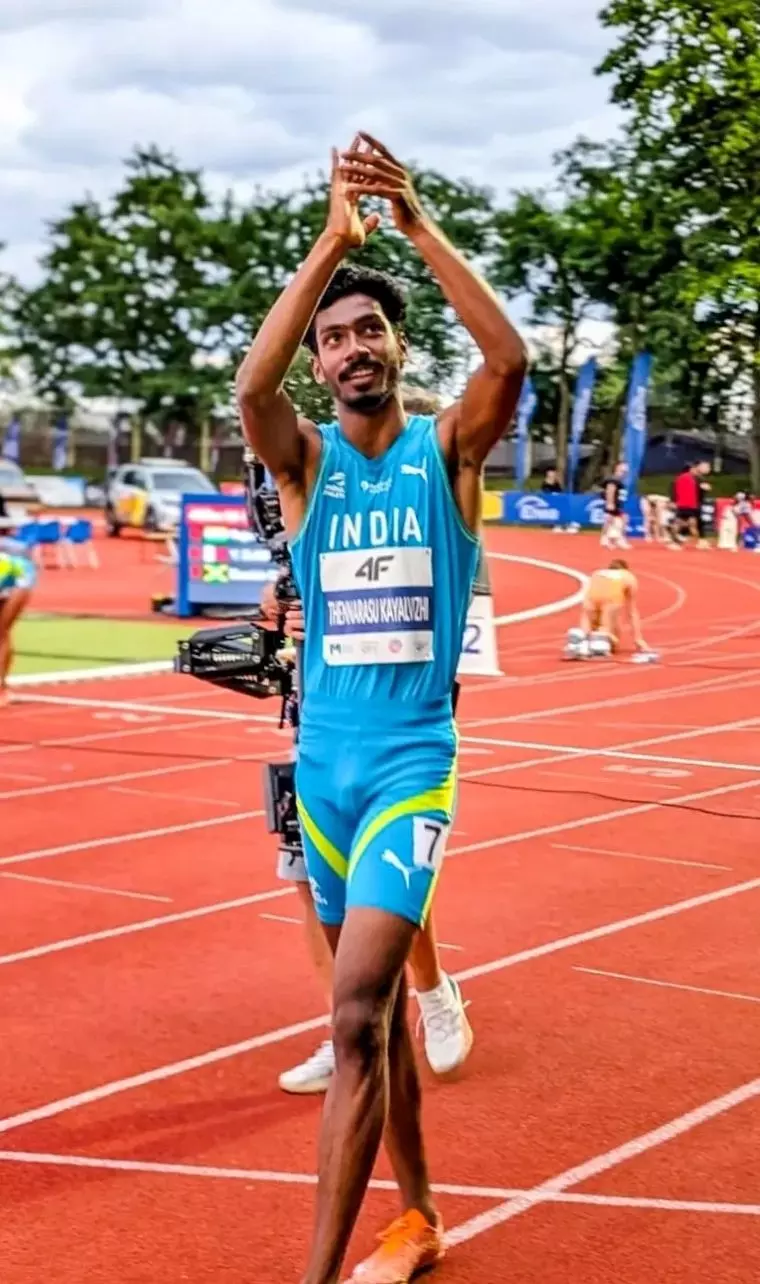
Vishal Thennarasu Kayalvizhi has become the first Indian athlete ever to run sub-45 seconds in the 400metres category. Photo: Wikimedia Commons
Bhanot’s observations are corroborated by AFI president Bahadur Singh, who credits the “teamwork and decentralisation of efforts” over the past few years for the current rise in athletics standards. “Earlier, we only had national camps restricted largely to top athletes,” Singh says. “Now there are decentralised activities where many more athletes are able to participate regularly, even at junior levels. This is creating a much greater depth of competition in Indian athletics.”
For younger athletes, too, decentralisation has brought a noticeable shift.
Siddharth Choudhary, who won gold in shot put at the 2024 South Asian Junior Athletics Championships as a 17-year-old, acknowledges that training closer to home has helped younger athletes feel more settled and mentally comfortable within the system. “Training closer to familiar environments and family support systems has made the process emotionally easier for us,” he admits. He also credits regularly training and interacting with senior athletes, which provides younger competitors with valuable insight into elite preparation and helps them believe bigger barriers can be broken.
The rise of sports science and structured high-performance environments are other reasons for the visible transformation in India’s athletics scene, say experts.
Government-backed initiatives like Target Olympic Podium Scheme (TOPS), Khelo India and the expansion of National Centres of Excellence have helped widen the talent pipeline in Indian athletics over the last few years. Improved access to synthetic tracks and sports science support has gradually created a far more professional environment than what previous generations of Indian sprinters often experienced.
James Hillier, athletics director with Reliance Foundation, points towards Gurindervir’s improved psychological preparation and ability to manage pressure as a key factor behind his rise. That insight perhaps indicates something Indian athletics historically lacked — long-term high-performance management.
The psychological shift within Indian athletics may owe something to Neeraj Chopra. His Olympic gold medal changed the psychological vocabulary of Indian athletics. Neeraj’s triumph shifted the imagination towards the belief that Indians could dominate world athletics too.
Also read: Why bird droppings episode at India Open forces question on state of India's non-cricket stadiums
But amid the optimism surrounding Indian athletics, there also remains a darker and more uncomfortable reality. Critics and international watchdogs continue to express serious concerns regarding doping in Indian athletics. In April this year, the Athletics Integrity Unit (AIU) officially reclassified the Athletics Federation of India into Category A, the highest-risk doping bracket in the sport.
This concern is backed by troubling data. According to the World Anti-Doping Agency’s 2024 Testing Figures Report, India recorded 260 Adverse Analytical Findings (AAF) from 7,113 tests, producing a positivity rate of 3.6 per cent, the highest among major nations conducting large-scale testing. India has now topped the global doping violation charts for three consecutive years. Athletics also accounted for the highest number of doping cases among Indian sports in the report.
AIU chairman David Howman has remarked that the “doping situation in India has been high-risk for a long time and, unfortunately, the quality of the domestic anti-doping program is simply not proportionate to the doping risk.”
Despite that caution, however, there is a growing sense that something deeper may genuinely be shifting within Indian athletics. India may still be some distance away from consistently challenging the world’s sprinting superpowers, but for perhaps the first time across sprinting and multiple track events, a new generation of athletes is beginning to push each other towards standards that once felt unreachable. The belief and ecosystem required to bridge that gap finally seem to be emerging together.
The next major test of how far this rise can realistically go may come at the Commonwealth Games in the coming months and the Asian Games later this year.
And if Indian athletes continue pushing those limits further, this could well become the foundation of Indian athletics’ most transformative era yet.