- Home
- India
- World
- Premium
- THE FEDERAL SPECIAL
- States
- Perspective
- Videos
- Sports
- Education
- Entertainment
- Elections
- Features
- Health
- Business
- Series
- In memoriam: Sheikh Mujibur Rahman
- Bishnoi's Men
- NEET TANGLE
- Economy Series
- Earth Day
- Kashmir’s Frozen Turbulence
- India@75
- The legend of Ramjanmabhoomi
- Liberalisation@30
- How to tame a dragon
- Celebrating biodiversity
- Farm Matters
- 50 days of solitude
- Bringing Migrants Home
- Budget 2020
- Jharkhand Votes
- The Federal Investigates
- The Federal Impact
- Vanishing Sand
- Gandhi @ 150
- Andhra Today
- Field report
- Operation Gulmarg
- Pandemic @1 Mn in India
- The Federal Year-End
- The Zero Year
- Science
- Brand studio
- Newsletter

Why the flight of India’s low-cost carriers may have hit turbulence
When Air Deccan began operations in 2003, it transformed flying for Indians. But 'cheap flights' are no longer cheap in the way people first understood them and as the recent IndiGo disruptions have shown, the low-cost aviation model may not be working for either passengers, crew or airlines.

“There was a scene in the 2002 movie Catch Me If You Can that made me think...long for the glamour of the past...,” Capt. Chesley “Sully” Sullenberger, retired American pilot, diplomat and aviation safety expert, wrote in his memoir Highest Duty about the elegance of flying’s golden age. The scene he refers to shows actor Leonardo DiCaprio, impersonating a Pan Am pilot, striding into...
“There was a scene in the 2002 movie Catch Me If You Can that made me think...long for the glamour of the past...,” Capt. Chesley “Sully” Sullenberger, retired American pilot, diplomat and aviation safety expert, wrote in his memoir Highest Duty about the elegance of flying’s golden age. The scene he refers to shows actor Leonardo DiCaprio, impersonating a Pan Am pilot, striding into a hotel lobby in full uniform with a group of stewardesses — a moment Sullenberger says “perfectly encapsulates the high level of respect given to airline crews then...” and the glamour of flying.
India’s own flag carrier matched that glamour: Air India’s 1960s long-haul service had champagne, silverware and the famed Maharaja hospitality and was ranked among the finest in the world.
It is hard to imagine a scene like that playing out in airports today. Instead, what you see now are crowds pressed against boarding gates, harried ground staff and cabin crew racing to complete a turnaround in under half an hour. The romance and space of mid-century flying have been replaced by a very different reality — dense seating, granular fees, operational fragility and, this winter, the sight of India’s largest airline buckling in public.
The December 2025 IndiGo crisis saw thousands of flights cancelled or delayed after new pilot fatigue rules came into force. And it has made India stare directly at the contradictions of its low-cost success story, with IndiGo controlling approximately over 60 per cent of India’s domestic market and operating an estimated 2,000-plus flights a day, according to data shared by the Directorate General of Civil Aviation (DGCA).
When it faltered, the entire system did. The episode has turned a simple question into something more urgent: twenty years after Air Deccan introduced the low-cost carrier model to India, does it still work for passengers, crew or airlines?
In 2003, when Air Deccan began operations, it brought a genuine transformation. Its rock-bottom fares, sometimes promoted as low as Rs 500, undercut air-conditioned train tickets and pulled first-time fliers into the skies. Middle-class students, pensioners, small-town families and migrant workers suddenly became part of the aviation story. In those early years of liberalisation, cheap flying felt like a tangible sign that opportunity was no longer the preserve of a tiny elite.
By the mid-2000s, the low-cost template was being copied at scale. IndiGo launched in 2006 and quickly built its brand around on-time performance, quick turnarounds and a single-class, no-frills product. SpiceJet and GoAir expanded in a similar fashion. Even Kingfisher, which tried to sell an image of champagne and red-carpet glamour, ended up absorbing Air Deccan and experimenting with a budget arm.
For a while, the math added up. Aviation turbine fuel (ATF) prices, though high, were not as punishing as they are now. Airport congestion was less severe. Crew rosters were tight but still manageable. The model relied on a simple equation: keep costs low, keep aircraft flying as much as possible and spread fixed costs over more sectors and passengers.
Two decades later, almost every part of that equation has shifted.
ATF prices have risen from an average of Rs 40–45 per litre in 2005 to Rs 90–105 per litre in 2025, with spikes crossing Rs 120 in some metros. Airport charges have multiplied, especially at private airports. Delhi’s user development fee plus aeronautical charges have increased by three-to-four times since 2012 and Mumbai’s by over twice. Crew costs have climbed sharply: pilot salaries that averaged Rs 6–8 lakh per month for senior commanders in 2010 are now often Rs 12–18 lakh, driven by shortages and global demand. Congestion has added hidden costs: average block times on metro routes are 10 to 20 minutes longer than a decade ago, owing to saturated airspace and gate constraints.
A model built on “high utilisation plus low cost” simply doesn’t yield the same margins today as it did in the past, say aviation experts.
Also read: Why Delhi moms across economic and social groups are losing out to a common fear
The most visible change for passengers is that “cheap flights” are no longer cheap in the way people first understood them. The base fare, which once largely reflected what you paid, is now only a starting point. Everything from seat selection to checked baggage to printed boarding passes is sliced into separate charges. What used to be included by default has become a menu of optional extras.
Take a flight from Chennai to Mumbai, for example. A typical minimum fare snapshot (approximate, based on current ranges) would include a base fare of Rs 4,000– Rs 4,500, fuel and other surcharges of Rs 2,200–Rs 2,800 and another Rs 300 to Rs 1,500 for your seat of choice. There are some free seats, but they are often unavailable by the time one checks in. Additionally, if your checked-in baggage exceeds the Rs 15 kg limit (some airlines allow more) for an economy class passenger, you pay for the excess. As you do if you want a printed boarding pass at the airport, meals and water on flight and priority check-in and boarding, if you don’t want to queue up.
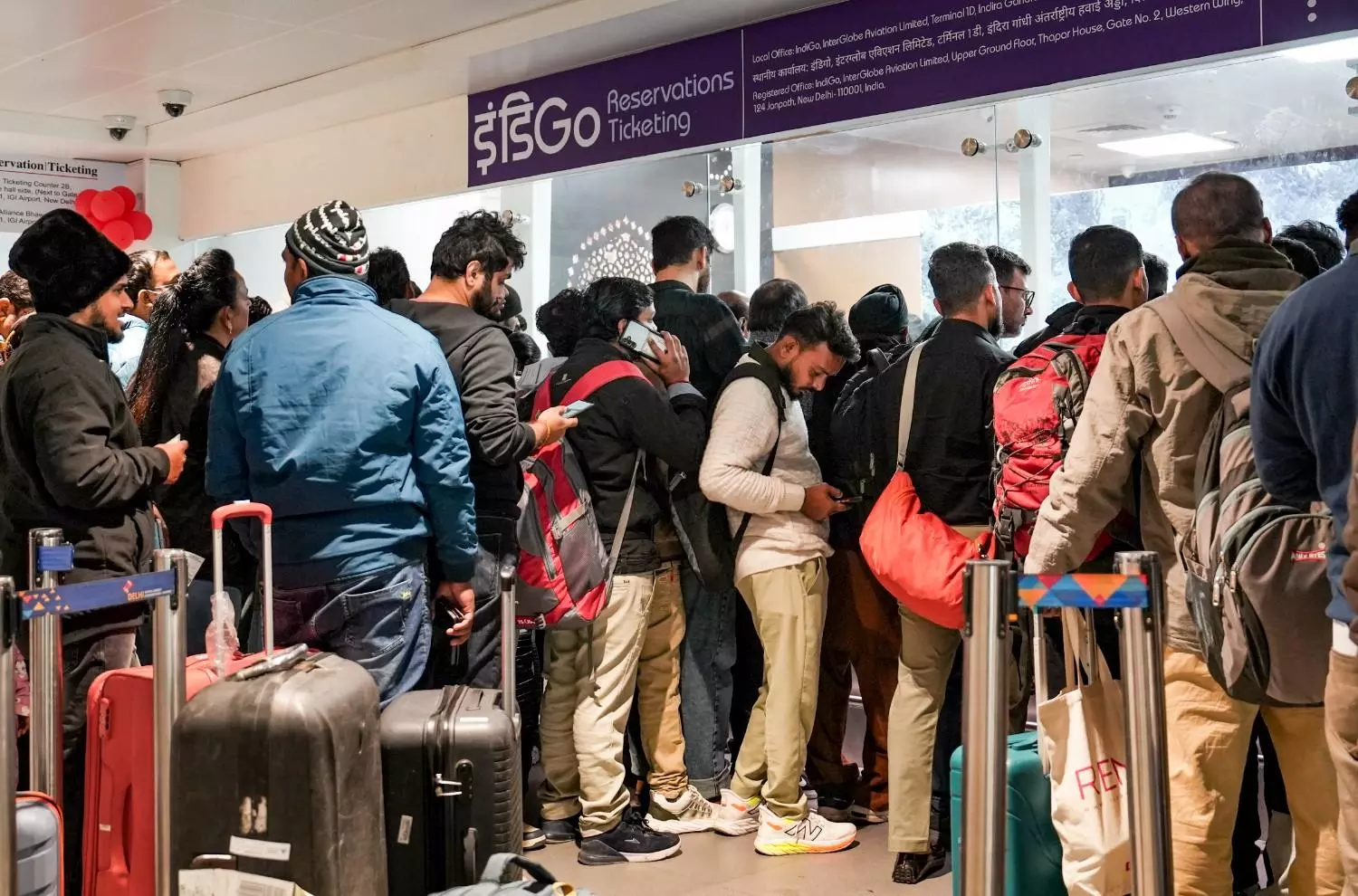
Passengers queue up at an IndiGo counter earlier this month. PTI file photo
So, a fare that appears to be Rs 4,000–Rs 5,000 when you are making an online booking, may easily go up to Rs 7,500–Rs 8,500 by the time you are on the flight. And this is not including other services like insurance or free cancellation, for example.
“I still book low-cost carriers thinking I’m saving money, but by the time I add a bag, pick a seat and pay the random fees at checkout, it ends up costing almost as much as a full-service airline,” claimed Rohit K, a Chennai-based tech worker, who flies twice a month on average for work.
When IndiGo’s December 2025 cancellations and delays rippled across India’s airports, passengers were the worst hit. One traveller, Aarthi Vaidyanathan, told The Federal, "Indigo cancelled my original flight (scheduled for December 6). I called them, it took almost two hours to connect and later get a flight.” She also spoke of long waits on call lines and unclear rebooking instructions from ground staff during the peak of the disruption. What Aarthi experienced was not an anomaly but a symptom of IndiGo’s ultra-lean operating model, where minimal call-centre and ground staffing leaves little buffer when disruptions hit.
Others have had similar issues with baggage mishandling.
"I had a delay of over 48 hours and no update on my baggage. I arrived in Kochi, but not my luggage. I find this totally unacceptable,” said N Sriram, another passenger who recently travelled by an IndiGo flight.
Beyond cancellations, the broader pattern of dissatisfaction predates the winter crisis. One widely shared post on social media reads: “I know I’m getting cuter with age, but never thought @IndiGo6E would start charging me for it,” commenting sarcastically on an airline's “CUTE fee” included in ticket invoices. “CUTE” stands for common user terminal equipment — a charge collected on airline tickets that covers the use of airport equipment such as metal detectors, escalators and other terminals that passengers use while moving through the airport.
These voices capture a cumulative frustration — not just about delays and cancellations, but about opaque charges and the experience of travellers who feel caught between rising prices and shrinking service quality.
“Low-cost fares used to feel like a deal. Now the fare is just the opening bid. By the time I’m done paying for a seat, a bag and basic add-ons, it feels like I’m getting less for more,” said Rohit.
If passengers experience the low-cost squeeze in their wallets and in shrinking legroom, pilots and cabin crew experience it in their bodies. The Safety Matters Foundation, run by Capt. Amit Singh, a commercial airline pilot, has been documenting that strain for years. In its pilot-fatigue report for 2024, the Foundation stated that “fatigue has been identified as the top concern [among other hazards such as chronic understaffing, training gaps and disruptive duty-hour patterns] in a survey”, which included not just pilots but cabin crew, engineers and air traffic controllers.
The same report warned that the pilot-fatigue survey “gives a wakeup call to the DGCA and the airlines that there is an imminent threat to flight safety and the subject needs immediate redressal.” On controlled rest and microsleeps on the flight deck, the foundation observed that fatigue “does affect flight safety in insidious ways”.
Also read: How in Haryana villages, dreams of a foreign job are landing young men at Russian battlefields
Former AirAsia India chief financial officer (CFO) Vijay Gopalan, while talking about the IndiGo meltdown, pointed out that the crisis was triggered when mandatory weekly rest for pilots was increased from 36 to 48 hours. “Now, the government said, you need 48 hours of rest,” he explained. “Unless you increase the number of pilots, the number of pilots available to operate all your aircraft, therefore, gets reduced logically. That is what has happened.”
In a conversation with The Federal on whether the chaos could have been avoided, he was blunt: “Could it have been handled better? One hundred per cent it could have been handled better. It should have been handled better.”
Aviation experts note that expanding pilot capacity is “a complex task”, requiring long lead times for hiring, training and command upgrades. When rest rules tighten, airlines either invest in more pilots or run up against the limits of their own scheduling.
For a carrier built on maxing out aircraft utilisation, that becomes a structural stress point. In that context, ancillary revenue — the small fees on seats, bags, coffee, water and flexibility — becomes a way to preserve margins without pushing headline fares to levels that would shock price-sensitive Indian consumers. For passengers, however, all of this is experienced as something simpler: paying more and feeling like they are getting less.
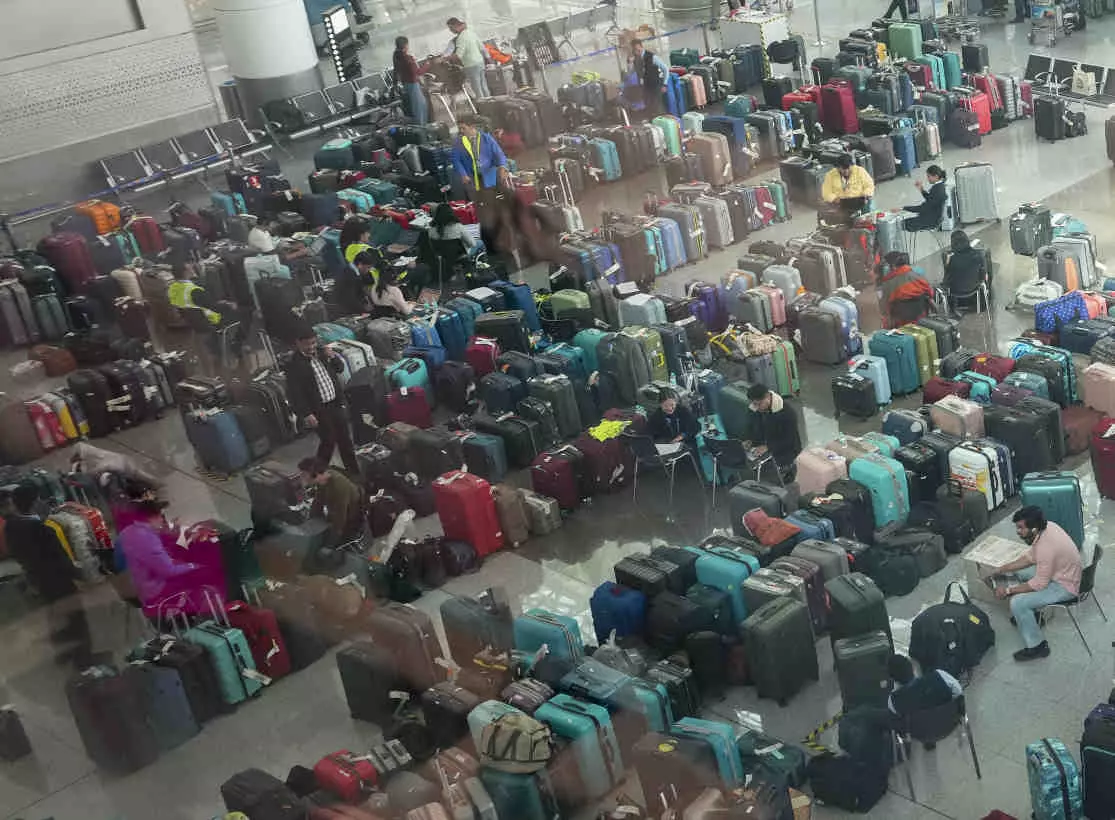
Luggage piled up at Delhi's Indira Gandhi International Airport, after cancellation of many IndiGo flights in early December. PTI photo
Meanwhile, the IndiGo disruption has exposed just how dependent India’s aviation ecosystem has become on a single low-cost carrier. When such a carrier stumbles, there are simply not enough spare seats in the system to absorb displaced passengers. Fares on other airlines spike. Airport terminals fill with stranded travellers. The government steps in with ad-hoc fare caps and partial schedule cuts, as it did when it ordered IndiGo to reduce its winter capacity by 10 per cent.
“The disruption has shown what happens when the traveller is forgotten. Passengers are stranded, missing connections and going through real hardship and there is still no strong passenger protection framework in India to prevent that,” said Sanjay Lazar, aviation consultant.
He added: “With IndiGo controlling such a large share of the market and other carriers unable to absorb the overflow, fares on remaining flights spiked”.
Also read: How a chain of community-led libraries is reimagining public reading spaces in Delhi-NCR
What looks like an IndiGo problem then, is, in effect, a design problem for Indian aviation. The low-cost model presumes redundancy at the level of individual carriers — if one airline miscalculates, others can take up the slack. But in an environment where low-cost carriers dominate and one airline has a super-majority of the market, the system becomes brittle. The same efficiency that investors praise — high utilisation, dense networks, thin buffers — becomes a vulnerability when combined with regulatory change and underinvestment in staffing.
Passengers The Federal spoke to complained of buying tickets weeks in advance only to have flights cancelled the night before departure, receiving minimal communication at the airport, being rebooked days later, or being offered train tickets as consolation. Many said they accepted cramped seats and buying on-board food as the price of affordability, but did not bargain for days of disruption without accountability.
“I actually paid for loss of baggage and free cancellation as my add-ons during flight purchase. What I wasn’t expecting was for the airline to fly me to Kochi and leave my baggage stranded,” said Sriram.
For most of the 2000s and 2010s, Indian passengers tolerated thin seats, strict baggage limits and delayed snacks in exchange for a dramatic reduction in travel time and cost. Cheap flying was itself the product. Today, after years of fee creep and with incomes higher than they were when Air Deccan launched, travellers are recalibrating what value means.
In December, one line of complaint kept recurring online: people said they did not want luxury or a return to full-service meals, they wanted predictability and basic dignity. Many described missing weddings, family events and long-planned celebrations; others wrote about losing crucial business meetings, university exams, job interviews, visa appointments and even scheduled medical treatments because their flights were cancelled at the last minute.
One viral social media post was about a Bengaluru-based techie couple who were forced to attend their own wedding reception virtually after a last-minute IndiGo flight cancellation disrupted their travel plans.
In the past few weeks, all that passengers have wanted to be assured of is that the flight they paid for would actually operate, that they would not be ambushed by a string of small charges and that the crew were not flying at the edge of exhaustion. In other words, they wanted the system to respect their time and their safety as much as their money.
Also read: 50 years of BMVSS: How the Jaipur Limb parent company rehabilitated 2.3 million since inception
As Condé Nast Traveller once observed, “Air India was synonymous with luxury, style and glamour”. The airline’s long-haul service routinely offered multi-course gourmet meals curated by chefs, silverware and bone-china table settings, caviar on select routes and wine lists featuring French and Italian labels. Flying Air India in that era meant wide-body cabins decorated with textile art, fresh flowers in the lavatories, menus printed like restaurant cards, and crew trained at the famed Air India Hospitality Training College in Mumbai. It was a time when Indian aviation sold not just transport, but elegance — and when air travel itself symbolised modernity, aspiration and national pride.
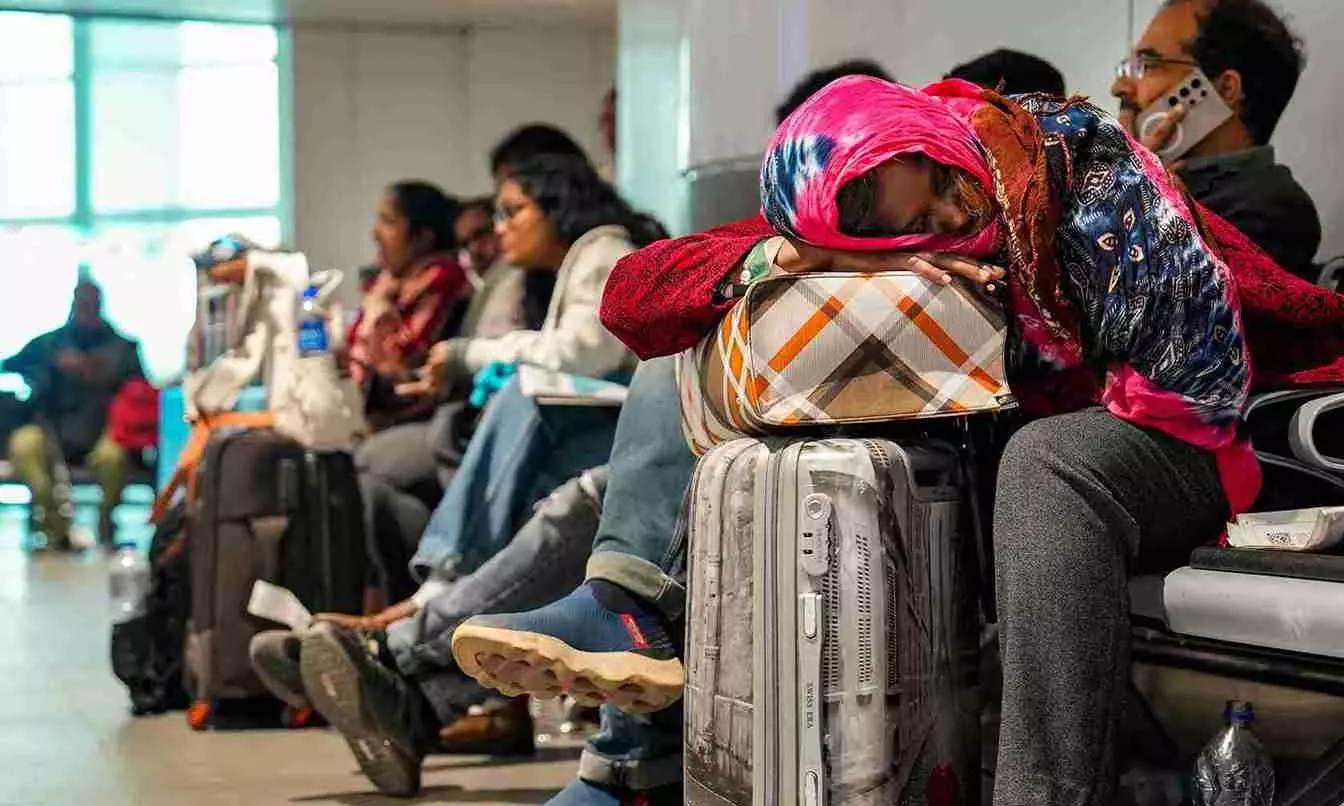
Amidst delays and cancellations of flights, passengers wait at Delhi's Indira Gandhi International Airport in early December. PTI photo
In the decades that followed, however, it was because of airlines like Air Deccan and IndiGo that India today has one of the fastest-growing aviation markets in the world, with low-cost carriers accounting for the majority of domestic capacity. According to DGCA data, IndiGo’s domestic traffic grew by approximately 9–10 per cent in 2024, while rivals like SpiceJet saw flat or declining traffic and Air India’s growth lagged behind IndiGo’s expansion.
The low-cost carrier model has made flying a normal part of life for people who, in their childhoods, would have crossed the country only by train or not at all. Small cities gained direct links to metros. Business travel changed shape. So did migration, tourism and even family life.
But as the events of this winter show, the model that delivered those gains cannot simply be stretched indefinitely.
“Look at the scoreboard; most of the original low-cost airlines have either folded or shrunk dramatically. Air Deccan, Kingfisher Red, Go First’s collapse, SpiceJet’s scale-down… the model hasn’t delivered stable profitability in India,” said pilot Prashant Singh, who handles cargo plane deliveries for e-commerce players in India. “When a business model requires 90-plus per cent load factors, perfect on-time performance and perpetual cost-cutting just to stay afloat, it’s not sustainable in the long run.”
The next phase of Indian aviation may not look like a clean break from the low-cost model so much as a slow hybridisation. IndiGo is already selling 'Prime' and 'Stretch' bundles that resemble a soft premium economy. Air India Express is trying to position itself as a 'smart' hybrid. Newer carriers like Akasa emphasise more humane service norms even within a low-cost framework. Regulators, jolted by the meltdown, are now being pushed by unions and global pilot groups to stick to evidence-based fatigue rules rather than retreating under political pressure.
That evolution will not bring back Pan Am-style glamour and it is unlikely to eliminate the logic of ancillary revenue. But it might force airlines and regulators to finally admit that cheap tickets cannot be sustained by invisibly shifting risk onto crew and passengers.