- Home
- India
- World
- Premium
- THE FEDERAL SPECIAL
- States
- Perspective
- Videos
- Sports
- Education
- Entertainment
- Elections
- Features
- Health
- Business
- Series
- In memoriam: Sheikh Mujibur Rahman
- Bishnoi's Men
- NEET TANGLE
- Economy Series
- Earth Day
- Kashmir’s Frozen Turbulence
- India@75
- The legend of Ramjanmabhoomi
- Liberalisation@30
- How to tame a dragon
- Celebrating biodiversity
- Farm Matters
- 50 days of solitude
- Bringing Migrants Home
- Budget 2020
- Jharkhand Votes
- The Federal Investigates
- The Federal Impact
- Vanishing Sand
- Gandhi @ 150
- Andhra Today
- Field report
- Operation Gulmarg
- Pandemic @1 Mn in India
- The Federal Year-End
- The Zero Year
- Science
- Brand studio
- Newsletter

International Day of Persons with Disabilities: Why India still lacks inclusive public spaces
A decade after India launched the Sugamya Bharat Abhiyan to ensure accessibility in built environment, transportation, information and communication systems, those living with disabilities say much remains to be done, beyond perfunctory ramps for wheelchairs, to ensure a disability-friendly society.

Bhavneet Kaur, 34, assistant professor at OP Jindal Global Law School in Sonipat, Haryana, was affected by polio in childhood, which makes walking difficult for her. Most public places require her to seek assistance, she says, but when she visited the Shri Aurobindo Ashram in South Delhi in 2022, she recalls not having to turn to a stranger for help for the first time in her life.“As a...
Bhavneet Kaur, 34, assistant professor at OP Jindal Global Law School in Sonipat, Haryana, was affected by polio in childhood, which makes walking difficult for her. Most public places require her to seek assistance, she says, but when she visited the Shri Aurobindo Ashram in South Delhi in 2022, she recalls not having to turn to a stranger for help for the first time in her life.
“As a person with a physical disability, living in metro cities of India, I had never really experienced disability friendly architecture until I visited this ashram,” she said. “At no point in that building did I have to ask anybody to give me their hand for support or to awkwardly navigate areas without a railing. It tells a stark story of what I have lacked in all urban spaces, an inclusivity for people with disabilities.”
It was this systemic ableism — a discrimination or prejudice in favour of the able-bodied and therefore a neglect of people with disabilities — that Alice Wong, American writer and disability rights activist, had fought against all her life. Wong’s Disability Visibility Project not only championed disability culture and history, creating an online space for them to “share, organise and connect”, but also encouraged people with disabilities to “record their oral histories with the option of having them archived at the Library of Congress” in Washington.
Wong, who had reportedly been diagnosed with muscular dystrophy at birth, died of an infection last month, aged 51. Her passing came days before the ‘International Day of Persons with Disabilities’, marked on December 3 annually.
For 2025, while the World Health Organization (WHO) has chosen to focus on “how inclusive financing can make a real difference to the lives, health and well-being of persons with disabilities, their families and society at large”, the United Nations (UN) has adopted the theme “Fostering disability-inclusive societies for advancing social progress”.
Also read: Why law banning commercial surrogacy has landed women who rented their wombs in greater misery
The idea of a disability-inclusive society, or space, is not a novelty for India. As far back as the 1990s, India had passed The Persons with Disabilities (Equal Opportunities, Protection of Rights and Full Participation) Act, 1995, which received the President’s assent on January 1, 1996. The Act was to “give effect to the Proclamation on the Full Participation and Equality of the People with Disabilities in the Asian and Pacific Region”, adopted at a convention in Beijing in 1992, of which India had been a signatory. The 1995 Act made provisions for persons with disabilities in education and employment, but also called for “non-discrimination in transport”, “non-discrimination on the road” and “non-discrimination in the built environment”, “within the limits of economic capacity and development” of each sector.
A decade later, in 2015, the Union government’s Department of Empowerment of Persons with Disabilities (DEPwD) launched the Accessible India Campaign, titled the Sugamya Bharat Abhiyan in Hindi, on December 3. The targets were similar to the 1995 Act — built environment accessibility, transportation system accessibility and information and communication system accessibility. “Although initially planned to conclude by March 2024, the campaign’s objectives have been absorbed into the Creation of Barrier-Free Environment Scheme under the broader umbrella of the Scheme for Implementation of the Rights of Persons with Disabilities Act (SIPDA). This transition reinforces the idea that accessibility is a continuous endeavour, requiring sustained efforts to meet evolving challenges,” stated a Ministry of Social Justice and Empowerment communication dated December 2024.
The Rights of Persons with Disabilities Act, 2016, also provided for “equality and non-discrimination”, “protection from cruelty and inhuman treatment”, “protection and safety” and “access to justice”, among other things. While detailing accessibility norms, the Act stated, “All existing public buildings shall be made accessible in accordance with the rules formulated by the Central Government within a period not exceeding five years from the date of notification of such rule”.
"The timeline set was five years from the Act coming into force. The Act came into force in April 2017, more than eight years down the line and universal access is nowhere in sight," rued Muralidharan, general secretary of the National Platform for the Rights of the Disabled (NPRD).
He added: “The Centre’s ‘Accessible India’ campaign, launched with much fanfare in 2015, remained only on paper. This is a clear indicator that access is no longer a priority. The challenges in the rural areas are much higher. We need to bear in mind that people with disabilities are not a homogeneous group. Each disability has a separate access need and accommodation that needs to be addressed."
According to the activist, except for access audits in some big buildings in major cities, little action has been taken in making public places more inclusive. “The railways had set various targets of stations accessible. Except for a few, all major stations continue to be terribly inaccessible. The major reason for this has been the inadequate budgetary support. The ‘Accessible India Campaign’, which had a separate budgetary head, has now been subsumed under the larger ‘Scheme for Implementation of Persons with Disabilities Act’," Muralidharan added.
Also read: How a chain of community-led libraries is reimagining public reading spaces in Delhi-NCR
For many families, the struggle begins right outside their homes. A 68-year-old mother in Tamil Nadu, whose adult son has cerebral palsy, says she has spent years begging local authorities to make the road near her home accessible. “Even the toilets in the Collector’s office are not accessible. This reflects a deep-rooted mindset, the assumption that a person with disabilities could never hold a position like Collector.”
According to the 2011 Census, India had an estimated 2.68 crore people with disabilities living in the country at the time. But most of those living with disabilities, or their families, or activists cite a disparity in facilities and sensitivity to the needs of persons with disabilities as the main problem — while some cities, or public buildings and spaces have tried to provide at the least the minimum facilities, like a ramp for wheelchair movement or railings for support for those with mobility issues, even such basic infrastructure is missing elsewhere, compounded at times by the lack of sensitivity in people around.
"There is silent and open gawking at my left leg's orthopedic brace whenever I head out. There has been sensitivity in the offering of assistance at times, which is appreciated. The other side is the uncalled for offering of advice on cure or complete indifference," Meghana Ravichandran, a 30-year-old freelance content writer told The Federal.
Justin J, 45, who heads operations at IIT Madras’s TTK Center for Rehabilitation Research and Device Development (R2D2) and uses a wheelchair for movement, talks of pockets of progress, with ramps in new government buildings, low-floor buses and metro stations with lifts, but also gaps that are “glaring and often dangerous”.
“I think a lot is desired in terms of the user, the wheelchair user or person who is using an assistive device to be able to access the ramp or the toilet independently. Thought is not given in that. For example, sometimes the ramps are steep; once you start using the toilet, it is not well designed right from being able to access the door,” Justin explained.
He added: “Moreover, even where the metro and bus are accessible, you don't have walkways that are disability-friendly. I have seen in Chennai, where there is a wheelchair symbol put for a walkway, there would be these barricades that prevent two-wheelers from going there, which also means that it prevents wheelchair users from accessing it.”
Justin also talks of “humiliation” at airports. “It’s only in India, that the security gives a tough time asking that the person be lifted or transferred into another wheelchair while they scan the person’s personal chair.”
Last year, a woman, reportedly with 75 per cent disability in her legs, moved the Supreme Court, after she was allegedly asked to stand and walk during security checks at the Kolkata airport. Earlier, in 2016, a woman with disabilities had alleged that she was made to crawl to the passenger coach by Air India after the airlines reportedly denied her a wheelchair for security reasons.
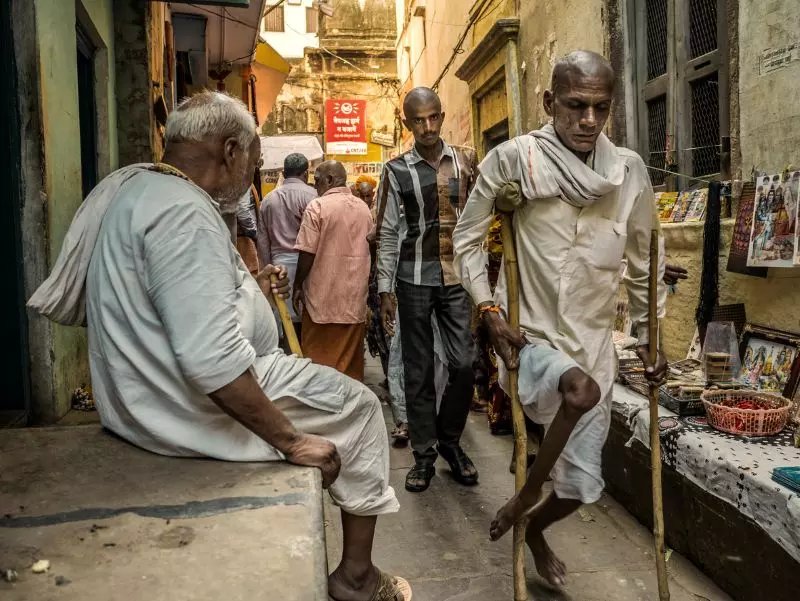
Representative image. iStock photo
Sathish Kumar R, 36, a public-sector bank employee in Chennai with cerebral palsy, who uses a motorised wheelchair for mobility and is a para-athlete, celebrates small victories such as ramps on Marina Beach. “The silver lining is that improving accessibility has given the opportunity for even people with disabilities to have a social life. But there is always a dependency on other people; the architecture is not supportive of people with disabilities. Basic urban planning needs to be done keeping in mind that such spaces can be accessed by everyone,” he said.
When it comes to facilities for those beyond mobility issues, the awareness and facilities drop even further, say those in the know.
"There are audio announcements in lifts, but they are often turned off because it is considered intrusive. On the other hand, earlier there were lifts with braille on the buttons, but of late, there is a trend of touch screen kind of lift interface, which cannot be used by blind people," pointed out Vaishnavi Jayakumar, disability rights activist affiliated with the Disability Rights Alliance.
Beyond physical disability, sensory and intellectual disabilities remain almost entirely ignored. Kavitha Krishnamoorthy, managing trustee of Bengaluru’s Kilikili Network, which has built 25 inclusive public parks in 15 years, says children and adults on the autism spectrum need far more than ramps.
"It's not easy navigating the system as a neurodivergent person, as ADHD [Attention Deficit Hyperactivity Disorder] and my other diagnosed conditions aren't classified as 'disabilities'. Additionally, I'm also autistic, but according to the government, I need to be 'more' autistic to avail certain benefits. Who decides these limits?” questions Astrid (identified by first name only), a 22-year-old tattoo artist apprentice.
Also read: 10 years of Constitution Day: Why it risks becoming a masking ritual for a backsliding democracy
Beyond accessibility in public places, meeting the education and employment needs of people with disabilities also remains a challenge.
"There are a few schools that are run by the government for children with disabilities, but many others do not have the basic infrastructure for them. There is only a ramp in the name of inclusion and while some schools have ramps, they lack visual boards for hearing impaired, signages for visually impaired are missing and tactile surfaces are not marked…there is no initiative to discuss the needs of children with disabilities at the planning stage itself,” said disability rights activist and working president, NPRD, S Namburajan.
When it comes to employment, “many organisations have taken it upon themselves to be more inclusive and are making strides in employing persons with disabilities”, said Jayakumar, but Astrid added, “it's not easy getting a job when companies are not willing to accommodate disabilities that aren't seen."
Even after a job is found, for a person with disability continuing at it depends on the inclusivity of the workplace. “Training is not accessible to a lot of people with autism. There are companies and corporate organisations that are talking about reservations for people with disabilities, but what we find is that it is a very small percentage of people with autism who can take up these jobs because their cognitive development should be suitable,” explained Krishnamoorthy. She added: “Unless there are very robust systems to support within the organisation, including training of team members, there is difficulty in accessing and continuing at these workplaces.”
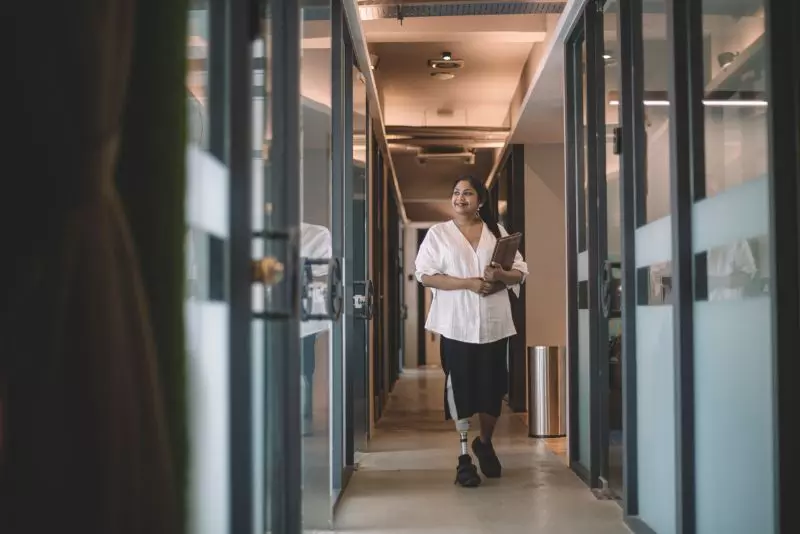
Representative image, iStock Photo
Layered atop these struggles is gender, a multiplier of marginalisation. A 2024 analysis by the Observer Research Foundation (ORF) highlights a significant employment disparity in India, where 47 per cent of men with disabilities are employed compared to only 23 per cent of women with disabilities.
Inaccessible infrastructure forces dependence on strangers, and the National Crime Records Bureau (2022) records that women with disabilities face two to three times higher risk of violence.
"I cannot ask for support from strangers because some miscreants touch inappropriately in the name of helping us. It is quite humiliating and I only end up feeling helpless," said 30-year-old Vinitha R, an IT sector employee who uses a wheelchair for movement after her mobility was impacted in an accident around 15 years ago.
S Govindaraj, commissioner, Office of the Chief Commissioner for Persons with Disabilities, admits “there is not 100 per cent accessibility” yet when it comes to public spaces, but insists that “efforts are being made”. “The change is visible on the ground over the last few years and there are measures by public and private sector stakeholders who are committed to the welfare of people with disabilities. We are seeing more informed and aware decisions being taken for the PwD over the last decade,” he said.
The Federal has also reached the secretary, Department of Empowerment of Persons with Disabilities, on the gaps in accessibility highlighted by those in the know; the article will be updated if a response is received.
Also read: Why Delhi moms fear their children are becoming collateral damage to the city's smog apathy
But the onus cannot be on the government alone, says professor Deepak, Department of Social Work, Loyola College. "How many housing societies are disability-friendly? How many restaurants, malls, community centers, religious places and other private public spaces are disability-friendly? Why would I call upon government authorities? We ourselves are not disability-friendly and we have not learnt that basic infrastructure needs to be made available in such a manner,” he added.
In rare instances, institutions show what inclusion can look like. Lady Shri Ram College for Women (LSR), University of Delhi, recently inaugurated the upgraded Resource Centre for Students with Disabilities, Swavalamban. The upgraded centre has introduced Hark Ai, an innovative artificial intelligence accessibility tool that can scan and read handwriting, translate documents in real time, describe images, and identify barcodes, providing students with unprecedented independence in accessing print and digital content.
“All it takes to make a city accessible is some structural empathy and planning. But our cities have failed us and made us always look at disability with a lens of pity and dependence rather than as people with equal dignity,” said Bhavneet.
(With inputs from Aranya Shankar and Priyadarshini N)