- Home
- India
- World
- Premium
- THE FEDERAL SPECIAL
- States
- Perspective
- Videos
- Sports
- Education
- Entertainment
- Elections
- Features
- Health
- Business
- Series
- In memoriam: Sheikh Mujibur Rahman
- Bishnoi's Men
- NEET TANGLE
- Economy Series
- Earth Day
- Kashmir’s Frozen Turbulence
- India@75
- The legend of Ramjanmabhoomi
- Liberalisation@30
- How to tame a dragon
- Celebrating biodiversity
- Farm Matters
- 50 days of solitude
- Bringing Migrants Home
- Budget 2020
- Jharkhand Votes
- The Federal Investigates
- The Federal Impact
- Vanishing Sand
- Gandhi @ 150
- Andhra Today
- Field report
- Operation Gulmarg
- Pandemic @1 Mn in India
- The Federal Year-End
- The Zero Year
- Science
- Brand studio
- Newsletter

How life has altered for residents of Kashmir villages living with the threat of wildlife attack
Across south Kashmir, a total of 52 people were injured in human–wildlife conflict between April and December 2025. Children are not allowed to even step into the courtyard in the evenings, livestock are brought in and people avoid even visiting neighbours, as bears and leopards stalk the area.

Around 9pm on December 17, five-year-old Sumiya Jan stood on the doorstep of her house in Gallan Ashdar Gujjar Basti in Khiram, a village in south Kashmir’s Anantnag district, looking out. Her father was busy with his own work, not far from where she stood. The neighbourhood was yet to retire for the night.Suddenly, in a moment that flashed by too quickly but that family members and...
Around 9pm on December 17, five-year-old Sumiya Jan stood on the doorstep of her house in Gallan Ashdar Gujjar Basti in Khiram, a village in south Kashmir’s Anantnag district, looking out. Her father was busy with his own work, not far from where she stood. The neighbourhood was yet to retire for the night.
Suddenly, in a moment that flashed by too quickly but that family members and neighbours now recall in agonisingly slow detail, a leopard emerged from the dark edge of the village and seized Sumiya, before retreating again into the shadows.
As shock gave way to frantic action, residents of the area rushed out of their homes, beating on tin sheets to scare away the animal. But when they found Sumiya where the leopard had dropped the child and run away, she was already dead.
Sumiya is unfortunately not an isolated case. On October 12, a five-year-old child was killed in a leopard attack in south Kashmir’s Anantnag district.
Also read: Why leopard-attack fear is holding parts of Uttarakhand hostage, causing disruption to normal life
Both deaths are part of a wider pattern of human-animal conflict unfolding across Kashmir, driven largely by encounters with leopards and black bears.
Reflecting on the attack on Sumiya, Sajad Ahmad, wildlife warden for the Anantnag Kulgam districts, said Khiram is located along the fringes of the Tral Wildlife Sanctuary, which forms part of the natural habitat of leopards. According to Ahmad, the child’s house was close to the forested areas, in a zone which is typically vulnerable to leopard attacks on livestock.
To convey an idea of the scale of the problem, the wildlife warden added that between April and November 2025, his office received nearly 400 distress calls reporting wildlife movement, attacks and sightings in human habitations.
"During this period, wildlife teams captured 40 black bears and released them into their natural habitats; l95 bears were driven back without capture. Only one leopard was captured and released, while 13 leopards were chased back into forest areas. Officials also captured one barking deer, 157 snakes, and five porcupines, all of which were later released safely into the wild," he said.
The crisis is not restricted to these two districts. Officials of the wildlife department in Pulwama and Shopian districts told The Federal that between April and October 2025, wildlife teams in the two districts rescued, tranquilised, rehabilitated, drove back, or facilitated the safe passage of 203 leopards from human habitation. During the same period, 134 black bears were similarly handled. While 61 leopards and 35 black bears were captured and later released into their natural habitats, the remaining animals were driven back or guided away without capture.
Across south Kashmir, a total of 52 people were injured in human–wildlife conflict between April and December 2025, with 40 injuries reported from Anantnag and Kulgam districts and 12 injuries reported from Shopian and Pulwama.
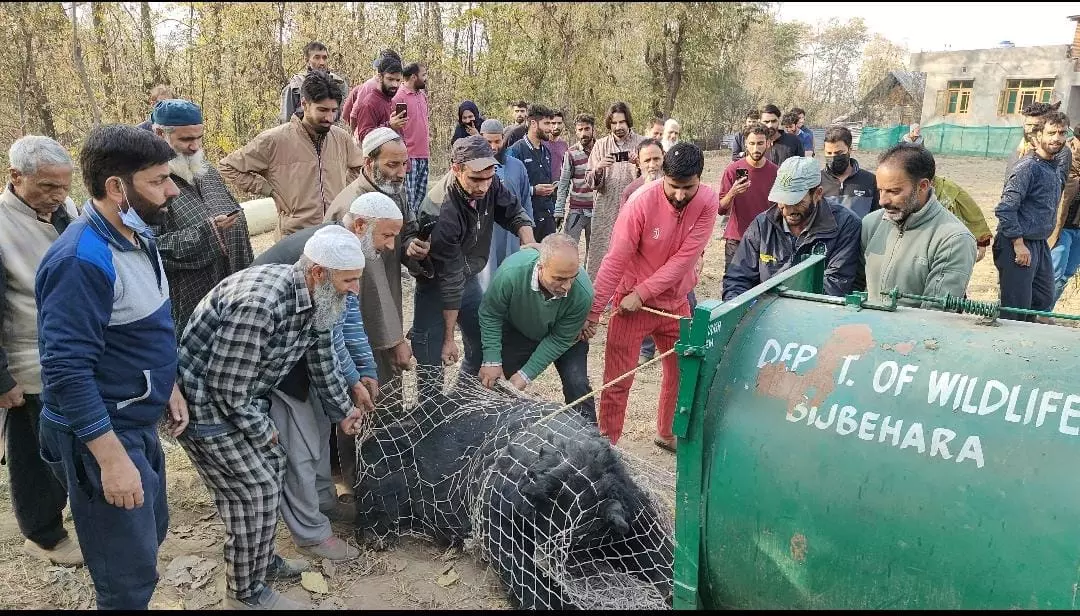
A bear captured in south Kashmir. Photo: By special arrangement
Meanwhile, in Khiram, neighbours of Sumiya wonder whether if preventive steps had been taken in time, the life of the child could have been spared. “Adequate lighting and boundary fencing [along the forest] could help prevent the loss of human lives,” claimed Faizan Ahmad, a resident of Khiram.
While Anantnag and Kulgam are among areas more prone to human-wildlife conflict, because of their proximity to forest belts, wildlife corridors and protected habitats for leopards and black bear, they are not the only regions in Kashmir vulnerable to the threat of animal attacks. Districts in north Kashmir, such as Kupwara and Baramulla, also report a significant number of cases of human-wildlife conflict.
The menace has been on the rise in the past five to eight years, claim locals. According to reports, authorities recorded 3,262 such cases in 2022-23, resulting in 15 deaths and 99 injuries. The following year, 2023–24, saw the number of human-wildlife conflicts in Kashmir rise with 4,947 incidents being reported, including 12 fatalities and 83 cases of injuries. The trend continued in 2024–25, with 16 deaths and 145 injuries, claimed reports.
Also read: Why camels, once the celebrated ‘ships of the desert’, seem to be losing their footing in Rajasthan
According to Reyan Sofi, a wildlife photographer and birdwatcher, the crisis is being caused by the shrinking natural habitats of animals, with rapid urbanisation and deforestation reducing the forest cover and food availability for wild animals, forcing them to move closer to human settlements in search of sustenance.
“Leopards have gradually adapted to human-dominated landscapes, particularly along the Karewa belt in Budgam, where dense vegetation provides adequate cover. Improper disposal of solid waste and the growing population of stray dogs have created a steady food source for leopards in these areas, reinforcing their presence and increasing the likelihood of conflict,” explained Soofi.
Jammu and Kashmir has reportedly seen a significant reduction in forest area in the past two decades, from 21,387 square kilometers in 2001 to 21,109 square kilometers in 2023.
Experts also cite the change in land use patterns in the union territory, from paddy cultivation to horticulture, for example, as a contributing factor to animals venturing into human settlements — while fruit orchards provide bears with a source of food, they provide ample scope for leopards to hide, better scope than a paddy field would. According to reports, the area under paddy cultivation in Jammu and Kashmir dropped from 1,62,309 hectares in 2012-2013 to 1,34,067 hectares in 2021-2022. The area under horticulture cultivation meanwhile went up from 82,486 hectares in 1975 to 3,30,956 hectares in 2021.
Living with the daily threat of animal attack has brought in lifestyle changes for the people of Jammu and Kashmir, particularly in villages bordering forest areas.
“Children are not allowed out after dusk anymore, even to step into the courtyard,” said Abdul Rashid, a resident of Khiram. “Livestock is brought indoors early, and people avoid moving between homes at night.”
According to warden Sajad Ahmad, the department has been conducting awareness drives to inform residents of leopards’ nocturnal habits, initiated round-the-clock patrolling in the area and set up a temporary camp to tranquilise and capture the animal that killed Sumiya. “Safety advisories are being communicated to residents through public announcements made from local mosques in Khiram.”
In addition to attacks, the wildlife conflict is causing financial problems for people in these areas owing to livestock loss.
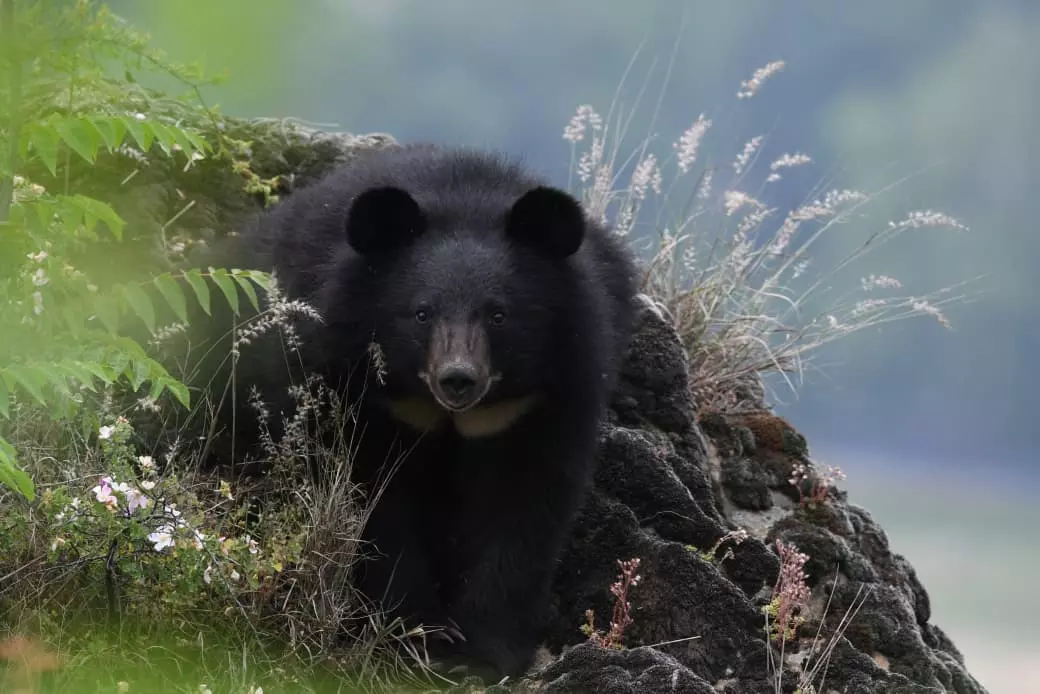
A bear in the wild. Photo: By special arrangement
On December 18, a leopard struck in Sopore’s outskirts, in Shiva village of north Kashmir’s Baramulla district. During the intervening night, the animal entered a sheep shed belonging to Showket Ahmad Dar, unleashing panic and destruction among a tightly packed flock. By morning, at least seven sheep lay dead inside the shed, while seven others were found grievously injured. Residents said the leopard had slipped into the enclosure unnoticed, mauling the animals before fleeing back into the darkness.
“Showkat and his family are completely dependent on his income from livestock and the attack, which killed seven animals and injured several others, caused an estimated loss of around Rs 1 lakh,” claimed a neighbour, Sabzar Ahmad.
In a further worrying development, the human–wildlife conflict in Kashmir is no longer confined to villages in forest areas. By November 2025, it had moved into the Valley’s academic and medical campuses — spaces assumed to be secure and that are constantly monitored.
Also read: How sniffer dogs are helping Telangana forest officials combat teak smuggling, animal poaching
On November 28, a Himalayan black bear was spotted inside the premises of the University of Kashmir at Hazratbal. The animal was seen moving close to the hostel areas late in the evening. Videos that later surfaced on social media showed the bear near the Sir Syed Gate, chased by street dogs, as students watched from a distance. “If wild animals can enter so easily, it shows how casually safety is being taken,” said a postgraduate student, Showkat Ahmad.
Added John Mohammad, a research scholar at the University of Kashmir, “Every time something happens, officials talk about awareness and patrolling. But nothing changes on the ground. Now wildlife is walking into campuses and even that doesn’t seem to trigger urgency.”
According to the university’s chief proctor, professor Imtiaz Ahmed Khan, the bear is believed to have entered by jumping over the boundary wall from the rear side of the campus, near the girls’ hostels. “The wildlife department, along with police officials, reached the campus the same night and carried out checks to ensure the animal had exited the premises. Precautionary measures were immediately taken, including advising students to remain indoors and avoid moving alone at night, particularly those studying late hours in the Allama Iqbal library," he said.
Khan added that wildlife officials were stationed on the campus for four days as a precautionary measure.
Meanwhile,just days later, on December 2, a black bear was spotted near the Sher-i-Kashmir Institute of Medical Sciences (SKIMS), Srinagar’s largest tertiary-care hospital, prompting those accompanying patients to question the security at the hospital.
“People come here with medical emergencies. There are elderly patients, children, and people sleeping outside the wards at night. If a wild animal can enter a hospital campus, what does that say about preparedness?” questioned Waseem Hassan, who was accompanying one of the patients.
Dr Ankit (identified by first name only), a member of the hospital administration department at SKIMS Soura, which manages the main SKIMS hospital, told The Federal that the administration acted immediately after receiving information about the bear sighting. “The hospital remained on alert and informed the nearby police station and the wildlife department. Early the next morning, once visibility improved, teams moved to the area where the bear’s movement had been reported, but the animal had already fled. The bear was later captured in Srinagar a few days after the incident.”
In another case of animal attack in Kashmir, a leopard entered a Central Reserve Police Force (CRPF) camp in Kapran, Anantnag district, on December 24, injuring a security personnel. According to officials, the incident occurred while CRPF personnel were assembled in the camp mess for breakfast.
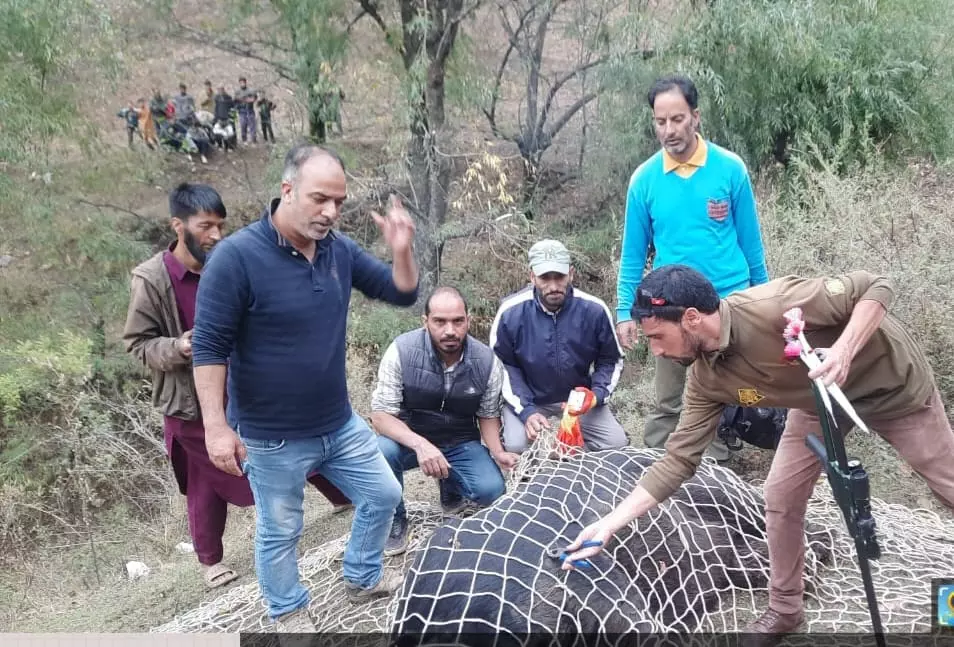
A wild animal caught in south Kasmir. Photo: By special arrangement
The solution, according to Sofi, “lies in protecting and restoring natural habitats, stopping unplanned urban expansion near forest areas and ensuring proper waste management so animals are not drawn to dumping sites”.
The Federal has also reached Rashid Yahya Naqash, regional wildlife warden (headquarters), Jammu and Kashmir, for comment. The article will be updated if a response is received.
Meanwhile, the leopard attack that killed Sumiya has also drawn political attention, with People's Democratic Party (PDP) leader Iltija Mufti visiting the area and criticising the administration for what she described as a lack of basic infrastructure and official presence. She has urged the government and the wildlife department to take immediate note of the situation and move beyond reactive measures.