- Home
- India
- World
- Premium
- THE FEDERAL SPECIAL
- States
- Perspective
- Videos
- Sports
- Education
- Entertainment
- Elections
- Features
- Health
- Business
- Series
- In memoriam: Sheikh Mujibur Rahman
- Bishnoi's Men
- NEET TANGLE
- Economy Series
- Earth Day
- Kashmir’s Frozen Turbulence
- India@75
- The legend of Ramjanmabhoomi
- Liberalisation@30
- How to tame a dragon
- Celebrating biodiversity
- Farm Matters
- 50 days of solitude
- Bringing Migrants Home
- Budget 2020
- Jharkhand Votes
- The Federal Investigates
- The Federal Impact
- Vanishing Sand
- Gandhi @ 150
- Andhra Today
- Field report
- Operation Gulmarg
- Pandemic @1 Mn in India
- The Federal Year-End
- The Zero Year
- Science
- Brand studio
- Newsletter

A decade after the 2016 event which saw JNU being branded ‘anti-national’, what's changed on campus
On Feb 9, 2016, an event at JNU, organised on the anniversary of Afzal Guru’s execution, saw Delhi Police arresting three students on sedition charges. A decade later, the university, once known for open debate and political ferment, is marked by a ‘sense of intimidation’ and ‘trust deficit’.

On February 9, 2016, an event at the Jawaharlal Nehru University (JNU) campus, organised to mark the anniversary of 2001 Parliament attack convict Afzal Guru’s execution, set off a chain of events that would have an enduring impact on the university. Television debates branded the campus “anti-national”, the Delhi Police arrested then JNU Students’ Union (JNUSU) president Kanhaiya...
On February 9, 2016, an event at the Jawaharlal Nehru University (JNU) campus, organised to mark the anniversary of 2001 Parliament attack convict Afzal Guru’s execution, set off a chain of events that would have an enduring impact on the university. Television debates branded the campus “anti-national”, the Delhi Police arrested then JNU Students’ Union (JNUSU) president Kanhaiya Kumar, and two other students — Umar Khalid and Anirban Bhattacharya — on sedition charges and several students were subjected to police investigations.
While the trio were granted bail and the high-pitched national controversy has since slipped into legal limbo — with the sedition law itself put in abeyance and questions raised about doctored video evidence circulated by television channels — the incident has left an enduring impact on JNU.
“2016 was a watershed moment for the campus, for two different reasons,” said Rohit Azad, JNUSU president between 2002 and 2004, who’s now teaching at JNU’s Centre for Economic Studies and Planning.
“One, while it created a sense of fear among the students, it also lifted their spirits that they could even resist the might of the state. Student movement was never the same [again]. Two, it vilified the campus to no end; so among the common people, JNU’s stature has been affected, which hopefully will wither away with time,” he added.
Also read: Professional milestones to personal moments — what Umar and Sharjeel have lost since 2020 arrest
For students at JNU today, the legacy of 2016 is experienced less as memory and more as routine. One consequential marker of this shift was the Chief Proctor’s Office (CPO) manual on “Rules of Discipline and Proper Conduct of Students of Jawaharlal Nehru University”, approved by the university’s Executive Council (EC) in November 2023.
“After the CPO manual came into force, every other day, even for some basic protest, whether it is a protest for drinking water or against sexual harassment, even for pasting posters, people have been fined. Once you pay a fine to the administration, you are no longer eligible to contest elections and this has come as a big blow to activism,” said JNUSU vice-president K Gopika Babu.
According to her, the physical spaces for protest, once central to JNU’s political culture, have steadily shrunk. “Earlier, only the 100-metre radius of the administrative block was restricted for protests. But according to the CPO manual, the entire academic block is not possible for us to protest in. Even dhabas come under the vicinity of the warden’s residence, so basically, we are left with no space in the campus to hold protests,” she claimed.
Babu also cited alleged ambiguity built into the rules. “There are terms such as ‘anti-national’ which have not been clearly defined in the manual and it is left to the Proctor’s Office to define what it means. In this political climate, saying anything outright against the government can be tagged as anti-national and that can be taken up against the student because there is no clear definition provided,” she added.
The Chief Proctor’s Office manual prescribes fines of up to Rs 10,000 for “any act of moral turpitude”, “printing, circulating or pasting posters/pamphlets (text or picture) carrying derogatory religious, communal, casteist or anti-national remarks” and “any activity which incites intolerance towards a religion, caste or community and/or antinational in nature which disturbs the peaceful atmosphere in the campus”.
Over the years, Babu claimed, this has produced what students call a “fine culture” — one that disciplines dissent while generating revenue. Reports suggest that until November last year, the university had collected around Rs 30 lakh in fines since 2016.
For many students, the effect extends well beyond protests, into the everyday rhythms of academic life. A PhD student in political science told The Federal that even talks and discussions are now tightly regulated.
“In terms of talks, who will be the speaker, and all the political programmes have come under very close scrutiny by the administration. Earlier, there was this democratic culture of having multiple talks, post-mess talks, post-dinner discussions everywhere. All of this has closed now. The administration at various levels doesn’t approve venues and now everyone fears that something will happen and they will be held responsible,” he alleged.
The fear, the student claimed, now shapes what can be discussed. “People have started fearing talking about certain issues, for instance, regarding Kashmir, what happened there, and how the Indian state is acting there. Everyone fears talking about these issues,” he explained.
The monitoring of speakers and events is no longer limited to student groups, claimed sources at the university. In recent years, academic and commemorative events organised by teachers have also been denied permission. These include a farewell event for a faculty member where historian Romilla Thapar was invited, and a memorial meeting at which economist Prabhat Patnaik was to be present. Both Thapar and Patnaik are Emeritus Professors at JNU, and yet —or because of it — sources claimed, their presence was deemed problematic by certain deans and chairpersons.
In 2024, JNU cancelled three seminars that were to feature the Iranian, Palestinian and Lebanese ambassadors on discussions about ongoing West Asian issues. Reports at the time had cited university sources who had claimed that the events were cancelled owing to concerns over potential protests on campus, while the coordinator of the seminars had purportedly blamed “threat culture” and filed complaints with the administration about alleged pressure.
For Moushumi Basu of the Centre for International Politics, Organisation & Disarmament, a similar moment marked a clear rupture with the past.
“A few months back, I held a gender sensitisation workshop on the steps of the SIS [School of International Studies]. It was organised by a students’ council. After the programme, some of the School of Languages students came to me and said they still had questions, so I suggested that we meet on another day in a classroom. When they put this up as a poster, my chair came in and actually locked the classroom, saying, ‘You can’t have these programmes here,” she said.
“That is where I really feel the change. Earlier in JNU, we would never have had to think twice about holding something so important – something they should be doing themselves but don’t. Now we find our own facilities being taken away, and that really, really bothers me,” she added.
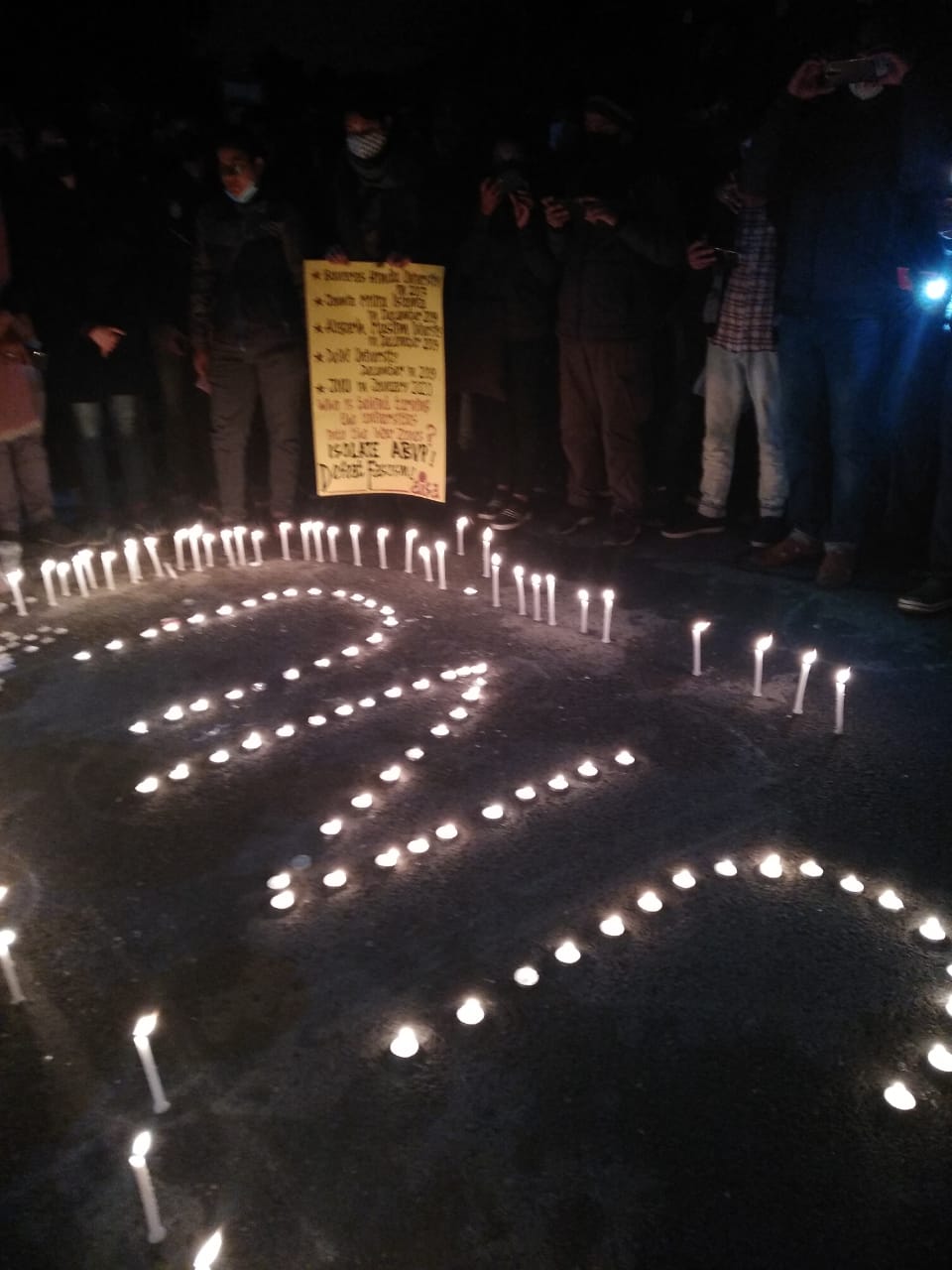
Students and faculty claim there is a 'trust deficit' on campus. File photo
According to a second university source, critical learning, once the “backbone of JNU”, “has been dented”. “There are overt and covert ways of denying this. Sometimes it is by denying permission for certain speakers or not allotting rooms and sometimes it is by increasing the room rent for such programmes,” claimed the source.
Alongside regulation has come surveillance, which has intensified the sense of intimidation, claimed some.
“They have started installing CCTV cameras everywhere, in the hostels and in the schools. Earlier, it was not like this [meaning the surveillance was not so extensive]. During the pandemic, when students were not on campus, they used that moment to install theṃ. Now they record everything. If you have any event, any small discussion, if six or seven people gather anywhere, even in the student union room, they record and keep an eye on you,” alleged a PhD student.
“It feels like an intimidating environment where cameras are always on, and people don’t feel free in the same way,” he added.
Faculty and students confided that there was now a “trust deficit” between them.
“I have heard faculty saying they are unsure of what they say in class. If I have to say something about a government policy, which I usually do, I have no hesitation in believing that someone will go and report it to earn brownie points. There is a reporting system that they have created, and that is a very serious problem,” alleged Basu.
A student speaking on the condition of anonymity told The Federal that teachers were afraid to stick their necks out for students sometimes, as they feared repercussions.
Also read: Emergency era to Nepal agitation: Decoding youth protests and what puts these movements at risk
Faculty representatives argued, however, that these experiences stemmed from bigger institutional changes.
“The first fundamental change is that the entire structure of decision-making and governance has been turned upside down. Chairpersons and deans are no longer appointed through a non-discretionary system like rotation by seniority. These appointees then form a significant part of academic and executive councils as ex officio members, which has centralised decision-making in the office of the vice chancellor,” alleged Surajit Mazumdar, president of the JNU Teachers’ Association (JNUTA).
He added: “Decisions like doing away with the JNU entrance exam and shifting everything to NTA (National Testing Agency) and CUET (Common University Entrance Test) did not flow from deliberations within the university. The faculty never came to an opinion that this was the best way to do things. These were decisions taken elsewhere and imposed from above.”
Mazumdar also cited a “growing use of discretion”. “There is an increased use of discretionary power in matters like recruitment, promotion, and housing allotment, exercised in ways that have nothing to do with academic statutes… Many promotion applications have been pending for years. This has changed the entire culture of the university, and the result is that the academic culture is gradually dying,” he alleged.
Former JNUTA general secretary Bikramaditya Chaudhury, who teaches at the university’s Centre for the Study of Regional Development, described how deliberative forums have allegedly been hollowed out, claiming that the campus had moved towards “authoritarian absolutism” in the past 10 years.
“The last academic council (AC) meeting I attended was in December 2016. It had begun at 2.30 pm and went on for eight hours, until 10.30 pm, when — at my request — it had been suspended because several important items were still pending. The meeting reconvened the next day. Today, academic council meetings are over in eight minutes. They rarely cross an hour. Academic matters are no longer deliberated in any meaningful forum; they are pushed through the executive council (EC) or cleared by notification,” he claimed.
Chaudhury added: “Everything is now online: EC meetings, AC meetings, even court proceedings. Everything is controlled by the administration, and they decide who is muted, who is allowed to speak and chat boxes are blocked.”
According to Basu, too, “huge meetings get over in nine or ten minutes”.
“Decisions are taken on behalf of a public university like this and it has become a personal fiefdom,” she alleged.
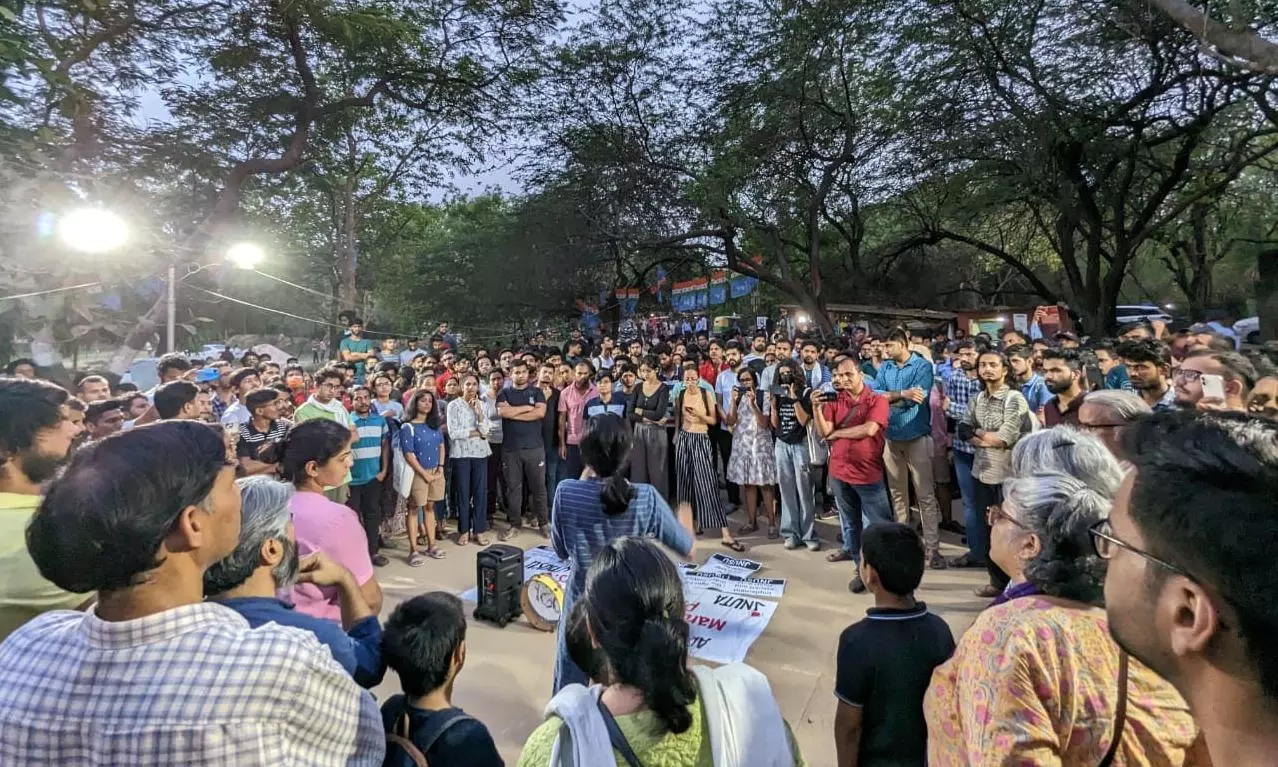
File photo of a protest at the university. Students and faculty claim now even talks and discussions on campus are tightly regulated.
V Lenin Kumar, who had been JNUSU President in 2012 and keeps himself updated on the current situation at the university, claimed the transformation has reshaped the university’s ethos. “Like the famous Jawaharlal Nehru quote inscribed on the JNU Nehru statue, ‘The university stands for tolerance and the idea of adventure,’ the JNU campus academically and politically reflected this quote by embracing various ideas and debates,” he said.
He added: “Students from any socio-political, regional, and linguistic background could make their points without fearing repercussions from the administration and other student outfits. Now, there is a clear line drawn by the administration and the government between nationalist and anti-national. Ideas and ideological debates have become sectarian and degraded into a single identity.”
According to Rohit Azad, the cost of this shift has been borne by campus politics itself. “JNU has always been a place for dissent; it never had any space for violence. But the violence unleashed over the past few years has changed the campus irrevocably. Doing politics today is way more difficult than it was even a couple of decades ago,” he claimed.
The administration rejected the allegation that dissent was being curtailed at the university. “Campus is better. There is always space for dissent and protest, but not for violence and vandalism. India is a thriving democracy, and so is JNU. Freedom entails responsibility, and choices have consequences. There is no shrinking hegemony. The domination of one ideology has ended, giving space and narrative diversity (sic),” vice-chancellor Santishree Dhulipudi Pandit told The Federal.
Many on campus, however, claimed the distance between this official account and their everyday experience continued to widen.
“The situation is 10 times more challenging than in 2016. Things that had felt like aberrations then have now become institutionalised. Students are trying to continue the legacy under much more pressure than before. The fine culture has really made things very difficult, and the administration’s autocratic attitude has only cemented over the years,” claimed an ex-student in the know of things.
For all the regulation and surveillance, however, the idea of JNU has not entirely vanished. Students still gather and teachers still push back.
Most recently, the JNUSU chose to defy the administration’s decision to rusticate all four union office-bearers and a former JNUSU president, declaring them out of bounds on charges of alleged “vandalism” during a protest last year — an unprecedented move. What followed was a university-wide strike, a mashaal juloos through the campus, a press conference backed by members of Parliament and a student parliament on the UGC Equity Regulations 2026. The JNU Teachers’ Association, too, spoke out, demanding the vice-chancellor’s removal — a sign that even under duress, dissent at JNU is far from disappearing.