- Home
- India
- World
- Premium
- THE FEDERAL SPECIAL
- States
- Perspective
- Videos
- Sports
- Education
- Entertainment
- Elections
- Features
- Health
- Business
- Series
- In memoriam: Sheikh Mujibur Rahman
- Bishnoi's Men
- NEET TANGLE
- Economy Series
- Earth Day
- Kashmir’s Frozen Turbulence
- India@75
- The legend of Ramjanmabhoomi
- Liberalisation@30
- How to tame a dragon
- Celebrating biodiversity
- Farm Matters
- 50 days of solitude
- Bringing Migrants Home
- Budget 2020
- Jharkhand Votes
- The Federal Investigates
- The Federal Impact
- Vanishing Sand
- Gandhi @ 150
- Andhra Today
- Field report
- Operation Gulmarg
- Pandemic @1 Mn in India
- The Federal Year-End
- The Zero Year
- Science
- Brand studio
- Newsletter

Why two NCERT Kannada language books have academics in Karnataka riled up
Two books titled Krishna and Mridula, designed for CBSE students of class 6 and 3, who have opted for Kannada as a third language, have drawn widespread criticism. While the title ‘Krishna’ has been alleged to be an attempt at ‘saffronisation’, a chapter on food which almost exclusively presents a milk, fruits and vegetable diet has been accused of promoting vegetarianism. The bigger discourse is on the alleged cultural and linguistic encroachment.

It’s unclear why, in an already charged academic climate surrounding the debate over the introduction of the three-language formula for schools, it took Karnataka’s academic circles nearly two months to react to a new Kannada language textbook introduced by the National Council of Educational Research and Training (NCERT). But last month, a book introduced in the 2026-27 academic year...
It’s unclear why, in an already charged academic climate surrounding the debate over the introduction of the three-language formula for schools, it took Karnataka’s academic circles nearly two months to react to a new Kannada language textbook introduced by the National Council of Educational Research and Training (NCERT). But last month, a book introduced in the 2026-27 academic year (which started in April) became the new epicentre of controversy in the three-language row after being in circulation for about a year.
Perhaps, the book became more widely-available in recent weeks, and hence drew attention. While that is but a conjecture, the fact of the matter is that the book, ‘Krishna’, has been caught in a storm since June.
The objection, raised by those protesting against the book, starts with the name itself. "Choosing the name 'Krishna' instead of icons that represent Karnataka's literary and cultural heritage — such as Pampa [10th century poet, regarded as one of the greatest classical poets of Kannada language and addressed as Adikavi or the first poet of Kanna language], Basavanna [12th century philosopher-poet], Kuvempu [poet, playwright, novelist] or Kaveri [the river most often associated with Karnataka] — is itself a cultural decision. It appears to be an attempt to establish a particular ideological perspective while sidelining Kannada identity,” Dr. Niranjanaradhya PV, chief coordinator of the People's Action for Fundamental Right to Education (PAFREF), told The Federal. The PAFREF is one of the organisations at the forefront of the backlash directed towards the book.
Niranjanaradhya adds: “Language textbooks must have an organic connection with the history, memory and lived experiences of local communities, something that is absent in the new NCERT text.”
The name has also drawn allegations of attempts being made to “saffronise” education in the state.
While NCERT has argued that like the Kaveri, Krishna is also the name of a river in the region, and that the book have been named after the river and not the Hindu deity Krishna, Kannada Development Authority chairman, professor Purushottama Bilimale insists, that it is the Kaveri has symbolised Karnataka's identity for centuries — from the ninth-century Kavirajamarga (the earliest available work on rhetoric, poetics and grammar in the Kannada language) to modern Karnataka's geographical, cultural and emotional identity. "When Kaveri has always represented Karnataka's identity, naming a Kannada textbook 'Krishna' cannot be viewed as merely an academic decision. It reflects cultural overreach,” he says.
Bilimale adds: "The Kaveri River is Karnataka's lifeline and a defining cultural symbol in Kannada history. Choosing the name 'Krishna' ignores the sentiments of Kannadigas. This decision should be reviewed immediately."
Also read: Beyond mid-day meal debate, how the humble egg remains both comfort food & delicacy in Bengal
The issue with the books is only the latest in a simmering backlash in parts of the country against the roll-out of the three-language formula under the National Education Policy (NEP), 2020 and the National Curriculum Framework for School Education (NCF-SE) 2023. As per NEP guidelines, two of the three languages have to be native to India. Karnataka is among states which have consistently opposed the move, claiming it to be an attempt to impose Hindi education on students in the state. Earlier this month, Karnataka stirred controversy when the state government decided to award only grades, without marks, for the third language in the secondary school leaving certificate (SSLC) examination.
Now, the NCERT books are the most recent flashpoint.
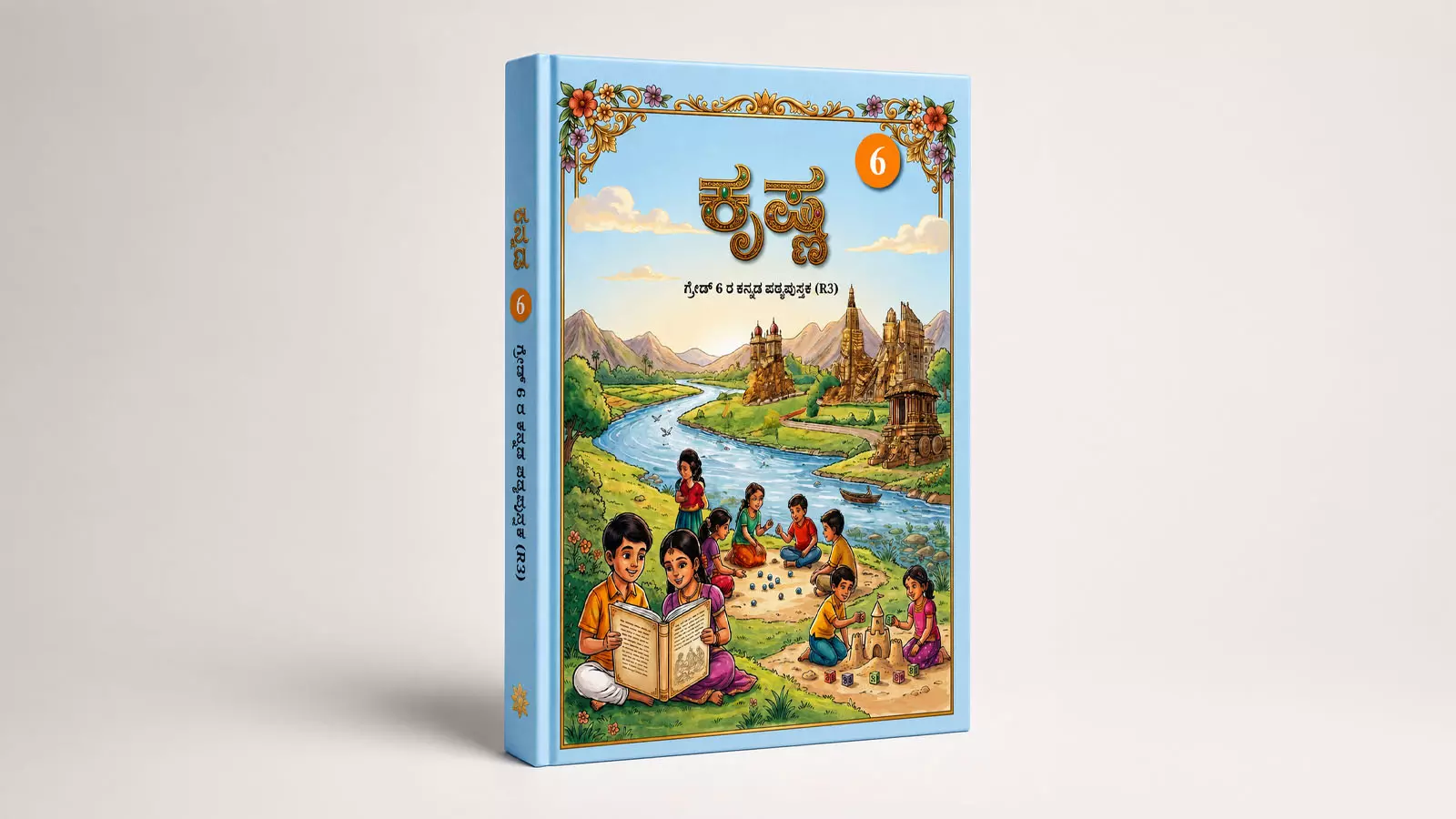
While NCERT says the book is named after the river Krishna and not the Hindu deity, critics complain the title smacks of saffronisation attempts.
Traditionally, Kannada language textbooks for children have carried titles such as Nali Kannada, Tili Kannada, and Siri Kannada [ Learn Kannada Joyfully or Joyful Kannada, Know Kannada or "Understand Kannada and Prosperous Kannada or Rich Kannada] —names that reflect local culture, language, and everyday life.
Krishna, a book for students of class 6, is not the only one to draw ire. Mridula, a book introduced for class 3 students, has drawn similar criticism. According to reports, both books have been introduced by NCERT for students studying in Central Board of Secondary Education (CBSE) affiliated schools and opting for Kannada as their third language.
But herein lies another objection raised by those against the introduction of the books. Under Karnataka's Kannada Learning Act, 2015, Kannada must be taught as either the first or second language in all schools within the state. Critics argue that NCERT's decision to design Kannada as a third-language runs contrary to the spirit of the state's language policy.
"Although education falls under the Concurrent List of the Constitution, central institutions have a responsibility to respect state language policies. Ignoring Karnataka's law while designing the curriculum could create unnecessary constitutional conflict,” Niranjanaradhya observes.
Sections of the book 'Krishna' have also come under criticism for allegedly promoting vegetarianism. A lesson titled "Health is Wealth" presents a balanced diet almost exclusively through milk, fruits, vegetables and ragi mudde (balls). Critics argue this leaves out Karnataka's coastal fish-based cuisine, the meat-eating traditions of North Karnataka and Old Mysuru, and even eggs served under the state's mid-day meal programme have been ignored.
"Food is not merely nutrition; it is also culture. Erasing Karnataka's food diversity and projecting only one dietary model should not be the objective of education. Children should learn about diversity, not uniformity,” argues Niranjanaradhya.
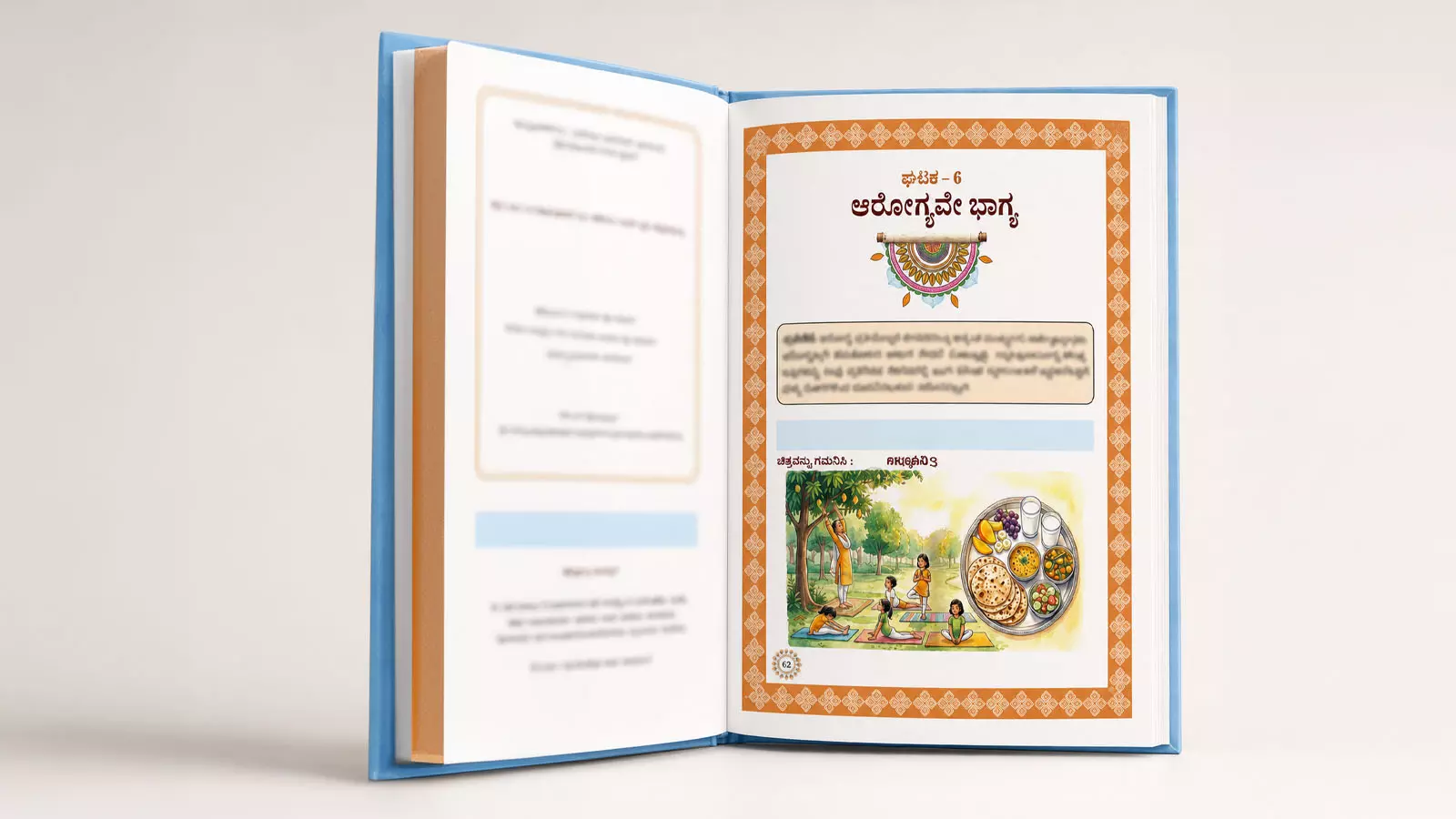
All-veg fare? Critics question the neglect of Karnatak's non-vegetarian cuisine.
Many have also questioned why the Department of State Educational Research and Training (DSERT), Karnataka's official body for developing school curricula, was not meaningfully involved in the finalising of the new textbook.
Speaking on condition of anonymity, a senior DSERT official admitted that the department has limited authority over NCERT publications. "There are demands for DSERT to intervene in the Kannada textbook issue. However, NCERT enjoys complete autonomy in textbook preparation. Our role is limited to state-level educational research.”
The Kannada language department of a Bengaluru-based school, which assisted NCERT with content preparation, has, meanwhile, distanced itself from the controversy.
"We only helped collect material and provided academic suggestions. We fulfilled that responsibility sincerely. At no stage did we neglect Kannada language, culture or heritage,” it clarified.
Amidst mounting criticism, NCERT issued an official clarification, stating, "The titles 'Krishna' and 'Mridula' were not chosen with any religious or political intent. They were selected to make language learning more accessible, familiar and culturally relevant for children." The council further stated that the textbook introduces Karnataka's geography, history, arts, culture, food traditions and biodiversity in a balanced manner and argued that interpreting the title through a religious or political lens was inappropriate.
Bilimale, however, rejects the NCERT argument.
"Our concern is not about one picture or one word. We are asking on what basis Karnataka's cultural framework was altered. Why was DSERT not consulted? Why were successful textbooks like Siri Kannada and Nali Kannada ignored? Instead of answering these questions, attention is being diverted." The academic also expressed concern that the gradual implementation of the National Education Policy 2020 could weaken Karnataka's rich local textbook traditions.
What began as objections to a textbook title has now grown into a wider discussion about states' cultural autonomy, language rights and the implementation of the NEP. Critics allege that central educational institutions are using the policy to encroach upon the cultural and linguistic autonomy of states. The controversy has also revived questions about who should ultimately decide the curriculum for regional languages such as Kannada and according to what standards, turning the issue into a conflict over centre-state educational rights.
Amidst this raging controversy, the NCERT is not completely without its supporters in Karnataka, though.
"Whether Krishna refers to the river or to the deity, what is wrong with it? Children should learn about India's cultural heritage. Those opposing this move are driven by political motives,” says writer and senior journalist BS Jayaprakash Narayan. According to Narayan, India's education system remained influenced by colonial thinking long after Independence and that the new textbooks represent an effort to reconnect students with Indian traditions.
Rohith Chakrathirtha, a member of Karnataka's textbook revision committee during the previous BJP government in the state (2019–2023), also defended the books, describing the current backlash as "unfortunate and baseless".
“In my view, this textbook [Krishna] stands out as one of the most thoughtful and comprehensive representations of Karnataka in recent times. It reflects the geographical diversity of the state, captures its rich traditions, art forms, cultural practices, food habits, and even its flora and fauna with remarkable balance and sensitivity,” says Chakrathirtha.
He adds: “Instead of appreciating this effort, a section of commentators — often identified with entrenched ideological positions — has chosen to create controversy for reasons that appear superficial and unconvincing. The objection begins with the very title of the book, ‘Krishna’, which is interpreted as communal. This line of reasoning is not only reductive but also ignores the cultural and geographical significance of the name. The Krishna river is one of the most vital lifelines of Karnataka, especially for North Karnataka. It sustains agriculture, supports livelihoods, and shapes the cultural identity of millions of Kannadigas. To dismiss it as unrepresentative of Karnataka is to overlook a fundamental reality of the state’s geography and society.”
Chakrathirtha further says that while criticism of educational material is “both necessary and welcome in a healthy democracy”, “such criticism must be grounded in substance, context, and intellectual honesty. Raising objections based on narrow interpretations or ideological predispositions does little to contribute to meaningful discourse.”
Also read: Heat waves to hazardous air — why Delhi’s school system seems ill-equipped for the climate crisis
Interestingly, neither the Congress government in Karnataka, nor the BJP-ruled Centre has waded into the controversy yet.
But the matter is being hotly debated on social media. While one user on X posted that “education should reflect the culture, language, and food habits of every region—not promote a one-sided narrative”, Madhu Bangarappa, MLA and the state’s former minister of primary and secondary education, posted, “strongly demand that the NCERT immediately withdraw this textbook. They must collaborate with our DSERT to design a new curriculum that truly reflects the culture, traditions, and literary-cultural heritage of this soil, and provide it to our students without delay”.
Away from debate, parents only want the best possible education for their children.
"Children and education should be kept away from ideological and political controversies as far as possible. We need textbooks that introduce India's heritage, Kannada identity and contemporary learning in a balanced manner while helping children understand their roots,” says Somashekar K., a Bengaluru resident whose daughter is a Class 6 student at a Kendriya Vidyalaya.
Meanwhile, those protesting against the new books have reportedly demanded the withdrawal of the books, to be replaced with existing Kannada texts. They have also demanded that the chapter on diet be revised to include non-vegetarian food items. Whether they will have success in this mission is as yet unclear. What is less doubtful, though, is that this is hardly the last that we will hear on the three-language row.