- Home
- India
- World
- Premium
- THE FEDERAL SPECIAL
- States
- Perspective
- Videos
- Sports
- Education
- Entertainment
- Elections
- Features
- Health
- Business
- Series
- In memoriam: Sheikh Mujibur Rahman
- Bishnoi's Men
- NEET TANGLE
- Economy Series
- Earth Day
- Kashmir’s Frozen Turbulence
- India@75
- The legend of Ramjanmabhoomi
- Liberalisation@30
- How to tame a dragon
- Celebrating biodiversity
- Farm Matters
- 50 days of solitude
- Bringing Migrants Home
- Budget 2020
- Jharkhand Votes
- The Federal Investigates
- The Federal Impact
- Vanishing Sand
- Gandhi @ 150
- Andhra Today
- Field report
- Operation Gulmarg
- Pandemic @1 Mn in India
- The Federal Year-End
- The Zero Year
- Science
- Brand studio
- Newsletter

How theatre activist Prasanna’s scheme for women empowerment has transformed these Karnataka villages
The Charaka Mahila Vividdodesha Kaigarika Sahakari Sangha was conceptualised in 1994, spearheaded by theatre activist and writer Prasanna, inspired by Gandhi's charkha movement. The aim was to establish an alternative model of rural economic self-sufficiency, especially for women, so that they need not migrate to urban industrial hubs to earn a living, while also challenging the assumption that handloom textiles must remain high-end boutique luxuries.

There’s a buzz at the Charaka Mahila Vividdodesha Kaigarika Sahakari Sangha's campus in Honnesara, Karnataka. The women’s organisation, which specialises in the production of handloom, natural-dyed fabric, apparel and other products, is gearing up for Gandhi Santhe, a rural marketplace and cultural celebration, to be held on September 26 and 27. The Shramajeevi Ashrama in Honnesara,...
There’s a buzz at the Charaka Mahila Vividdodesha Kaigarika Sahakari Sangha's campus in Honnesara, Karnataka. The women’s organisation, which specialises in the production of handloom, natural-dyed fabric, apparel and other products, is gearing up for Gandhi Santhe, a rural marketplace and cultural celebration, to be held on September 26 and 27. The Shramajeevi Ashrama in Honnesara, the venue of the event, is being cleaned, and stalls set up for visiting rural businesses.
Touted as a “buyer-seller meet” to connect consumers with rural artisans, it will feature handwoven and naturally dyed apparel and handicrafts from across Karnataka, with live demonstrations of natural dyeing, and traditional food and cultural activities.
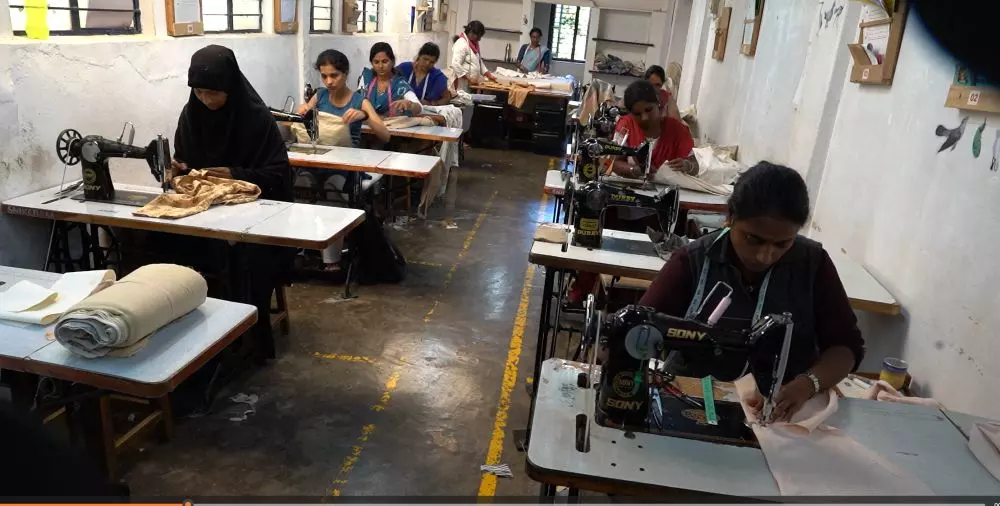
The stiching unit at the cooeprative. Photo: Ramakrishna SC
The Charaka Mahila Vividdodesha Kaigarika Sahakari Sangha, which translates to the Charaka Women’s Multipurpose Industrial Cooperative Society in English, began its journey from Bhimanakone village, a short distance from Honnesara. For the past three decades, first Bhimanakone and then Honnesara, both in Shivamogga district, have been the sites of a slow, steady movement towards women’s empowerment, witnessing the steady growth of a cooperative enterprise that is owned, operated, managed and governed by women.
Set deep within the dense, evergreen expanse of Karnataka’s Malnad region, with its areca nut groves, there are no towering factory chimneys here or hyper-automated assembly lines — the tell-tale signs of mass manufacturing and production often associated with economic growth. Instead, under the tiled, sloped roofs of unassuming rural structures, hundreds of women sit at wooden looms weaving cloth and their way to economic independence, as others tend to vats of natural dyes, work sewing machines and keep note of production and sale, steering an entire production ecosystem inspired by Gandhi’s charakha (spinning wheel) movement.
Also read: How planned repatriation of ancestral human remains from UK museum is uniting Naga tribes back home
Charaka was conceptualised in 1994, spearheaded by theatre activist and writer Prasanna, who sought to establish an alternative model of rural economic self-sufficiency. His core thesis challenged two dominant assumptions: first, that handloom textiles must remain high-end boutique luxuries and second that rural communities — particularly women — must inevitably migrate to urban industrial hubs to earn a living.
“Gandhi believed in Gram Swaraj — that villages should be economically self-reliant and that rural communities should have control over their own livelihoods. Charaka was conceived around this idea. It is an attempt to create a rural economy where people, particularly women, can find dignified work within their own villages,” Prasanna explains.
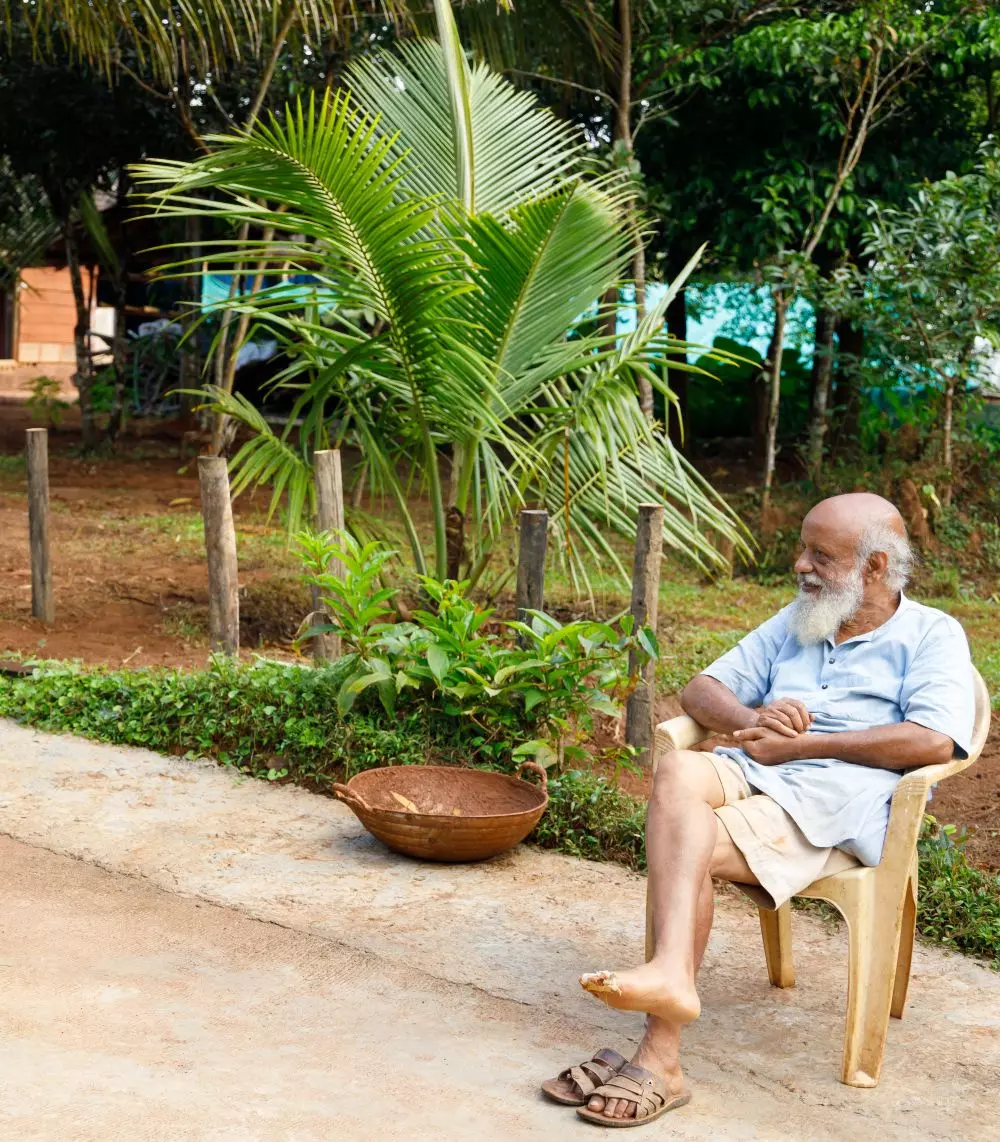
Prasanna at the cooperative. Photo: Ramakrishna SC
What started with just 13 women in a makeshift structure with a few sewing machines is today a 300-strong community, which further extends support to a network of over 800 artisans across Karnataka.
As the cooperative expanded, in 2014, khadi production was shifted from the original two-acre Bhimanakone campus to the Shramajeevi Ashram in Honnesara, a six-acre property that now serves as the major production centre of yarn, khadi thread and woven cloth. The Bhimanakone unit meanwhile focuses mainly on post-production activities, including converting khadi fabric into garments and other products, along with packaging, marketing and distribution to different regions.
Products range from cotton, natural-dyed fabric, apparel for men, women and children, home linen and lifestyle merchandise, with prices varying from just over a hundred for a metre of cloth to a few thousand for a saree.
Fifty-six-year-old Mahalakshmi (identified by first name only) remembers a time before Charaka, when the women in the village would be reduced to severe poverty when the men squandered away household money on alcohol. Income from the cooperative has not only given the women financial independence but the means to support families. She cites the example of mothers who have managed to put their children through schools and colleges with their earnings from the cooperative.
Mahalakshmi had herself joined Charaka at the entry level years back, working in “stock-checking or tailoring” sections. “From there, growing step by step, today I have become the president. In the same way, we provide everyone here the opportunity to grow. When women join Charaka, they are all untrained. We take them in as they are and train them. Through that training, they grow,” she explains.
That flexibility on prior qualifications, which allows any and every woman to be a part of the cooperative, is something Charaka’s CEO Terence Peter also stresses on.
"We don’t have any skilled labour as such. They are all self-trained, though there are volunteers who come and train us,” says Peter, emphasising that research, technical refinement and learning at Charaka are an ongoing process.
The day starts to the tune of ‘Raghupati Raghav Raja Ram’, as the women come together in prayer, before starting work.
The acquisition team calculates the season’s requirements, engaging with suppliers, maintaining stock ledgers and inspecting raw material quality upon arrival. The dye-masters extract pigments from natural sources: areca nut (betel nut) supplies rich terracotta browns and earthy red tones, pomegranate peels are boiled to produce warm mustard yellows and olive shades, eucalyptus leaves and bark yield subtle greys and muted tans, madder root provides vibrant pinks and reds, iron rust and jaggery solutions combined with botanical tannins produce deep, jet-black and indigo is fermented in specialised vats to create blues. On the workshop floor, another group operates foot looms or are engaged in block printing, embroidery, precision garment cutting and stitching. Quality inspectors check every metre of fabric or quality of clothing before they leave Charaka.
One of those involved in end-of-production-line jobs is Aruna B, 45, who works as the marketing warehouse manager at the Charaka women’s cooperative society, “overseeing the central hub that processes handloom garments coming in from various production units”. After the finished clothes are received, ironed, barcoded, and systematically catalogued, Aruna coordinates their distribution across Charaka’s retail outlets based on incoming purchase orders.
Most women here have a story to tell about how the cooperative has made a difference to their lives.
Mangala Hebbailu, 46, lost her husband 17-18 years back. “I was left alone to provide for two very young daughters,” she recalls. Working as a farm labourer, she earned only about Rs 150-200 a day, she says. Then she joined Charaka eight years back. Currently she works in the garment finishing and steam-ironing section, earning about Rs 500 a day. She has to travel about 8 kilometres daily, from her village Hebbayalu to the cooperative, but the steady daily income allowed her to put her daughters through college. Today, both have jobs in Bengaluru. “Charaka gave me back my life. There are so many widows and women from broken homes here who have built their dignity and lives entirely through Charaka,” she says.
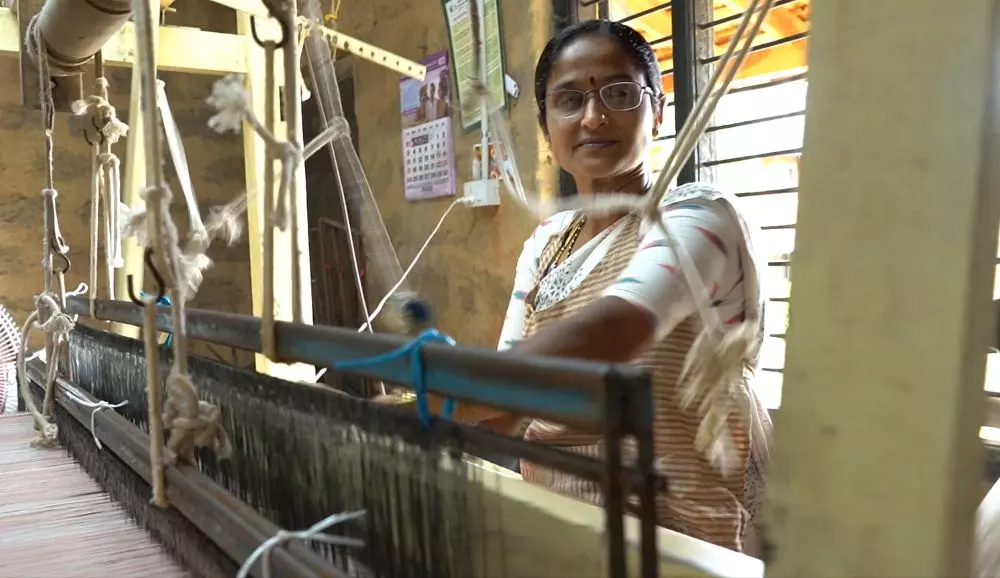
A woman works the loom. Photo: Ramakrishna SC
Her sentiments are echoed by Savitha Gadikatte, a weaver, who calls Charaka a “lifeline”. "I weave 10 metres of cloth a day on this handloom and for the past 14 years, this craft has given me steady work and dignity,” she adds.
Shashikala Hebbailu, 45, realised the importance of the cooperative in her life when she met with a road accident 10 months back, which left her with serious head and leg injuries. Through Charaka, she was able to access the Employees’ State Insurance (ESI) scheme, “a vital lifeline when I was fighting between life and death, with nothing to fall back on”, she says. A tailor by profession, she has since been set up with the required infrastructure at home, from where she continues to stitch apparel and other products for the cooperative.
For some, like 25-year-old Madhunisha Hegoodu, a resident of Sagara, a village five to six kilometres away from Bhimanakone, working at Charaka has meant not having to migrate. A bachelor in commerce, Madhunisha manages the cooperatives business-to-business (B2B) department. “Since it is hard for clients from states like Maharashtra, Goa or Rajasthan to travel all the way to Heggodu, we coordinate directly through WhatsApp, Instagram, and website links to share available weaves and ship bulk consignments straight to their doorsteps. It is empowering to run modern business operations and connect our village weavers to national markets right from here,” she beams.
To ensure long-term stability and operational scale, Charaka established the retail brand Desi in 1977 to market its products through retail outlets in cities like Bengaluru, Mysuru and Shivamogga.
Despite its policy of ‘no profit, no loss’, the cooperative has managed to flourish. The cooperative’s turnover, which stood at Rs 4.42 crore in 2017–18, increased to Rs 4.72 crore in 2018–19 and Rs 5.07 crore in 2019–20. During the Covid period, the turnover declined to Rs 2.92 crore in 2020–21, but subsequently recovered. The turnover increased to Rs 5.10 crore in 2022–23, Rs 7.75 crore in 2023–24 and Rs 8.15 crore in 2024–25. In 2025–26, the society recorded a turnover of Rs 9.66 crore, with a net profit of Rs 5.19 lakh.
“When a woman achieves financial stability, all other forms of empowerment naturally follow. They interact with peers, share their experiences, and grow stronger together,” says 43-year-old Padma Shree Sagara, a resident of a village located eight kilometres from Heggodu. Having studied Apparel Designing and Fabrication Technology in Shivamogga, she says she worked in the garment industry in Bengaluru for two years before returning home and has been associated with Charaka for the past 15 years. The cooperative also give the women something more than financial stability: a shared social space where women work side-by-side through the day, sharing meals, discussing personal challenges, mentoring younger apprentices, and collectively negotiating workspace policies. There are on-site child care facilities for young mothers. The women take pride in their work, many buying and wearing the handloom sarees and kurtas produced by the cooperative.
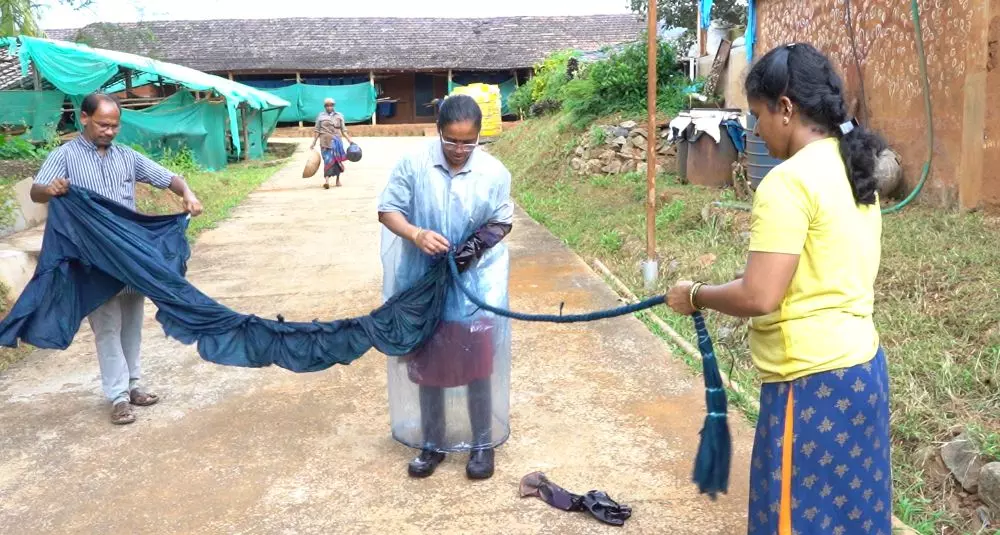
Fabric being dyed. Photo; Ramakrishna SC
Meanwhile, Charaka intends to keep scaling production, broadening market reach, and strengthening rural artisan livelihoods. There are also plans to further expand its efforts to turn waste generated during textile production into a useful resource while creating additional livelihood opportunities for rural households and women, an initiative started only weeks back. The natural dyeing and khadi production units generate considerable quantities of biodegradable waste, including spent plant material, natural dye residues, seed pods and wastewater sludge. Instead of allowing this waste to accumulate or contribute to environmental pollution, Charaka has started processing it along with locally sourced cow dung to produce organic manure and compost. The model also creates a supplementary source of income for local women.
The Gandhi Santhe fits perfectly into this scheme of things, with its aim to strengthen the rural economy, promote environmentally conscious production and give artisans greater financial independence through direct access to consumers.