- Home
- India
- World
- Premium
- THE FEDERAL SPECIAL
- States
- Perspective
- Videos
- Sports
- Education
- Entertainment
- Elections
- Features
- Health
- Business
- Series
- In memoriam: Sheikh Mujibur Rahman
- Bishnoi's Men
- NEET TANGLE
- Economy Series
- Earth Day
- Kashmir’s Frozen Turbulence
- India@75
- The legend of Ramjanmabhoomi
- Liberalisation@30
- How to tame a dragon
- Celebrating biodiversity
- Farm Matters
- 50 days of solitude
- Bringing Migrants Home
- Budget 2020
- Jharkhand Votes
- The Federal Investigates
- The Federal Impact
- Vanishing Sand
- Gandhi @ 150
- Andhra Today
- Field report
- Operation Gulmarg
- Pandemic @1 Mn in India
- The Federal Year-End
- The Zero Year
- Science
- Brand studio
- Newsletter

Why Kashmiri traders scattered across India claim fear of verbal abuse, assault
For decades, Kashmiri traders with their bundles of woollens have travelled across India in winter in search of customers. But terror incidents back home have exposed them to alleged harassment and assault in other states. While the traders are shaken, families in Kashmir live in daily concern.

Thirty-year-old Nisar Ahmed has spent winter away from home for years, travelling with bags of woollens — shawls and pherans — that he would sell to eager customers at the National Capital. This year too, Nihar left home in Kashmir’s Bijbehara sometime in November, but there is an unease as he walks down Delhi streets with his ware on his back now. “So far, things have been mostly...
Thirty-year-old Nisar Ahmed has spent winter away from home for years, travelling with bags of woollens — shawls and pherans — that he would sell to eager customers at the National Capital. This year too, Nihar left home in Kashmir’s Bijbehara sometime in November, but there is an unease as he walks down Delhi streets with his ware on his back now. “So far, things have been mostly okay, but there is a fear after last year’s Delhi car blast incident [near Red Fort, in which a group of doctors from Jammu and Kashmir are among those accused],” he says. “There is a feeling of being watched and judged.”
For decades, Kashmiri traders with their bundles of woollens have been a common sight across India in winter. But terror incidents such as the 2019 Pulwama attack and last year's Pahalgam killings and Delhi car blast have exposed these traders to not only alleged jibes and verbal abuse, but purportedly, even assault. The first two months of 2026 have seen reports of two such alleged attacks on Kashmiri traders in Uttarakhand and Himachal Pradesh.
“Our only crime is that we are Kashmiri and Muslim,” says a bitter Tabish Ahmad Ganie. The 17-year-old and his brother, Danish, 19 — who are in Uttarakhand with their father, a shawl trader — were allegedly attacked by a shopkeeper and others in Vikasnagar, a town about 40 kilometres west of Dehradun, on January 28.
Recalling the horror, Tabish alleges, “He [the attacker] said, ‘You people killed our Hindu brothers in Pahalgam, today we will kill you. He then struck me repeatedly with an iron rod.” The 17-year-old claims he was hit on the head and lost consciousness. “If he had hit me a few more times, I would have surely died there,” says Tabish, adding that he was left with a fractured arm, injuries on his leg which make walking difficult and wounds on his head which required stitches.
According to Tabish, their ordeal started when they stopped at a shop to buy food and were talking to each other in Kashmiri. The shopkeepers allegedly accused them of abusing him. “We denied. But he said this is Uttarakhand, not Kashmir and that Kashmiris can’t live here,” the 17-year-old alleged.
Since the attack, Tabish’s father, Mohammad Yaseen Ganie, says they have not stepped out of their rented room in Ponda, Himachal Pradesh. “For the past seven years, we have spent every winter here, selling shawls. But this year, everything has come to a halt [since the alleged attack]. Both my sons are in bed, injured. We live in constant fear — afraid to go out, afraid to work, afraid of what might happen again,” says Ganie.
Ganie also alleged that Rs 2,200 in cash and shawls worth around Rs 70,000 were stolen at the time of the assault on his sons, compounding the family’s distress, and dealing a blow to their already shaky financial condition.
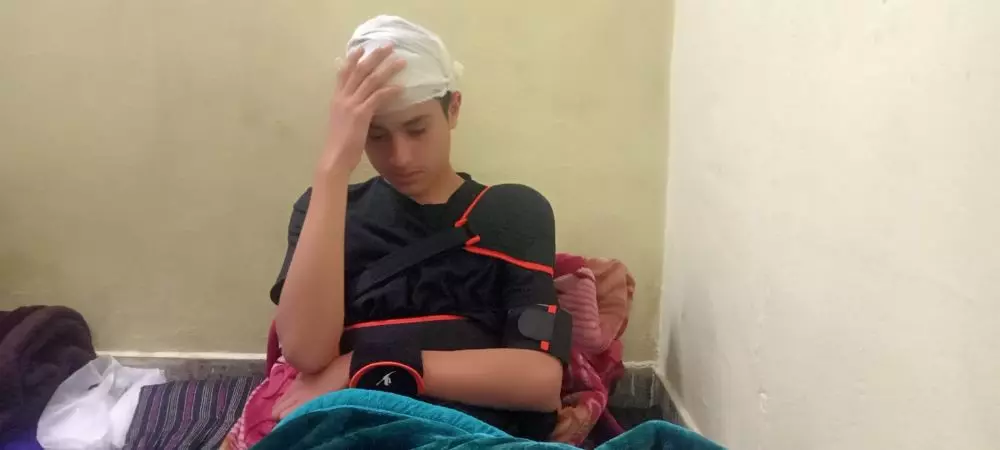
Tabish Ahmad Ganie, 17, rests in their rented accommodation in Uttarakhand after the alleged assault. Photo: By special arrangement
Police have since identified the main accused in the assault as Sanjay Yadav, a local shopkeeper. Confirming that an FIR has been registered in the case and that the accused were arrested, Sunil Kumar Meena, inspector general of police (law and order), Uttarakhand, told The Federal, “investigation was being conducted in accordance with the law and that due process was being followed”. The senior officer also stressed that harassment or violence against any individual would not be tolerated, regardless of “religion, caste, creed, place or ethnicity”.
Meanwhile, Tabish, who has denied allegations of misbehaviour made by the accused’s family, says the grant of bail to the main accused within days of the assault has left the family further shaken.
Also read: Smell, stigma and supremacy: How 'food racism' shapes everyday life in India
Close on the heels of the alleged attack on Tabish and Danish came reports of an attack on another Kashmiri trader, this time in Himachal Pradesh. According to reports, on February 1, two Kashmiri traders from Kupwara were allegedly stopped and harassed in Kangra district, while they were on their way to a local market with bags of shawls.
A purported video of the incident, the authenticity of which could not be independently established by The Federal, which has been circulating on social media, appears to show one of the two traders being followed and questioned about his identity, and ordered to open his bag, while accusations are made that it could be hiding an AK-47 rifle rather than shawls.
“He kept asking what was inside my sack and said it should be checked because it might be an AK-47,” Mohammad Ramzan, one of the two traders, told The Federal, adding that the confrontation left him scared and humiliated. Claiming that he had repeatedly tried to explain that he was only selling shawls, Ramzan alleged that he was accused of disloyalty and blamed for violence in Kashmir, despite insisting that he was an Indian citizen and had never harmed anyone.
The trader further alleged that when he approached the police, his complaint was initially not taken seriously.
Meanwhile, Sunil Kumar, the station house officer (SHO) of Rehan police station in Himachal Pradesh’s Jawali area, where the alleged incident is said to have taken place, told The Federal that they were conducting a verification process. In what seemed like an effort at downplaying the alleged incident, Kumar claimed the individual who appeared to be harassing the trader in the purported video had “mental health issues” and routinely questioned strangers in the area. Claiming that police had summoned the accused and spoken to him, Kumar maintained that the police had assured Kashmiri traders of their safety.
The two alleged incidents, in Uttarakhand and Himachal Pradesh, are set within a bigger narrative of alleged targeting of Kashmiris following last year’s terror strikes. According to reports, an elderly Kashmiri man identified as Mohammad Wali Shah, who had travelled to Saharanpur in Uttar Pradesh for medical treatment, was allegedly stopped by a group of local youths in the Ramdaspur area earlier this month and questioned about his presence in the area. His Aadhaar card and medical documents were reportedly examined, and he was allegedly warned not to return to the locality, despite him explaining that he was there for treatment and showing his medical records and prescriptions, the report added.
The travel of Kashmiri traders to other states typically begins in November, as thousands leave home with bags full of shawls, pherans and handicraft items. Over the next few months, they go door-to-door or set up small stalls in places like Delhi, Kolkata, or towns across Uttarakhand, Himachal Pradesh and other states. While many return home by March, others remain throughout the year, relying entirely on informal trade to support their families.
This year, however, the reports of assaults and harassments that have come in quick succession have not just left the travelling traders shaken, but become a topic of discussion and lament back home, in Kashmir.
Also read: Why Kashmiri Pandits’ hopes of being rehabilitated by the BJP seem to be on the wane
In a post on social media platform X, Nasir Khuehami, national convenor of the Jammu and Kashmir Students Association (JKSA), wrote that there was no let-up in harassment of Kashmiri traders, warning that intolerance against Kashmiris appeared to be intensifying.
The matter was taken up in the Jammu and Kashmir assembly, with legislators urging immediate intervention to protect traders. Legislators from the ruling National Conference as well as opposition parties, including the People’s Democratic Party (PDP) and the People’s Conference (PC), called for concrete steps to halt the assaults and intimidation.
Chief Minister Omar Abdullah, too, has voiced concern over reports of harassment of Kashmiris outside Jammu and Kashmir, adding that such incidents must be firmly and promptly addressed. Speaking to reporters outside the legislative assembly, he said he had raised the issue at a recent conference of north zone chief ministers and urged the Union home minister to ensure that harassment of Kashmiris — whether students or traders — is stopped without delay.
The Jammu and Kashmir CM also thanked his counterpart in Uttarakhand, Pushkar Singh Dhami, for what he described as swift action in the recent case involving a Kashmiri shawl seller in Uttarakhand (a reference to the alleged assault on Tabish and Danish). Expressing concern over similar reports emerging from Himachal Pradesh, Abdullah added that such incidents were unexpected in a Congress-ruled state.
Outside the political arena, news of the assault has disturbed people across all walks of life.
“The Constitution of India guarantees every citizen the right to move freely, reside, and carry on any lawful profession anywhere in the country. Targeting Kashmiri shawl sellers or students because of their identity is a direct violation of these fundamental rights,” Yavar Ramzan, an advocate at the Jammu and Kashmir high court, told The Federal.
Failure to promptly register FIRs and take decisive action in such cases weakens the rule of law and creates a sense of impunity, the lawyer added.
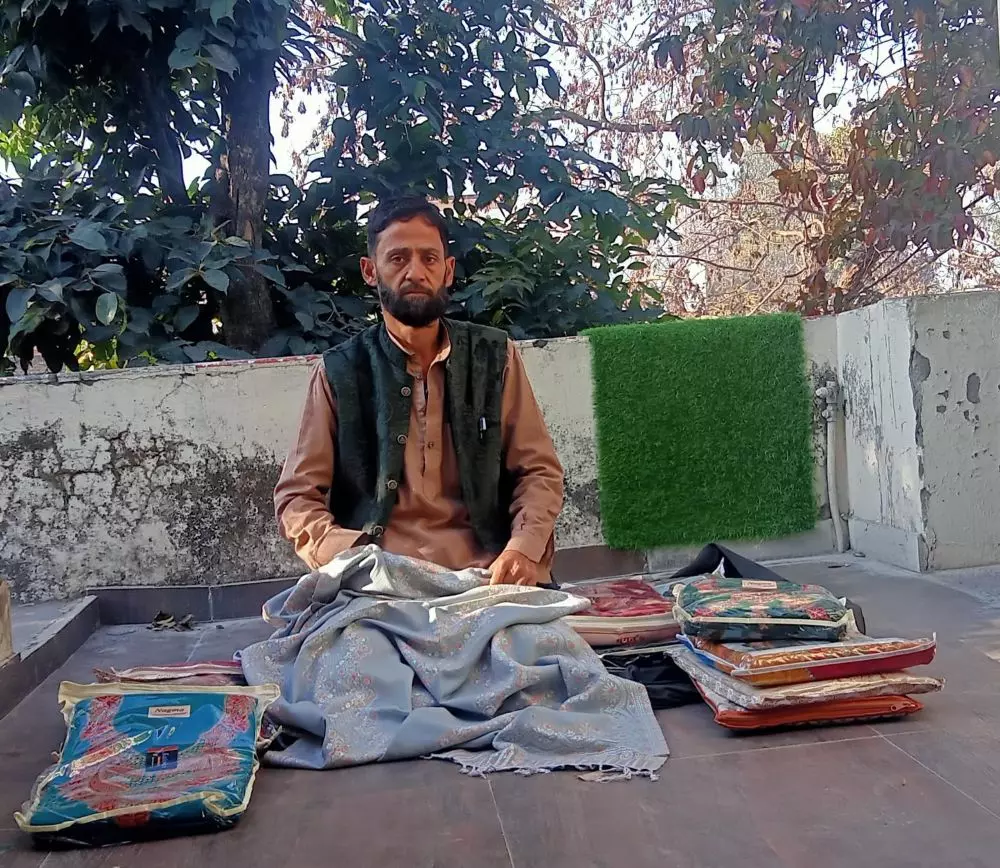
A trader displays his wares. Photo: By special arrangement
Amid this growing climate of distrust, traders say their work has become harder. Beyond the cases that made news, several Kashmiri traders in different parts of India told The Federal they have faced verbal abuse and intimidation, frequently linked to their regional and religious identity, with accusations amplified by local groups and social media narratives.
“We are from the same country, yet this keeps happening again and again,” rued Mohammad Yaseen Khan, president of the Kashmir Traders and Manufacturers Federation. “Why are we being targeted repeatedly? This is my question to the people of my country.” The federation, said Khan, had taken up the issue with the Lieutenant Governor’s administration and the elected government in Jammu and Kashmir, and had also raised it during a meeting with the Chief Minister.
Meanwhile, families of traders on business outside Kashmir live in daily fear and suspense, praying for the safe stay and return of their husbands, fathers, sons and siblings.
“When I hear about attacks on shawl sellers, my hands start shaking,” says Jana Begum, whose husband Abdul Majeed is in Ponda, Himachal Pradesh, selling woollens.
“He calls me every night just to tell me he is safe, but then I cannot sleep. I keep imagining him being stopped, beaten or humiliated, and there is nothing I can do from here.”
Jana says her children sense her anxiety and ask repeatedly when their father will return. “We send our men out to earn so the family can survive, not to face hatred and violence. Living with this fear every day is killing us slowly from the inside.”
Also read: How residents of Udhampur’s Tirshi village have lived since losing homes in September landslide
According to a Press Information Bureau (PIB) factsheet released on October 3 last year, the handloom and handicraft sector remains one of the most important livelihood sources in Jammu and Kashmir, employing over 3.5 lakh people directly and indirectly, including a large number of artisans and marginalised workers. The sector, which includes pashmina and other shawls, carpets, papier-mâché and embroidery, has long been a backbone of the region’s rural economy.
Travelling traders in these handicrafts told The Federal that 80 per cent of their annual income comes from sales outside Kashmir during the winter months.
“For more than ten years, this trade has fed my family and paid for our children’s education. We travelled every winter with hope. Now, every time I step out with my shawls, my heart races. I worry whether I will return safely or be stopped, questioned or attacked, just because of who I am. Earning an honest living should not feel like risking your life, but that is what it has become for us,” rues Mushtaq Ahmad, a Kashmiri shawl seller, presently in Himachal Pradesh.
Adds Mohammad Shafi, another trader, “For eight winters, I travelled to different states to sell shawls and never felt unsafe. Now there is fear at every step [he too is currently in Himachal Pradesh] — fear of being stopped, questioned, or humiliated because of our identity. I go out only because my family depends on this income, but every day I leave with anxiety and return with relief that nothing happened.”
The fear has impacted their earnings, resulting in a drop of almost 60 per cent, say some traders who are avoiding going out as much as they normally would.
Meanwhile, for Nisar in Delhi, a sense of security is something which comes and goes as he moves from one neighbourhood to another. “In some places, especially crowded areas or those dominated by the majority community [Hindus], I am more cautious and alert. In others, I feel relatively safer,” he says, trying to sound matter-of-fact about a risk that he should never have had to face.