- Home
- India
- World
- Premium
- THE FEDERAL SPECIAL
- States
- Perspective
- Videos
- Sports
- Education
- Entertainment
- Elections
- Features
- Health
- Business
- Series
- In memoriam: Sheikh Mujibur Rahman
- Bishnoi's Men
- NEET TANGLE
- Economy Series
- Earth Day
- Kashmir’s Frozen Turbulence
- India@75
- The legend of Ramjanmabhoomi
- Liberalisation@30
- How to tame a dragon
- Celebrating biodiversity
- Farm Matters
- 50 days of solitude
- Bringing Migrants Home
- Budget 2020
- Jharkhand Votes
- The Federal Investigates
- The Federal Impact
- Vanishing Sand
- Gandhi @ 150
- Andhra Today
- Field report
- Operation Gulmarg
- Pandemic @1 Mn in India
- The Federal Year-End
- The Zero Year
- Science
- Brand studio
- Newsletter

30 years since launch, why Kerala’s iconic decentralisation project appears to have lost steam
The People's Plan Campaign, launched on August 17, 1996, by the then Left Democratic Front (LDF) government in Kerala, was an ambitious experiment in taking development planning and decision-making closer to citizens. It devolved a substantial share of state plan funds — approximately 30% — and responsibilities to local self-government institutions. Today, those in the know talk of funds crunch and limited people involvement.

On the quiet coastal plain of Alappuzha, Kerala, surrounded by coconut groves, canals and small plots of cultivated land, the nondescript village of Kanjikkuzhy offers an unlikely entry point into understanding Kerala’s radical experiment in decentralised governance. Even before the state formally launched the People’s Plan Campaign in 1996, the panchayat was already trying to...
On the quiet coastal plain of Alappuzha, Kerala, surrounded by coconut groves, canals and small plots of cultivated land, the nondescript village of Kanjikkuzhy offers an unlikely entry point into understanding Kerala’s radical experiment in decentralised governance. Even before the state formally launched the People’s Plan Campaign in 1996, the panchayat was already trying to make development a collective exercise. In the early 1990s, the panchayat was experimenting with collective vegetable farming, community mobilisation and the idea that local development could begin with the people. Later, after the People’s Plan Campaign was launched, the village became synonymous with Kerala’s experiment in people’s planning and decentralisation.
M Santhosh Kumar, now the president of Kanjikkuzhy gram panchayat, was a student when the experiment began. He remembers PP Swathanthryam, the late panchayat president, bringing nearly 6,000 families into the programme. The panchayat bought vegetable seeds with its own funds and organised households into ayalkoottams, or neighbourhood groups, to distribute the seeds, monitor cultivation and identify local needs, he recalls.
“They created the ayalkoottams even before the system formally existed,” says Santhosh. “The groups were not just for distributing seeds. They looked at whether people had planted them, guided them on cultivation and identified what each locality actually needed. Officials and elected representatives worked together with these groups. That was the strength of Kanjikkuzhy and the important part was its sustainability.”
What began as a local experiment in collective farming would soon contribute to a much larger idea of decentralisation as a route to self-reliance, with Kanjikkuzhy emerging as one of its most celebrated examples.
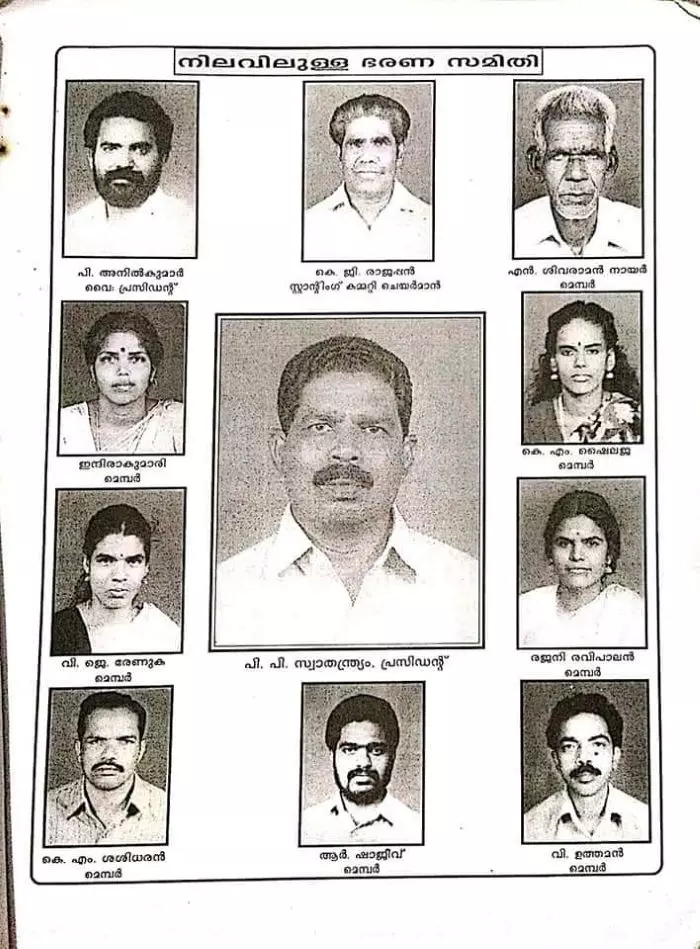
Members of the 1996 governing council of the Kanjikkuzhy panchayat. Photo: By special arrangement
The village was, however, not an isolated experiment. Around the same period, another strand of Kerala’s emerging decentralisation thinking was taking shape in Kalliassery, in Kannur district. In the early 1990s, the Kerala Sasthra Sahithya Parishad (KSSP), working with scientists from the Centre for Earth Science Studies (CESS), helped villagers map their land, water, soil and other natural resources and collect socio-economic data. According to the KSSP, nearly 1,200 people participated, contributing more than 3,100 person-days of work, most of it voluntarily.
The exercise eventually led to the formation of the Kalliassery Development Society in 1993, bringing residents, elected representatives and officials together to identify local priorities. The significance went beyond resource mapping.
Like Kanjikkuzhy, Kalliassery demonstrated that development could begin with people understanding and planning their own locality, rather than waiting for a blueprint from the government. Together, these experiments worked as pilot projects for Kerala’s People’s Plan Campaign, providing the grassroots experience and institutional imagination that would later feed into the state’s decentralisation project.
Officially launched on August 17, 1996, 30 years ago, the People’s Plan campaign was an ambitious experiment in taking development planning and decision-making closer to citizens. Initiated by the then EK Nayanar-led Left Democratic Front (LDF) government in Kerala, it devolved a substantial share of state plan funds — approximately 30 per cent, according to old timers — and responsibilities to local self-government (LSG) institutions, transforming panchayats and municipalities from largely administrative bodies into institutions with greater autonomy over development priorities. Gram sabhas, working groups and development seminars became mechanisms for identifying local needs and shaping projects.
The campaign built on a longer intellectual and political tradition associated with communist idealogue and former Kerala chief minister EMS Namboodiripad, the atomic scientist turned communist and science propagator MP Parameswaran, CPI(M) leader Dr TM Thomas Issac, the Kerala Sasthra Sahithya Parishad and experiments in participatory planning that preceded 1996.
Also read: In Assam, recurring floods bring psychological trauma of displacement, rehabilitation fatigue
The experiments in Kanjikkuzhy and Kalliassery indicate that the People’s Plan did not suddenly appear in August 1996 and its intellectual and political roots ran much deeper.
“Apart from these celebrated models, there were other notable experiments [in the years since the launch of the campaign in 1996]. Kunnothuparambu in Kannur district developed a community-based environmental protection model. Olavanna in Kozhikode responded to water scarcity by developing wells to supply higher areas, using local resources to solve a local problem. Tanalur in Malappuram developed a panchayat-wide health system that systematically collected community health data and helped identify the prevalence of lifestyle diseases such as hypertension, heart disease and obesity. The Meenvallam micro hydel project in Palakkad demonstrated the possibilities of small-scale hydropower generation,” recalls G. Sajan, developmental journalist and resource person who had been documenting the entire stretch of the campaign on video.
He adds: “There was a period when such experiments were happening across sectors with tremendous enthusiasm. Together, these examples showed that local governments could go beyond implementing government schemes. They could identify problems within their own territory, mobilise people and resources, and develop solutions suited to local conditions.”
Over three decades, decentralisation contributed to improvements in basic infrastructure, health, education, housing and poverty reduction, while expanding women’s and citizens’ participation in local governance, recall locals. Yet its original momentum has now weakened, with questions over financial autonomy, bureaucratic control, public participation and the declining emphasis on local economic development.
“Decentralisation has produced major gains. In one sentence, it helped make Kerala the state with the lowest levels of poverty and improved basic needs. It also created resilience at the grassroots to face crises like the floods and [even] the Covid pandemic [which came much more recently, between 2018 and 2020]. But there are weaknesses as well,” reflects Dr TM Thomas Issac, one of the proponents of the movement, then a member of the state planning board and later finance minister of Kerala.
He adds: “Local economic development has not succeeded enough. Modernising and giving a push to the local economy is crucial for building a new Kerala. Also, decentralisation is not just about material gains. It is about creating good citizens. So the process matters as much as the outcome.”
In a note prepared for the thirtieth anniversary of the campaign and shared on social media, Issac cited poverty eradication as the “biggest achievement” of decentralisation. Last year, then Kerala chief minister Pinarayi Vijayan announced that the state had successfully eradicated extreme poverty — defined as income below the World Bank-set international poverty line of $3 per day in 2025.
In another post, Issac wrote, “I would say that decentralisation of power has contributed significantly to Kerala’s development and these improved outcomes continue to this day. However, the vitality of the participatory methods introduced through the People’s Plan Campaign has faded. Participation has declined, and the processes have become routine formalities. The People’s Plan Campaign was the largest informal education programme Kerala had ever seen. The young people who participated in it then are now older... Young people [today], particularly, are not participating in local democracy. People’s Plan 2.0 can become a reality only by bridging this gap...”.
EMS Namboodiripad had long argued that democracy could not remain confined to periodic elections or the legislature. His understanding of decentralisation was connected to the larger communist project of taking power and decision-making closer to ordinary people. The first communist government under EMS (formed in 1957) had already attempted administrative reforms aimed at reducing bureaucratic domination and strengthening local institutions. The constitutional amendments of 1992, giving constitutional status to the Panchayati Raj System in the country to promote local governance, gave the idea a national institutional framework. Kerala followed with the Kerala Panchayat Raj Act and Kerala Municipality Act in 1994 and elected the first local governments under the new system in 1995. The next step was to make those institutions more than elected bodies without real power.
The ambition was extraordinary. Around 30 per cent of the State Plan funds were to be devolved to local governments. More importantly, local governments would not simply receive money. People would participate in deciding how it should be spent through gram sabhas, working groups, development seminars and local planning committees. The aim was to change the grammar of governance itself.
The real significance of the People’s Plan was not the money alone. It was the attempt to create a new relationship between citizen, elected representative, official and expert. The gram sabha was supposed to become a space where ordinary people could articulate priorities. Working groups brought elected representatives, officials and community stakeholders together. For many elected representatives, especially women and first-time entrants, this was their first experience of exercising meaningful institutional power.
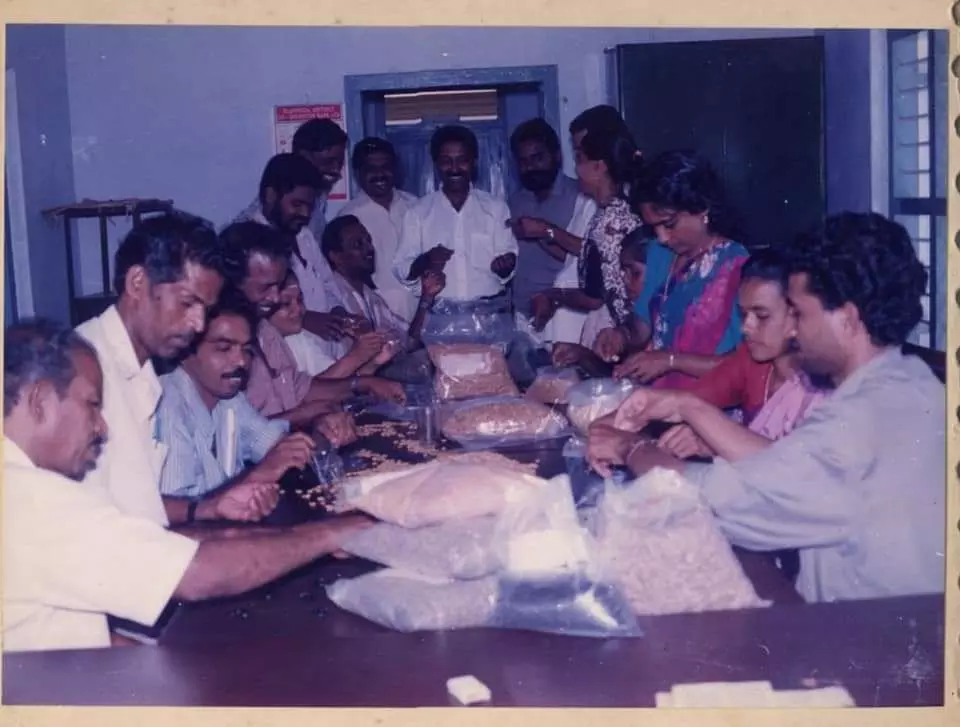
Panchayat members and officials packing seeds for distribution at the Kanjikkuzhy panchayat office in 1996. Photo: By special arrangement
Sindhu Ennazhiyil, who has served as president of both Maranchery Gram Panchayat and Perumbadappu Block Panchayat of Malappuram between 2010 and 2025, and has received multiple awards for local governance from the state and central government, recalls how the experience transformed elected representatives. From training camps for panchayat members to actually governing local bodies, the process helped turn them from elected representatives into leaders and activists.
“I was involved in the campaign even before I became a panchayat member in 2010. I was a law student then and was part of the team that organised camps for people who had become panchayat members for the first time. It was a very dedicated group of people working day and night. For many of the members, that was their first experience as elected representatives and our first step into public life and that has changed their entire life for sure.”
“Initially in the nineties, there was some apprehension among us in the UDF [United Democratic Front, LDF rival] that this was essentially a project of the Left and the Marxist party. But we soon realised that it was something we had to engage with, because we needed to connect with people and the People’s Plan was precisely about that. I think my party, the IUML [Indian Union Muslim League, a UDF constituent], was one of the most active UDF partners on the ground in the People’s Plan Campaign. You can see its impact particularly in Malappuram district,” says Faseela T, a former People’s Plan Campaign volunteer from Mankada village, who was actively involved in the project between 2000 and 2007, before moving to the UAE later.
That is perhaps one of the least discussed legacies of the experiment. The People’s Plan created a generation of local politicians and community activists who learned how a government institution works from the inside. They had to deal with engineers, doctors, agricultural officers, bureaucrats and contractors. They had to read budgets, understand projects and argue about priorities. It gave local democracy an apprenticeship.
PK Mahin, a retired engineer from Palakkad district who served as a resource person for village-level beneficiary committees involved in rural electrification and road construction between 1996 and 1999, recalls how deeply people were involved in the process.
“We were actively involved in surveying the roads and even had a say in deciding the alignment. We were not just beneficiaries waiting for a government scheme. We were part of identifying the need, planning the project and implementing it. That changed the old relationship between people and the bureaucracy. The beneficiary became a participant in the whole process,” he tells The Federal.
It also contributed to women's empowerment.
Jasintha Fazil, 47, a homemaker in Ernakulam, says she first heard about the People’s Plan Campaign as a student in 1996. “After I got married in 1998 (an interfaith marriage not approved by either family), I got some exposure to the programmes and initially received some assistance to start goat farming through the women's component programme. Later, the Kudumbashree movement [women empowerment and poverty eradication programme] came in, and that is when we started a small unit making snacks and pickles. Today, our micro self-help group has around 20 to 25 women working together,” she says.
Though Kudumbashree, launched in 1998, was not formally created as part of the People’s Plan Campaign, it grew out of the same decentralisation process.
Thirty years later, the critical question is not whether the People’s Plan changed Kerala. It clearly did. The more difficult question is what happened to the original ambition.
IB Satheesh, former CPI(M) MLA from Kattakada and one of the on-ground faces of the decentralisation experiment, believes the first decade and a half was transformative. But he argues that the momentum was gradually weakened by political interruptions, shrinking allocations and the failure to deepen the transfer of governing power.
“When we started in 1996, we believed that this would lead to decentralisation in every sense,” Satheesh says. “We were not thinking only about the decentralisation of resources or funds and capital. We were also envisaging the decentralisation of governing capital.”
The problem, he argues, was the absence of continuity.
“We had assumed that decentralisation would always receive the highest priority amid our day-to-day politics and the various political equations in Kerala. That did not happen. It was weakened.”
Agrees Sindhu. “When we compare the 1996-2001 period with the development activities of local self-government institutions in recent years, there has clearly been a major decline in the ability to translate people’s aspirations, interests and needs into projects through genuine public participation. People’s involvement has gradually reduced at every stage, from identifying and designing projects to their implementation and continuity. It has increasingly become a process in which only a small group of people who are interested in the subject actively participate.”
She adds: “Gram sabhas and ward sabhas were the backbone of the People’s Plan Campaign. Initially, the quorum was 10 per cent of the total voters in a ward; it needed real mobilisation, but it was very effective. Over time, that enthusiasm declined. Later, the quorum was reduced to at least 50 members and even that is often not happening now. When I stepped down as panchayat president last year, I felt that the idea of the People’s Plan was far from being in effect in many local governments across the state.”
Many who were deeply involved in the People’s Plan were later left dissatisfied with the way it evolved. They argue that citizens were never given enough knowledge, skills or authority to become genuine masters of the planning process. The campaign also failed to sufficiently transform the productive economy, particularly at the local level. That may be the central paradox of Kerala’s great decentralisation experiment: it succeeded enough to become institutionalised, but not enough to become irreversible.
“People’s Planning has grown old. There was no real attempt to make it young again,” observes M Santhoshkumar of Kanjikkuzhy. His observation captures the central question of Kerala’s 30-year experiment: did decentralisation transform governance, or did the system eventually absorb and tame it?
The Kalliassery experiment began with people mapping their own resources. Thirty years later, Kerala has an elaborate system of local planning, substantial local institutions and a generation of representatives shaped by that experience. The question now is whether the state can once again make the people the mapmakers.
Santhoshkumar adds: “Fund devolution became a major problem in the later years of decentralised planning. The state’s financial problems, along with the Union government’s negative approach, put local governments under pressure. Projects started getting stuck, and it became harder for local bodies to keep development work going at the grassroots.”
His allegation is echoed by KP Vinod, former vice chairman of the Guruvayoor municipality. “The main issue is the funds,” claims Vinod. “For example, we used to get an average of Rs 9 crore until the last financial year. Now it has come down to Rs 2.68 crore. Gram sabhas and ward sabhas have become routine and in many cases the LSG council has to manipulate attendance just to meet the quorum. Development seminars, where people once came forward with their development needs, have also become largely a formality. Overall, it feels like power is slowly moving back to the bureaucracy from the people.”
Allegations raised by former LSG members are repeated by residents.
Johnson Mathew, a 54-year-old plumber living in Thrissur, recalls, “The road in front of my house, a stretch of about six-seven kilometres, was aligned and built by us in 1999–2000. We, as a beneficiary group, did the survey, negotiated with landowners and even got local people to volunteer for the work, including laying the tar. It was a huge success.”
Over the years, however, Mathew claims, “maintenance became a problem. In 26 years, it has been re-tarred and repaired only three or four times. It eventually reached a pathetic condition. Our next generation has not been able to bring the same kind of people’s mobilisation, and the panchayat is also short of funds. In the end, the will and commitment of local politicians is what matters most.”
LDF leaders, including Sathish, argue that the UDF was never fully committed to decentralisation, pointing out that the Indian Union Muslim League (IUML) was the only UDF constituent to seriously embrace the programme, with a dedicated cadre network on the ground comparable to that of the communist parties.
The result was an unusual form of institutional survival. The People’s Plan did not disappear. It became part of the architecture of Kerala’s governance. But the radical energy that animated it in 1996 was gradually absorbed into routine administration.
Satheesh alleges that the ruling UDF establishment has never completely reconciled itself to genuine devolution of power. “The ruling class has never fully accepted the decentralisation of power,” he claims. “We have not been able to overcome the bureaucratic mindset through the willpower of elected representatives. The two have to work in sync.”
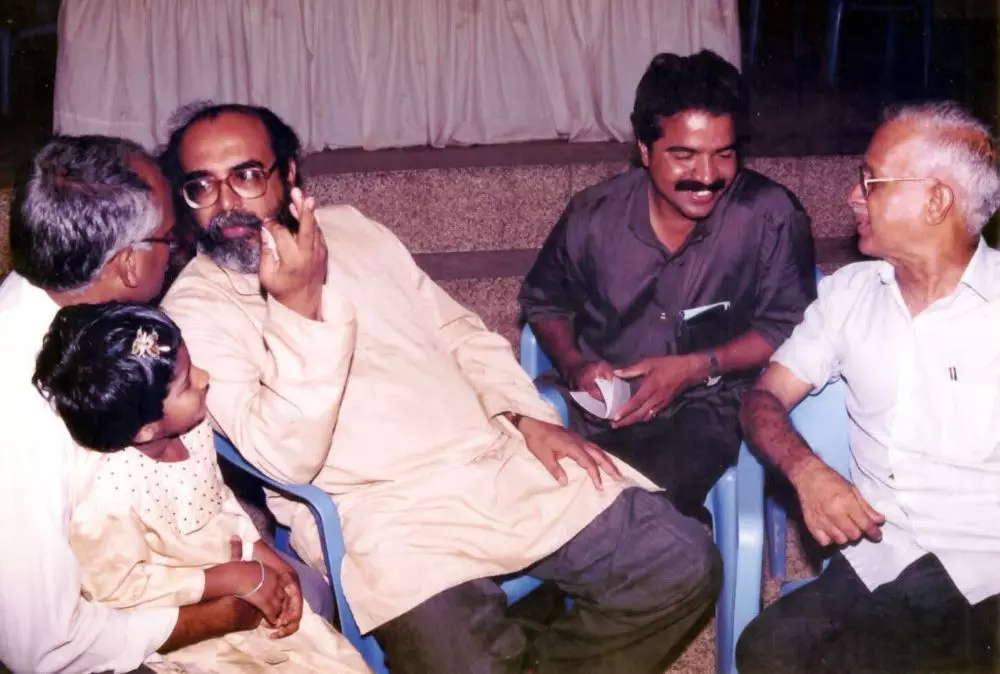
Dr Thomas Issac and Dr MP Parameswaran in the '90s. Photo: Facebook/Dr TM Thomas Isaac
That tension was built into the system from the beginning. Kerala transferred functions and institutions to local governments, but officials often retained dual accountability to local bodies and their line departments. The State Planning Board itself noted during evaluations of the ninth Five-Year Plan (1997-2002) that the transfer of powers, functions, institutions and staff took place between 1995 and 2000. The result was not a clean transfer of power but a negotiation between the local political leadership and the permanent bureaucracy.
The People’s Plan was supposed to be about development, not simply the distribution of benefits. But many critics later argued that too much attention went towards welfare and infrastructure, while the productive sector received inadequate attention.
This criticism resonates strongly with Satheesh’s concerns about agriculture and water.
“The real impact of People’s Planning should have been on the productive sector, particularly agriculture. Kerala continues to depend heavily on other states for food and raw materials, and Covid exposed that vulnerability. The next phase of decentralised planning has to focus on water. In Kattakada, we showed how water conservation could become a local development programme through the convergence of different government departments and people’s participation. Schoolchildren, senior citizens and different sections of the community were brought into it. That is the kind of model we need to take forward,” says Satheesh.
The point is significant. The original People’s Plan asked people what their locality needed. The next stage must perhaps ask what the locality needs to survive. Climate change, water scarcity, floods, food security and ecological degradation cannot be solved through isolated projects. They require precisely the kind of local knowledge and interdepartmental planning that the People’s Plan was designed to enable.
In that sense, the failure to sustain the original spirit of the campaign could become a serious problem as Kerala confronts a new set of challenges.
The strongest defence of decentralisation is not found in official anniversary speeches. It is found in places where local institutions have actually made a difference.
There are examples of local governments that have tried to keep the spirit of People’s Planning alive by adapting it to changing needs. The total digital literacy mission of Pullampara panchayat in Thiruvananthapuram district is one such example. Long before Kerala was declared the country’s first fully digitally literate state in 2025, Pullampara identified digital literacy as a new local need and launched a programme in 2021 to train residents between the ages of 14 and 65.
The People’s Plan proved its value also during the 2018 and 2019 floods and the Covid pandemic, when local governments demonstrated their capacity for coordination, service delivery and community mobilisation.
Even the State’s own recent assessment acknowledges that these crises reinforced public confidence in decentralised institutions.
But success stories should not become substitutes for evaluation.
Also read: On a low: Why Kerala's traditional toddy industry, already in decline, is facing a new challenge
According to LSG Minister KM Shaji, the responsibility now is to take the People’s Plan Campaign forward by making it relevant to a new generation. “We need to start thinking about how to present People’s Planning to Gen Z [those born between 1997 and 2012] and Gen Alpha [born between 2012 and 2025]. When they ask why they should participate in all this, we should be able to give them a clear answer. They have already begun taking on important responsibilities in nation-building. The challenge now is to bring them into this process and make decentralised governance meaningful to them,” he said while talking at a People’s Plan campaigners meet, linked to the thirtieth anniversary of the campaign, in Thiruvananthapuram.
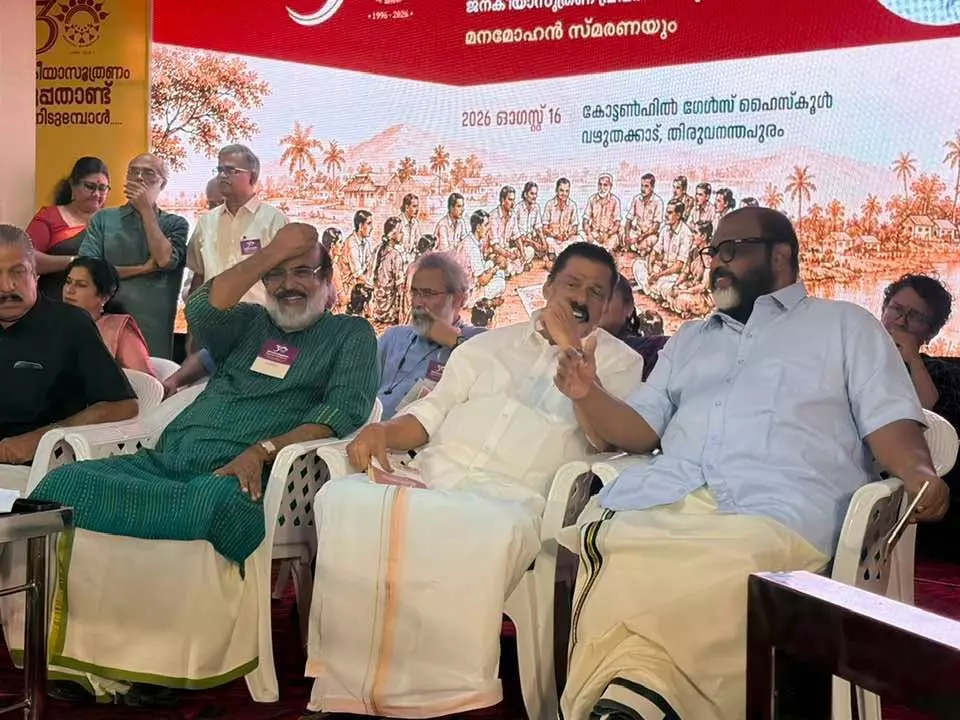
Conclave of People's Plan activists in Thiruvananthapuram to celebrate 30 years of the campaign. Photo: Facebook/Dr TM Thomas Isaac
The first People’s Plan was about transferring the power to decide where a road should be built, where a school should be improved or which welfare project should be prioritised. The next phase has to be about something bigger, giving communities the power and capacity to understand the ecological, economic and social future of the places they inhabit, and to shape it themselves.
That would take Kerala back to where it began in Kalliassery, when a map was not merely a map. It was an invitation to imagine that a village could plan its own future.
The question is whether the anniversary can become more than a commemoration of the past. Can it lead to another round of political and social mobilisation around decentralisation, restore people’s participation in local planning and take Kerala beyond its familiar development narrative towards a new phase of locally driven growth?