- Home
- India
- World
- Premium
- THE FEDERAL SPECIAL
- States
- Perspective
- Videos
- Sports
- Education
- Entertainment
- Elections
- Features
- Health
- Business
- Series
- In memoriam: Sheikh Mujibur Rahman
- Bishnoi's Men
- NEET TANGLE
- Economy Series
- Earth Day
- Kashmir’s Frozen Turbulence
- India@75
- The legend of Ramjanmabhoomi
- Liberalisation@30
- How to tame a dragon
- Celebrating biodiversity
- Farm Matters
- 50 days of solitude
- Bringing Migrants Home
- Budget 2020
- Jharkhand Votes
- The Federal Investigates
- The Federal Impact
- Vanishing Sand
- Gandhi @ 150
- Andhra Today
- Field report
- Operation Gulmarg
- Pandemic @1 Mn in India
- The Federal Year-End
- The Zero Year
- Science
- Brand studio
- Newsletter

How neighbourhood dance collectives are changing lives for women in Kerala’s Thrissur
In the years following the Covid pandemic of 2021-22, as social life got back on track and videos shared on social media turned mobile screens into stages, across the western parts of Thrissur, women — some employed, others homemakers — started coming together in small neighbourhood groups to try something new. Today, these dance troupes are travelling across the state to perform.

On most days, 40-year-old Sindhu Madhavaraj’s routine once revolved around her boutique in Perinjanam and her responsibilities at home. A mother of two, she had little engagement with performance or public life. That began to shift when a group of women in her locality started gathering near a temple, initially as a way to spend time together and practice a bit of dance."I used to keep...
On most days, 40-year-old Sindhu Madhavaraj’s routine once revolved around her boutique in Perinjanam and her responsibilities at home. A mother of two, she had little engagement with performance or public life. That began to shift when a group of women in her locality started gathering near a temple, initially as a way to spend time together and practice a bit of dance.
"I used to keep to myself, not really interacting much, even with neighbours. But that has changed now. The dance and the life that came with the group have transformed me completely," says Sindhu.
In the years following the Covid pandemic of 2021-22, as social life slowly got back to normal and the reels shared on social media turned mobile screens into stages, close to a hundred women from across the western parts of Kerala’s Thrissur district — most of them leading routine family lives, some employed, others full time homemakers, spread across different economic backgrounds — started coming together in small neighbourhood groups, not with any grand plan, but simply to try something new.
What emerged from these gatherings was a dance that did not quite fit into any single category. Drawing from the familiar base of Thiruvathirakali (traditional women’s group dance of Kerala, performed in a circular formation with graceful, synchronised steps and hand movements, usually around a lamp and often associated with the Thiruvathira festival connected to the Hindu deity Shiva), they began to experiment, adding pace, energy and a certain swagger that the older form did not demand. The result was a hybrid, evolving with each rehearsal and each performance.
The teams recall that they themselves struggled to name the new style. Initially, they called it Kaikkottikali (Clap dance ) and later began referring to it as Veeranatyam (Heroic dance), because of its newfound high-octane movements.
What began as a post-pandemic collective activity has now turned into a sought-after performance circuit, with bookings coming in advance and troupes travelling across the state.
Also read: How a platform of Kathakali enthusiasts in Kerala is helping artistes battle mental health issues
Sandeep Pothani, an Irinjalakkuda-based vlogger with a keen interest in local folk art forms, has played a key role in documenting and amplifying their work . Part cultural chronicler and part digital catalyst, he identified these emerging collectives early on and helped push them into wider visibility through viral videos online, even naming the form Veeranatyam.
“One of the earliest active teams was Narthana from Irinjalakkuda. A video I shot of their energetic performance during a festival went viral after being widely shared, including by public figures like former Higher Education Minister Dr R Bindu. That Onam season, they were flooded with programmes,” recalls Sandeep.
He adds: “Later, some members dropped out and the group slowed down. But by then, others had already taken inspiration. Perinjanam [village] based group, Alingalamma, for instance, began after watching such performances. They performed with the expectation that their videos would be recorded and shared and those clips too went viral. After that, there was a surge. Many teams started forming, inspired by these early groups. Today, there are several new teams, including children’s groups.”
Alingalamma, the group of which Sindhu is a part, too began with the familiar, traditional format, mostly Thiruvathirakkalai. Over time, their practice evolved. The music changed, the rhythm picked up, and what started as a slow, circular group dance gradually transformed into something more energetic, thanks to Narthana’s success in the previous months. The collective, named after a local goddess, also began to experiment with folk, devotional and even film music, creating a stuel that was both rooted and adaptive. Videos of their performances began circulating widely. Visibility brought attention, and attention brought opportunity. Today, Alingalamma is a busy troupe, with bookings across Kerala and occasionally beyond.
“We began as a small group around the Alingalamma temple, and today we have about 24 to 26 members, ranging from a 12-year-old to 40. Around 24 of us are active, while a couple stepped aside after getting jobs,” says Sindhu, who is one of the captains of the team.
She adds: “My co-captain, Jincy Kannan, works as a confidential assistant to a judge, so she cannot be part of every show, but she plays a key role in managing the troupe. Together, we lead the team.”
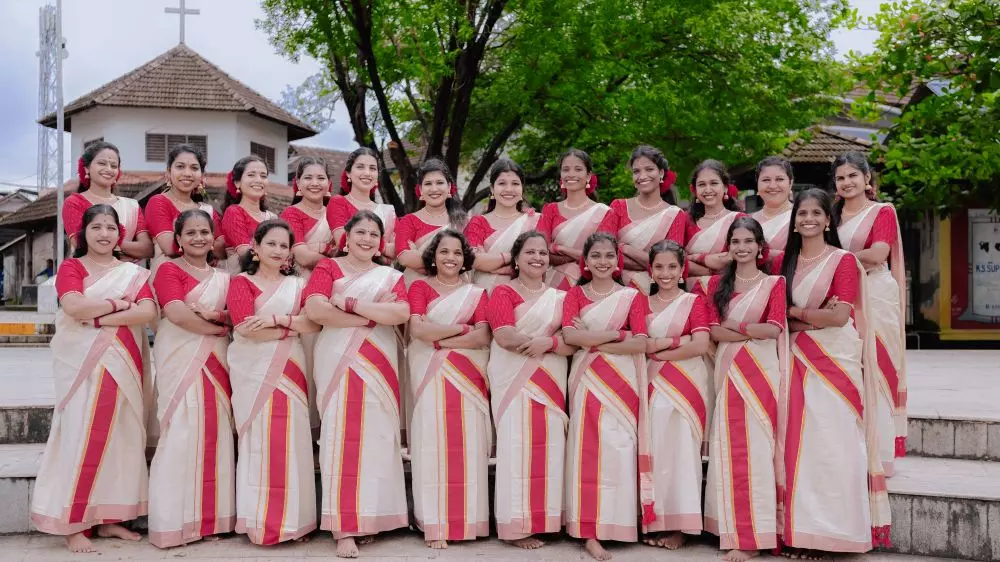
Alingalamma, named after a local deity, started with the traditional format, before beginning to experiment with folk, devotional and even film music Photo: By special arrangement
In another part of Perinjanam, 40-year-old Ranjita Sundaran entered this space through a different route. Her association with the group Nakshatra began with a cultural competition organised by Kudumbasree, Kerala’s grassroots women’s self-help network known for its role in poverty eradication and community development. When the teacher assigned to train the women withdrew, Ranjita stepped in to take up the responsibility.
Unlike many other group leaders, Ranjita came with a background in political work. An active member of All India Women’s Democratic Association (AIDWA) and the CPI(M), she was already well known in the locality and had even run a women’s mess for a living. Her early exposure to dance as a child helped her ease into the role.
From that initial exposure, a more structured group began to take shape. Like the others, Nakshatra brought together women who were not trained performers but were willing to learn and participate. Regular practice sessions followed and soon, performances became part of their routine.
The pattern repeated. Videos were recorded and shared. Audiences extended beyond immediate circles. Invitations followed.
“It was social media that gave us this kind of attention. After a Ramayana based song went viral with me dancing as the lead, even my identity itself changed. Now people recognise me more as Janaki”, says Ranjitha.
“The change it has brought to our lives is immense. There are now around twenty-four women in the troupe. During an active season, each of us can earn up to Rs 50,000 a month, apart from the gift money given to individual performers during shows, which goes directly to them. We manage everything ourselves. We travel as a group of women and girls, and we trust the organisers who arrange our shows. Apart from a local driver who accompanies us, it is all of us together. We are capable of handling things on our own,” adds Ranjitha.
A few kilometres away, in Porathissery near Irinjalakkuda, 44-year-old Remya Vinod’s journey follows a similar arc, though shaped by a different collective dynamic. Her group, Kaishori, is a 22 member team that includes women across generations, from a 10-year-old student to a 56-year-old homemaker. Most members are relatives or neighbours, bound as much by proximity as by shared interest.
Kaishori began with traditional group dances, staying closer to established forms. Over time, they introduced variations and new elements, though their performances remain less high energy than some of the newer troupes. Like Alingalamma, their turning point came through digital exposure. Videos shared online began attracting attention, leading to invitations to perform.
“We are a close-knit group, mostly relatives and neighbours. Initially, we used to perform Pinnal Thiruvathira (a semi-traditional dance in which dancers use long sarees or cloth strands woven between them, creating braid-like patterns while performing steps, often depicting themes from Lord Krishna’s life), mostly during temple festivals in our locality. Then, a nearby temple committee invited us and wanted something beyond that. That is how we began experimenting with folk songs, creating our own steps and choreography. Kolaattam (a traditional group dance in which performers use short sticks, rhythmically striking them together while moving in coordinated patterns, often set to folk music) was one of the forms we tried,” says Remya.
She adds: “Today, we are a busy troupe, but we are selective about the shows we take up. Most of us were earlier confined to our homes and now we are able to enjoy a different kind of life after all the visibility we got. We are not big celebrities, but this has made a real difference. For some, the money does not matter much, but for others it does. In my case, I had not been working for some time; I was a teacher earlier, so this has become a useful source of income.”
For many of the dancers, stepping out to perform was in itself a significant shift. Travel, stage presence and audience interaction were entirely new experiences, further amplified by social media virality, which, in many cases, elevated them to a kind of local celebrity status. The group adapted gradually, balancing rehearsals with work, school and family responsibilities. The presence of multiple age groups within the same troupe has created a shared space that cuts across generations, something that was less common in their earlier routines.
Also read: Why in Kerala, World Cup flex wars are reflective of football being a lived experience in the state
In a region as politically active as Kerala, the groups insist they consciously steer clear of politics. While their performances are largely centred around temple festivals, they are equally present on stages organised by art societies and other platforms. “Some organisers are particular about certain songs, and some ask us to avoid specific ones. That’s the only kind of ‘politics’ we have encountered,” says Remya. Ranjitha echoes a similar approach: “We take up invitations irrespective of the organiser’s political leaning. After all, we are artists. At times, organisers may have preferences about costumes too.” Within the teams themselves, political differences exist, but are kept aside. “We have members with different political views, but as a team, we stay away from politics,” says Sindhu.
Everywhere they go now, these women are greeted with fanfare, and the respect they command is hard-earned through consistent performances and growing public visibility. What began as group recognition has now extended to individual popularity, with many performers emerging as young stars in their own right. Each troupe has its own set of recognisable faces, apart from the respective captains. This includes Amrutha and Devika of Alingalamma, Devi Krishna, Deva Gayathri and Avantika of Kaishori, and Balamani, Anamika and Meenu of Nakshatra. Their individual followings, both on the ground and on social media, reflect how deeply this movement has connected with audiences.
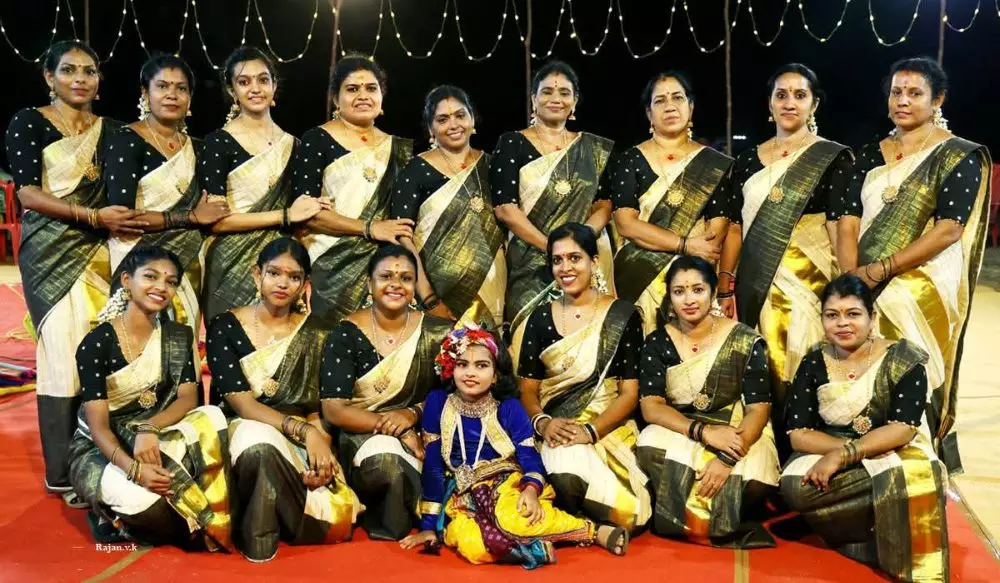
Kaishori is a team of mostly relatives and neighbours. As with the other groups, the turning point came through digital exposure. Videos shared online began attracting attention, leading to invitations to perform. Photo: By special arrangement
Across these narratives, the contours of a broader shift become visible. These are not stories of professional dancers building careers through formal training. Instead, they are accounts of ordinary women, most of whom had little exposure to public performance, finding new roles through a collective activity.
“I teach pinnal thiruvathira for various groups that includes Alingamam and Kaishori. It's kind of traditional, not as peppy as the hybrid veeranatyam which is so popular. As this dance has no strict rules or age bar, it is becoming increasingly popular, with each team bringing its own style and variety. It did not begin as something professional, but with friends, families and local communities coming together. Now some groups approach it more professionally, which adds a different quality," says Uma Sandeep, 45, a dance teacher.
She adds: "What stands out is the joy it brings, especially seeing children step away from mobile phones and actively engage. Even mothers lead and participate with their children, which is a big strength. Many from villages are gaining visibility and confidence, exploring new opportunities, and for many, it is also bringing decent financial benefits."
Dance, in this context, offers both familiarity and flexibility. It requires minimal infrastructure, draws on existing cultural forms and allows for participation across age groups. What began as a way to break routine and isolation gradually developed into something more structured. The second factor in this transformation is the rise of short-form video on social media platforms. The accessibility of recording and sharing content meant that performances were no longer confined to physical audiences. A routine performed in a small locality could reach viewers across districts and states within hours.
“Now they have a huge fan following, not just as groups but at an individual level too. In many troupes, there are girls with over 100,000 followers each. Beyond stage performances, competitions with judging and prize money have also emerged, which has naturally created a competitive spirit among teams. Today, many groups are performing this dance across the state,” adds Sandeep Pothani.
This shift from local visibility to digital reach altered the scale at which these groups operated. Recognition no longer depended solely on physical presence at festivals or events. Instead, it was mediated through views, shares and engagement online.
For the women involved, this translated into tangible outcomes. Bookings for performances brought income. Travel for events expanded their mobility. Participation in public programmes increased their visibility within and beyond their communities. The experience brought confidence and a sense of self-worth. Women who previously operated within limited social spaces now navigate public environments with greater ease. The economic aspect, while not uniform across all groups, has played a significant role in changing perceptions. Activities that were initially seen as recreational began to be viewed as productive. This shift influenced how families responded to the time and effort invested in rehearsals and performances.
Also read: Why residents of Kerala's Thasarak village have been 'living' with fictitious characters for decades
There are, however, constraints that continue to shape these experiences. Most members of these groups balance multiple responsibilities. Rehearsals are often scheduled in the evenings, after work and household duties. Long-distance travel is not always feasible. Educational commitments for younger members and employment obligations for others limit the number of performances that can be taken up.
Despite these limitations, the continuity of these groups suggests a sustained interest and commitment. The collectives function not only as performance units but also as social spaces where women interact, collaborate and support each other.
In many ways, the structure of these groups reflects existing community networks. Members are often drawn from the same locality, connected through family ties, neighbourhood proximity or shared institutions such as Kudumbasree.
“The evolution of these performances reflects a negotiation between tradition and change. While rooted in familiar forms, the use of new music and movements shows a clear willingness to adapt. This adaptability has been central to their appeal in digital spaces, where novelty and energy drive engagement,” observes Sreekala PK, a social science researcher tracking this as a movement of rural women. “The participants come from diverse class and caste locations, which also shapes how different teams are received. The varying responses to groups like Alingalamma, Kaishori or Nakshatra point to patterns that merit closer study and could yield important insights,” she adds.
Yet, the core of the story remains less about the form of dance and more about its impact. For Sindhu, Remya and Ranjita, and for the many women who are part of these collectives, dance has become a medium through which other changes have unfolded. It has created opportunities for income, enabled mobility, and facilitated entry into public spaces.
What began as a simple act of gathering has, over time, reshaped routines, relationships and roles. In the process, it has created a quiet but significant shift in the lives of ordinary women. The transformation is neither dramatic nor uniform. It unfolds in small increments, in adjusted schedules, in new conversations within families, in the confidence to step onto a stage or travel to an unfamiliar place.
Taken together, these changes point to a broader phenomenon; one, where collective activity, combined with digital visibility, has opened new possibilities. For these women, the journey from local gatherings to wider recognition is not just about performance. It is about access, agency and the redefinition of everyday life in a post-pandemic context.