- Home
- India
- World
- Premium
- THE FEDERAL SPECIAL
- States
- Perspective
- Videos
- Sports
- Education
- Entertainment
- Elections
- Features
- Health
- Business
- Series
- In memoriam: Sheikh Mujibur Rahman
- Bishnoi's Men
- NEET TANGLE
- Economy Series
- Earth Day
- Kashmir’s Frozen Turbulence
- India@75
- The legend of Ramjanmabhoomi
- Liberalisation@30
- How to tame a dragon
- Celebrating biodiversity
- Farm Matters
- 50 days of solitude
- Bringing Migrants Home
- Budget 2020
- Jharkhand Votes
- The Federal Investigates
- The Federal Impact
- Vanishing Sand
- Gandhi @ 150
- Andhra Today
- Field report
- Operation Gulmarg
- Pandemic @1 Mn in India
- The Federal Year-End
- The Zero Year
- Science
- Brand studio
- Newsletter
- Home
- IndiaIndia
- World
- The Federal Special
- StatesStates
- PerspectivePerspective
- VideosVideos
- Sports
- Education
- Entertainment
- ElectionsElections
- Features
- Health
- BusinessBusiness
- Premium
- Loading...
Premium

Why Keralam’s women fish vendors seem to be fighting a losing battle against changing retail
For generations, women have been a crucial link between Keralam’s small-scale fishing communities and consumers, buying fish at landing centres and auctions and selling it door-to-door or in local markets, especially in the state’s southern districts. But the Covid pandemic changed the way the trade worked. With online sales picking up, the women vendors find themselves being increasingly pushed out of the retail fish market.

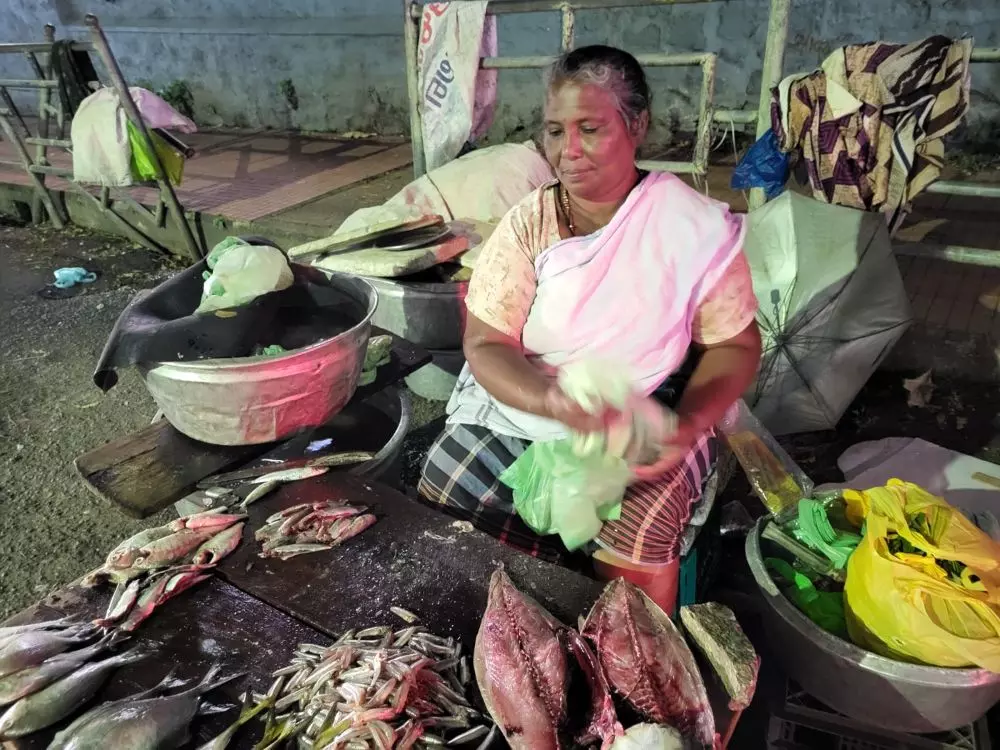
Madonna Moses, 54, a resident of Vettukad in Thiruvananthapuram, is a familiar face to residents of the Vazhuthacaud area in Keralam’s capital city, where for years, she has been selling fish by the roadside every evening, near the famous Cotton Hill Government Girls Higher Secondary School. She sits with her basket of fish from around 4 pm until well past midnight. But the customers she...
Madonna Moses, 54, a resident of Vettukad in Thiruvananthapuram, is a familiar face to residents of the Vazhuthacaud area in Keralam’s capital city, where for years, she has been selling fish by the roadside every evening, near the famous Cotton Hill Government Girls Higher Secondary School. She sits with her basket of fish from around 4 pm until well past midnight. But the customers she has sold fish to for nearly 35 years now increasingly have other ways of getting their supplies, without having to step out of home.
Madonna has spent most of her adult life selling fish. She has raised three children on the income from the trade. All three have degrees. Two work as drivers and another does billing work. Her husband, who once went to sea, no longer fishes. Yet after 35 years of selling fish, Madonna says she has no savings. Whatever she earns goes towards repaying loans incurred both for business and family expenses. She puts her debt at somewhere between Rs 10 lakh and Rs 26 lakh.
Till before the Covid pandemic (2020-23), on a good day, she recalls making Rs 1,500 to Rs 2,000. But now, she talks of the struggle to make even Rs 1000 a day.
“The business has come down badly,” says Madonna. “Now there are online fish sellers. They buy fish not only from the shore but also from wholesale shops in the city. They buy in bulk, keep the fish on ice and deliver it to customers who place orders online. Then there are fish-selling vehicles. One person may have several vehicles working in different places. They can sell fish in different areas at the same time,” says the 54-year-old, explaining the competition and business loss.
Madonna adds: “For us, it is different. I have to carry my basket, walk, take a bus or an auto and come here to sell. I reach the market around four or five in the evening and sometimes stay until 1.30 in the morning. When I finish, I take an auto back home. “The problem has reached our homes too. There is no money even to repair or paint the house. Even borrowing has become difficult because we have to think about how we will repay it.”
“What we earn in a day puts food on the table for that day,” she says, talking of the hand-to-mouth existence.
Keralam’s 590-km coastline supports nearly a million people from diverse marine fishing communities, spread across 222 fishing villages. According to available government data, there are about 1.9 lakh registered fishers and their families in the state. Thiruvananthapuram is the heartland of traditional fishing in the state, with more than 55,000 active sea-going fishers across 42 villages, according to a study conducted by Ashni L & Santhosh R in 2019. It also has Keralam’s largest population of women fish vendors, and women’s earnings have historically been an important economic buffer for fishing families. But things started to change around the time of the Covid pandemic, say those in the trade that The Federal spoke to. With online sales and orders being placed over the phone picking up, traditional women vendors find themselves being increasingly pushed out of the retail fish market.
Vimala Denilson, 37, who sells fish in the Kuravankonam area of Thiruvananthapuram, stepped into the trade three years ago after her mother, who had sold fish for years, became unwell. Her husband, Denilson, 51, is a fisherman, but the sea does not provide a steady income either. The couple have five children, the youngest seven and the eldest 15. Today, Vimala spends long hours buying and selling fish, often returning home only around midnight. Yet there is no certainty that the day's work will fetch her a profit.
“Sometimes, if we get anchovy or some other small fish, we may make something. Otherwise, it is a loss,” she says. The small fish are safer for her to trade, she says, because customers buy them more readily. Buying expensive, larger fish can leave her with a heavy loss if they do not sell.
For Vimala, the difficulties are not limited to the uncertainty of the catch. She claims the availability of fish has declined sharply since the Vizhinjam port (The international seaport developed and operated as a public-private partnership with Adani Ports) came up (the inauguration was last year), while the market has changed rapidly. Sellers arriving in vehicles, delivering fish directly to homes and taking orders online have taken away some of the customers who once came to roadside vendors like her.
“People can sit at home and order fish online. They bring it right to the doorstep, in cars, autos and bikes. So our business has reduced,” she says. “Even if I get Rs 500, it helps. I have to look after the children,” she adds.
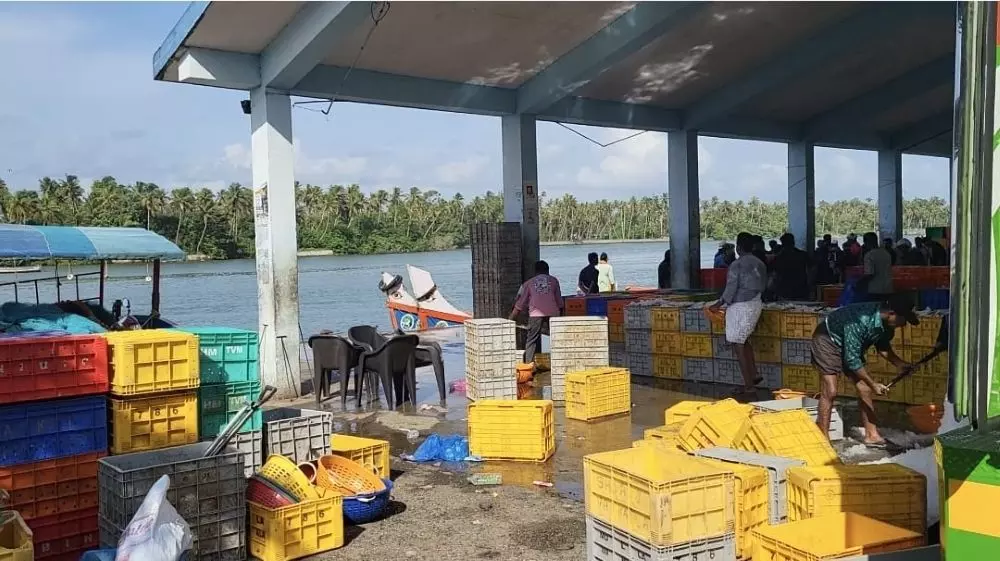
A fishing harbour in Keralam. Photo: Rajeev Ramachandran
For generations, women have been a crucial link between Keralam’s small-scale fishing communities and consumers, buying fish at landing centres and auctions and selling it door-to-door or in local markets, especially in the state’s southern districts, such as Thiruvananthapuram. Their place in Keralam’s fish economy dates back to a time when the relationship between fishing, selling and household survival was built around the labour of both men and women. While the state does not have a single, comprehensive and up-to-date official count of women fish vendors for 2026, according to pre-Covid data of the fisheries department, Keralam had 27,053 registered fish vendors in 2020, of whom 18,718, or 69.19 per cent, were women. The state also had the highest share of fisherwomen who had taken up marine fisheries as a full-time occupation, at 67 per cent. Thiruvananthapuram has a coastal stretch of around 78 km and nearly 70 per cent of fisherwomen in the district work as fish vendors.
Studies over the years have revealed that households with women engaged in fish vending were often relatively better off because their income supplemented the uncertain earnings of fishing. The erosion of women’s access to fish vending, therefore, has had a serious impact on household incomes.
Elizabeth (identified by first name only), 47, is a single mother of two daughters, one studying in an engineering college and the other in Class 12. She supports the family through fish vending, a workday that begins at the fish landing centre early in the morning and often ends only by evening. But despite the long hours, income is uncertain. “Just the auto fare to reach the landing centre is Rs 200 and daily profit from sales can be as little as Rs 300,” says Elsa.
Most fishers in the district belong to the Mukkuvar community, predominantly Latin Catholics classified as other backward class (OBC) by the state. The Latin Catholic Church has also traditionally acted as an important intermediary between fishing communities and the state, especially the southern part. Parish-level structures have played a role in regulating fishing and fish sales, sometimes implementing government directives and at other times imposing locally decided restrictions.
Mercy Alexander, 68, a prominent social worker, veteran feminist activist, and trade unionist who started organising women from the fisher communities, remembers that world from her childhood. “My mother and other women in our coastal community would buy fish locally and carry it in baskets made from palm leaves. The men went fishing and the women sold what they brought home. They would leave in the morning, return after selling the fish and often go out again later in the day. It was a complementary household economy. The men caught the fish and the women took it to the consumers”.
She adds: “There was very little of the infrastructure that defines the fishing economy today. Outboard engines had not arrived. There were no ice factories or fish-processing units as we know them today.”
Whatever fish remained unsold was dried or preserved using traditional methods. Then things began to change. Outboard engines arrived in the '80s. Trawling expanded along the coast. Ice factories and fish-processing units appeared. Large traders started arriving in lorries to buy fish in bulk.
“As large traders gained control over the catch, less fish was left for women who traditionally bought fish in smaller quantities and sold it in local markets,” says Mercy. “The change was not only about the quantity of fish available. It also changed what kind of fish reached local consumers. Prawns, squid and other species that were once processed locally increasingly went to fish-processing factories. I remember a time when prawns had very little value. Coastal families would boil them, peel them and dry them. Squid too was traditionally dried and sold. That local economy gradually disappeared.” With the expansion of processing, these fish increasingly moved into another commercial chain.
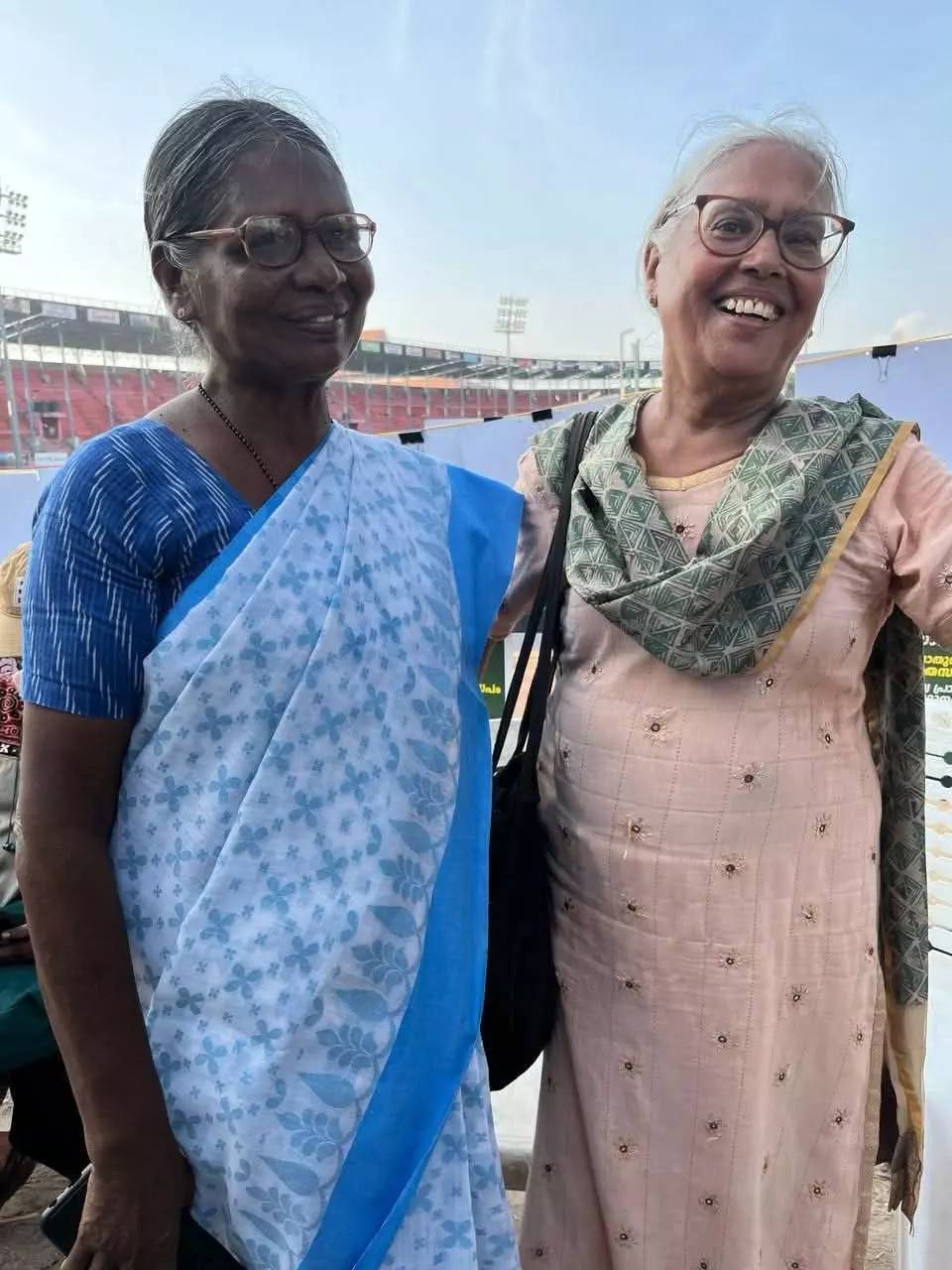
Mercy Alexander (left) and Nalini Naik, two early leaders who spearheaded the unionisation of women in Kerala’s fishing sector. Photo: By special arrangement
In the late 1970s, before the formation of many of the organised fisher’s unions, women fish vendors began forming their own organisations. Mercy was among those involved in setting up ‘Mahila Samajams’ in coastal villages in the late seventies. The effort had its roots in the Marianad Community Development Project associated with the Archdiocese of Thiruvananthapuram. The project worked among fishing communities living in severe housing, health and educational deprivation and helped relocate families to Marianad, where they were provided houses and land. Young women were trained and then worked in villages, organising women around health, education, savings and other community concerns. But when they began meeting fish vendors, they found that the women themselves had identified a very different priority, which was transport.
The women’s demand for transport gradually grew into a broader struggle for the recognition of fish vending as work and for basic rights at the workplace. In December 1978, a temporary committee of women fish vendors was formed, and meetings were organised in coastal villages, often through churches since Sunday was the only day the women had free. The organisers mapped the routes the women travelled and the markets they depended on, while street plays and other forms of mobilisation helped build awareness that fish vending was not merely an activity to supplement the family income, but work that deserved recognition and support.
Their demands went beyond buses. They sought sheds, water and toilets in markets, an end to what they considered unfair market fees collected by contractors, and land titles for the houses where coastal families lived. But transport became the immediate rallying point. The women argued that walking several kilometres with heavy baskets consumed much of their working day and made it difficult to take their children to school, return home to cook and manage their families.
When the authorities suggested that other facilities could address their problems and raised objections to allowing women carrying fish baskets on buses, the women refused to back down. Their campaign eventually developed into a protest movement, taking their demands to the state Secretariat. In 1981, the government accepted their transport demand and introduced special buses.
Mercy describes it as the first major organised struggle by fisherwomen in Keralam for their livelihood rights. The demands were not abstract. They were for the ability to travel to the market, for basic market facilities and for an end to what they considered unfair market charges.
Nearly half a century later, the problem has changed shape. The women are no longer simply fighting for a bus to take them to the market. They are trying to remain relevant in a market that is being reorganised around private vehicles, digital ordering, wholesale procurement and home delivery. The Covid-19 pandemic accelerated some of these changes. Restrictions on movement and the disruption of traditional markets created space for new ways of buying and selling fish. Online ordering and home delivery became more familiar. Private vehicles could move fish directly to consumers.
Dr Johnson Jament, a researcher who has extensively studied Keralam’s fishing communities and the changing conditions of women fish vendors, sees the shift from village-based fishing to centralised, harbour-based systems as a crucial factor behind the erosion of women’s livelihoods.
“The fishing sector in Thiruvananthapuram has traditionally been village-based. Launching, landing, fish auctions and fish vending all happened within the fishing villages. When you centralise this village-based industry and move it into harbours, the biggest victims are the women, particularly the women fish vendors,” Johnson says.
He points out that fish vending was not merely casual or informal work but a form of small-scale entrepreneurship in which women exercised considerable control. More importantly, the village system allowed them to enter the trade without substantial capital. Community-based arrangements often allowed women to pay for the fish after selling it, giving them access to the trade even when they had little money to invest.
That flexibility also gave women room to negotiate. “Suppose a woman bought fish for Rs 5,000 at an auction but found that she could sell it only for Rs 4,500. She could go back and bargain. She could tell the seller that she did not get the profit she expected and ask for a reduction. That negotiation was possible in the village system,” Johnson says.
The shift to harbours, he argues, has altered that balance of power. Harbour markets require greater capital, allowing traders who can buy fish worth lakhs of rupees to dominate the auctions. Small-scale women vendors cannot compete with them on equal terms, he claims. They may return without fish or end up with whatever remains after the larger traders have made their purchases.
The problem is compounded by the structure of decision-making in the harbours. “In the harbour management committees, women have virtually no representation. They are dominated by men, many of whom may not have the same close connection with the sea or the knowledge of fish and fish trading that these women have,” he claims.
The result, according to Johnson, is not simply the loss of a traditional workplace but the erosion of the bargaining power that women had built within the village economy.
Johnson’s research with UK-based academic Caroline Osella has similarly documented how state-led modernisation and centralisation, along with the growth of new retail practices, have reduced women's space in fish auction markets. Their research found that women who traditionally relied on public transport and face-to-face sales were increasingly disadvantaged by new systems involving private vehicles, online platforms and larger market players.
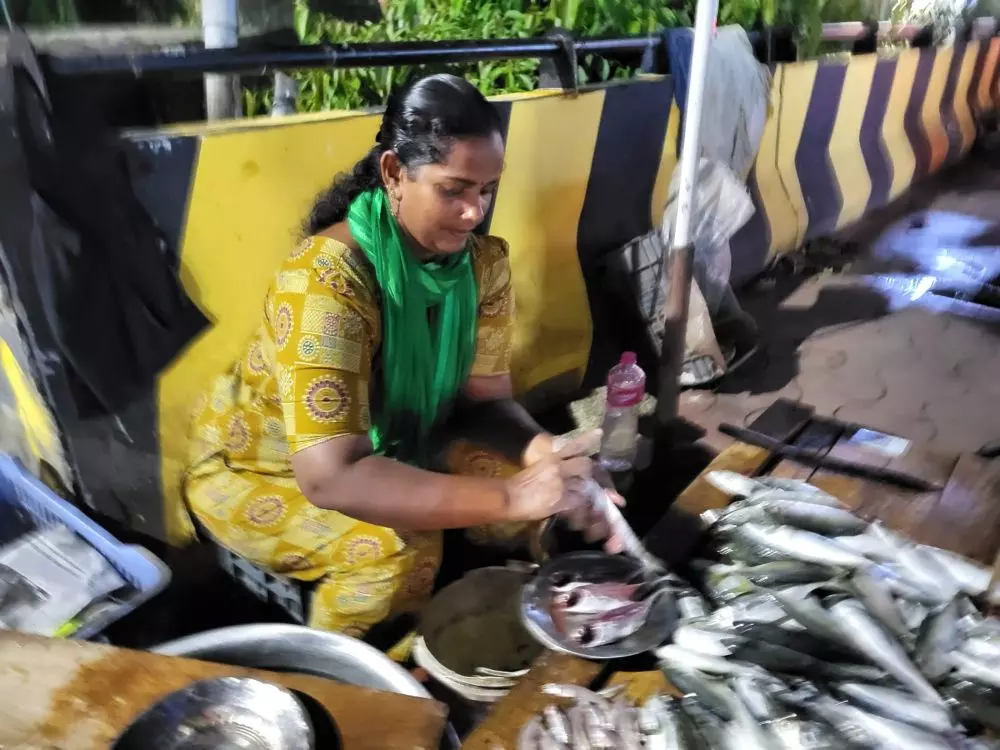
Vimala Denilson, 37, stepped into the trade three years ago after her mother, who had sold fish for years, became unwell. But fewer women have been coming into the trade in recent years, says the younger generation. Photo: Rajeev Ramachandran
The state government, within the limits of its capacity, has intervened through a range of measures aimed at easing the livelihood challenges faced by women fish vendors, including transport, credit, marketing and storage support, a fisheries department official said. “The government has introduced several measures specifically aimed at supporting women fish vendors. KSRTC [Kerala State Road Transport Corporation] has started special ‘Samudra’ bus services for women fish vendors and assistance is also being provided to help them purchase two-wheelers so they can market their fish independently. We are also making low-interest bank loans available to protect women from exploitative informal lenders, along with self-employment loans through the Women’s Development Corporation. The government is creating modern fish markets and high-tech marketing centres with basic infrastructure for women who currently sell fish by the roadside,” says the official.
However, these interventions have yet to translate into a meaningful change, with women vendors continuing to struggle for space in the retail market, both literally and figuratively. “Local workers used to know us as their mothers, sisters or friends of their families and there was a certain respect. Now, with vehicle vendors and bike suppliers, we are treated like garbage,” complains Susan Rosario, a 60-year-old vendor.
Women vendors who had once fought an organised battle for their rights now claim they have “no union supporting them, the backing of no political party”.
The struggle, and the changing fish trading economy, appear to be acting as a deterrent for the younger generation, many of whom say they are not keen to join the business.
Sini D’Costa, a student at a private dental college, comes from a fishing family. Her mother still sells fish while her father goes out to sea. “They are still doing this because my brother and I have to study. We have loans on our house and the scooter my mother uses. Once I finish my degree and get a job, they are going to retire. We are not going to let them do this anymore. As far as I know, no one from my generation in my village has taken up fish vending,” says Sini.
Also read: Why in Keralam, Muthalapozhi in Thiruvananthapuram has become ‘harbour of death’ for fishers
The women who once carried baskets into the market are now competing against an economy that can put fish into a refrigerated vehicle, display it on a phone screen and deliver it to a customer's doorstep. For women like Madonna and Vimala, the difference between the two worlds is measured not in technology but in what is left at the end of the day. Earlier, Madonna says, five baskets of fish could be brought home before 10 in the morning. Today, even one basket can demand the effort of two. Meanwhile, organised online sellers can source from multiple wholesale points, giving them access to a wider variety and allowing them to compete not just on convenience but on choice.
The history recalled by Mercy shows that women fish vendors have never been passive participants in Keralam's fishing economy. They have adapted to changes in fishing technology, markets and household needs. At one point, they organised themselves to demand something as basic as a bus. They built organisations around the idea that selling fish was work and that the women doing it were workers with rights.
But now, the very market has moved ahead. And women who once fought to gain access to it are asking whether they still have a place in it.