- Home
- India
- World
- Premium
- THE FEDERAL SPECIAL
- States
- Perspective
- Videos
- Sports
- Education
- Entertainment
- Elections
- Features
- Health
- Business
- Series
- In memoriam: Sheikh Mujibur Rahman
- Bishnoi's Men
- NEET TANGLE
- Economy Series
- Earth Day
- Kashmir’s Frozen Turbulence
- India@75
- The legend of Ramjanmabhoomi
- Liberalisation@30
- How to tame a dragon
- Celebrating biodiversity
- Farm Matters
- 50 days of solitude
- Bringing Migrants Home
- Budget 2020
- Jharkhand Votes
- The Federal Investigates
- The Federal Impact
- Vanishing Sand
- Gandhi @ 150
- Andhra Today
- Field report
- Operation Gulmarg
- Pandemic @1 Mn in India
- The Federal Year-End
- The Zero Year
- Science
- Brand studio
- Newsletter

Why the revival of a festival last held about 270 years ago has public opinion divided in Kerala
The Mahamagha Mahotsavam is being spearheaded by Swami Anandavanam Bharathi of the Juna Akhada. Touted the 'Kumbh Mela of Kerala', the presence of saffron groups at the event in Malappuram, a district with a sizeable Muslim population, has some worried. Environmental concerns are a separate issue.

Last month, on Republic Day, an estimated three lakh people are said to have visited the ongoing Mahamagha Mahotsavam, being held on the banks of the Bharathapuzha (also known as the Nila) river in Thirunavaya. The town, known for its Navamukunda Temple, dedicated to the Hindu deity Vishnu, is located in Kerala’s Malapurram district.What is of probable interest here, though, is not the...
Last month, on Republic Day, an estimated three lakh people are said to have visited the ongoing Mahamagha Mahotsavam, being held on the banks of the Bharathapuzha (also known as the Nila) river in Thirunavaya. The town, known for its Navamukunda Temple, dedicated to the Hindu deity Vishnu, is located in Kerala’s Malapurram district.
What is of probable interest here, though, is not the footfall on the inaugural day of the festival on January 26, but the fact that the Mahamagha Mahotsavam, also known as the Mamankam, is being revived after an interval of approximately 270 years.
The Kerala tourism website describes Mamankam as a “grand medieval cultural event that took place every 12 years” and was “marked by trade fairs, sports events, martial arts demonstrations, intellectual contests, cultural activities, rituals, and folk art performances”. It is traditionally celebrated over a 30-day period commencing from the Makam asterism that appears during the ‘bright’ phase of the moon — the waxing fortnight — in Magha, a month in the Hindu calendar, or Saka calendar as it is also known. The website adds: “Many historical landmarks in the region are associated with Mamankam, including Manikkinar (a burial site), Nilapadu Thara (the festival venue), Marunnara (an explosives storage centre), Changampalli Kalari (a training ground for soldiers), and Pazhukkamandapam (a gallery for kings and queens to watch the festival).” The remains of some of these monuments are preserved and maintained by the state archaeology department, with a plaque informing that the last Mamankam was held here in 1755.
So what led to its revival in 2026? The more pertinent question would perhaps be ‘who’?
In the Maha Kumbh held last year in Uttar Pradesh’s Prayagraj, Swami Anandavanam Bharathi, a monk of the Juna Akhara, was anointed 'Mahamandaleshwar'. The akhara website defines Mahamadkeshwars as “senior monks”, junior only to the “Shri Mahant” or head of the akhara, “who are spiritually advanced and respected within the Akhara… Each Mahamandaleshwar may have a following of disciples and manage their own ashrams”. Bharathi, according to reports, had received special charge of South India during his elevation as Mahamadaleshwar.
The Mahamagha Mahotsavam 2026 is his brainchild.
“Magha holds special significance for deities such as the Sun, Shiva, Vishnu, and the Ganga. The Puraṇas regard Magha as the most distinguished among the months. During this period, the divine energies and the Sun are particularly potent, resulting in nature appearing pure and radiant. Magha is when the influence of these deities is at its zenith at the Bharathapuzha, referred to as the ‘Dakṣiṇa Gaṅga’ [Ganga of the South], which is linked to the presence of seven sacred rivers,” Bharathi told The Federal.
He added: “The sacred baths taken in this river during Magha enhance, on a subtle level, the individual, their family, and their community. Magha is the month designated for cleansing all sins associated with one's actions and those accumulated through experiences, paving the way for a prosperous life filled with merit.”
Also read: Amidst exploding spiritual tourism, how Tamil Nadu’s Navagraha temples offer a quiet ode to pattern
A website created for the Mahamagha Mahotsavam promotes the event as the “Kumbh Mela of Kerala”.
Not far from the Navamukunda Temple in Thirunavaya are two other temples — one dedicated to the Hindu deity Shiva and a second dedicated to the deity Brahma, in Thavanur. Religious scholars believe that three temples create a triangle of energy where the Mahamagam festival would traditionally take place.
The event website offers registration for special pujas such as ‘Parashuram Puja’ and ‘Yogeshwara Puja’. Ritualistic bathing in the Bharathapuzha is open every day between 6am and 6pm. But the highlight of the event is the daily Nila Arathi at 6.30pm; organisers claim Bharathi has brought in a team of priests who perform the Ganga Arti at Varanasi’s Dashashwamedh Ghat for the purpose.
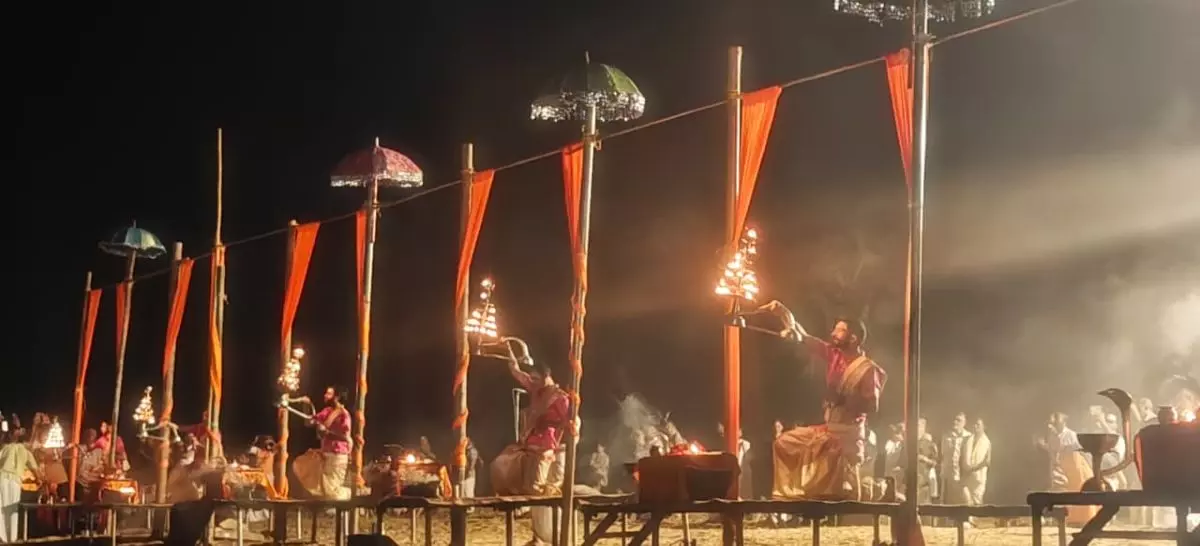
Nila Arathi being held on the banks of the river. Photo: By special arrangement
According to popular accounts, the inaugural Mamankam yajna was conducted by Brahma, with the deity’s guru, Brihaspati, presiding over the festival. Over the years, the responsibility of the festival was transferred to the Perumals (local rulers). However, after the legendary Chera dynasty king, Cheraman Perumal, departed for Kailash, the festival lost its royal sponsorship. The Perumbadappu Swaroopam, or kingdom of Cochin, is said to have assumed the chairmanship of the festival after that and designated the then king of Valluvanadu, Valluvakkonathiri, as its representative. Eventually, the Samuthiri (better known by the anglicised title Zamorin), the erstwhile ruler of Calicut, assumed the chairmanship of the festival, resulting in a rivalry between the royal families, before the Mamankam stopped being celebrated.
A version of this narrative is also mentioned on the Mahamagha Mahotsavam maintained by this year’s organisers. It adds: “This year's Thirunavaya Maghamahotsavam is a call to face the challenges facing the Sanatana Samskara.”
Also read: Why in Tamil Nadu, Pongal celebrations unite Hindus and Muslims in common 'thanksgiving’
The organisation of the festival itself was not achieved without navigating some hurdles.
Thirunavaya is a quiet town that lacks the kind of essential facilities needed to host an event of this magnitude. There are no hotels.
However, Bharathi’s event has drawn members of many saffron organisations to the place, who have shouldered the responsibility of its management.
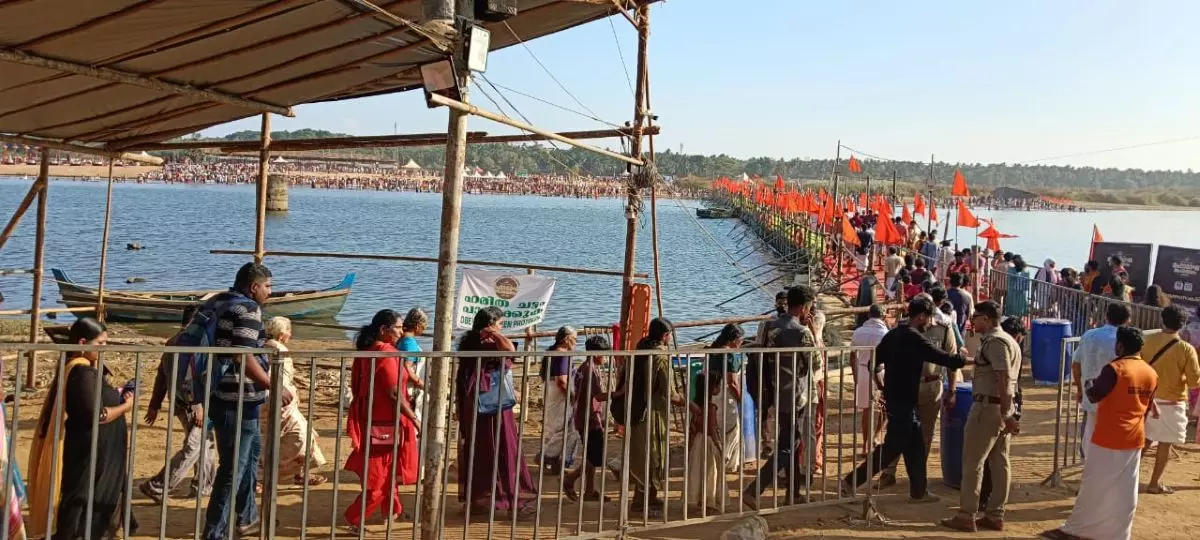
People make their way to the river. Photo: MT Saju
While the police are ensuring security, members of the Haritha Karma Sena are taking care of sanitation and waste management. Volunteers from Seva Bharathi, a branch of the Rashtriya Swayamsevak Sangh, dressed in saffron t-shirts, are seen helping with crowd and traffic management. For all those participating in the festival, Ammucare Charitable Trust (a registered non-profit organisation founded by the spiritual guide and philanthropist, Mohanji, in 2003) is running an ‘Annashala’ — free food service. Drinking water is available at stalls managed by volunteers. Bio toilets for both men and women have been set up, as well as separate changing rooms for women.
“This is the first time Thirunavaya is witnessing such a huge crowd. We are doing our level best now and everything is under control. But we need to look for better options in the coming years when such festivals are organised,” says Sreelakshmi K, the young and vibrant secretary of the Thirunavaya panchayat.
Also read: How a groundnut festival to appease a bull became a part of Bengaluru's cultural calendar
Meanwhile, the presence of the pro-Hindu organisations and factions at the event in Malappuram, a district with a sizeable Muslim population, has got some people concerned. According to the 2011 Census, 70.24 per cent of Malappuram’s population were Muslum — numbering 2.89 million in a total of 4.11 million.
“India is renowned for its festivals. However, at events such as Mahamagham and Kumbh Mela, religion and political motivations, as well as commercial opportunities, are intertwined,” says B Jeyamohan, a renowned writer and critic in Tamil and Malayalam literature. He adds: “Festivals themselves are not problematic. My concern lies in the religious and political dimensions that pose a threat to these celebrations, nothing more. The encouraging aspect is that the public does not seem overly concerned with these issues, as they do not take the religious and political implications seriously. This is a positive development,” he said.
Indeed, Thirunavaya’s Muslim residents do not seem unduly concerned about the motive, if any, behind the revival of the Mamankam, choosing instead to share in the activity and attention it has brought to the little town.
“They believed the festival would disrupt the Muslims, but that has not been the case. A few days ago, I arrived in Thirunavaya at 8pm, because my train was delayed. An autorickshaw driver, who was a Muslim, was extremely helpful in finding me accommodation,” recalled Vimala S, a resident of Thrissur, who was visiting the festival. Abdul Sathar, a teacher from Thanur, expressed his satisfaction regarding the large festival taking place in his area. “It is a wonderful event, and people from various places come to our town to partake in it. It brings me immense joy. I have offered my vacant land for the parking of visitors’ vehicles,” he said.
Renowned art historian and author MG Sasibhooshan recalled a recent visit to Vellamassery Garudan Kavu Temple in Tirur, also in Malappuram district. “I saw many Muslim women visiting the Garuda temple. They do not enter but wait outside to receive the prasadam. While people may not be deeply religious, the leaders desire them to be, which poses a challenge,” he said.
Questioning the timing of the ongoing festival and the apparent urgency with which it was held, Sasibhooshan added: According to my astrological assessments, the precise month for Mahamagam is mid-August. Given that assembly elections in Kerala are anticipated in April, I am uncertain if there is any significance to this urgency.”
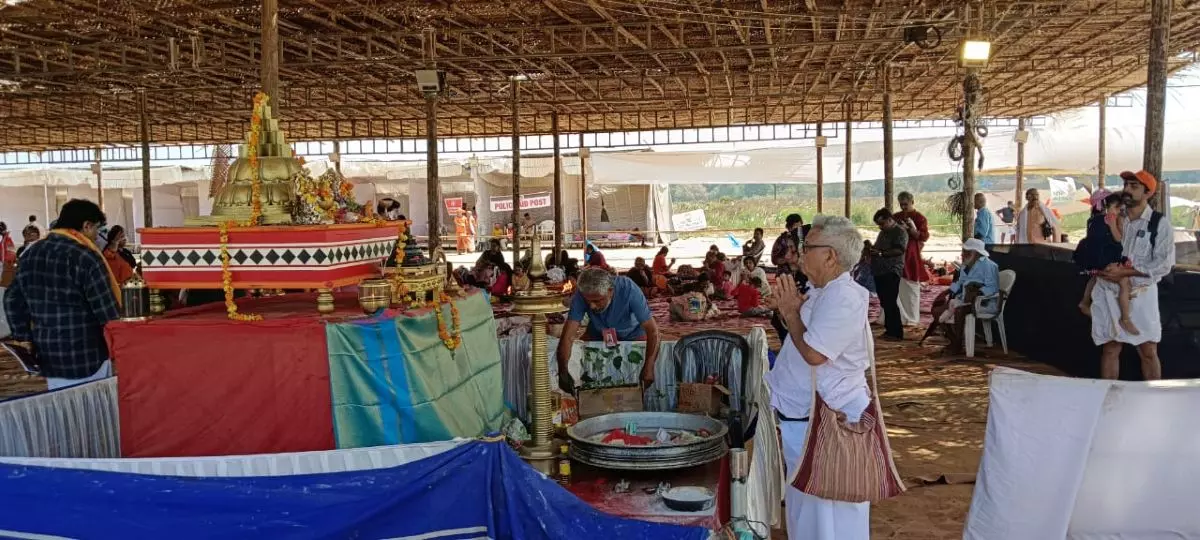
Pujas being performed at the festival. Photo: MT Saju
But the benefit from the event, if any, was unlikely to be reaped by any single party, felt filmmaker G Prabha. “The festival has created a momentum, but who gets its benefit and how much is to be seen in the coming months. Not all who come for the Kumbh Mela will vote for the BJP. A Hindu revival is on, but it should not cross the line. We should not forget our vasudhaiva kutumbakam [the world is one family] concept,” said Prabha.
For now, leaders across party lines are choosing to downplay any political motivation behind the event.
“We are pleased that people from various regions of the country are coming to our area during this festival. Our place will gain popularity and attention, which will ultimately contribute to its development. Although we lack basic facilities, owing to the area's remoteness, we are striving to assist the pilgrims in every way possible. We are ensuring that the communal aspect, if any, does not disrupt this fabric of religious coexistence,” said Mohammed Ali Mulakkal, the president of the Thirunavaya Mandalam Congress committee.
Manoj K, a BJP functionary from Thirunavaya, too, insists that the revival of the Mahamagham festival is not intended to foster communal animosity. "Contrary to the beliefs of various political parties, there is no political agenda associated with it. It is solely a cultural event and nothing more. We hope to continue celebrating Mahamagham in the years to come," he said.
Also read: Why a 7-year-old’s prayer to Shiva has a lesson on restraint and accountability for adults
The other concern against the festival — that of environmental damage — is less easy to explain away with words alone.
Originating in the Anamalai Hills of Tamil Nadu, Bharathapuzha is the second longest river in Kerala. Once regarded as a cradle of civilisation in the region, the river has encountered numerous threats over the years, including pollution and alleged sand mining, which have affected its flow.
Now, with the Mahamagha festival, G Shiva Kumar, an environmental activist from Tirur, fears that both the river and its surrounding areas will suffer significantly, owing to the surge of visitors. “Thirunavaya is a remote town lacking the essential facilities to accommodate such a large crowd. The state of Bharathapuzha is even more dire. Although the members of Haritha Karma Sena are making efforts to manage the waste, the volume is overwhelming. Once the Mahamagam concludes, it will accumulate, causing harm to the environment and the river,” he said.
Bharathi, however, will allow no such concern.
“We aim to restore Bharathapuzha through Mahamagam,” he told The Federal. “The main ghats along the Ganga in Varanasi were in poor condition ten years ago, but they are now clean owing to the efforts initiated by the Central government. Similarly, we will collaborate to address the significant challenges confronting the river. I am confident that events like Mahamagam will create awareness among the public not only about cultural and spiritual dimensions but also regarding climate change and environmental concerns,” he added.
As he speaks, he is already moving, from one site to another, his eyes missing nothing, eager to ensure that the festival goes off without a hitch. He has almost pulled it off — there is only one more day to go before Mahamagham Mahotsavam 2026 ends. February 3 is the last day for this year’s festival.
Whether the event is able to become a permanent fixture of the region’s cultural calendar remains to be seen, but despite all concerns, it has given moments of job to visitors like KS Usha, a 55-year-old resident of Palakkad district, who was visiting the Mahamagham Mahotsavam when The Federal was there. “Despite having visited numerous temples in Kerala and Tamil Nadu, this was my first experience of a sacred bath. Taking a dip in the river was special. Observing the Nila Arathi was a great experience. I had studied about the Mahamagam in history, but never thought I would get to experience it firsthand.”