- Home
- India
- World
- Premium
- THE FEDERAL SPECIAL
- States
- Perspective
- Videos
- Sports
- Education
- Entertainment
- Elections
- Features
- Health
- Business
- Series
- In memoriam: Sheikh Mujibur Rahman
- Bishnoi's Men
- NEET TANGLE
- Economy Series
- Earth Day
- Kashmir’s Frozen Turbulence
- India@75
- The legend of Ramjanmabhoomi
- Liberalisation@30
- How to tame a dragon
- Celebrating biodiversity
- Farm Matters
- 50 days of solitude
- Bringing Migrants Home
- Budget 2020
- Jharkhand Votes
- The Federal Investigates
- The Federal Impact
- Vanishing Sand
- Gandhi @ 150
- Andhra Today
- Field report
- Operation Gulmarg
- Pandemic @1 Mn in India
- The Federal Year-End
- The Zero Year
- Science
- Brand studio
- Newsletter

How Saraswati seems to be losing out to Lakshmi in age of materialistic pursuits
Durga arrives armed for battle, Kali embodies destruction and Lakshmi is associated with prosperity and abundance. Saraswati’s power is quieter. She represents knowledge. Across India, as Navratri sees the veneration of various forms of the 'Devi', the female goddess, in some parts it will include worship of Saraswati. But have we as a society stopped valuing what she represents?

Māṇikya vīṇām upalālayantīm/Madālasāṁ mañjula-vāg-vilāsām/Māhendra-nīla-dyuti-komalāṅgīm/Mātaṅga-kanyāṁ manasā smarāmi (I meditate upon the daughter of Sage Matanga, the Goddess who gently plays a veena made of rubies, whose speech is charming and sweet and whose tender limbs possess the dark-blue radiance of a sapphire).The sound wafts out of a room in...
Māṇikya vīṇām upalālayantīm/Madālasāṁ mañjula-vāg-vilāsām/Māhendra-nīla-dyuti-komalāṅgīm/Mātaṅga-kanyāṁ manasā smarāmi (I meditate upon the daughter of Sage Matanga, the Goddess who gently plays a veena made of rubies, whose speech is charming and sweet and whose tender limbs possess the dark-blue radiance of a sapphire).
The sound wafts out of a room in Mumbai’s Borivali early in the morning, as Odissi guru and exponent Shubhada Varadkar puts her students through their paces, beginning the class with an invocation to Saraswati, the goddess of learning. The verse is from the Shyamala Dandakam, a powerful poetic composition traditionally attributed to Sage Agastya, which flows as a single continuous sentence in praise of the goddess.
For Varadkar, the choice of the invocation is deliberate. “Saraswati is one of the most ancient goddesses in the Hindu pantheon. Yet today, apart from the obligatory puja once a year, she is largely forgotten. That is why during Navratri, when I do the Mangalacharan [invocation], I deliberately choose this prayer.”
The annual nine-day autumnal Navratri festival is being celebrated between October 11 and 19 this year. Across India, the festival sees the veneration of various forms of the Devi (the female goddess), which includes the worship of Saraswati in some parts — such as Ayudha Puja in the South.
Earlier this year, the Madhya Pradesh high court recognised the disputed Bhojshala-Kamal-Maula complex in Madhya Pradesh as a temple. While Muslims claimed the structure to be linked to Sufi saint Kamaluddin Chisti, Hindus have held the site to be a temple dedicated to goddess Vaghdevi Saraswati. The legal recognition of the site as a temple, however, seem more the settlement of a communal issue than a celebration of the goddess of wisdom.
Meanwhile, Varadkar’s observation about Saraswati being “forgotten” raises a deceptively simple question. In a culture that routinely invokes the ‘Devi’ and has given her countless forms, stories and names, does Saraswati appear to occupy far less space in popular imagination than Durga, Kali, Amba, and Lakshmi? The first three embody strength and power, the victory of good over evil, the fourth, wealth and prosperity. Saraswati’s blessings are far more subtle, non-exhibitory.
Also read: How a character’s success can limit the actor from experimenting on screen
Varadkar laughs when the question is put to her. She is quick to clarify that it is not as though Saraswati has disappeared. Yet she believes the priorities of contemporary society have altered the way people approach the divine. “We live in an era when everyone is in a mad rush chasing money. Many may feel that the blessings of the ‘Goddess of Wealth’ are all that matter,” she offers. Varadkar adds, with a hint of sadness, “People perhaps feel that once you have money, all else will follow. It is a mark of the times we live in.”
While there are plenty of beautiful compositions in the scriptures in praise of Saraswati, the dancer believes that contemporary audiences often want their goddesses to arrive with greater force and drama. “We want to see them as demon-slayers, armed to the teeth, like Amba, Durga, Chandi or Kali,” she says.
For this Sangeet Natak Akademi awardee, the preference is more than a question of artistic taste. She sees it as a kind of transfer of society’s expectations of women onto the goddess herself. “If she brings dowry or other material gifts, she gets respect. But if she wants her due, equal space or respect, she has to fight for it,” Varadkar says. “Look around you. A subdued, mellow woman is often seen as a pushover and disregarded by everyone around,” Varadkar contends.
Perhaps this is why the contemplative Saraswati, dressed in white and absorbed in the music of her veena, does not always possess the same popular resonance as the more visibly powerful manifestations of Devi. Durga arrives armed for battle, Kali embodies destruction and Lakshmi is associated with prosperity and abundance. Saraswati’s power is quieter. She represents knowledge, music, speech, learning and contemplation, all of which require time and attention rather than immediate gratification.
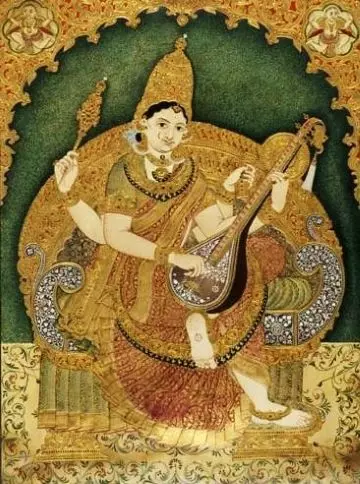
A 19th-century Mysore painting of Saraswati. Photo: Wikipedia
Even classical dance, Varadkar admits, is not immune to the seduction of spectacle. “On stage, powerful demon-slaying can be more appealing than tranquillity and peace,” she says. Such themes allow for dynamic mudras [gestures], heightened abhinaya [expression] and expansive pure dance, making them naturally suited to dramatic performance. “The hunger for the loud and the desire of artistes to feed that hunger have become a vicious cycle,” she says.
The thought lingers as the conversation moves from a dance class in Mumbai to one of Maharashtra’s most famous temples devoted to Lakshmi.
Nearly 375 kilometres away, in Kolhapur, the crowd is already growing at Bhawani Chowk outside the Mahalakshmi temple. Devotees make their way towards the shrine carrying offerings as the bustle of the town continues around them.
Among them is Jatin Solanki, 48, a Pune resident who says he visits the temple regularly. He offers a coconut, jaggery and flowers as he chants a familiar invocation to the goddess: Namastestu Mahāmāye Śrīpīṭhe Surapūjite/Śaṅkha Chakra Gadāhaste Śrī Mahālakṣmī Namostute (I bow to Goddess Mahalakshmi, the great Goddess who is worshipped by the gods and resides in the sacred seat of Sri. O Goddess, who holds the conch, discus and mace in your hands, my salutations to you).
Solanki deals in stocks and for him the association between his livelihood and the goddess Lakshmi is almost self-evident. “If not here, where else will I go and worship?” he asks, talking about the strict nine-day fast and rituals he observes during Navratri in reverence of the goddess.
Narayan Prabhu, 76, the priest who has performed Solanki’s puja, joins in on the conversation. “If it weren’t for Goddess Mahalakshmi, where would the country’s financial capital be?” he asks, a reference to Mumbai’s recognition as the business and economic centre of the country.
Prabhu then recounts a story linking the Goddess to the making of Bombay itself. When William Hornby, then Governor of Bombay, sought to unite what were essentially seven islands separated by the sea, work began in 1782 on an embankment designed to block the Worli Creek and protect the low-lying city from flooding at high tide. According to the story, portions of the sea wall collapsed twice. The chief engineer subsequently dreamt of a statue of Goddess Lakshmi lying in the sea off Worli. After a search, the idol was recovered and a temple was built in 1784, with the Goddess installed there. The embankment, Prabhu points out, has held to this day. “It is all her blessing,” he says with a grin, quickly underlining that he too belongs to the same community as the engineer in the story.
There is something revealing in the intimacy of this relationship with Lakshmi. She is not merely worshipped as an abstract embodiment of prosperity. She is woven into everyday ideas of business, household fortune, property, social mobility and financial security. Her blessings can be imagined in terms that are tangible and recognisable. A successful business, a prosperous household, gold in the locker or money in the bank can all become signs of Lakshmi’s presence.
Saraswati’s gifts are considerably harder to display. What does one put a price on when the gift is curiosity, imagination, reflection or the ability to question?
Over 1,600 kilometres to the north, Varanasi-resident Radheshyam Tiwari, who holds a doctorate in Hindu mythology, sees the ‘changing relationship’ with Saraswati as part of a much larger transformation in Indian society. “Earlier, across the subcontinent, wisdom, knowledge and scholarly pursuit were treated with utmost regard,” he says. “It was not seen as a means to an end but something that people pursued with devotion, just for the love of it.”
He believes that modern society has progressively stripped education of that intrinsic value. Education, he says, has been reduced to something people endure because an academic qualification is necessary for employment. Even that qualification is increasingly reduced to information that can be converted into economic opportunity.
The sequence is familiar. One studies to obtain a degree, obtains a degree to get a job and gets a job to earn money. In the process, knowledge itself can become instrumental.
Tiwari finds the irony particularly striking because in some traditions Saraswati is described as the elder sister of Lakshmi and Durga.
Symbolically, he argues, the order is significant. Wisdom can lead to prosperity and empowerment. But contemporary society, he believes, has inverted that hierarchy by placing wealth and power ahead of knowledge. “Unfortunately, in a commercial world, we have turned the whole idea upside down,” he says.
Tiwari also raises another, more uncomfortable possibility. Perhaps Saraswati’s relative marginalisation is not only a consequence of materialism. Perhaps some of the mythology surrounding her has itself made her a difficult goddess to accommodate within contemporary Hindu practice. He refers to a story in the Matsya Purana in which Brahma creates Satarupa, another name associated with Saraswati, from his own body and then becomes enamoured of her. In the story, she moves from one direction to another in an attempt to escape his gaze, while Brahma creates additional heads so that he can continue to see her. Eventually, she agrees to become his consort. The story inevitably raises uncomfortable questions about desire, familial boundaries and power.
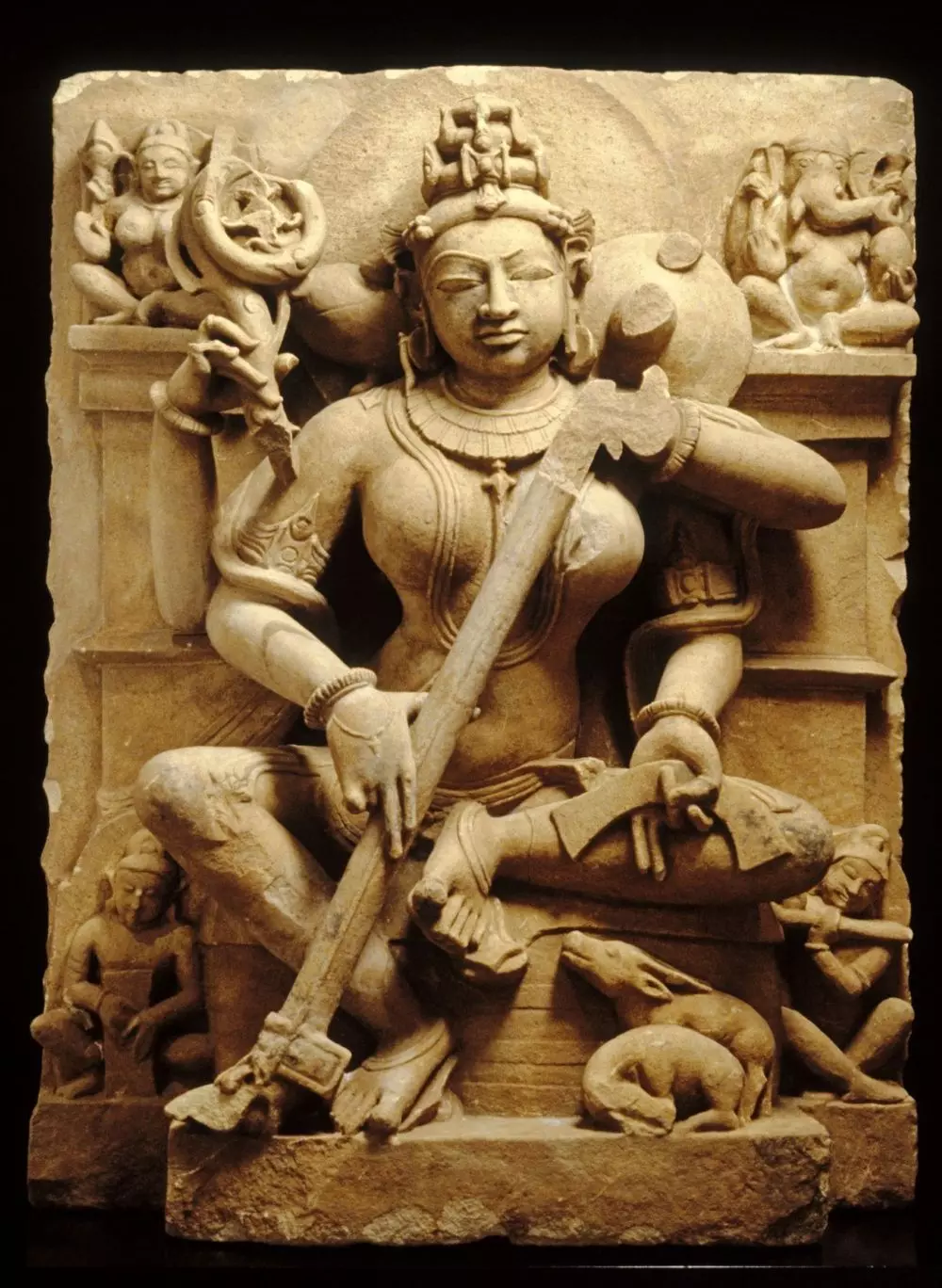
A 10th century stone sculpture of Saraswati. Photo: Wikipedia
Yet Saraswati’s story also demonstrates just how resilient the Goddess has been across cultures and religious traditions. Her worship endured the rise and spread of Buddhism and Jainism. As Buddhism moved from its earlier Theravada traditions towards Mahayana, elements of the Hindu pantheon were incorporated into Buddhist cosmology and visual culture. Saraswati travelled with them.
Tiwari points to early Buddhist mandalas in which Saraswati appears among other divinities. As Mahayana Buddhism travelled across the Himalayas into Nepal, Tibet, Java, China and eventually Japan, the goddess acquired new names and forms while retaining associations with knowledge, music and eloquence. “In Tibet, she appears as Vajra-Saraswati, associated with the vajra. In Japan, she becomes Benzaiten, or Dai-Ben-Zai-Ten, a deity associated with music, eloquence and learning,” says Tiwari and adds, “The goddess of knowledge, in other words, did not disappear when she crossed civilisational boundaries. She adapted, travelled and survived.”
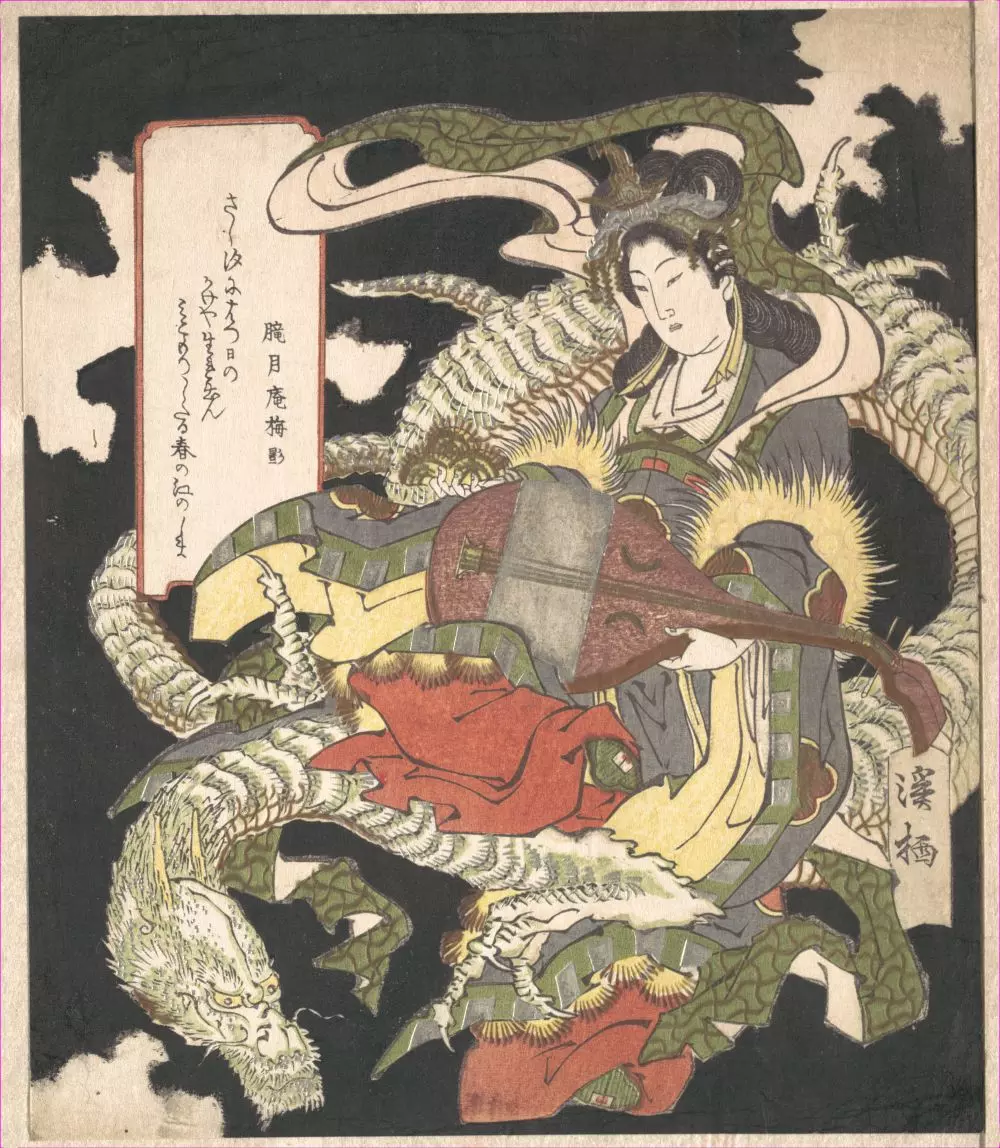
Japan's Dai-Ben-Zai-Ten, holding a lute and seated on a white dragon. Photo: Wikipedia
Her apparent diminished visibility in contemporary popular worship is therefore not some inevitable consequence of history. It is a reflection of changing cultural priorities. From the banks of the Ganges to the Tungabhadra in Karnataka, concerns about the declining cultural centrality of Saraswati and, by extension, the pursuit of knowledge for its own sake are echoed at the Sringeri Math in Karnataka.
It is here, in the quiet of the Western Ghats, that Adi Shankaracharya is traditionally associated with establishing the Sringeri Sharada Peetham and installing Saraswati, or Sharada, as its presiding deity. A priest at the shrine points towards the main temple and asks why Shankaracharya, remembered as one of Hinduism’s great philosophers and scholars, would have chosen Saraswati. “He was one of our most learned men and in direct communion with the Divine. Why do you think he installed Saraswati and not any other goddess?” he asks.
For him, the answer also lies in the traditional stages of life. Saraswati may have been central to the student years, but her importance appears to diminish as the individual moves into adulthood. “By the medieval era, Saraswati stopped mattering after the first stage of life, brahmacharya, as a student. Later, in grihastha, vanaprastha and even sanyas, all that people think of is Lakshmi,” he says.
The contrast between Sringeri and Kolhapur is difficult to miss. Kolhapur’s Mahalakshmi temple draws crowds of devotees seeking blessings for prosperity, while the landscape around Sringeri offers something altogether different. The hills are quieter, the river moves below the temple and there is an unmistakable invitation to contemplation.
For Pune-based women’s studies scholar Tejaswi Sevekari, however, the more interesting question in contemporary times is what happens when even Lakshmi, the goddess of wealth, is placed within a patriarchal framework. “It sounds very nice when men talk about their wives saying, ‘Yeh toh mere ghar ki Lakshmi hai [she is the Lakshmi of my house]’.” she says. “But look at what that actually means.”
Sevekari points to the familiar imagery of Lakshmi and to the long-standing belief that the goddess’s feet must be treated carefully because if she leaves, prosperity leaves with her. In parts of western Maharashtra, she says, an earthy expression is used for someone who is exceptionally wealthy: tyanna kaay kami, Lakshmi paay tutun gharat padliye tyanchya. They could want for nothing because Lakshmi has broken her leg and fallen permanently into their home.
The joke may be about extraordinary wealth. But Sevekari believes the metaphor tells us something about the way women themselves have been imagined. “The ideal woman, within this framework, is one who brings prosperity into the household and ensures that it remains there. She is valuable because of what she contributes to the home. Her presence is associated with good fortune, abundance and domestic stability. But the same society can become considerably less comfortable when the woman demands autonomy, equality or control over her own life.”
She argues that this is part of a larger process in which goddesses who once existed as independent embodiments of fertility, strength and community power were increasingly absorbed into a male-centred pantheon. She describes the ‘spousification’ of goddesses as “a clever latter-day masculinist ploy” that tied the stature of the goddess to her relationship with a male deity. In the process, she argues, some ancient local traditions in which goddesses existed as independent entities were pushed to the margins, while the spouses of the principal male deities of the Hindu pantheon became increasingly prominent.
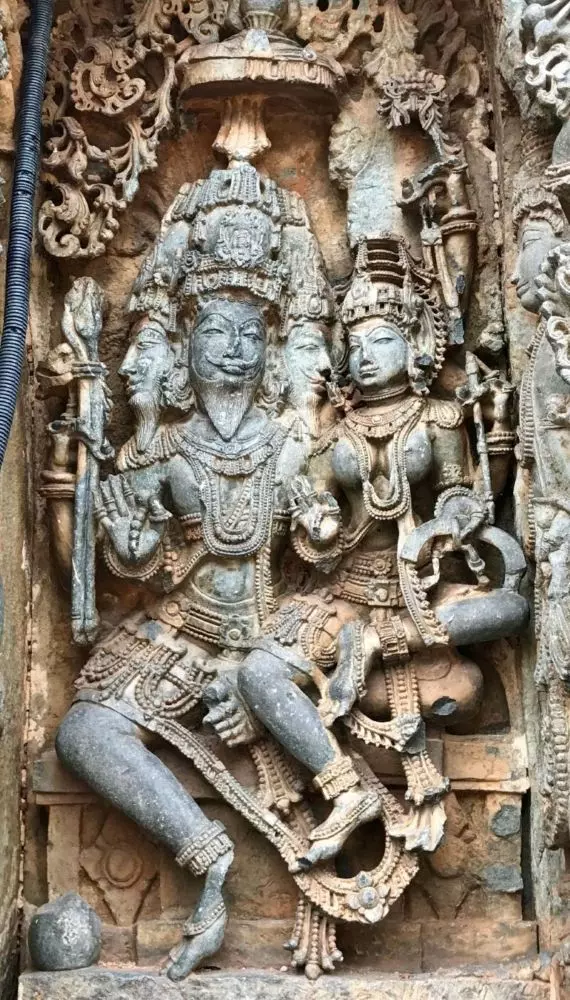
A 12th century sculpture of Brahma and Saraswati at the Hoysaleswara Temple in Karnataka. Photo: Wikipedia
Many tribal and Dalit communities, however, continue to worship local goddesses as independent figures without necessarily making a male consort central to their identity. Sevekari sees these traditions as important reminders that the association between female divinity and a male spouse is neither universal nor inevitable. “At the same time,” she acknowledges, “some practices associated with standalone local deities, including animal sacrifice and forms of occult worship, have themselves alienated sections of society.”
The history, therefore, is neither simple nor linear. It is a story of absorption, adaptation, resistance and change. But the gender questions remain: Why is the goddess so often acceptable when she is nurturing, prosperous or protective, but more complicated when she is independent? And why is the quiet goddess of knowledge so much easier to overlook than the goddess who promises wealth or arrives carrying weapons?
“Perhaps the answer lies in the way Indian society has historically treated women themselves. The woman who brings prosperity into the home is celebrated. The woman who protects her family is admired. The woman who fights when necessary can be elevated into a goddess,” says Sevekari. “But the woman who quietly accumulates knowledge, develops an independent mind and insists on being heard presents a different proposition.”
Varadkar returns to the contemporary position of Saraswati and its link to how women are perceived in society with a deceptively simple observation. “Women either get treated like goddesses and are kept on a pedestal or are seen as mere objects of lust. Till they aren’t seen as equals, our goddesses will also not be unshackled from this masculine paradigm.”
Saraswati’s power is not spectacular. She does not need a weapon to establish her authority. Her instruments are the veena, the book, language, music and learning. Her power lies in the ability to shape how people think.
Perhaps the larger issue is not whether Indians have stopped worshipping Saraswati. They have not. The more uncomfortable question is whether we have stopped valuing what she represents. In a society increasingly concerned with what education can earn, what knowledge can produce and what credentials can deliver, there is something almost radical about the older idea of learning as an end in itself, says Swamy. “Saraswati asks for no dowry. She promises no fortune. She carries no weapon. She simply asks us to learn, to listen, to think and to speak.”