- Home
- India
- World
- Premium
- THE FEDERAL SPECIAL
- States
- Perspective
- Videos
- Sports
- Education
- Entertainment
- Elections
- Features
- Health
- Business
- Series
- In memoriam: Sheikh Mujibur Rahman
- Bishnoi's Men
- NEET TANGLE
- Economy Series
- Earth Day
- Kashmir’s Frozen Turbulence
- India@75
- The legend of Ramjanmabhoomi
- Liberalisation@30
- How to tame a dragon
- Celebrating biodiversity
- Farm Matters
- 50 days of solitude
- Bringing Migrants Home
- Budget 2020
- Jharkhand Votes
- The Federal Investigates
- The Federal Impact
- Vanishing Sand
- Gandhi @ 150
- Andhra Today
- Field report
- Operation Gulmarg
- Pandemic @1 Mn in India
- The Federal Year-End
- The Zero Year
- Science
- Brand studio
- Newsletter

Why Manipuri singer’s death from ‘assault’ highlights problem of linking identity, freedom with noise
Earlier this month, Chongtham Vikram Singh died after being allegedly assaulted for asking a group of people making a racket outside his Delhi house to keep the noise down. In Pune, citizen activist Vidyanand Bapat has been campaigning against excessive noise during festivals and has also faced alleged abuse and physical assault. Both cases highlight how noise has become a contest between competing ideas of public behaviour, celebration and individual freedom.

The night Chongtham Vikram Singh died, he had done something many Indians have done countless times in the past without imagining that it could put their lives at risk.He stepped out of his home in Kilokari in south-east Delhi and reportedly asked a group of people making a racket outside to keep the noise down. What purportedly followed was an alleged assault that left the Manipuri musician...
The night Chongtham Vikram Singh died, he had done something many Indians have done countless times in the past without imagining that it could put their lives at risk.
He stepped out of his home in Kilokari in south-east Delhi and reportedly asked a group of people making a racket outside to keep the noise down. What purportedly followed was an alleged assault that left the Manipuri musician and music teacher aged in his 50s critically injured. He was taken to hospital but died from his injuries. Seven adults and a juvenile have since been arrested in connection with the case, while the circumstances surrounding the alleged assault continue to be investigated.
There is a bitter irony in Singh’s death. He was himself a musician, a pioneering guitarist associated with Manipur’s early rock scene. After moving to Delhi, he spent nearly two decades teaching music and helping younger musicians learn the guitar. He had collaborated with artists across musical traditions, including Rajasthani singer Mame Khan. Yet, according to accounts of what unfolded on the night of September 6, it was his objection to the sounds created by somebody else outside his home, sounds which had reached the domain of noise, which brought him into the confrontation from which he did not return.
Manipuri musician Chongtham Vikram Singh reportedly died after an alleged attack on him for objecting to a noise being created outside his house. File photo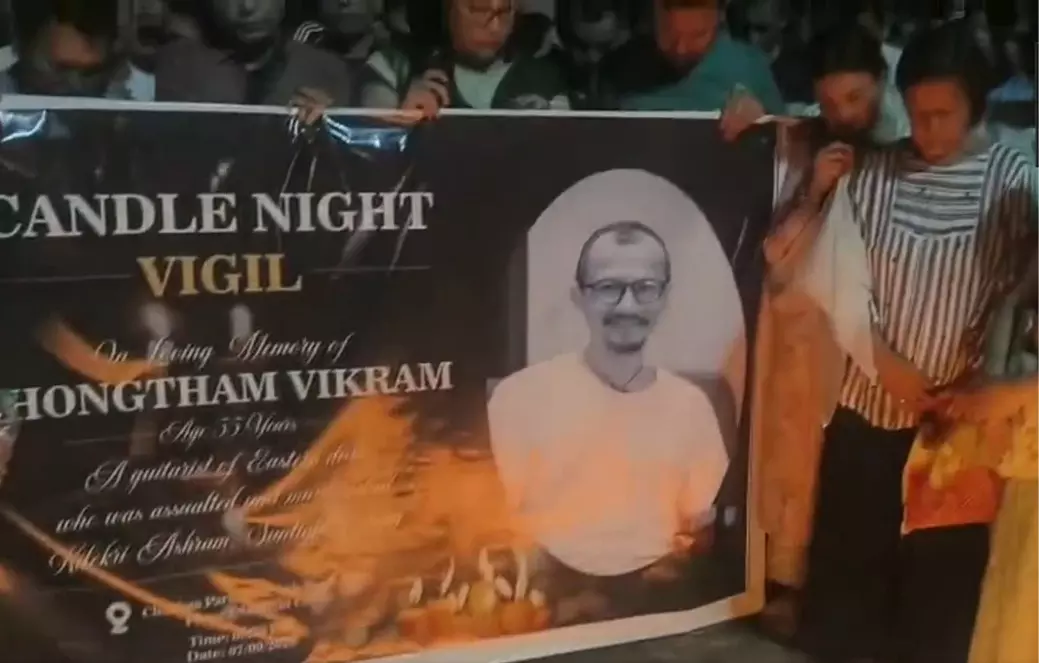
Singh’s death is not a simple story about noise pollution. The circumstances of the alleged assault, including the identities and motivations of the accused and the possibility of racial prejudice against a Northeastern resident, require their own investigation. But the reported sequence of events has acquired a disturbing resonance in Maharashtra, where Pune citizen activist Vidyanand Bapat has been campaigning against excessive noise during festivals and has himself faced alleged abuse and physical assault after objecting to loud DJs and amplified music.
Also read: Is the state shaping our private choices? From what we eat to who we love and what we read…
Indore-based civil rights advocate-activist Maithili Pandey underlines what connects the two cases while acknowledging that they are distinct. “Bapat survived an attack and has continued his campaign, while Singh’s confrontation ended in his death. What connects them is something more fundamental: in both cases, a citizen’s demand for consideration from those making excessive noise became a source of hostility rather than an ordinary exercise of civic rights,” she points out.
That question has now moved beyond individual confrontations and into the courts.
Ahead of the ongoing Ganesh Utsav celebrations in Maharashtra (the annual festival is being celebrated between September 14 and 25 this year), citizens’ groups served a legal notice to Maharashtra director general of police (DGP) Sadanand Date and Pune police commissioner Amitesh Kumar, raising concerns about excessive noise, high-powered sound systems and DJs, laser shows, the unauthorised occupation of public roads by festival mandaps and what they describe as the failure of the authorities to act against repeated violations. The DGP’s office and the Pune police commissionerate acknowledged receipt of the notice but refused to comment on the issue.
A senior police officer in Bangalore, watching the developments closely as the Karnataka capital too braced for the festive season, put the dilemma bluntly. “While it’s good that citizens’ groups are getting vigilant, they should understand that the police administration is always under fire – no matter what it does. If we go by the law, religious groups scream outrage.”
A separate contempt petition filed before the Bombay High Court on August 27 has put the issue even more squarely. Six petitioners, including the Akhil Bharatiya Grahak Panchayat, Bharatiya Mazdoor Sangh, Pune District Co-operative Housing Societies and Apartments Federation and Pune District Retail Traders Association, have alleged that Pune police have failed to effectively implement the high court’s directions on noise pollution issued on August 20, 2024, which had reiterated an earlier Supreme Court ruling that loudspeakers were not essential to any religion. The 2024 high court directions had also highlighted the violation of decibel limits during festivals.
The courts have held that the use of loudspeakers is not essential to any religion. Photo: iStock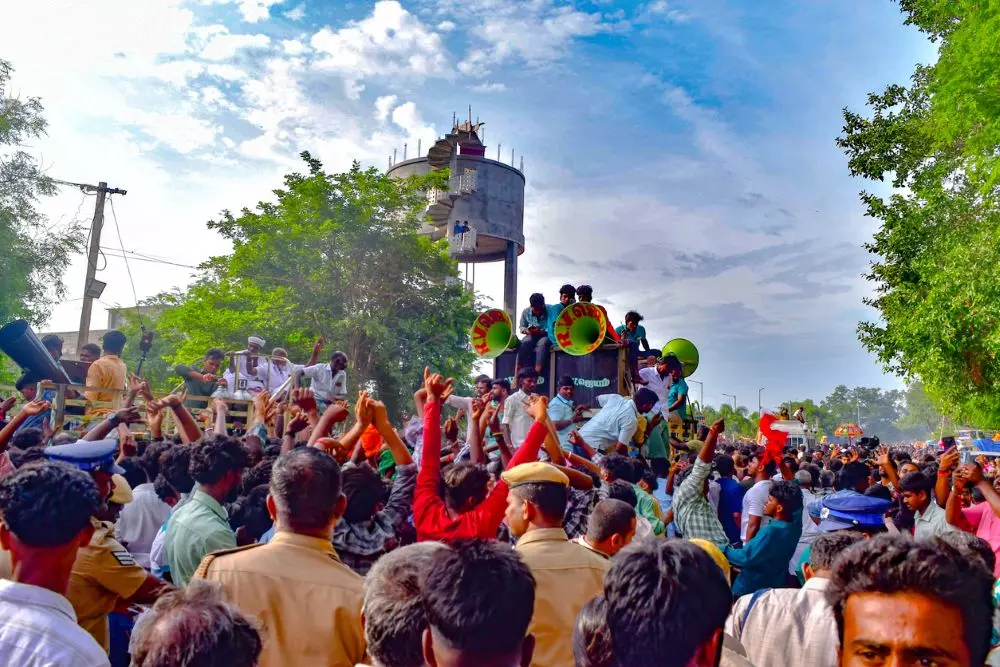
Advocate Satya Mule, who represents the petitioners, is careful to draw a distinction between opposing festivals and demanding that the law be enforced during them.
“We aren’t seeking a ban on celebrations or legitimate public activities. We are asking for the law to be enforced uniformly. Religious, political or commercial activities cannot be allowed to become an excuse for violating prescribed noise limits,” he says.
That distinction is central to the dispute because India does not lack a legal framework governing noise.
The Noise Pollution (Regulation and Control) Rules, 2000, require written permission for loudspeakers and public-address systems and prohibit use of such devices between 10 pm and 6 am, subject to specified exceptions. The rules also prescribe ambient noise standards for residential and silence zones. The Supreme Court and various high courts have repeatedly dealt with the issue, including the limits on the duration and intensity of amplified sound.
The problem, therefore, is not that citizens want a new law. The contempt petition filed before the Bombay high court raises a larger question of accountability. “Citizens are approaching the police and using the available helplines to complain about excessive noise, but in many cases, they do not see effective action on the ground,” Mule says. “A complaint mechanism has little meaning if violations continue despite repeated complaints.”
The soundscape of Pune, Mumbai or any other city in Maharashtra, Gujarat, Karnataka or Telangana during festivals is familiar. DJs, loudspeakers, drums, horns, musical instruments and amplified music can continue late into the night.
But the petitioners have deliberately broadened the issue, pointing to “political meetings and processions as well as bars, pubs, restaurants and entertainment centres”. Their argument is simple. Noise pollution cannot be treated as a seasonal problem that appears with a festival and disappears once the pandals come down.
Bapat makes the same point, insisting his objection applies equally to religious events of every community, political rallies, electoral propaganda, weddings, processions and commercial establishments.
His position is that noise itself should be treated as an offence, irrespective of who produces it and that one community’s violation cannot be used to justify another’s. The activist has reached a more radical conclusion than simple decibel regulation.
Bapat believes “decibel regulation in open public spaces is practically unworkable when powerful amplification systems are involved, because a DJ or loudspeaker system capable of producing very high volumes will inevitably affect people who have not chosen to participate”. He therefore wants amplified music moved into enclosed, soundproof venues where those who want to hear it can do so without imposing the sound on an unwilling neighbourhood. His argument is “less about the legal maximum than about the social meaning of the maximum”.
“The fact that a particular sound level is within a permissible limit,” he argues, “does not mean that organisers should deliberately operate at that threshold simply because they can.”
His strongest argument concerns choice.
“A person attending a festival has voluntarily chosen to participate in it, whereas a resident living alongside the celebration has made no such choice,” he explains. “Once amplified sound enters the home, the resident cannot simply opt out. A child cannot choose to stop hearing it, nor can a patient, an elderly person, a student preparing for an examination or somebody who has to wake up for work the next morning.”
In some old Pune neighbourhoods, Bapat claims residents have at times been forced to leave their homes during Ganeshotsav because the noise becomes intolerable. “When that happens, the burden of accommodation is effectively transferred from the person creating the disturbance to the person suffering it,” he laments.
For Mumbai-based environmentalist Sumaira Abdulali, whose Awaaz Foundation has campaigned against noise pollution for more than two decades, this battle has gone on for far too long without consistent enforcement. Abdulali began documenting noise during the Ganpati festival in 2003. Her data was relied upon by the Bombay High Court in proceedings that resulted in directions concerning loudspeakers in silence zones. Since then, both the Bombay High Court and the Supreme Court have repeatedly issued directions concerning permissible noise levels, timings and enforcement.
Yet Abdulali admits, “The decisive factor has often been political will rather than the absence of legal provisions”, and points out, “noise levels tend to rise or fall according to how seriously the government and police choose to enforce the rules in a particular year”.
There have been examples of progress. Mumbai’s Ganpati mandals agreed in 2019 to stop using DJs following discussions involving mandal leaders, including Naresh Dahibawkar. But Abdulali underlines the larger point: “Mere banning DJs does not automatically solve the problem when traditional instruments are themselves amplified through loudspeakers. The relevant question, therefore, is not whether the sound comes from a DJ, a dhol or another instrument. It is how loud the sound becomes and how far it is imposed on people who have not consented to it.”
In Maharashtra, the response of Ganpati mandals to the growing protests over festival noise is far from uniform. Uday Mahale, president of Shri Gurudatta Mitra Mandal in Shivajinagar, accepts the need for regulation but argues that sound is part of the scale and character of the celebrations. His mandal has used DJs during visarjan for decades, and while he backs the four-bass, four-top limit, he says members still want “a sound system to enjoy dancing at least one day during the Ganpati visarjan”. But there are organisers who reject the idea that Ganpati celebrations necessarily have to mean deafening amplification. Sunil Kunjir, president of Garud Ganpati Mandal, points out that his mandal has managed without loudspeakers for more than 26 years. His mandal and neighbouring Gajanan Mandal have even shared a single dhol-tasha pathak for a decade, although each was entitled to two.
Mumbai’s Ganpati mandals agreed in 2019 to stop using DJs. Photo: iStock
Often it is politics that makes enforcement of sound limits harder, claim activists.
“There are vested political and commercial interests in celebrations of all kinds, while police sometimes fear that strict enforcement could trigger a law-and-order situation. This creates an uncomfortable imbalance in which the state may become more worried about the consequences of stopping a violation than about the consequences of allowing it to continue,” alleges Abdulali.
That imbalance becomes particularly troubling when the person who complains is expected to confront the people responsible.
Abdulali should know. She has herself been verbally attacked twice while attempting to control noise, once during a Muslim festival and later during a Hindu festival. A criminal complaint from one incident remains pending in a Mumbai court.
She calls the killing of Singh “a terrible escalation of a pattern that activists have encountered for years”. “There are several other examples of verbal and physical attacks, though this is the first reported death.”
The World Health Organization recognises “excessive environmental noise as a significant health risk, linking exposure to sleep disturbance and a range of cardiovascular, metabolic, cognitive and hearing-related effects”. ENT surgeon Dr Naresh Dholakia of Ahmedabad says prolonged exposure to high-decibel noise, particularly above 85 decibels, can cause irreversible damage to the delicate hair cells in the inner ear. These microscopic cells transmit sound signals to the brain and, once damaged, “do not regenerate”. Repeated exposure can therefore lead to permanent noise-induced hearing loss. Loud noise can also cause tinnitus, with people experiencing persistent “ringing, buzzing or roaring” in the ears even after leaving the noisy environment.
The danger rises sharply at extreme sound levels. “Above 120 decibels, noise can cause immediate pain and severe discomfort,” Dr Dholakia says. Exposure to around 150 decibels or more can be powerful enough to rupture the eardrum. He adds that the effects are not restricted to the ears, as very loud sound can trigger “widespread stress responses” across the body.
Psychiatrist Dr Rajendra Barve, who has observed a sharp rise in noise-related maladies during the festival season, says prolonged exposure to high-decibel noise can keep the brain and body in a state of chronic physiological stress. “The brain does not simply switch off when you stop consciously listening to the noise,” he says. Intrusive sound can keep the body’s stress-response system activated, leading to the release of hormones such as cortisol and adrenaline and leaving the nervous system in a persistent “fight-or-flight” state. Over time, he explains, this can affect sleep, mood and emotional regulation, particularly among very young children and the elderly.
Which is why Abdulali believes “noise pollution should now be treated primarily as a public-health issue rather than merely as an environmental inconvenience.” The responsibility for protecting citizens from harmful exposure, she argues, ultimately rests with the government.
The cultural response to Bapat’s campaign shows how contested that responsibility has become. A small but increasingly visible section of Maharashtra’s entertainment world has rallied behind him. Actor Sonali Kulkarni has been among Bapat’s strongest supporters. In an open message on social media, she praised his civic awareness, clarity and firmness, congratulating him for “rewriting the definition of an alert citizen". Singer, composer and filmmaker Avadhoot Gupte has written and performed a song in Bapat’s support. His social-media post carried hashtags including “#SupportBapat” and “#HatsOffBapat.” Actor Aarti Solanki has also defended Bapat while distinguishing his opposition to DJs and excessive noise from opposition to Ganeshotsav and comedian Punit Pania has approached the issue through satire. The response, however, has not been uniformly sympathetic. Some like musician Sagar Patil, associated with the Dubai-based Trivikram Dhol-Tasha Pathak, released a rap mocking Bapat.
For Pandey, the cultural backlash is revealing. “It shows that the dispute has moved beyond the technical question of decibels. It has become a contest between competing ideas of public behaviour, celebration and individual freedom.”
Bapat’s own experience shows how quickly that contest can become personal and an argument that began with excessive sound can be reframed as a question of religious loyalty. And Singh’s death following the alleged assault on him has given the debate on noise a grim new dimension. Filmmaker Shirish Kunder captured the disturbing irony in a post following Singh’s death: “When a man asks for a little peace and quiet, the mob ensures he gets it permanently.”
His post highlights what happens when the right to make noise becomes so deeply associated with freedom that the person asking for restraint is seen as the one violating somebody else’s freedom. “The two freedoms are not symmetrical. The person operating a sound system has the ability to switch it off. The person exposed to it does not necessarily have the ability to escape,” says Pandey. “A resident may shut their windows, but there are limits to what walls and doors can do against powerful amplification. A family may leave its home, but then the cost of somebody else’s celebration has been transferred to them.”
The law exists precisely because individual freedom has limits when its exercise harms others, says Mule. “This principle is hardly unique to noise. A restaurant cannot discharge untreated waste into a neighbour’s home because it is exercising its commercial freedom. A vehicle cannot block an ambulance because the driver has a right to use the road. A factory cannot release pollutants simply because its owners have a right to conduct business. The same logic applies to sound.” The difficulty, he explains, is that noise is deeply tied to identity. “It can be religious, political, cultural or commercial, and therefore becomes harder to regulate without accusations of discrimination. But that is precisely why the standard has to be neutral.”
Also read: Why CM Suvendu seems not to have factored in the Bengali disconnect with 'Sahitya Samrat' Bankim
A decibel has no religion. A sound wave does not know which political party produced it. Pandey believes the issue is ultimately about the kind of society urban India wants to become. “Public space is necessarily shared space, and sharing it requires restraint from those who have the greatest ability to impose themselves on others.”
The real test of a society’s civic maturity is therefore not how loudly it can celebrate, but whether it can hear the person asking for consideration, says Mule. “For far too long, that person has been told to adjust, leave, shut the windows, tolerate it for a few hours or accept that this is simply how festivals are celebrated.”
The question now is whether the law, the courts and the wider culture are prepared to say something different. That a citizen should not have to choose between enduring the noise and risking violence for asking that it stop.