- Home
- India
- World
- Premium
- THE FEDERAL SPECIAL
- States
- Perspective
- Videos
- Sports
- Education
- Entertainment
- Elections
- Features
- Health
- Business
- Series
- In memoriam: Sheikh Mujibur Rahman
- Bishnoi's Men
- NEET TANGLE
- Economy Series
- Earth Day
- Kashmir’s Frozen Turbulence
- India@75
- The legend of Ramjanmabhoomi
- Liberalisation@30
- How to tame a dragon
- Celebrating biodiversity
- Farm Matters
- 50 days of solitude
- Bringing Migrants Home
- Budget 2020
- Jharkhand Votes
- The Federal Investigates
- The Federal Impact
- Vanishing Sand
- Gandhi @ 150
- Andhra Today
- Field report
- Operation Gulmarg
- Pandemic @1 Mn in India
- The Federal Year-End
- The Zero Year
- Science
- Brand studio
- Newsletter

How Jitu Munda — Odisha man who carried dead sister’s skeletal remains to bank — became ‘a VIP’
On April 27, Jitu Munda, a resident of Odisha’s Dianali village, carried his sister's skeletal remains to a bank to prove her death, after failing to withdraw her savings. The video of the incident went viral, leaving millions shocked. Since then, Dianali has seen a steady stream of visitors, including government officials, political leaders and journalists. But Munda is yet to comprehend why everyone has suddenly become concerned about him.

At around 11am on a day last week, a crowd of over 100 men, women and children were gathered under trees at Dianali — a nondescript village somewhere between Dhenkikote Bazaar and Patana block headquarters in Odisha’s Keonjhar district. It’s been a ritual for the villagers ever since fellow resident Jitu Munda made the tribal dominated village under Erendei Gram Panchayat national,...
At around 11am on a day last week, a crowd of over 100 men, women and children were gathered under trees at Dianali — a nondescript village somewhere between Dhenkikote Bazaar and Patana block headquarters in Odisha’s Keonjhar district. It’s been a ritual for the villagers ever since fellow resident Jitu Munda made the tribal dominated village under Erendei Gram Panchayat national, and international, news by carrying the skeletal remains of his sister to a bank, to prove her death, and access her savings.
Following Munda’s shocking act on April 27, Dianali has seen a steady stream of people it has rarely seen before — government officials, politicians, journalists. In a village where little happens, the visits have brought residents a rare diversion, drawing them out of their houses every morning to gawk at the unknown faces coming in.
“Never before, not even during elections, have so many big people and vehicles come to our village” a woman in her forties tells The Federal, awe evident in her voice. Ironically, the only person in the village who appears unfazed by all the attention is 63-year-old Munda himself.
Sitting on the verandah of a two-room house, where he had lived with his sister before her death and where he now stays alone, Munda admits, “I don’t understand why so many people are visiting me.” Part of the house had belonged to a brother, who is also now dead. "Both rooms were built with money received by my siblings under the Pradhan Mantri Awas Yojana," he says.
According to Munda, before carrying his sister’s remains to the Malliposi branch (in Keonjhar district) of Odisha Grameen Bank, he had approached the bank officials thrice, requesting them to release the Rs 19,400 his late sister Kalara had deposited at the bank. Vague on dates, he only says his sister died three months ago.
“Each time the bank officials told me the savings could only be withdrawn by my sister,” he says.
Pushed to the edge of desperation, Munda says he exhumed his sister’s body and carried it to the bank to convince the officials to give him the money.
Also read: Why ‘Kalinga Bull' Biju Patnaik came riding a donkey to an award ceremony in the ‘90s
According to Erendei Gram Panchayat sarpanch Parbati Dehury, Munda’s ordeal began after his elder sister, Kalara, passed away. While The Federal couldn’t ascertain her age or the cause of her death, Dehury says Kalara was a widow who received government ration. She might also have received monetary assistance under the government’s widow pension scheme, which would explain her bank savings.
“Since Munda himself had no ration card, he was not a beneficiary of the scheme. After his sister’s death, at times other villagers would offer him some food, but he was struggling,” says Dehury.
A member of the panchayat samiti, Jambu Naik, adds that over 50 per cent of the population of Dianali comprises members of the Scheduled Tribes (ST) communities. The other dominant group here is of the Mahantas, listed as a Socially and Educationally Backward Class (SEBC) in Odisha.
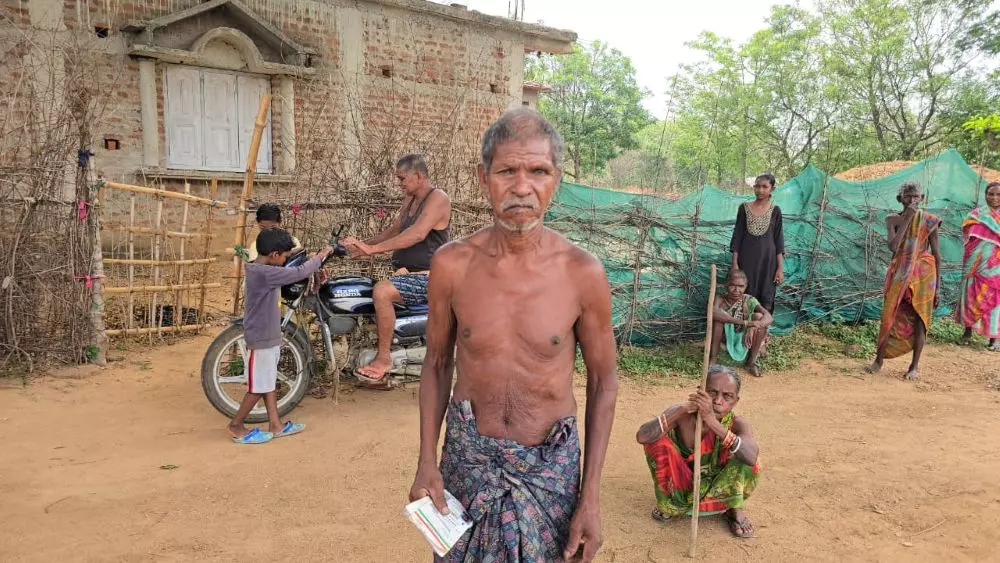
Jitu Munda holds his new Aadhaar card in hand. Photo: By special arrangement
While the village has over 1,000 voters, according to Naik, a teacher at a local government-run school, speaking on anonymity, adds, “The literacy level, particularly among the tribal community, is pathetically low. Not even 30 per cent of the STs can sign their names.”
The teacher adds: “Paddy is the only crop grown in the region. [But] In the absence of proper irrigation, [income from agriculture remains low] and every year, many migrate to cities in search of livelihood. There is a proposal for the construction of a mega steel plant in another part of the block, but the youth are sceptical about whether it will solve the local unemployment issue.”
Munda’s situation is a case study in the many social and financial issues that define life for the locals here.
“Of the roughly 700 households in Dianali, the majority is constituted by tribals. Among them, many are as poor as Jitu. At times, he works as a labourer or does odd jobs for a meal,” explains a resident speaking on condition of anonymity.
Not only is Munda not a lone sufferer, his plight is not the first to have drawn attention from the region.
In 1984, Phanas Punji, a resident of Odisha’s Kalahandi district, allegedly sold her 14-year-old sister-in-law to a much older, visually impaired man, for Rs 40 and a saree. Back then, too, the incident had drawn national attention. According to news reports of the time, then Prime Minister Rajiv Gandhi had visited the area to meet Punji and ask her what prompted her to do this. The woman had purportedly claimed the need to eat.
In 2016, there were reports of Dana Majhi, a tribal resident of Kalahandi, carrying the dead body of his wife on his shoulder for 13 kilometres, as hospital authorities had purportedly failed, or refused, to provide a hearse or ambulance.
Also read: Why a Karnataka farmer’s campaign for road access to his land has made him a local ‘Gandhian’ hero
However, Munda’s case has been of special embarrassment to the ruling Bharatiya Janata Party (BJP) government in the state, coming as it has from Chief Minister Mohan Charan Majhi’s home district. Responding to the incident, Majhi has since reportedly ordered a probe by the revenue divisional commissioner (RDC).
Days later, when The Federal visited Dianali, members of the probe team were already at the village.
According to reports, the initial probe indicates lapses on the part of the bank. RDC (northern division) Sangram Keshari Mohapatra, who is leading the probe, has been quoted as saying that preliminary findings pointed to negligence by the bank officials. He purportedly added that Jitu and his late sister had visited the bank multiple times in the past for transactions. CCTV footage also confirmed that Munda spent over 30 minutes at the branch on the day of the incident and met the manager twice. The absence of audio, however, made it difficult to determine the exact interaction between him and the bank staff. “This incident is extremely shameful,” the RDC was quoted as saying.
Jitu’s case has also drawn significant political backlash.
Former Odisha Congress president, Niranjan Patnaik, alleged after meeting Munda that the incident could have been avoided and cited the erosion of the social fabric as a reason for the man’s plight. Another state Congress leader, Jayadev Jena, who had accompanied Patnaik on his visit to Munda, claimed, while talking to The Federal, that the incident was proof of “administrative laxity”.
Meanwhile, former state Chief Minister and Biju Janata Dal (BJD) chief Naveen Patnaik too has written to Union finance minister Nirmala Sitharaman for “compassionate intervention” in the case. In a letter shared on social media, the former CM has requested that accountability be fixed on the “shocking lapse”, which he adds, “will send a clear signal to all rural banks to guarantee citizen-centric service delivery with empathy and compassion”.
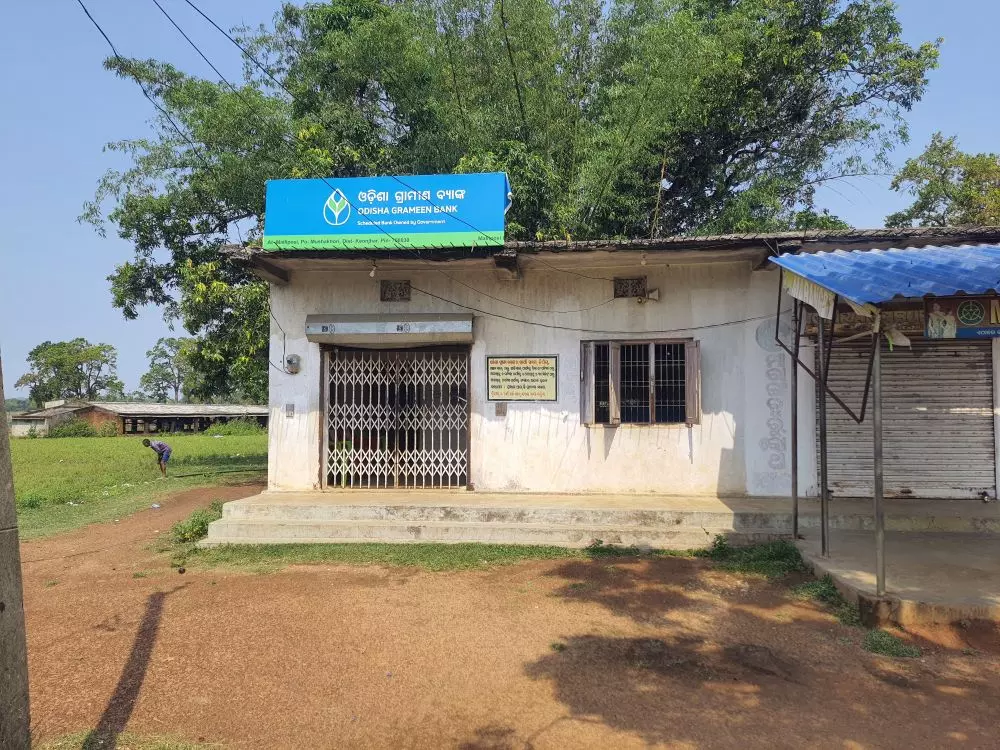
The bank in the eye of the storm. Photo: Debi Mohanty
The Odisha Grameen Bank branch, where the incident took place, reportedly claimed that Munda was “drunk” and “lacked awareness” of the settlement process.
The latter is not a claim Munda will deny.
Asked whether he was aware of the need for providing a death certificate or proving that he was a legal heir, to claim inheritance, the 63-year-old, who admits to never having been to school, responds with, “How will I know?”
In a social media statement, the Association of Odisha Grameen Bank officers have defended the bank manager who is at the eye of the storm over the incident. “Our Branch Manager has acted with strict adherence to RBI guidelines / protocols designed not as barriers, but as safeguards to ensure the rightful settlement of death claims. But the incident arose due to unwillingness of the customer to accept and follow the procedure of settlement of death claim," the statement said.
However, the association’s stand has drawn further criticism for the bank.
"What is more shocking is the bank's attempt to justify this inhuman conduct by citing adherence to RBI [Reserve Bank of India] guidelines. This shows a disturbing intent on the part of the bank officials to hide behind procedures and abandon the very people they are meant to serve,” Naveen Patnaik has written in his letter.
The incident has left the local intelligentsia with mixed feelings.
Keonjhar-based senior journalist Binay Patnaik and activist Prafulla Samantara both agree that the bank officer deserves to be reprimanded, but maintain that the administration, of which the panchayat is a part, should also shoulder the blame.
“The government can’t simply pass the buck,” says Samantara. “The incident proves that in the race for development, we have neglected the poor.”
Also read: Why, despite laws and court orders, sanitary workers continue to die in toxic fumes-filled manholes
Meanwhile, the sudden attention brought in by his action has also ensured a windfall of sorts for Munda.
In addition to providing him Rs 30,000 from the District Red Cross Fund, the administration expedited the process of issuing a death certificate for his sister. Munda was recognised as the legal heir of Kalara and the Rs 19,402 account saved by her was handed over to him with interest within 24 hours of the incident. According to panchayat members, Munda has also been enrolled in a state-run monthly financial assistance scheme and issued a new Aadhaar card (which mentions his age as 63; the old one he claims was somehow damaged) and a ration card entitling him to 35 kg of free rice every month. “Besides political leaders, many private individuals have donated money for Munda. His house will soon receive an electricity connection,” says Dehury.
Someone has also gifted him a new gamuchha (cotton towel).
It’s a lot for a man who till recently had little beyond the house where he lived. A little distance away from the two-room house of his siblings, where he continues to live, is a dilapidated kuchha house where his mother spent his life. The shabby structure reflects Munda's own gaunt build. With his both his siblings gone, and having never married, the 63-year-old has as little in terms of material wealth, as family comfort.
His sister has been put to rest; again. And Munda is left to make sense of the sudden assistance coming his way.
Fortunately, no one, either in the village or in the administration, has questioned the legality of his digging up his sister’s body — moved perhaps by his abject poverty and the desperation behind his action.
But according to reports, the tribal community of which he is a part, has prescribed a purification ritual for him because of his act of digging up his sister’s remains. Munda has reportedly agreed, as failure could mean being excommunicated.
For most people in his neighbourhood, though, Munda is now a celebrity.
A young boy, part of the crowd watching the stream of officers and others coming into Dianali the day The Federal visited the village, exclaims, “It’s all because of Jitu Munda. He is no less than a VIP.”