- Home
- India
- World
- Premium
- THE FEDERAL SPECIAL
- States
- Perspective
- Videos
- Sports
- Education
- Entertainment
- Elections
- Features
- Health
- Business
- Series
- In memoriam: Sheikh Mujibur Rahman
- Bishnoi's Men
- NEET TANGLE
- Economy Series
- Earth Day
- Kashmir’s Frozen Turbulence
- India@75
- The legend of Ramjanmabhoomi
- Liberalisation@30
- How to tame a dragon
- Celebrating biodiversity
- Farm Matters
- 50 days of solitude
- Bringing Migrants Home
- Budget 2020
- Jharkhand Votes
- The Federal Investigates
- The Federal Impact
- Vanishing Sand
- Gandhi @ 150
- Andhra Today
- Field report
- Operation Gulmarg
- Pandemic @1 Mn in India
- The Federal Year-End
- The Zero Year
- Science
- Brand studio
- Newsletter

Amidst exploding spiritual tourism, how Tamil Nadu’s Navagraha temples offer a quiet ode to pattern
The Navagraha temples — nine temples dedicated to nine planetary or celestial deities that are believed to influence human lives and destinies — stand witness to the ancient human need to locate our fragile lives within a larger, indifferent cosmos.

I have never believed in gods, but I have always believed in stories, especially the kind nations tell themselves, repeatedly, until they harden into faith, commerce, and spectacle. As a travel journalist, I have witnessed it at close quarters, seen spiritual tourism swell into a kind of religious capitalism, where belief is scaled, ticketed, and Instagrammed.There is data to support this. A...
I have never believed in gods, but I have always believed in stories, especially the kind nations tell themselves, repeatedly, until they harden into faith, commerce, and spectacle. As a travel journalist, I have witnessed it at close quarters, seen spiritual tourism swell into a kind of religious capitalism, where belief is scaled, ticketed, and Instagrammed.
There is data to support this. A 2024 report by the India Brand Equity Foundation cites Ministry of Tourism data that claims that the number of people engaged in religious tourism in India rose from 677 million in 2021 to 1,439 million in 2022. Meanwhile, revenues generated by the sector reached US$ 16.2 billion (Rs. 1.34 lakh crores) in 2022, up from US$ 7.9 billion (Rs. 65.1 thousand crores). “By 2030, more than one hundred million people will be gainfully employed through temporary and permanent jobs driven by India’s Spiritual Tourism alone, which is anticipated to be worth around US$ 59 billion by 2028,” the report added.
Think of last year’s Maha Kubh. From luxury tents to airport enhancements and drone shows.
On recent travels to Varanasi and Ayodhya, I have been made acutely aware of how spirituality now performs for tourism. In Varanasi, I encountered boat rides bundled with priests, photographers, and fixed-price artis; the sacred reduced to a checklist of experiences. In Ayodhya, faith arrived with designated paths, guided narratives, and merchandise stalls. Last week, while extending greetings to the people of Uttar Pradesh on the occasion of UP Diwas (January 24-26), Prime Minister Modi, among other things, touched upon major religious and cultural projects in the state, which have helped unlock its vast tourism potential.
And so, as I have witnessed how religious spaces are experienced beyond faith, I have found my mind repeatedly returning to the Navagraha temples of Tamil Nadu, which I had visited in 2023 — nine temples dedicated to nine planetary or celestial deities that are believed to influence human lives and destinies.
Built in the Dravidian architecture style, the temples are believed to date back to the Medieval Chola period (9th century BCE).
Against the machinery of devotion that I have witnessed in recent times, the Navagraha temples felt almost radical in their restraint: they honour astrology over theology, planets over prophets, acknowledging that most Indians, believers or not, ultimately place greater faith in their horoscopes and kundalis.
Also read: How the centuries-old tradition of Tamil Nadu’s Athangudi tiles is finding a place in modern homes
I had been in Tamil Nadu for an assignment and decided to visit the Navagraha temples to understand Chola-architecture better. It had also been an exercise in anthropological curiosity: nine temples for nine planets, each governing a slice of human destiny since birth, each a blueprint of cosmic paperwork (Kundali/horoscope) I don’t remember signing.
I arrived in Kumbakonam, in Thanjavur district, with a notebook and a camera, but with zero conviction in divine intervention. Faith has never been my dialect; facts are. Temples to me have always been relics — historical, artistic, yes, but never life-changing.
That shifted here. Somewhere between the first bell at dawn and the last lamp at dusk, the Navagraha temples did something I didn’t expect. They didn’t convert me. They made me curious. And that felt far more powerful.
The Navagrahas together form a religious circuit. Primarily Shiva temples, each is associated with one celestial ‘graha’, or planet. Only Suryanar Kovil is dedicated to the Sun as its main deity. The rest honour the planets through secondary shrines within larger Shiva temple complexes. What emerges is not just an astronomical map, but a cultural one, a network of belief layered onto sacred architecture.
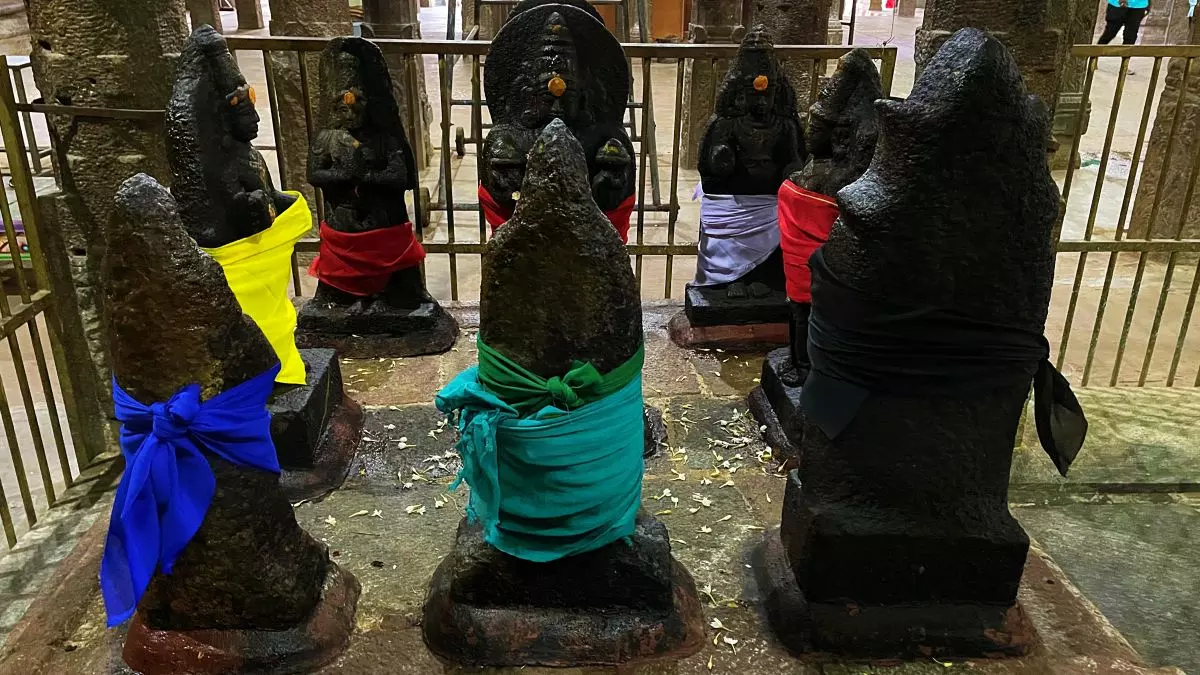
Navagraha shrine at Vaitheeswaran Koil. Here the nine planets are worshipped in raw stone forms wrapped in coloured cloth. Photo: Veidehi Gite
As architectural historian George Michell puts it, “The Hindu temple is conceived as a microcosm of the universe, with the sanctum representing the centre of creation.” According to historian Subhash Kak, the Navagraha temples represent “the outer and inner cosmos, with structural axes and orientations reflecting celestial cycles”. Architectural historian Adam Hardy similarly observes that “Chola temples demonstrate a rigorous concern for axiality and proportion, embodying both religious symbolism and advanced architectural engineering.”
Whether or not one buys the astrology of the Navagraha temples, the architecture is undeniably intentional.
Shiva, my lean and tall guide, put it more simply over a filter coffee in a brass tumbler. He had been in his early thirties at the time, fluent in both Tamil and English, unlike many of the locals I observed at the temples, but couldn’t communicate with owing to my lack of Tamil knowledge.
“You don’t have to believe in planets. But respect what these temples do for people. They give courage. That itself is divine,” Shiva had said. He added, “These aren’t just celestial temples that honour planets. They give people a framework for understanding themselves.”
His words were an echo of the observation made by Indian scholar and academic RKK Rajarajan in his scholarly article ‘Navagrahas in Indian Thought’; that by the Nayaka period (14th century-early 19th century), the “Navagraha shrines had become a formalised component of Tamil temple architecture, reflecting the assimilation of astrological belief into ritual space.”
Shiva and I began our 14-hour Navagraha tour at Suryanar Kovil, about 15 km from Kumbakonam. “This temple holds the circuit together,” he said, as he stood and paused beneath the five-tiered rajagopuram [the tallest gopuram, or entrance to the temple], as I admired its stucco deities painted in blues, greens, and earthly terracotta. The mandapa [pillared hall or pavilion] ceiling was painted in a startling green, bordered with lotus medallions and floral motifs, while the pillars — striped in pink, teal, and mustard — carrying yali [mythological creature, portrayed with the head and the body of a lion, the trunk and the tusks of an elephant, and sometimes bearing equine feature] sculptures and carved images of the gods. On the roofline, golden-yellow shrines bordered a heavily ornamented vimana [tower], textured with scales, scrollwork, and guardian beasts.
![Suryanar Kovil embodies the classic Dravidian architecture featuring a walled courtyard, a compact mandapa, and the garbagraha [inner shrine] at its core. Photo: Veidehi Gite](https://thefederal.com/h-upload/2026/01/27/592308-suryanar-kovil-new-1.webp "Suryanar Kovil embodies the classic Dravidian architecture featuring a walled courtyard, a compact mandapa, and the garbagraha [inner shrine] at its core. Photo: Veidehi Gite")
Suryanar Kovil embodies the classic Dravidian architecture featuring a walled courtyard, a compact mandapa, and the garbagraha [inner shrine] at its core. Photo: Veidehi Gite
Dating back to the 11th-century reign of Kulottunga Chola I, Suryanar Kovil embodies the classic Dravidian architecture featuring a walled courtyard, a compact mandapa, and the garbagraha [inner shrine] at its core. But what sets it apart, Shiva reminded me, is that this is the only shrine on the circuit where all nine planets are worshipped together. Surya in the centre and others around him — that arrangement isn’t decorative; it’s doctrinal.
As Telugu poet and playwright Devulapalli Krishnasastri had noted in 1916, the Navagrahas are typically installed within the enclosed verandah around the central shrine of a temple, sometimes under their own structure, sometimes not.
“They’re scrupulously worshipped,” Shiva added, “because they’re believed to influence human destiny.” In most Shiva temples, the shrines occupy the northeast corner. You will rarely find them in Viṣhṇu temples.
The signage, in Tamil and English, declared it to be the “Arulmigu Siva Suryaperuman Thirukovil”, or the “The Sacred Temple of the Venerable Lord Shiva and the Great Sun God Surya”.
There was commerce here too, blurring seamlessly into rituals, but the scale was much more modest. I can recall the coconut baskets, stone-studded idols of Ganesha, ghee-filled lamps, devotees lighting oil lamps, laid on steel trays filled with grains.
Also read: What Telangana’s Mudumal Menhirs say about India’s past astronomical prowess
From Suryanar Kovil, we had driven 30 km to Thingalur for the Kailasanathar Temple, which is the Chandra (Moon) sthalam. This is a Chola-era, Shiva temple, which was later expanded with a five-tiered gopuram. Architecturally, it’s restrained — granite walls, modest mandapas, and stucco sculptures of Shiva and Parvati. While the main Moon shrine lies within the complex, its temple tank, Chandrapushkarani, I’m told, mirrors the sky like an extra moon. Shiva added, “Moon is the mind. That’s why people come here when their thoughts won’t settle.”
As Indian archaeologist KV Soundararajan, who had served as the superintendent of the Chennai circle has noted in the book, A Comprehensive History of India, “Architecture in South Indian temples is not merely structural; it is psychological and symbolic, shaping the devotee’s experience of the divine.”
Our next stop was Vaitheeswaran Kovil associated with Angaraka (Mars). It’s about 40 km away from Thingalur. This temple dates to the 11th–century Chola period with a few Nayak-era expansions, according to online writings on the temple that I read later.
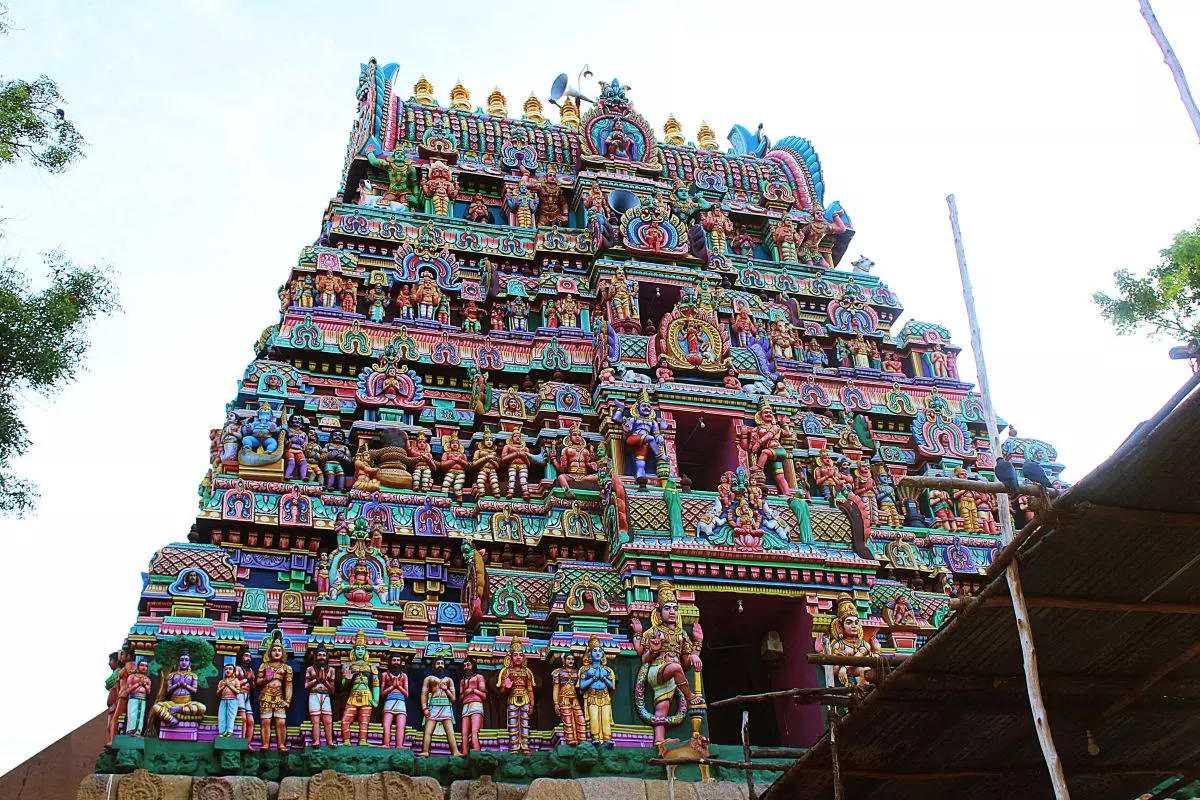
The Thirunageswaram Raagu temple, dedicated to 'Rahu', is one of the most powerful Navagraha sites. The gopuram rose like a riot of myth, layered with hundreds of painted gods, demons, and celestial guardians. Photo: Veidehi Gite
Dedicated to Shiva as ‘Vaidyanathar, the Divine Healer’, it was one of the most architecturally developed complexes in the circuit. Different prakaras (outer walls), long pillared corridors, sprawling mandapas, healing spaces, offerings of turmeric and medicinal herbs and a large temple tank define the layout.
At Thiruvenkadu (Swetharanyeswarar Temple), the Buddha (Mercury) sthalam, about 27 km from Vaitheeswaran, the sculptural density became extraordinary. This was a textbook example of late-Chola Dravidian artistry: layered mandapas, detailed iconographic panels, and three temple tanks — Surya, Chandra, and Agni Theertham — arranged within the complex. Buddha’s shrine is again secondary, but the architecture is what holds attention. Carvings of Nataraja, ganas, sages, and mythic creatures line the granite corridors. It’s not “martial symbolism” — it’s the ornamental richness characteristic of mature Chola temple aesthetics. “Buddha is intellect,” Shiva said. “And look around — this place celebrates thinking.”
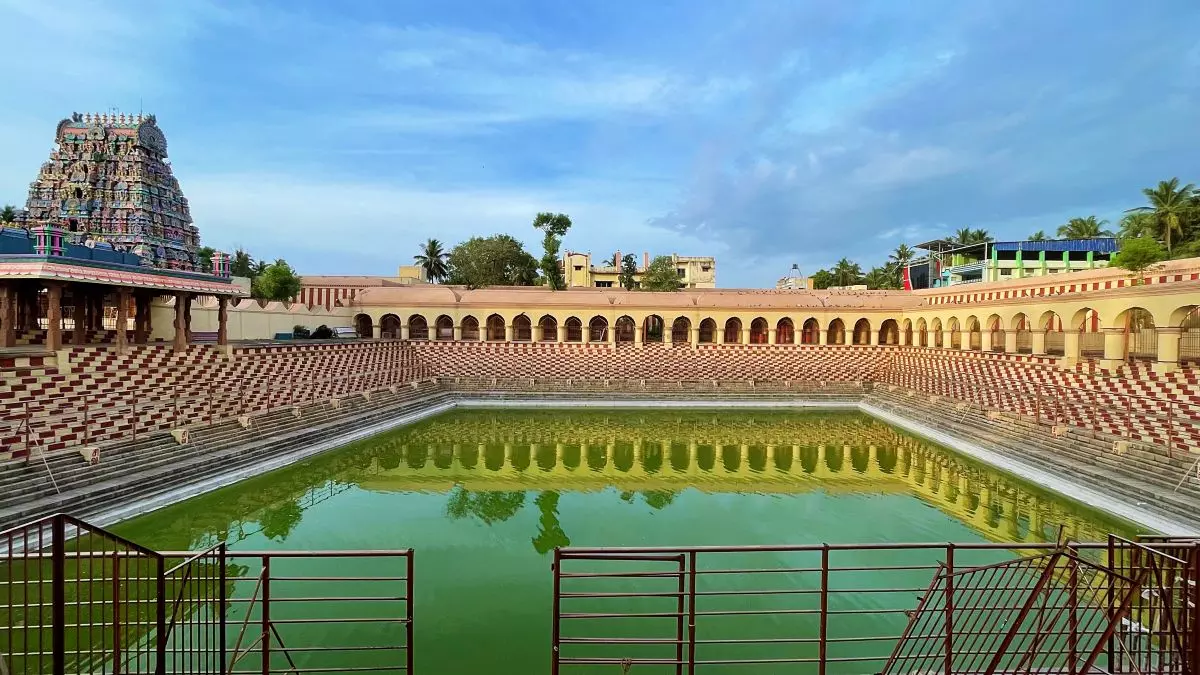
This is the Siddhamirtham Theertham, the main sacred tank of Vaitheeswaran Koil. Photo: Veidehi Gite
From there, we had driven 18 km south to Alangudi, the Guru (Jupiter) sthalam. The Apatsahayesvarar Temple is believed to date to the Chola period, with later additions by Vijayanagar and Nayak rulers. I could notice the layered history in the temple’s rising gopuram and its colourful stucco figures. The core sanctum remains distinctly Chola — austere, geometric, granite-built — while later additions feel lighter and more ornate. “Guru is wisdom,” Shiva reminded me. “People come here when they want guidance.”
We had then arrived at Kanjanur, 12 km from Apatsahayeswarar. This temple is associated with Shukra (Venus). The Agniswarar Temple here is again Shiva-centric, said to date back to the Chola period with a few Vijayanagar renovations. The temple’s scale is modest. Oil lamps flickered against granite pillars; shadows moved across carved stone like a breathing surface. “Venus is about balance,” Shiva said.
A longer drive — roughly 55 kilometres — brought us to Thirunallar, the Shani (Saturn) sthalam. The Dharbaranyeswarar Temple here is one of the largest and most visited in the Navagraha set. Its architecture spans centuries, said Shiva: Chola foundations, Nayak-era mandapas and later renovations. The vast temple tank, ‘Nala Theertham', is central to ritual cleansing. Unlike the serenity of earlier shrines, Thirunallar felt dense, disciplined, almost heavy. “People fear Saturn,” Shiva sighed. “So the temple feels strict.”
From Agniswarar, we had also driven seven kilometres to Thirunageswaram, home to the Rahu shrine, within the Naganathaswamy Temple complex. Enroute, Shiva described ‘Thirunageswaram’ as one of the most powerful Navagraha sites, one that emerged like a sculpted mountain. The gopuram rose like a riot of myth, layered with hundreds of painted gods, demons, and celestial guardians. Even the entrance mandapam played its part: fierce yali guardians flanked the doorway, ushering visitors straight into the temple’s sacred theatre. “It’s where spectacle gives way to stillness,” Shiva said, leading me through long granite-pillared corridors.
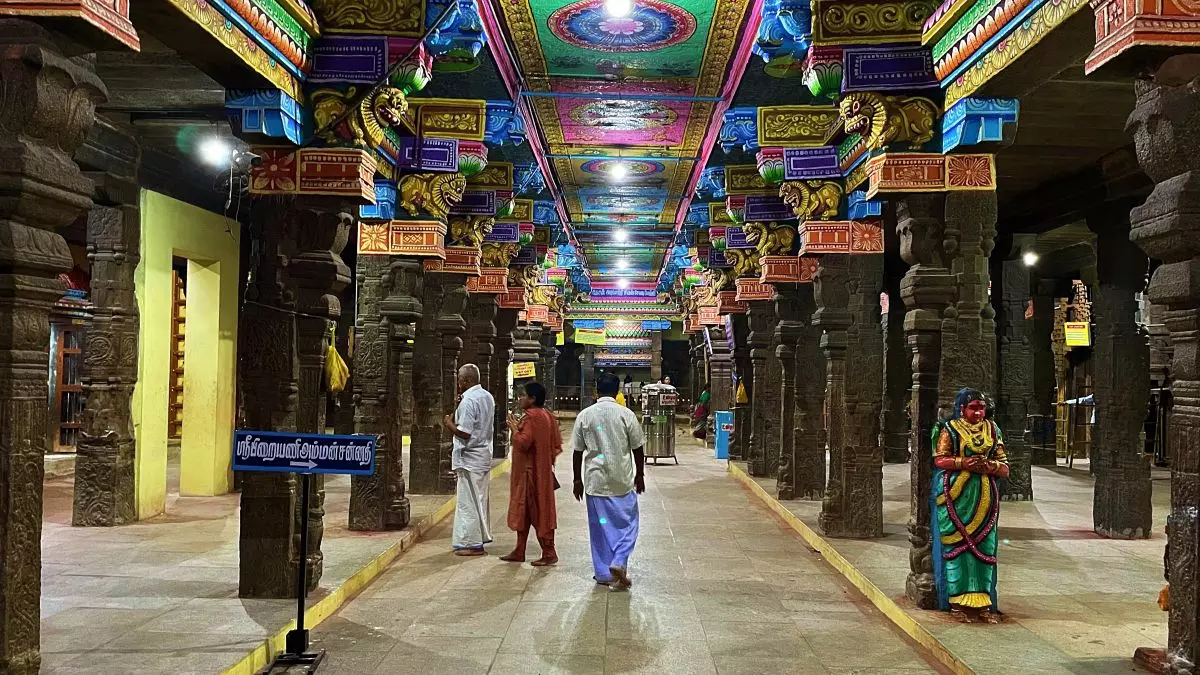
The ceilings were a cascade of concentric lotus medallions, cosmic eyes and battle scenes. The shrine itself is famous for its abhishekam ritual, where milk poured over the Rahu idol turns blue. Photo: Veidehi Gite
The ceilings were a cascade of concentric lotus medallions, cosmic eyes and battle scenes. The shrine itself is famous for its abhishekam ritual, where milk poured over the Rahu idol turns blue. Photo: Veidehi Gite “People come expecting miracles,” Shiva said, “but the science — oxidation and mineral reaction explains it just as well.”
According to my latter readings, this Chola-era temple was expanded under Kulothunga I. Its architecture reflects that lineage with serpent carvings and sculpted panels.
Sixty kilometres later, we arrived at the Ketusthalam of Keezhaperumpallam, the smallest of the nine temples. This was our last stop. Dedicated to Shiva as Naganathar, the temple retains its original Chola-era sanctuary while the outer structures were expanded later. The simplicity is the point. Ketu represents release, detachment — and here, the architecture mirrored that: a compact sanctum, minimal ornamentation, and a quiet courtyard that feels like an ending rather than a climax.
Also read: How a groundnut festival to appease a bull became a part of Bengaluru's cultural calendar
On my last evening, Shiva said, almost to himself, “You don’t need God to understand devotion. Just watch people long enough.”
I did. I remember standing before Shani’s shrine, watching devotees queue with oil, black cloth and an almost contractual hope that Saturn might finally ease up on their lives.
Through my journey across the Navagraha circuit, I had seen barefoot men in crumpled white veshtis and faded cotton shirts walking through the temple bazaar with unhurried gait, their lives paced by prayers rather than clocks. I recalled two young priests sitting bare-backed on cold stone floors, their tired bodies revealing the unseen manual work behind sacred ceremonies. Women in silk sarees had lit rows of clay lamps with soot-stained fingers, the performance of devotion more than a symbolic gesture. Elderly men in white dhotis and middle-aged pilgrims in muted cotton move slowly through the painted pillars, not in words, but in posture.
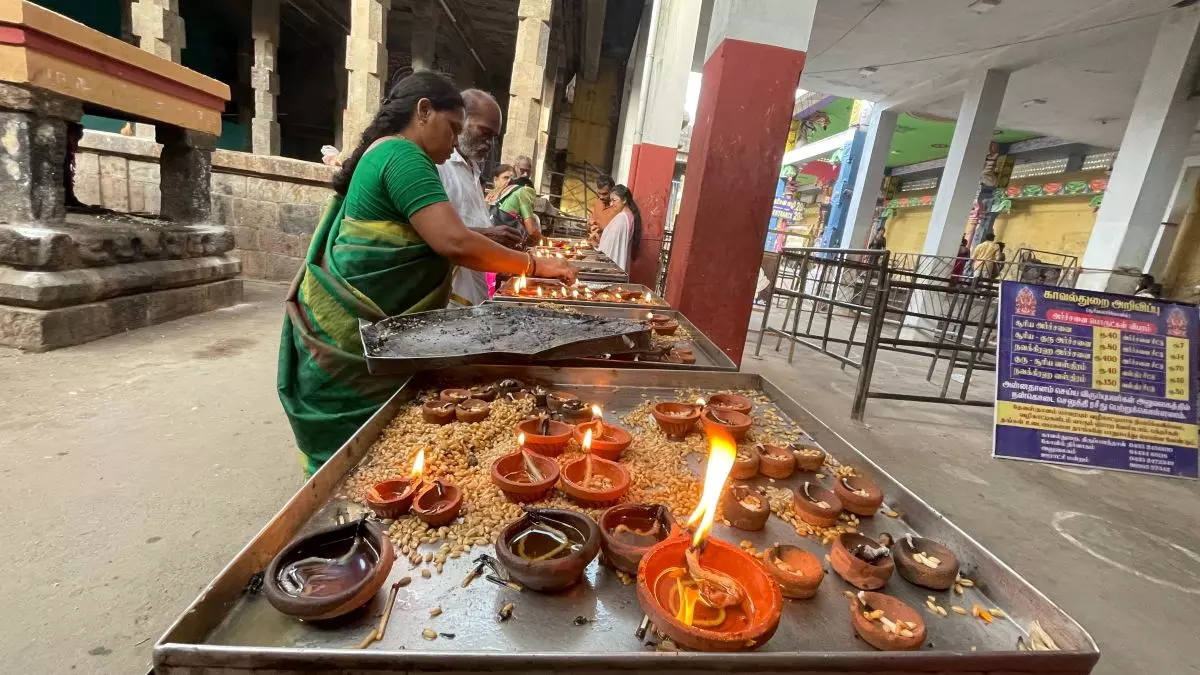
Women in silk sarees lit rows of clay lamps with soot-stained fingers, the performance of devotion more than a symbolic gesture. Photo: Veidehi Gite
I left Kumbakonam still an atheist. But I also left with respect. In a country where belief is increasingly politicised and packaged, the Navagraha had offered me something unexpectedly secular: a reminder that our oldest impulse is not worship, but pattern-seeking — the need to locate our fragile human lives within a larger, indifferent cosmos and still insist, stubbornly, that it somehow revolves around us.
Today, at other pilgrimage spots, wherever I see the spectacle of devotion, I think back to this quiet conviction of the Navagraha temples.