- Home
- India
- World
- Premium
- THE FEDERAL SPECIAL
- States
- Perspective
- Videos
- Sports
- Education
- Entertainment
- Elections
- Features
- Health
- Business
- Series
- In memoriam: Sheikh Mujibur Rahman
- Bishnoi's Men
- NEET TANGLE
- Economy Series
- Earth Day
- Kashmir’s Frozen Turbulence
- India@75
- The legend of Ramjanmabhoomi
- Liberalisation@30
- How to tame a dragon
- Celebrating biodiversity
- Farm Matters
- 50 days of solitude
- Bringing Migrants Home
- Budget 2020
- Jharkhand Votes
- The Federal Investigates
- The Federal Impact
- Vanishing Sand
- Gandhi @ 150
- Andhra Today
- Field report
- Operation Gulmarg
- Pandemic @1 Mn in India
- The Federal Year-End
- The Zero Year
- Science
- Brand studio
- Newsletter

The chimera called ‘Mahakal Time’ and why it is merely empty rhetoric
At a conference in Ujjain earlier this month, Union education minister Dharmendra Pradhan asked why the centre of global timekeeping should not be shifted from Greenwich to Ujjain. In the first of a two-part series, we look at how, not only does the minister's argument — based on Ujjain's apparently unique location — fall flat at the level of basic geography, but Greenwich Mean Time has not been the global standard since 1972.

At a conference on India's knowledge traditions held in Ujjain earlier this month, a bold idea was placed on the table: why should the world continue to follow Greenwich Mean Time (GMT)? Why not shift the centre of global timekeeping to India, specifically, to Ujjain? Union education minister Dharmendra Pradhan argued that Ujjain lies at the unique point where the Earth's Equator and the...
At a conference on India's knowledge traditions held in Ujjain earlier this month, a bold idea was placed on the table: why should the world continue to follow Greenwich Mean Time (GMT)? Why not shift the centre of global timekeeping to India, specifically, to Ujjain? Union education minister Dharmendra Pradhan argued that Ujjain lies at the unique point where the Earth's Equator and the Tropic of Cancer intersect; therefore, the world should adopt 'Mahakal Standard Time' (MST).
The suggestion is symbolic and does evoke national pride. Ujjain, after all, holds an important place in India's intellectual and cultural history. However, there are two issues: the Minister's claim about Ujjain's unique geographical position is erroneous and the world no longer follows GMT; Coordinated Universal Time (UTC) replaced it in 1972.
Pradhan’s argument in favour of adopting ‘Mahakal Time’ rested partly on geography. Ujjain, it was said, lies at the intersection of the Equator and the Tropic of Cancer.
But that is incorrect.
The Earth rotates around an axis defined by the North and South Poles. The equator is the imaginary line midway between them. The Tropic of Cancer lies about 23.5 degrees north of the equator. And these two lines are in fact parallel circles. They do not meet; they cannot meet. Like railway tracks, they run alongside each other without ever intersecting.
The claim fails at the level of basic geography.
Also read: How the failure of a satellite’s atomic clock has put India’s national security at risk
But then, what was the significance of Ujjain?
Longitudes are imaginary lines on the Earth's surface joining the North Pole to the South Pole and passing through a given place. They are also called meridian lines. Lines of latitude, or parallels, divide the Earth horizontally.
Unlike longitudes, there is a unique latitude, the Equator (called bhūmadhyarekhā in Indian astronomy), which is universal, dividing the Earth into northern and southern hemispheres.
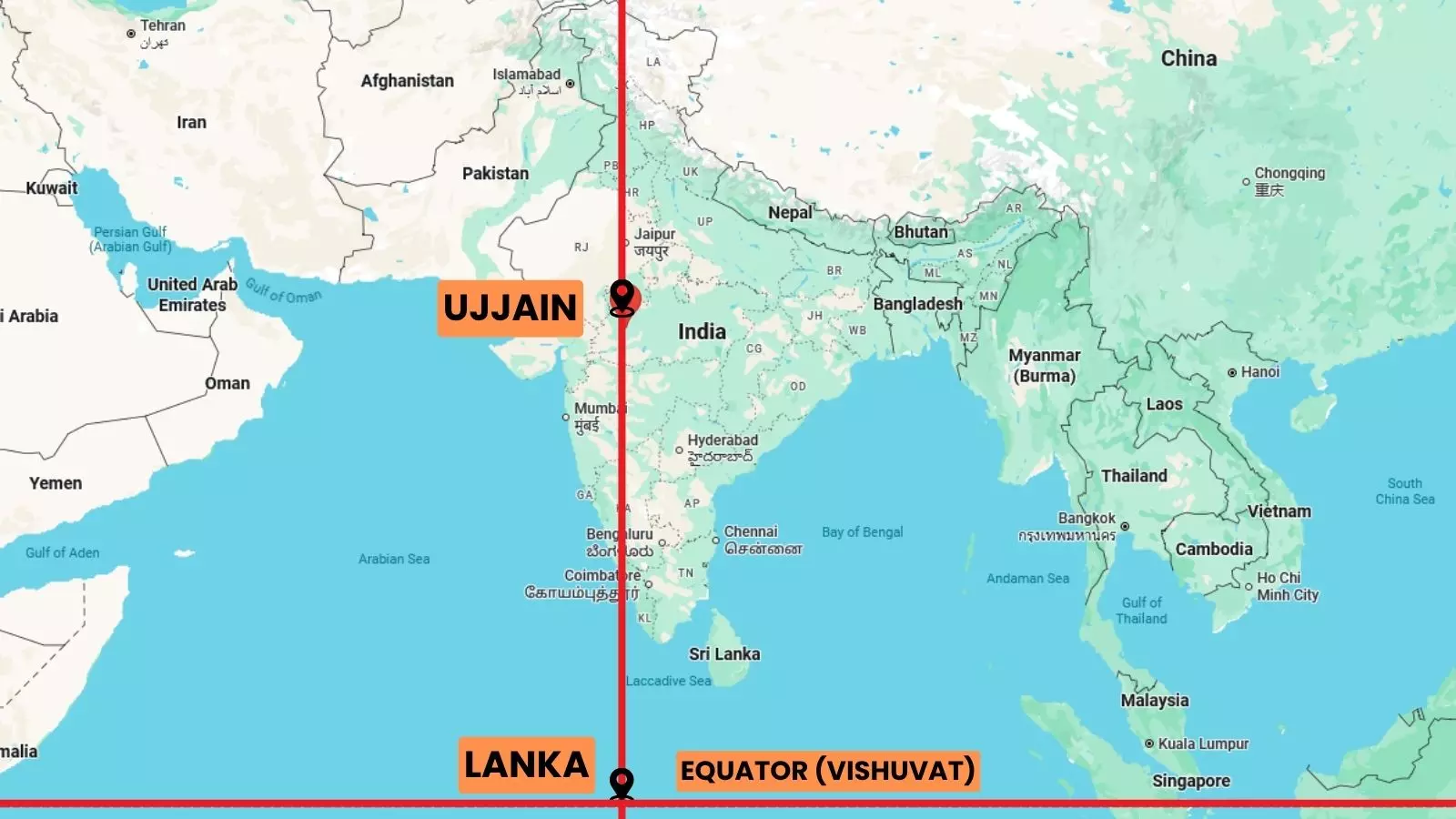
Most Indian astronomical texts used the madhyarekhā, the longitude passing through Ujjain, as the reference meridian and computed celestial positions as they would appear at this imaginary point where it intersected the Equator, known as Laṅkā.
Ancient Indian astronomers identified the longitude passing through Ujjain as the madhyarekhā. The point where it intersected the Equator was named Laṅkā (not related to Sri Lanka).
Most Indian astronomical texts used this madhyarekhā as the reference meridian and computed celestial positions as they would appear at this imaginary point, Laṅkā.
In high school mathematics, we learn to shift the frame of reference by moving the origin of the coordinate axes. This allows us to express positions in a new system. Similarly, Indian astronomers used a method called deśāntara to compute local time and celestial positions relative to Laṅkā for their specific locations.
While most siddhāntas (established tenets, principles or conclusions) use Ujjain as the prime meridian, the Romaka Siddhānta (literally meaning the Doctrine of the Romans) places the beginning of the day at sunset in Yavanapura, identified with present-day Alexandria in Egypt.
Perhaps the minister intended to refer to this idea, but messed it up.
One may set aside this error as a misunderstanding. The larger questions, however, remain: Is Mahakal Standard Time feasible? Is it necessary? Would it meaningfully project Indian culture globally?
Also read: Why ISRO’s handling of post-failure transparency after PSLV-C62 mission loss will be closely watched
Interestingly, influenced by Indian astronomy, some Arabic astronomers used the meridian passing through Ujjain and an imaginary equatorial point called Arin as a reference.
In Greco-Roman astronomy, Eratosthenes and Hipparchus developed coordinate systems, later formalised by Ptolemy. The meridian through the 'Fortunate Isles' (Canary Islands, thought to be the westernmost point of the land mass) became the prime meridian. Medieval Europe used various meridians, including those of Toledo, Paris, and Rome.
In China, the imperial capital served as the reference longitude. In early times, it was Chang'a; later, when the unified Chinese empire emerged, it was Beijing. Astronomical tables were computed for the capital's local time. Chinese astronomers used a method similar to deśāntara (longitudinal correction), known as Li Cha, to derive local values.
Thus, there is nothing uniquely special, astronomically or geographically, about the Ujjain meridian. Nor is the Laṅkā reference point something universal. Every civilisation developed its own reference system and computational methods.
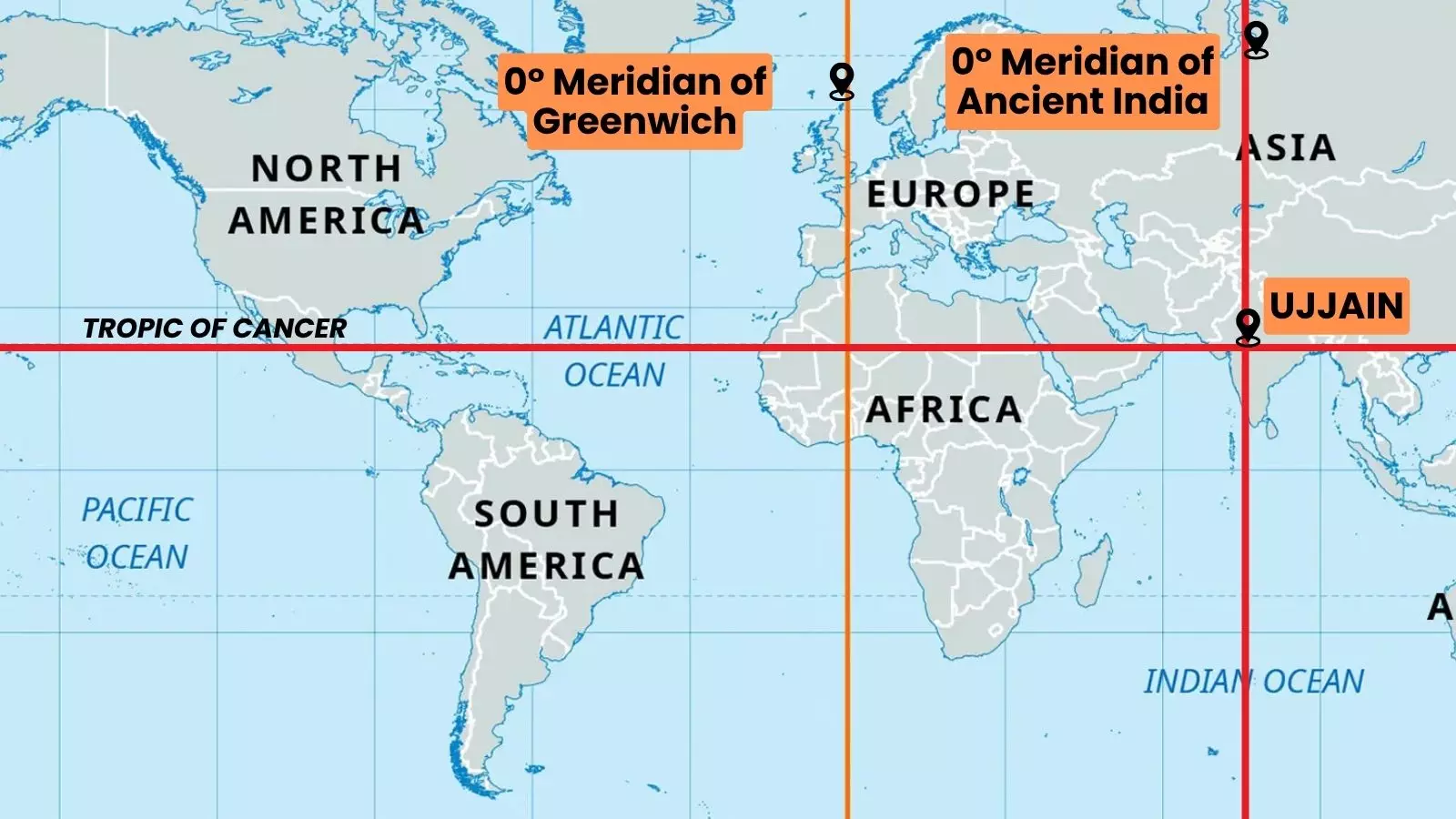
There is no shred of evidence that Ujjain time was ever adopted as a unified standard in historical time. Not even a single inscription or copperplate record uses Ujjian time.
The fact that '12:00 noon' means the same thing across India, from Kashmir to Kanyakumari, and from Kutch to Kohima, is the result of railways, telegraphy, and scientific meteorology. It has nothing to do with Ujjain.
Ujjain certainly has a place in India's astronomical tradition, and classical texts like the Surya Siddhanta used it as a reference point. The Jantar Mantar observatories built by Sawai Jai Singh in the eighteenth century are impressive in their time. Still, they eventually fell into disuse and lacked the precision of modern observatories.
Historical records clearly show that people across India followed local time. (Read part two of the series tomorrow, April 25, for more on the evolution of the Indian Standard Time.) There is no shred of evidence that Ujjain time was ever adopted as a unified standard in historical time. Not even a single inscription or copperplate record uses Ujjian time.
Standard time arose from modern needs. Burgeoning railways, telegraph networks, scientific data collection, and global capitalism needed standard time. When global timekeeping systems evolved in the nineteenth century, Ujjain lacked the necessary instruments and data continuity to be even a serious contender.
Consider the twelfth century Siddhānta Śiromaṇi of mathematician-astronomer Bhāskarācārya. He states that the madhyamarekhā passes through Laṅkā, Ujjayinī (Ujjain), Kurukṣetra, and extends to the North Pole. However, the longitudes of Ujjayinī and Kurukṣetra differ significantly. Śrīpati, another medieval mathematician and astronomer, describes the madhyamarekhā as passing through Laṅkā, Kumārī-nagarī (Kanyakumari), Kāñcī, Ṣaṇmukha Sītā-parvata (meaning in modern terms not known), Śrī Vatsagulma, Māhiṣmatī, Ujjayinī, Pāṭṭaśiva (Pattaseema), Śrī Gargarāta (meaning in modern terms not known), Sthāṇvīśvara, Śītāgiri, and then the North Pole. A simple look at a world map shows that this alignment does not correspond to actual geography.
Time zones are not abstract lines on the maps. They shape everyday life.
Consider a student in Kibithu, Arunachal Pradesh. A 9:00 am school start under IST corresponds roughly to 8:00 a.m. solar time. If India shifted to a Ujjain-based time zone, that student might have to start the day closer to 7:30 a.m. local time. Imagine the hardship they will face.
The clock would say one thing. The Sun, another.
This mismatch would create real hardships. Already, there are demands from eastern India and the Andaman and Nicobar Islands for multiple time zones. A shift to Ujjain time would only intensify such demands.
Are we prepared for that?
Also read: What Telangana’s Mudumal Menhirs say about India’s past astronomical prowess
Interestingly, many may be surprised to learn that GMT has not been the global standard since 1972. Today, the world follows Coordinated Universal Time (UTC). Yet, as with photocopying, which is still called "Xerox", GMT continues in popular usage.
Sadly, none of the conference organisers bothered to inform the minister of this. GMT, sorry, it's already replaced.
UTC is not based on the Sun's transit above the Greenwich meridian. Instead, it relies on a global network of more than 450 atomic clocks. Using caesium and rubidium atomic vibration standards, it defines the second with remarkable precision.
India is part of this system. Atomic clocks at the CSIR–National Physical Laboratory in New Delhi contribute to the global timekeeping network. UTC is thus an international collective system, not one controlled by a Western power imposed on the rest of the world.
More precise systems have also emerged. Continuous atomic timekeeping produces International Atomic Time (TAI), used in scientific research and high-precision networks.
Because the Earth's rotation is irregular, affected by earthquakes and other factors, astronomers use UT1 (Universal Time 1), which accounts for these variations.
In practice, UTC (often still called GMT) underpins global civil time, aviation, broadcasting, and the internet, even though it is no longer tied to Greenwich in any physical sense.
Today, even Indian Standard Time is maintained by atomic clocks at the National Physical Laboratory, not by a physical meridian line at 82.5 0 E. GMT, and the IST meridian has become largely symbolic.
There is nothing wrong with taking pride in India's intellectual past. Ujjain remains a site of deep cultural significance, a civilisational memory.
But the world's clocks are unlikely to reset themselves around it.