- Home
- India
- World
- Premium
- THE FEDERAL SPECIAL
- States
- Perspective
- Videos
- Sports
- Education
- Entertainment
- Elections
- Features
- Health
- Business
- Series
- In memoriam: Sheikh Mujibur Rahman
- Bishnoi's Men
- NEET TANGLE
- Economy Series
- Earth Day
- Kashmir’s Frozen Turbulence
- India@75
- The legend of Ramjanmabhoomi
- Liberalisation@30
- How to tame a dragon
- Celebrating biodiversity
- Farm Matters
- 50 days of solitude
- Bringing Migrants Home
- Budget 2020
- Jharkhand Votes
- The Federal Investigates
- The Federal Impact
- Vanishing Sand
- Gandhi @ 150
- Andhra Today
- Field report
- Operation Gulmarg
- Pandemic @1 Mn in India
- The Federal Year-End
- The Zero Year
- Science
- Brand studio
- Newsletter

Teachers’ Day special: Why discourse on coaching institutes seems to ignore plight of faculty
While much has been written about the regimented schedules and hyper-competitive atmosphere of India's coaching institutes preparing students for engineering and medical entrance exams or government job recruitment tests and the toll taken on students, the one aspect of this academic ecosystem that gets neglected is the pressure on teachers whose own merit is measured by the success of their students.

For the past several years, Aashi Choudhary, a 17-year-old student in Delhi, currently preparing for engineering entrance examinations, had been attending a premier coaching centre in the national capital, both for help with her schoolwork and to prepare for the entrance tests.“It’s very transactional,” she says, when asked to explain how the classes differed from her school...
For the past several years, Aashi Choudhary, a 17-year-old student in Delhi, currently preparing for engineering entrance examinations, had been attending a premier coaching centre in the national capital, both for help with her schoolwork and to prepare for the entrance tests.
“It’s very transactional,” she says, when asked to explain how the classes differed from her school experience. “There are 60-80 students in each class and there is little scope for one-to-one interaction with the teachers. If you have a doubt with anything that has been taught, you have to book a separate slot to get it cleared and even then the time allotted is limited and there are others waiting in the queue.”
Aashi’s experience matches the image that has been emerging out of India’s booming coaching centre economy in the past years — regimented schedules, students allegedly sorted into classrooms based on test results and merit, gruelling hours of cramming or solving practice exam papers and little time for friends, family, entertainment or even rest.
The pressures of the hyper-competitive academic environment possibly take a bigger toll on those staying away from home in hostels or rented accommodations in coaching hubs like Kota or Sikar (in Rajasthan), or Delhi’s Gautam Nagar, to prepare for engineering or medical entrance tests, or in Patna to prepare for recruitment exams for government jobs.
Repeated instances of deaths by suicide of students of such coaching centres have given the institutes the unsavoury monikers of ‘cram factories’ and ‘killer factories’.
The plight of students who spend years preparing for that one exam which is expected to lead them to a future of employment security was highlighted again earlier this year, with the National Eligibility Cum Entrance Test (NEET, for medical entrance) paper leak scandal, which broke out in May. The subsequent months saw frenzied preparations for a re-examination, more deaths of students by suicide and a students’ protest for reforms and accountability in education — culminating in the resignation of Bharatiya Janata Party member of parliament Dharmendra Pradhan as Union education minister — which transformed the template of dissent in the country.
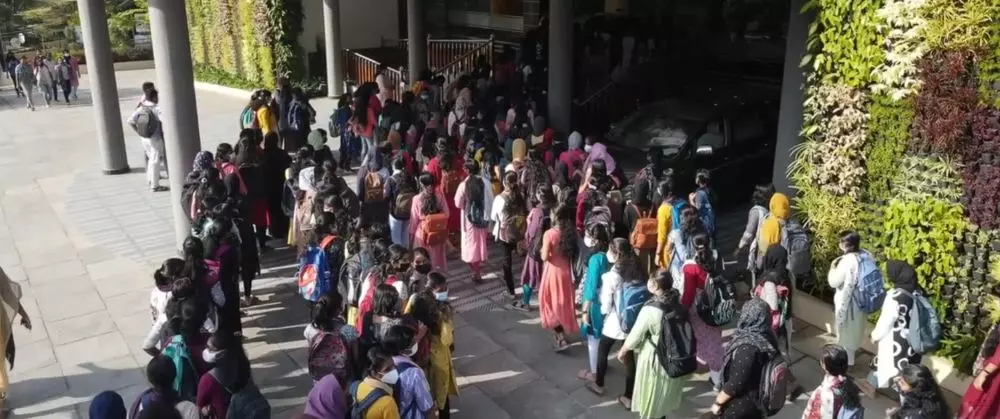
File photo of students at a coaching centre in Keralam.
But often in this narrative of student trauma, the one aspect of this academic ecosystem that fails to get highlighted is the pressure on teachers whose own merit is often measured by the ability of these students to crack whatever competitive tests they have been preparing for. Every student who successfully gets into an engineering or medical institute is a symbol of the teacher’s success; every student who fails, a reflection of the teacher’s inability to train them. (Ironically, it was a teacher who cared enough to push beyond these pressures to act as the whistleblower in the NEET paper leak case.)
Also read: Jantar Mantar to South Mumbai, can Neha Bora's Gen Z campaign penetrate beyond Left liberal camps?
“Teaching in a coaching institute is highly demanding. It is 365-day work, with hardly any leaves like normal school teachers have. And one has to give at least five to six hours each day for teaching, in addition to preparing test papers, test series and upgrading oneself with competitive exam patterns. So it is almost 20 hours of rigorous work daily for teachers, which makes it difficult to maintain work-life balance,” admits Manoj Sharma, founder and chief mentor of the Kota-based ScholarCITY Eduventures and former growth strategist, Resonance Eduventures Limited.
He adds: “Kota's coaching industry takes in fresh IIT graduates as teachers. They are initially trained for three months on a stipend ranging between Rs 6 to 9 lakh per year. Once they are absorbed, their salaries go up to Rs 12 lakh per annum. For senior teachers, salaries can go up to Rs 1.5 to Rs 2 crore annually.”
It is the same story of working under pressure that is shared by Shailendra Gupta, a teacher with over 20 years of experience, formerly associated with the Aakash Institute in Delhi, which provides coaching for NEET, Joint Entrance Examination (for engineering) and other competitive examinations. “The management wants performance and, of course, the teachers have to answer for the students’ results,” he says. There are monthly tests to evaluate the students and poor performance reflects badly on the teachers.
In 2024, the Ministry of Education issued guidelines for the regulation of coaching centres. The directive has at its core “student well-being”, and the creation of a “learning ecosystem where students can flourish”. While it does allow tutors, along with students, parents and other coaching centre employees to file complaints against coaching centres, by and large, the nature of these complaints prioritise students’ interest.
In its intent the guidelines echo the provisions of The Coaching Centres (Regulation and Control) Bill, 2007, which was also aimed at protecting students.
While the move to safeguard students is essential and welcome, from Kota to Keralam, coaching institute teachers too narrate the plight of not just having to live daily with the pressure to perform, but the burden of an insecure employment. Across Delhi last year, there were reports not just of pay-cuts of coaching institute faculty, but lay-offs of teachers, or closure of institutes which failed to meet the enrolment targets.
“The pay is good, often better than what one would get teaching at a school. Just the starting salary, for a fresher, would be around Rs 80000 a month. But there is no job security,” says Gupta.
M Sudha, who works in a well-known private coaching institute in Chennai offering NEET coaching, has faced this first-hand. The 43-year-old recalls the shock of being told by the management recently that her salary was being slashed by 30 per cent owing to poor enrolments in the past five months. She was told she would receive performance-linked incentives to compensate for the salary cut, but these would depend on the scores of the students attending her classes.
“I have been coaching students for the past seven years. Teaching is both my livelihood and passion. But when they link earnings to scores secured by students, I would be forced to focus on better-performing students. In a competitive exam, we cannot use the success rate of students as a tool to measure teachers' knowledge,” rues Sudha, who says she is actively seeking jobs in other coaching institutes and even planning to set up an online coaching class on her own.
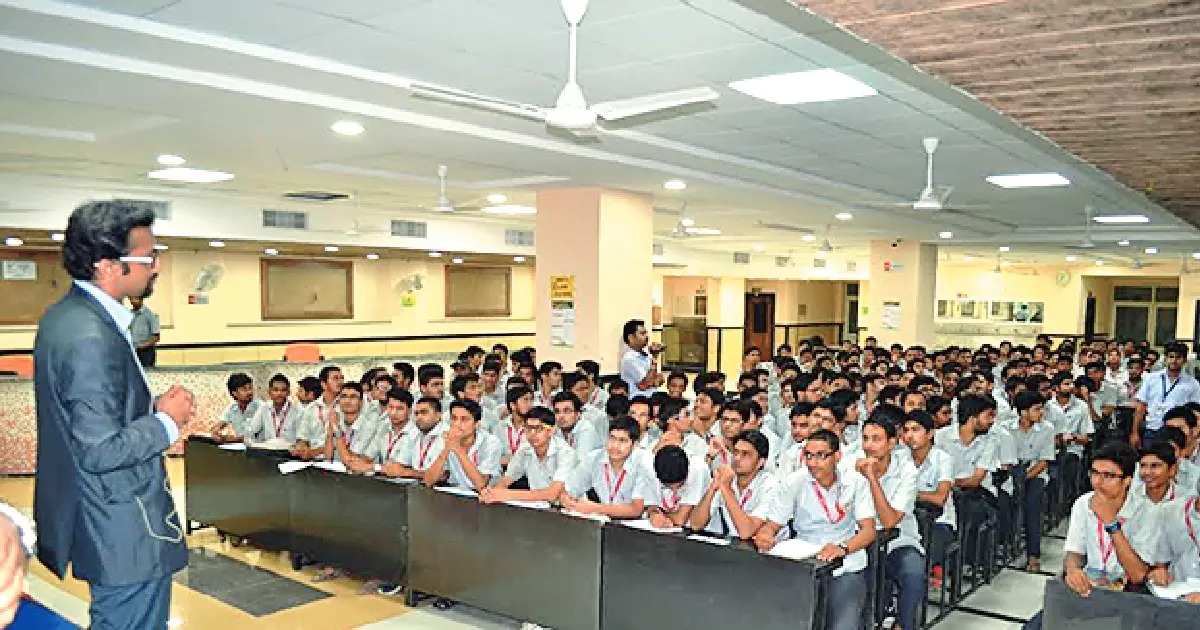
File photo of a coaching centre classroom in Kota.
Sharma admits that teachers are evaluated on the “number of students selected [in various courses for which they received training]”, but adds that feedback is also sought from students every two to three months on the faculty’s “teaching methodology, their knowledge, their test papers and how much the students are understanding”. “There is practically a report card at the end of the year, depending on the selection of students and the growth of the institute itself,” explains Sharma.
After 31 years in the profession, Ashish Arora, chief academic officer at the Jaipur-based Narayana Educational Institutions, says he doesn’t have to “live with the pressure anymore” as he is no longer answerable to anyone. While he insists that he doesn’t “believe in letting pressure get to my teachers in the coaching institutes because output will always suffer if teachers work under pressure and stress”, he does admit that the coaching industry is competitive and gruelling for everyone, teachers included. “Less pressure, better productivity is the mantra I tell my teachers to follow. We don’t set targets for our teachers as most coaching institutes do. We set softer targets like increasing the average class percentage by a certain number over last year. So this way the entire class benefits and not just the toppers, who anyway would score high. If you set high-high targets, teachers develop a certain detachment and become obsessed with achieving it anyhow. He is not teaching anymore but running after targets,” explains Arora.
Most industry insiders admit that the students’ success in any competitive examination depends on a range of factors, including their own ability to understand the subject. “And yet, parents feel just because their children are enrolled in a coaching institute they will get a seat [in engineering or medical,” agrees Sharma.
Ananda Padmanabhan T, a coaching institute faculty member in Keralam, talks of how many students who score more than 90 per cent in school exams are often not familiar with the fundamental concepts of the subject. “Yet they manage to score, often by memorising subjects. I am not immune to giving them such tips either, because that is what the system demands. Students are trained to learn templates for frequently asked questions, rather than understanding the subject. It is an issue with our education system itself,” he rues.
And so, coaching institute teachers talk of the “invisible” burden they carry linked to students’ performance.
“If students face pressure to secure ranks, there is also an invisible pressure on the teachers,” says Sirisha (identified by first name only), who teaches biology at a coaching institute in Hyderabad. Venkat Reddy, a 50-year-old mathematics faculty member at another Hyderabad-based coaching institute, talks of the teacher’s instinctive urge to help a student when he sees them struggling. “But when there are 100 students in a class, it becomes a challenge to give each individual attention. The tight timeline of syllabus teaching and preparatory tests also does not allow one the time to spare to answer individual doubts,” he rues.
And so blended with the pressure of ensuring that the teacher’s own grades do not drop owing to a slow-performing class, comes the guilt of not being able to help those who need it.
In such an ecosystem, bonding between teachers and students is rare. “Not many students feel connected with teachers at coaching centres. Since the courses are short-term, we do not teach or monitor them for long. We are working towards training them to achieve a target, which is very different from learning,” says Sudha, adding, “Very few students call us to inform that they have cleared the exam.”
Also read: Why legal experts, activists are critical of PM Modi’s call to ‘identify and isolate Dimagi Naxals’
Her experience finds echo in Aashi’s words, as she explains how the “friendly bond” that she had had with her school teachers (she completed her higher secondary this year) was missing with those at her coaching institute. “With them [her school teachers], I would discuss many things, look for guidance. At the coaching centre, any conversation about the future is also restricted to how to crack the IIT [Indian Institute of Technology] or life there.”
Speaking to The Federal a day before Teachers’ Day (September 5), the 17-year-old recalls that there would be celebrations at the coaching centre, similar to those at school. “We would be called to the main assembly hall and there would be food and music.”
Amidst the show, what the teachers at the coaching centres probably found lacking was the emotions and acts of the students' love, gratitude, even mischief and pranks pulled on the faculty, that remain endearing memories of every student’s and teacher’s school and college years. Aashi’s earlier use of the word ‘transactional’ is, perhaps, what best defines the realities of the job that these teachers give the better part of their days to.
(With inputs from Rakee Roytalukdar, Pramila Krishnan, Rajeev Ramachandran and Fazalullah Khan)