- Home
- India
- World
- Premium
- THE FEDERAL SPECIAL
- States
- Perspective
- Videos
- Sports
- Education
- Entertainment
- Elections
- Features
- Health
- Business
- Series
- In memoriam: Sheikh Mujibur Rahman
- Bishnoi's Men
- NEET TANGLE
- Economy Series
- Earth Day
- Kashmir’s Frozen Turbulence
- India@75
- The legend of Ramjanmabhoomi
- Liberalisation@30
- How to tame a dragon
- Celebrating biodiversity
- Farm Matters
- 50 days of solitude
- Bringing Migrants Home
- Budget 2020
- Jharkhand Votes
- The Federal Investigates
- The Federal Impact
- Vanishing Sand
- Gandhi @ 150
- Andhra Today
- Field report
- Operation Gulmarg
- Pandemic @1 Mn in India
- The Federal Year-End
- The Zero Year
- Science
- Brand studio
- Newsletter

How the fatal attack on Anjel Chakma is symbolic of a growing bloodlust in 'Devbhoomi' Uttarakhand
Particularly since 2017, when BJP came to power in the state, it has seen recurring atrocities. India Hate Lab report shows Uttarakhand ranked among top five states with highest number of hate speech events in 2025. Lived experiences too point at growing social disharmony, communal faultlines.

On December 26, 24-year-old Anjel Chakma, a native of Tripura pursuing his final year MBA course in Dehradun, succumbed to multiple stab wounds he suffered 17 days earlier when he resisted racial and casteist slurs hurled at him and his brother Michael by six youth, including, ironically, one each from Manipur and Nepal. A senior police officer reportedly claimed that the attack couldn’t...
On December 26, 24-year-old Anjel Chakma, a native of Tripura pursuing his final year MBA course in Dehradun, succumbed to multiple stab wounds he suffered 17 days earlier when he resisted racial and casteist slurs hurled at him and his brother Michael by six youth, including, ironically, one each from Manipur and Nepal. A senior police officer reportedly claimed that the attack couldn’t be called racist, since one of the accused was from Manipur — "a state like theirs".
A day before Chakma’s death, a posh private hotel in Haridwar was forced to cancel a Christmas gala following protests led by a self-styled local Hindu ‘priest’, Ujjwal Pandit, who claimed that the event would violate the sanctity of the holy Ganges, along whose banks the hotel is situated.
As curtains drew on 2025, these two instances stood out not solely for the growing bloodlust that has been spreading gradually across ‘Devbhoomi’ Uttarakhand, the idyllic Land of the Gods, but because at the receiving end were not Muslims. The year gone by and those that preceded it, particularly since 2017, have seen recurring incidents of hate speeches, atrocities and even administrative excesses targeting Muslims, both local and outsiders, across Uttarakhand.
To Nainital-based historian and social commentator Dr. Shekhar Pathak, a Padma awardee who had “returned” his Padma Shri to the central government in 2017 in protest against “rising intolerance”, the fatal assault on Chakma or the threats issued to the hotel in Haridwar were “no different from the communal targeting of Muslims in Uttarakhand”.
“Over the past decade and particularly since the Bharatiya Janata Party (BJP) came to power in the state in 2017, Uttarakhand has become a troubling microcosm of the wider social fissures that you witness as sporadic incidents across different parts of the country. Muslims, of course, are the obvious targets because they have been villainised to the fullest extent by the BJP and RSS [the Rashtriya Swayamsevak Sangh, ideological fountainhead of the BJP] combine but when perpetrators of such crimes can’t find a Muslim target, they will find ways to target anyone else because they have been led to believe by the government that Hindus can do whatever they like to whoever they like without fear of the law,” Pathak told The Federal.
Pathak’s claims aren’t merely a libertarian’s angst; they are backed by solid statistics and publicly available records — newspaper reports, viral videos on social media, posts by perpetrators and targets of such violence alike on platforms such as X, Facebook and Instagram, data collected by both government and private institutions, et al.
Also read: Consolidation of ongoing political process or new twists and turns — what 2026 could hold for India
On January 13, the India Hate Lab (IHL), a project of the Washington DC-based nonprofit think tank Center for the Study of Organized Hate (CSOH), released its annual report documenting 1318 in-person hate speech events targeting religious minorities, primarily Muslims and Christians, across 21 states, one Union Territory, and the National Capital Territory (NCT) of Delhi in 2025.
Among the IHL findings that stand out is not just the 97 per cent pan-India hike in recorded hate speech incidents in 2025 compared to 2023 or that hate speeches targeting Christians, aside from those against Muslims, were also on a gradual rise in the country but that Uttarakhand, despite its relatively small population compared to most other states, ranked among the top five states with the highest number of recorded hate speech events.
Unsurprisingly, across the 23 states and Union Territories analysed in the IHL report, the BJP rules, either independently or in coalition, all five states with the highest incidents of hate speeches — Uttar Pradesh (266), Maharashtra (193), Madhya Pradesh (172), Uttarakhand (155), and Delhi (76) — which also collectively account for 65 per cent of all incidents reported nationwide in 2025.
The infamy of being in the top 5 hate-speech prone states aside, Uttarakhand, according to the IHL report, scored another significant distinction; that of having its chief minister, Pushkar Singh Dhami, ranked first as India’s “most prolific hate speech actor with 71 speeches”. Dhami, whose public speeches are liberally peppered with terms like “love jihad”, “land jihad”, “thook jihad [spit jihad]” and so on, was so prolific in spewing venom, especially at Muslims, that as per the IHL he outranked by a league his more ‘illustrious’ party seniors, Union home minister Amit Shah (27 recorded hate speeches) and UP chief minister Yogi Adityanath (22 hate speeches). The IHL didn’t, for unspecified reasons, analyse speeches of Prime Minister Narendra Modi.
According to the India Hate Lab report, Uttarakhand chief minister Pushkar Singh Dhami ranked first as India’s “most prolific hate speech actor with 71 speeches”. File photo
The IHL data, inconvenient to the BJP for obvious reasons, can be dismissed as misleading, exaggerated or simply fake, but what about data from India’s own institutions? The National Crime Records Bureau (NCRB) may have stopped tabulating data on hate speeches/hate crimes since 2017, on the Centre’s flippant excuse that such data isn’t accurately provided by the States, but data collected under different categories of crimes too shows a gradually increasing trend in the hill state.
In 2023, the year for which the ‘latest’ NCRB data is currently available, Uttarakhand recorded 3570 violent crimes, a dip from the high of 3923 recorded the previous year but an increase compared to the 2021 figure of 3162 such cases. Of these 3570 violent crimes recorded in 2023 in Uttarakhand, 799 were cases registered under Section 153A, Section 147 and Section 151 of the Indian Penal Code (since replaced by the Bharatiya Nyaya Sanhita), which are clubbed together in the NCRB report under rioting but include the offence of promoting enmity.
Data aside, there are lived experiences of people in Uttarakhand that tell a tale of growing social disharmony and widening communal faultlines. “Violence in the name of protecting Devbhoomi Uttarakhand from the influence of other religions has become a daily affair and this has been encouraged by the State, from the chief minister downwards, in different ways. When you have the chief minister repeatedly stoking fears of demographic change or of our cultural, social and religious practices being in danger from people of other faiths, the message emboldens anti-social elements from the Hindu Right. It is like giving them the license to wreak havoc; telling them that the state’s hands may be tied by the Constitution, but yours are not, so go ahead and do what you can,” says Avikal Thapliyal, an independent journalist based in Dehradun.
Also read: Why, in 2025, centenarian RSS is having to weather the belief that it has been diminished by Modi
That hate speech and violent hate crimes have surged in the state not as isolated aberrations but as part of a discernible pattern tethered to political and ideological mobilisation by the ruling BJP and its patronised network of Hindu right-wing organisations is clear. The increase in hate crimes across the state, though more prominently across the Garhwal region that includes the Hindu pilgrimage sites of Badrinath and Kedarnath (or Haridwar and Rishikesh in its foothills), has coincided with a mushrooming of rabid Hindutva organisations like the Devbhoomi Raksha Abhiyan Sanghathan (DRAS), the Rudra Sena as well as proliferation of RSS shakhas and new units of the Bajrang Dal, Vishwa Hindu Parishad and other such Sangh affiliates.
A senior RSS pracharak in Uttarakhand told The Federal on condition of anonymity — since he is “not authorised to speak to the media” — that the state had seen a manifold increase in the number of RSS shakhas since the BJP stormed to power in the state back in 2017. Dhami took oath as CM in 2021 and incidents of hate speeches, atrocities against minorities have intensified since, given the brazenly communal rhetoric he peddles himself, emboldening others.
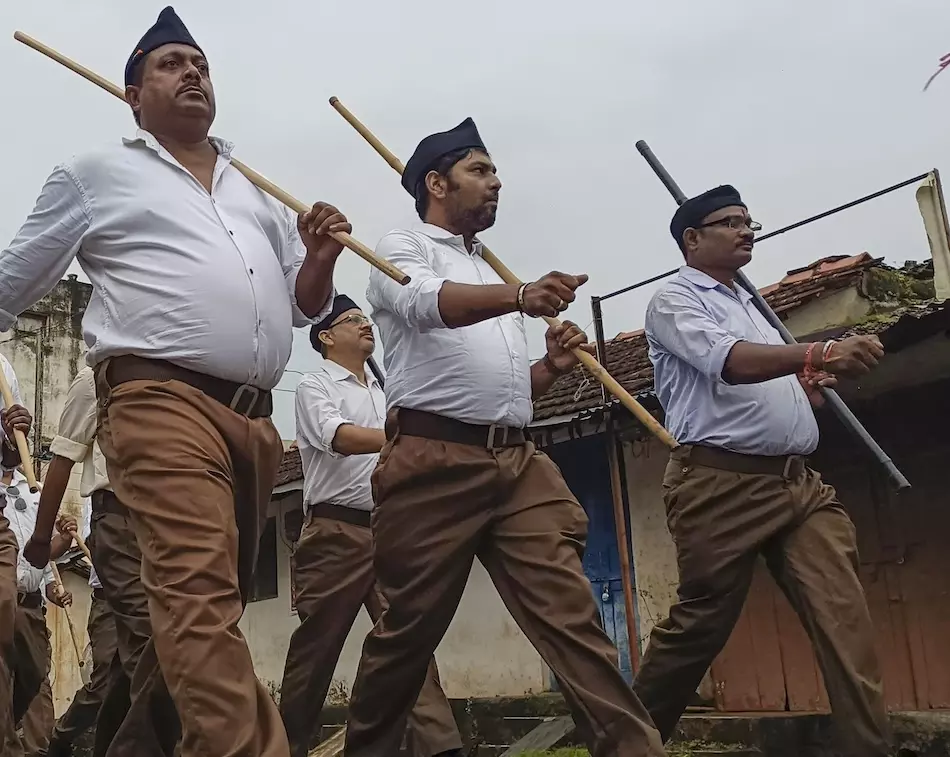
The increase in hate crimes across the state has coincided with a mushrooming of rabid Hindutva organisations as well as proliferation of RSS shakhas and new units of other Sangh affiliates. Representative image. PTI file photo
That the Dhami government went the extra mile to bolster the RSS’ ranks in the state was evident in the way it lifted the ban, in 2024, on participation of government servants in RSS shakhas. Then last year, to mark the centenary year of the RSS, the Dhami government held a special session of the Uttarakhand Assembly in November solely to acknowledge the Sangh’s role in “nation-building, social awakening, and cultural renaissance”. While the special session of the Assembly had been ostensibly called to mark 25 years of statehood for Uttarakhand, Dhami spoke primarily about the RSS centenary; the first time a State Assembly has been used for a RSS commemoration of this sort.
“We had just around 200 shakhas in Uttarakhand nine years ago, but the number has grown steadily because our people have gone to every village and panchayat with our ideology. By 2023, our shakhas had increased to 1300 and we had set a target of 1500 shakhas in Uttarakhand by the end of 2025; which we have proudly achieved within the centenary year of the Sangh. The number will keep going up and we have the full support of the Dhami government. We aim to have a shakha in the remotest corners of Uttarakhand so that our message of Bharatiyata and Hindutva reaches every corner of this Devbhoomi,” the RSS pracharak said.
This mushrooming of Hindutva outfits, new and old, like the DRAS, VHP, RSS and Bajrang Dal, is also because of the ability of such organisations to blend religious symbolism with an overstated sense of political grievance; “framing communal division as a defence of culture and security”, says a political commentator and activist who does not want to be named.
The support from the Dhami government is “merely an enabling factor”, he adds, noting that the “actual threat to Uttarakhand’s peace is from the fact that a large number of people are willing to believe such narratives and this is now seeping even into remote villages of Uttarakhand which never had communal problems earlier because there was hardly any Muslim population there to begin with; it was concentrated either in the Haridwar district or in some pockets of Nainital-Udham Singh Nagar”.
This escalation in rhetoric has corresponded with spikes in actual violence and intimidation. In February 2024, Haldwani erupted in the worst communal violence the state had seen in recent years when a madarsa and mosque, suddenly deemed illegal by the local administration, was razed. At least six people lost their lives in the riots that followed, while over 200 others were injured. In the aftermath, scores of Muslim families were forced to evacuate their homes, citing fear of further violence.
These disturbances were not merely spontaneous; they unfolded amid pre-existing social anxieties about demographic change, amplified by local social media networks that circulated rumours and falsehoods about “illegal encroachments” and existential threats to Hindu identity.
In December 2021, a Dharam Sansad in Haridwar became a national flashpoint when hate-spewing self-anointed guardians of Hinduism, including Yati Narsinghanand, Rakesh Tomar Uttarakhandi and Darshan Bharti, openly incited violence and issued genocidal threats against Muslims under the guise of protecting Hindu society. Since then, similar calls for more dharam sansads have been discussed openly with some of the same individuals threatening further assemblies to catalyse violence against Muslims (and people of other faiths) who are “polluting Devbhoomi Uttarakhand with their presence”.
In mid-2023, the otherwise sleepy hamlet of Purola in Uttarkashi district simmered with communal tensions after posters appeared on shop shutters across Purola and the adjoining Barkot village warning Muslims to “vacate their shops” ahead of a proposed Hindu mahapanchayat. Calls to “protect our daughters and heritage” against supposed plots like “love jihad” and “land jihad” were widely circulated by people linked to the DRAS and other Hindutva groups, forcing an exodus of Muslims from Purola. Many of those Muslim families that had fled Purola in 2023 are yet to return to their homes.
Last year, scores of incidents were reported across the state at varying intervals – many of them captured on video and circulated on social media platforms – of Muslims being harassed by locals, including in at least two instances women office bearers of the BJP’s panchayat committees and district units, and being told to “leave Devbhoomi”. In December, a Kashmiri shawl vendor was assaulted by Bajrang Dal men in Kashipur and forced to chant ‘Bharat Mata ki Jai’.
Clearly, what was once dismissed as nuisance by fringe elements now intersects with everyday life in Uttarakhand, while the government turns a blind eye; occupied as it is in more pressing matters such as moral policing through measures like a Uniform Civil Code that aims to not just do away with Muslim personal laws but also regulate live-in relationships and other personal choices of people.
Also read: Nearly six months after flash floods wreaked havoc in Dharali, why locals are yet to move on
“For residents of Uttarakhand’s towns and villages, this has translated into a steady drumbeat of suspicion against neighbours, amplified by messaging on WhatsApp and other platforms where misinformation proliferates unchecked. The repetition of claims that Muslims are a demographic threat, or that their presence endangers local culture and women’s safety, has created fertile terrain for polarisation and for episodes of violence. The venom has spread so deep that now it isn’t just about targeting Muslims; anyone who is not ‘visibly Hindu’ is fair game. At least that is how I see the Anjel Chakma episode or other instances where Christians have been targeted, even if the severity of those cases pales when compared to what is being done to Muslims,” says Nitin, a Dehradun-based SFI activist.
Pathak suggests that a “less probed” factor that is “definitely at play” in the way such polarising narratives of hate and othering have taken root in Uttarakhand, especially among its youth, is spiraling unemployment.
“If you look at the statistics, Uttarakhand has a fairly good enrollment ratio in schools and colleges. The literacy rate is above the national average and a bulk of the youth here are at least graduates, if not post graduates, but then where are the jobs? Those who can secure employment outside the state do so, which explains why the state has an abundance of ghost villages (villages that have been emptied out due to migration), but what about those who can’t secure a job outside for some reason? They are stuck here, frustrated and angry and then they get into all kinds of bad activities; anything to let off steam,” says Pathak.
Senior journalist Manan Kumar says it is not uncommon to find “educated Uttarakhandi youth who are sitting without jobs making a beeline for RSS shakhas or joining Hindutva outfits”. “The initial attraction is perhaps to get involved with some activity, as these shakhas and other organisations keep doing some event or the other; they will provide food and even expenses for petrol, commute, etc. Once you are there, it is difficult to escape the indoctrination because, under the garb of events, what essentially happens at such events is the peddling of hate against Muslims or anyone who is not Hindu. Since the youth are unemployed, they are told repeatedly that this is so because Muslims have come and taken their jobs. The CM himself goes around talking about naukri jihad; so you are basically building up an angry cadre; foot-soldiers to carry out the Hindutva agenda,” explains Kumar.
The tragedy of Uttarakhand’s recent trajectory is not just the rise in incidents of hate and violence but the erosion of norms that once restrained communal strife. The consolidation of such narratives under long BJP rule and networks that foreground religious identity in politics has normalised polarisation as a public life staple.
The biggest irony of it all is, perhaps, that this bloodlust and bloodletting is being done to protect the sanctity of Devbhoomi Uttarakhand; a province once known for its spiritual and natural tranquility but one that now resembles a tinderbox.