- Home
- India
- World
- Premium
- THE FEDERAL SPECIAL
- States
- Perspective
- Videos
- Sports
- Education
- Entertainment
- Elections
- Features
- Health
- Business
- Series
- In memoriam: Sheikh Mujibur Rahman
- Bishnoi's Men
- NEET TANGLE
- Economy Series
- Earth Day
- Kashmir’s Frozen Turbulence
- India@75
- The legend of Ramjanmabhoomi
- Liberalisation@30
- How to tame a dragon
- Celebrating biodiversity
- Farm Matters
- 50 days of solitude
- Bringing Migrants Home
- Budget 2020
- Jharkhand Votes
- The Federal Investigates
- The Federal Impact
- Vanishing Sand
- Gandhi @ 150
- Andhra Today
- Field report
- Operation Gulmarg
- Pandemic @1 Mn in India
- The Federal Year-End
- The Zero Year
- Science
- Brand studio
- Newsletter

Why for Dalits in Uttarakhand there is a silver lining in ‘purification’ row after Kharge visit
A Hindu right-wing organisation conducted a ‘purification ritual’ in Haldwani last month, days after Congress president Mallikarjun Kharge, a Dalit, addressed a rally there. While the Congress has already demanded action against the accused, if the party mounts a major campaign and sustains it till next year’s assembly polls, it could, for the first time in decades, place questions of Dalit identity at the centre of Uttarakhand's political discourse.

“Who in Uttarakhand will admit today that caste discrimination exists here,” chief minister Pushkar Singh Dhami asked recently.Dhami was responding to a political row his party, the Bharatiya Janata Party (BJP), has been battling since a Hindu right-wing organisation, the Shri Ram Sena, conducted a ‘purification ritual’ at the Ramlila Maidan in Uttarakhand’s Haldwani on August 10,...
“Who in Uttarakhand will admit today that caste discrimination exists here,” chief minister Pushkar Singh Dhami asked recently.
Dhami was responding to a political row his party, the Bharatiya Janata Party (BJP), has been battling since a Hindu right-wing organisation, the Shri Ram Sena, conducted a ‘purification ritual’ at the Ramlila Maidan in Uttarakhand’s Haldwani on August 10, two days after Congress president Mallikarjun Kharge, a Dalit, addressed a rally there. Kharge and Lok Sabha’s Leader of Opposition, Rahul Gandhi, have likened the ‘purification ritual’ to practicing untouchability and demanded that an FIR be registered against the culprits.
Dhami’s retort was a typical act of political grandstanding; far removed from the truth.
That the BJP and Dhami government have been compelled to respond aggressively demonstrates that Rahul has struck a raw nerve. With an FIR now registered against Rahul at the Haldwani police station under the non-bailable Section 3(1)(q) of the Scheduled Castes and Scheduled Tribes (Prevention of Atrocities) Act, for demanding the arrest of those who performed the ritual, it is clear that the row won’t die down soon.
The Congress, the party’s Uttarakhand in-charge Kumari Selja told The Federal, is “planning a state-wide agitation to demand the arrest of those who performed the shuddhikaran (purification), withdraw the politically motivated FIR filed against Rahul Gandhi and to expose the anti-Dalit politics of the BJP and RSS [Rashtriya Swayamsevak Sangh]”.
If the Congress mounts a major campaign and sustains it till next year’s Uttarakhand assembly polls, it could, for the first time in decades, place questions of Dalit identity, respect and rights at the centre of the state’s political discourse. This is where Dhami’s impassive statement questioning the existence of caste discrimination in his state not just whitewashes lived realities of Uttarakhand’s Dalits but also seeks to erase centuries of caste oppression and a quest for social reformation that began in this region long before Babasaheb Ambedkar turned Dalit emancipation into a national cause.
Also read: How the language of political discourse in India has transformed with the years & why it's a matter
“For Rahul, this may be just an attempt to woo Dalits in Uttarakhand, UP and Punjab but, perhaps, he doesn’t realise the full socio-political canvas of this issue in Uttarakhand. If he did, the Congress wouldn’t just be speaking about what happened with Kharge but about what Dalits here face every day,” says Jai Singh Bisht, a cultural commentator based in Almora.
Recalling that in June, an 18-year-old Dalit boy in Tehri Garhwal “was beaten to death just for befriending an upper caste girl”, Dalit political activist Dinesh Tamta told The Federal, “whether you are in Garhwal or in Kumaon, there are still villages where caste discrimination and Bith (upper caste) domination is rampant; Dalit grooms can’t ride a horse in the wedding procession… shuddhikaran is the mildest discrimination because Dalits in Uttarakhand face far worse”.
Tamta claims that “no political party has taken up the Dalit cause since we became a state because over 60 per cent of Uttarakhand’s population constitutes of Rajputs and Brahmins and it was primarily these two communities that led the statehood agitation in the 1990s on an anti-reservation foundation.”
The demand for a separate state comprising just the hill districts of the erstwhile United Provinces (later Uttar Pradesh, or UP) was raised sporadically since the 1920s, on one ground or another. Yet, it wasn’t until 1994 that it turned into a pitched agitation. That was the year then UP chief minister Mulayam Singh Yadav decided to implement 27 per cent reservation for other backward classes [OBCs] in state-run educational institutions and government jobs as per recommendations of the Mandal Commission. Across the hills of Garhwal and Kumaon, where the OBCs totalled fewer than five per cent of the population, Rajputs and Brahmins were up in arms.
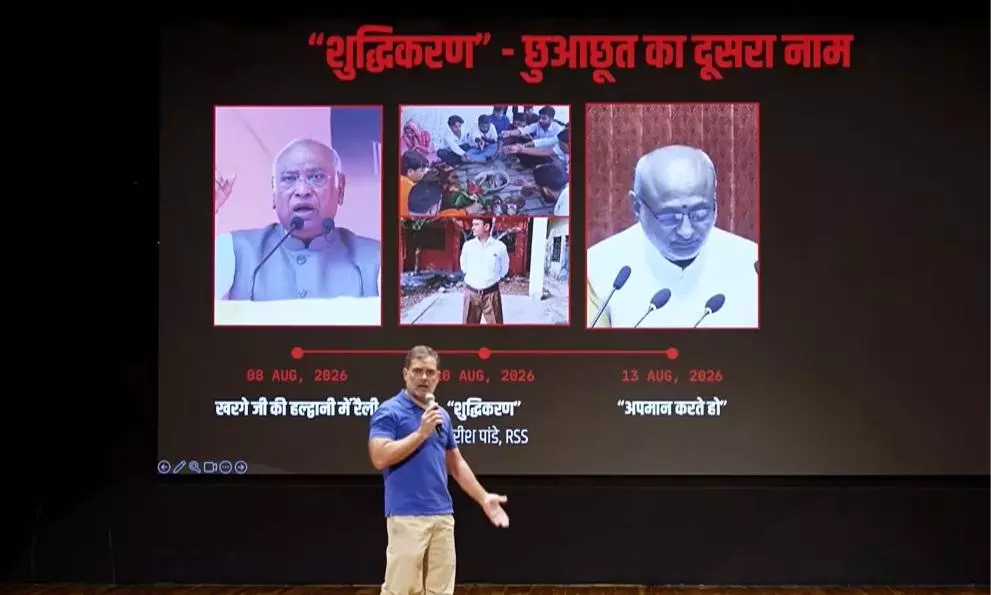
File photo of Rahul Gandhi at a press conference. Photo: X
In November 2000, the then National Democratic Alliance (NDA) government at the Centre, under Prime Minister Atal Bihari Vajpayee, carved Uttarakhand out of UP. While the demand was for a separate state constituting the eight districts across the Garhwal and Kumaon hills, the Centre also gave away Haridwar and Udham Singh Nagar, districts that fall in the plains and have a sizeable population of Dalits and Muslims, to Uttarakhand, creating new fault lines – hills versus plains, Hindus versus Muslims – that are now hard to miss in the state’s politics.
Nainital-based journalist Ravindra Devliyal believes “marginalisation of the Shilpkar (Dalits) and the complete absence of any meaningful political discourse on the community’s plight” was a “direct consequence” of the decision to create a state the demand for which was predominantly led by upper castes.
“From the start of the statehood agitation in 1994, it was clear that this was a campaign led by Rajputs and the Brahmins. Because in UP, it was the coalition government of Mulayam Singh Yadav’s Samajwadi Party (SP) and Kanshi Ram’s Bahujan Samaj Party (BSP) that was implementing 27 per cent OBC reservation, the statehood campaign witnessed abusive slogans directed at backward castes and Dalits,” Devliyal told The Federal.
Congress leader Pradeep Tamta, who in 2016 went on to become the first Dalit Rajya Sabha MP from Uttarakhand, was among those opposing the demand for a separate state. Then a young political activist in Almora, he saw how Dalits faced the “worst brunt of abuse and violence” during the statehood agitation because “the agitation was essentially anti-reservation and since our hill districts have a very thin OBC population, the upper caste anger turned towards ordinary Dalits who are present in large numbers across Almora, Pithoragarh, Bageshwar, Nainital and Uttarkashi”. He says the Dalits “kept their distance from the agitation because they realised that if a new state is carved out, their condition will only worsen”.
In the 26 years since the creation of Uttarakhand, Pradeep Tamta’s apprehension about upper caste hegemony getting further entrenched in the new state appears to have come true, especially in politics.
While Dalit leaders like Pradeep Tamta, Yashpal Arya (from the Congress) and Ajay Tamta (of the BJP) have been given various posts by their respective political parties as “token representation” for the community, Pithoragarh-based Dalit activist Sudarshan Prasad says, “real power remains with Rajputs and Brahmins”.
“Uttarakhand has seen 10 chief ministers since its formation and irrespective of whether it is the BJP or the Congress that is in power, the CM’s position is reserved for either Rajput or Brahmin, who constitute about 35 per cent and 22 per cent of the state’s population, respectively. These two communities dominate key positions in administration too. Dalits, who are an estimated 20 per cent of the population, have accepted this as normal and do not agitate for greater say in power or decision-making,” Prasad said.
Historian and Padma Shri awardee Shekhar Pathak sees a “distressing irony” in what he calls the “normalisation of discrimination against Dalits” in a region that “once showed the country how this community can mobilise against oppression”. Pathak says the “muted response” by Dalits of Uttarakhand to the purification row is in “complete contrast to how this community used to once react to such incidents”. He hopes the political backlash from the Congress, spearheaded by Rahul Gandhi, would “revive awareness and an appetite to agitate among Dalits that existed in this region for the first half of the 20th Century”.
Pathak cites various historical records, covering the first three decades of the 20th Century, to explain how Dalits mobilised across various hill districts of the state (still the United Provinces) for different causes under different leaders and banners. The earliest such instance, arguably, dates back to 1905 when Hari Prasad Tamta, all of 18 years, began mobilising Dalits in his home town of Almora under the banner of Tamta Sudhar Sabha (later rechristened as the Kumaon Shilpkar Sabha) against caste discrimination.
Over the next decade, Pathak says different triggers – including issues as diverse in character as the ban on Dalits from attending the 1911 Delhi Durbar for coronation of King George V, the upper caste-imposed restriction on the use of dola palki (palanquin) in Dalit wedding processions in the hills and the prohibition on Dalits from wearing a janeu (a sacred thread worn by some upper caste Hindus) – led to local Dalits mobilising in other hill districts too.
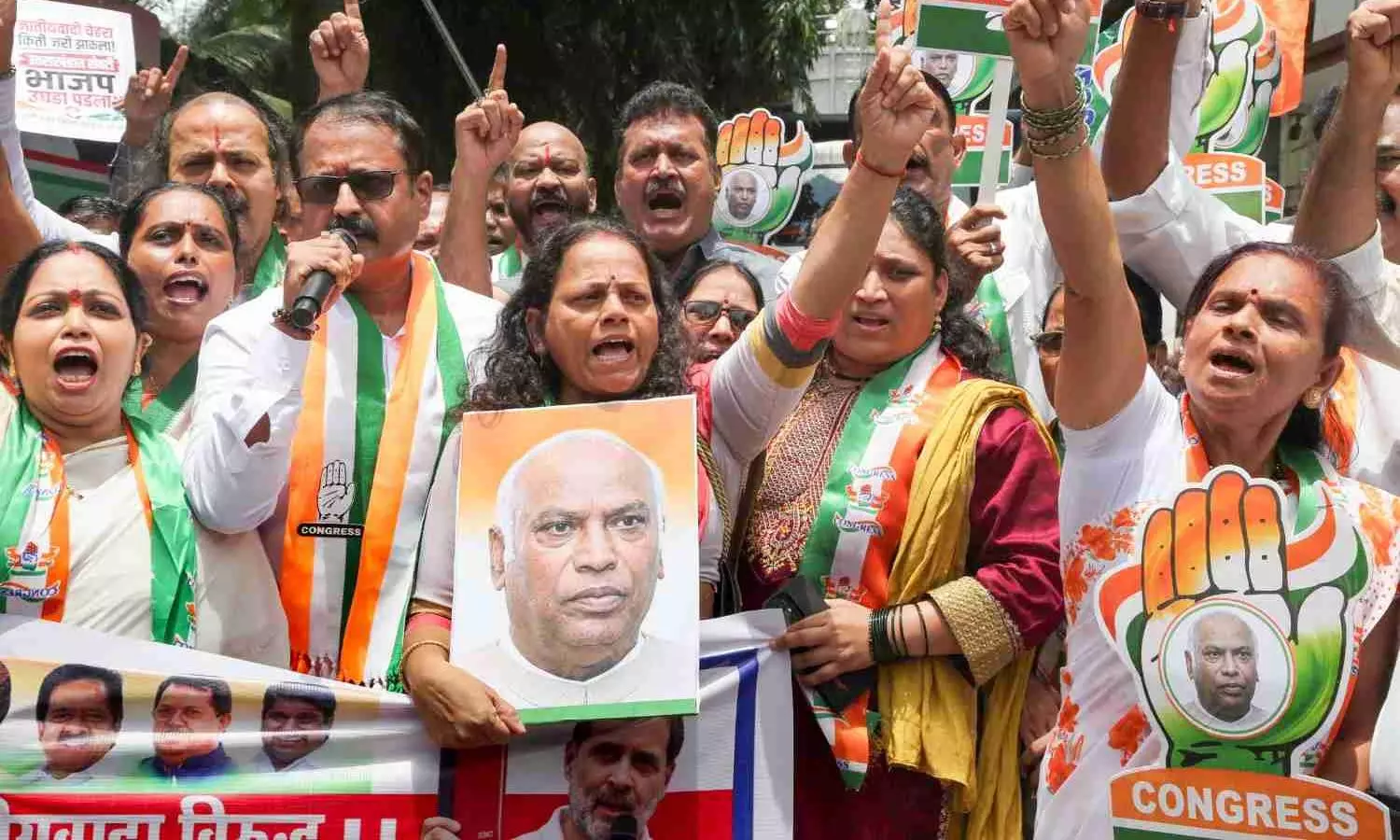
Congress workers protest against the Haldwani incident. Photo: PTI file photo
By the early 1910s, partly because of fears that Dalits may start converting to Islam or Christianity to improve their social standing and partly owing to its own push for social reformation, the Arya Samaj got deeply involved with the Dalit cause in the hill districts. Though by then, Dalit reformers like Hari Prasad Tamta and Khushi Ram had already become prominent figures in the hills, it was Lala Lajpat Rai’s support to the Dalit cause that acted as a catalyst for unity across the community.
Pathak says it was Rai who coined the term ‘Shilpkar’ (artisans) for Dalits when he visited Khushi Ram in Sunkiya (in Nainital district) in 1913 and praised his work for Dalit awakening. “Inspired by the Arya Samaj, many Dalits dropped their caste surnames and started using Arya as their title; Dalits are still referred to as Shilpkar in Uttarakhand,” explains Pathak.
Another key turning point came in 1920, when Khushi Ram defied the upper castes to insist that a Dalit marriage procession in Ramgarh would use the dola palki. This is not to say that the upper castes simply walked away without protest. Quite to the contrary. In 1923 a Dalit marriage party was brutally beaten up in Sendikhal (Pauri Garhwal) for using a dola palki. Yet, what began with Khushi Ram’s act of defiance in 1920 went on to encourage many Dalits in the decades that followed to defy symbols and practices of caste discrimination all across Kumaon and Garhwal.
Congress leader Pradeep Tamta says Dhami’s denial of the existence of caste discrimination in Uttarakhand today is “an insult to the decades of struggle by Dalits to seek equality and a lie to hide the rising incidents of caste atrocities during his tenure”.
Tamta recalls an incident from May 2022, nearly a year after Dhami first became chief minister and just over a month after he was sworn-in a second time, when a 27-year-old Dalit groom was threatened by upper caste men in the Salt tehsil of Almora district to dismount the horse he was riding during the wedding procession. “They (upper caste members) told him if he did not get off the horse, he and everyone in the procession would face what had happened in Kafalta,” Tamta, who represented Almora in the Lok Sabha from 2009 to 2014, told The Federal, asserting that “such threats to Dalits continue even today”.
The Kafalta reference was a reminder of the massacre of 14 Dalits, six of whom were burnt alive inside a hut, by upper-caste men, 42 years earlier, in May 1980, in a village of the same name located in Salt, for resisting the diktat against use of a dola palki in Dalit marriage processions.
For Pathak, the Kafalta massacre of 1980, the incident from May 2022, the murder of the 18-year-old this June for befriending an upper caste girl or the countless other crimes against Dalits, many of which remain undocumented due to fear or state apathy, aren’t merely a continuation of atrocities by the upper castes. Instead, they are a “worrying pattern of a state steadily regressing into societal evils that Dalits fought to eliminate a century ago”.
In the furore kicked up by the Congress over the ‘purification ritual’ against Kharge, Pathak sees the “promise of a revival of political discourse around Dalits and caste oppression” and hopes that the Grand Old Party will stay the course.
Yashpal Arya, Leader of Opposition in the Uttarakhand Assembly and among the state’s senior-most legislators, believes Rahul’s aggressive stance on the issue has “brought the issue of untouchability and caste discrimination into focus” and it is now the responsibility of party leaders like himself to “take the message forward and ensure this doesn’t fizzle out”.
With assembly polls in the state due early next year, electoral ramifications of the purification row can’t be ignored. The Dalits comprise nearly 20 per cent of the state’s electorate, but their voting patterns, particularly across the 20 assembly constituencies spread across Haridwar and Udham Singh Nagar where Mayawati’s BSP still has considerable influence and the 13 SC-reserved constituencies (some within Haridwar and Udham Singh Nagar), show that the community rarely votes en masse.
Political commentator Umakant Lakhera believes if the Congress succeeds in building a strong Dalit outreach, coupled with an equally aggressive plan to woo Muslims, it can neutralise the BSP’s impact in Haridwar and Udham Singh Nagar, which have 11 and nine assembly segments, respectively.
“The BSP has consistently polled a high number of votes in these two districts and that has always damaged the Congress. In the last three elections, with the exception of the Haridwar constituency in Haridwar district and the Bajpur and Kichha seats in Udham Singh Nagar, the BSP has consistently polled more votes than the BJP or Congress candidate’s margin of victory… barring the last assembly election (in 2022), when the Congress won 11 of these 20 seats, the BJP has usually swept these two districts because of the split in Dalit and Muslim votes,” says Lakhera.
Also read: Why legal experts, activists are critical of PM Modi’s call to ‘identify and isolate Dimagi Naxals’
While the Congress needs a strong strategy to neutralise the BSP’s impact in these two districts that fall in the plains, journalist Avikal Thapliyal says the party will need a “completely different strategy” for constituencies in the hill districts where Dalits have a sizeable population.
“In the past 10 years of its rule, the BJP has completely polarised Uttarakhand on communal lines,” says Thapliyal, arguing that this “creates a problem for the Congress in wooing Dalits in the hill districts because there the BJP has courted the community by spreading fears that Congress will allow Muslims, who are much fewer in number in the hills compared to Haridwar or Udham Singh Nagar, to overrun Hindu areas of Uttarakhand and that would hurt not just upper castes but also Dalits.”
A classic example of this politics, perhaps, is Purola (a Dalit reserved constituency in Uttarkashi district), where communal tensions have cropped up repeatedly over the last three years. “The other complication in the hill constituencies is that a majority of them are numerically dominated by Rajputs and Brahmins. If the Congress gets too aggressive with its pro-Dalit pitch, it could lose support among upper castes,” says Thapliyal.
For Sudarshan Prasad, how the Congress proceeds with its electoral strategy on Dalits or whether the BJP has a counter-offensive that goes beyond Dhami’s denial of caste discrimination is immaterial.
“At least Dalits are being talked about,” Prasad says.