- Home
- India
- World
- Premium
- THE FEDERAL SPECIAL
- States
- Perspective
- Videos
- Sports
- Education
- Entertainment
- Elections
- Features
- Health
- Business
- Series
- In memoriam: Sheikh Mujibur Rahman
- Bishnoi's Men
- NEET TANGLE
- Economy Series
- Earth Day
- Kashmir’s Frozen Turbulence
- India@75
- The legend of Ramjanmabhoomi
- Liberalisation@30
- How to tame a dragon
- Celebrating biodiversity
- Farm Matters
- 50 days of solitude
- Bringing Migrants Home
- Budget 2020
- Jharkhand Votes
- The Federal Investigates
- The Federal Impact
- Vanishing Sand
- Gandhi @ 150
- Andhra Today
- Field report
- Operation Gulmarg
- Pandemic @1 Mn in India
- The Federal Year-End
- The Zero Year
- Science
- Brand studio
- Newsletter

Weddings to weekend planning, how India is turning to its weathermen (& women) for all decision-making
While the India Meteorological Department remains the authoritative source for weather forecasts, private platforms such as Google Weather, Windy, AccuWeather and Skymet have also become popular and a new generation of independent weather forecasters is simplifying technical jargon, weather charts and colour-coded alerts to help people understand official bulletins in layman's language.

Sixty-five-year-old Anand Kumar Sharma, a Delhi-based meteorologist, received an unusual phone call from a bustling wedding venue in Jaipur last year. At first, he dismissed it as a prank. But the caller's anxiety was real.The caller’s family had booked an open-air wedding venue. As dark clouds gathered overhead and guests began worrying about a heavy downpour, panic spread. Shifting...
Sixty-five-year-old Anand Kumar Sharma, a Delhi-based meteorologist, received an unusual phone call from a bustling wedding venue in Jaipur last year. At first, he dismissed it as a prank. But the caller's anxiety was real.
The caller’s family had booked an open-air wedding venue. As dark clouds gathered overhead and guests began worrying about a heavy downpour, panic spread. Shifting the celebrations indoors at the hotel would cost them an additional Rs. 3 lakhs. Before making that decision, they wanted to know whether it would really rain.
“I understood their fear. I looked up the radar data and checked the satellite imagery. Those dark clouds would just drizzle and pass. When I told the family to go ahead with the open-air venue as planned, they were still anxious. But after two hours, they called and thanked me profusely,” Sharma recalls.
The incident reflects a quiet but significant change in India. Weather forecasts, once regarded as advisories mainly for farmers and fishermen, have become an integral part of everyday decision-making. From weddings and weekend outings to office commutes and hospital preparedness, weather has become a daily conversation in both cities and rural India.
In the era of weather apps and social media pages run by hyperlocal forecasters, Sharma has reinvented himself after retiring as additional director general of meteorology, India Meteorological Department (IMD) in 2021. Today, he teaches laymen how to decode IMD bulletins and understand meteorological terms such as isolated rain, heavy rain, cyclone landfall, the eye of the storm, and much more.
According to Sharma, weather data can influence everything from whether you should work from home or drive to the office, to what clothes you wear and whether your weekend plans belong on the beach or inside a pub.
“Weather forecasts are essential for everyone these days. Gone are the days when forecast bulletins were merely advisories for farmers and fishermen. Today, forecasts are equally important for a daily wager like an auto driver and an IT professional,” he says.
Also read: Why in Himachal, approaching monsoon has those living in the lap of the Himalayas worried
Access to weather information has also become easier than ever before. IMD's free apps are available in several Indian languages. Mausam provides general weather updates, Meghdoot offers farm advisories, Damini sends lightning alerts, and weather services are also integrated into the government's UMANG app, besides the website mausam.imd.gov.in.
“The IMD has dedicated teams of experienced scientists and technical experts working round the clock to provide accurate and reliable weather forecasts. Through our Nowcast services, available on the IMD website and mobile applications, the public can access weather forecasts for the next three hours and take timely decisions,” says VR Durai, head of the Regional Weather Forecasting Centre (RWFC), Regional Meteorological Centre (RMC), Chennai.
While IMD remains the authoritative source for official colour-coded warnings and safety advisories, private platforms such as Google Weather, Windy, AccuWeather and Skymet have become popular for city-level forecasts and short-term planning.
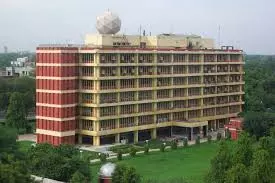
Mausam Bhava, the office of the Regional Meterorological Centre in Delhi. IMDs free apps are available in several Indian languages. Mausam provides general weather updates, Meghdoot offers farm advisories, among others. Photo: Wikimedia Commons
Alongside these platforms, a new generation of independent weather forecasters has emerged on social media. They simplify technical jargon, explain weather charts and colour codes, and help people understand official bulletins in everyday language.
An orange warning in an IMD bulletin, for instance, signals that people should remain alert for extreme bad weather (such as heavy rainfall or extreme heat/cold), while a yellow warning just calls for people to be alert (just a possibility of severe weather conditions). A red alert is the most severe kind.
Such explanations have made meteorological terminology far more accessible. Discussions on weather codes and rainfall patterns are no longer confined to scientists; with issues of climate change and severe weather patterns dominating public discourse, such conversations have found their way into coffee shop circles and dinner table talks.
When The Federal reached 29-year-old R. Hemachander, an amateur meteorologist, he was busy preparing his daily rainfall report for Tamil Nadu's delta region. With over one lakh followers on Facebook and 64,000 subscribers on YouTube, he has become a familiar face on television channels seeking expert opinions on cyclones and rainfall patterns. His forecast during Cyclone Fengal in 2024 earned him widespread recognition, he says.
“While many reports predicted that Cyclone Fengal [which had its landfall near Puducherry and brought severe rainfall and strong winds to Tamil Nadu] would weaken and not cause much damage, I believed it had the potential to re-intensify and trigger heavy rainfall and strong winds. I studied an important factor that suggested the cyclone would remain slow-moving and therefore had the potential to cause severe damage. My assessment was appreciated. More importantly, many farmers thanked me for the timely warning,” Hemachander tells The Federal.
He is equally candid when asked what happens if a forecast goes wrong.
“Weather forecasting is not like mathematics. It is different from arriving at a fixed conclusion. A prediction may match reality, but sometimes it may not. Conditions can change rapidly, and we cannot always provide an exact forecast. At other times, when the factors are favourable, our prediction can be 100 per cent accurate. For example, Cyclone Ditwah in 2025 was expected to cause severe damage in Tamil Nadu. But instead of moving towards Tamil Nadu after brushing past Sri Lanka, it made landfall in Sri Lanka itself. That changed the entire story. Sri Lanka suffered extensive damage because Ditwah was a rain-bearing cyclone,” he explains.
For 26-year-old Biswajit Sahoo from Odisha, weather forecasting is as much about public communication as it is about science.
He regularly posts memes, graphics and weather cards on social media to explain cyclone movements, heavy rainfall and cloud patterns in simple language. His fascination with cyclones eventually led him into meteorology, and today he also trains AI models to interpret weather data and generate forecasts. Alongside a postgraduate degree in oceanography, he studied data science to better decode weather charts and statistics.
His post on the minor flooding in the Baitarani River after this year's monsoon onset carried a simple message: avoid unnecessary photoshoots and social media reels near swollen rivers. The advice struck a chord with Gen Z audiences.
“I post two or three graphic cards every day. I also answer questions in the comments. Three days ago, Odisha witnessed extremely heavy rainfall due to the formation of a depression over the Bay of Bengal, exactly as I had predicted. I also talk about precautions people should take during periods of high humidity and rising temperatures,” says Sahoo.
The growing interest in weather is also reshaping business. Weather forecasting has evolved into a full-fledged industry, with private companies, marketing firms, agricultural businesses and even hospitals increasingly relying on weather intelligence to prepare for disruptions and make informed decisions.
Mumbai-based Ravishankar Mantha runs a data analytics firm that interprets weather data for businesses planning investments, procurement and future projects. His firm's analyses help clients understand how seasonal forecasts influence rural consumer behaviour, procurement strategies and price movements, while also providing early warning signals for market volatility.
According to Mantha, India's weather literacy has undergone a remarkable transformation. “This year, everybody is talking about El Niño, a term that was once restricted to weather scientists and business circles. Now it has become part of everyday conversation. If it moves money or people, weather data has become an important input. It is no longer limited to agriculture. Consumer companies also depend on it. People have become weather-conscious, and that is a significant development. They are now able to correlate the impact of weather across different sectors,” he tells The Federal.
Also read: World Environment Day: Why some Indians are giving up jobs, businesses to focus on sustainability
While access to weather information and its use have increased, according to meteorologists — both private and the IMD — climate change and extreme weather conditions may pose a challenge in accurate forecasting. The past years have seen every approaching season heralding a stream of discussions on the possibility of heat wave or cold wave conditions and too much rain or too little rain.
According to experts, India's weather literacy has undergone a remarkable transformation in recent years. Photo: iStock
"Weather study is complicated," admits Sharma. "We cannot assure that the prediction will be 100 per cent correct [everytime], because we cannot [always] decode extreme weather patterns and its impacts immediately." He adds: "Of late, however, we have been getting our predictions right with the help of technology."
Tech power is something IMD also talks of. Over the years the department has significantly strengthened its weather forecasting capabilities by adopting state-of-the-art technologies, advanced observing systems, high-performance computing, and Artificial Intelligence (AI).
"Artificial Intelligence (AI) and Machine Learning (ML) models are now an integral part of our forecasting system. These models help us better recognise weather patterns and improve forecast accuracy when used alongside conventional dynamical and statistical forecasting models,” says Durai.
The IMD uses indigenous satellites such as INSAT-3DR and INSAT-3DS, which provide frequent observations of cloud systems and other atmospheric parameters. The department currently operates a nationwide network of nearly 40 Doppler Weather Radars (DWRs) to monitor thunderstorms, heavy rainfall, cyclones and other severe weather events in near real time. In addition, it maintains a dense network of Automatic Weather Stations (AWS) and Automatic Rain Gauges (ARGs) across the country, providing continuous weather observations for forecasting and early warning services.
Durai adds: “The IMD is further strengthening its observational network under the Government of India's Mission Mausam by installing around 80 additional Doppler Weather Radars across different parts of the country. The expanded radar network will significantly enhance the monitoring of rapidly evolving weather systems, improve the accuracy of forecasts, and provide more timely impact-based warnings, particularly at the district and city levels.”
According to Durai, while India is often perceived to be lagging behind other countries in weather forecasting, “this is a misconception”. “IMD today possesses world-class forecasting infrastructure, including advanced satellites, Doppler Weather Radars, high-performance computing systems, sophisticated numerical weather prediction models, and AI-enabled forecasting techniques. Our radar network continues to expand, and the frequency of satellite observations has increased significantly. Faster observations enable us to monitor rapidly evolving weather systems much more effectively, resulting in more timely and accurate forecasts and warnings," he says.
The true success of such technological advancement lies in its positive impact on human life, how far it is able to protect people and livelihoods from climatic disasters.
Continuing with his conversation on how intrinsic weather patterns have become to daily life today, Sharma says, “Earlier this year I had a deep-dive session with doctors who wanted to decode heatwave and cold-wave indicators because they had to identify various kinds of fungal infections among patients during these weather events.”
Weddings to hospital beds, climate conditions are dictating human decisions every day, and our weathermen and women remain poised to decode the most banal or extreme change, unfazed by the rain or shine.